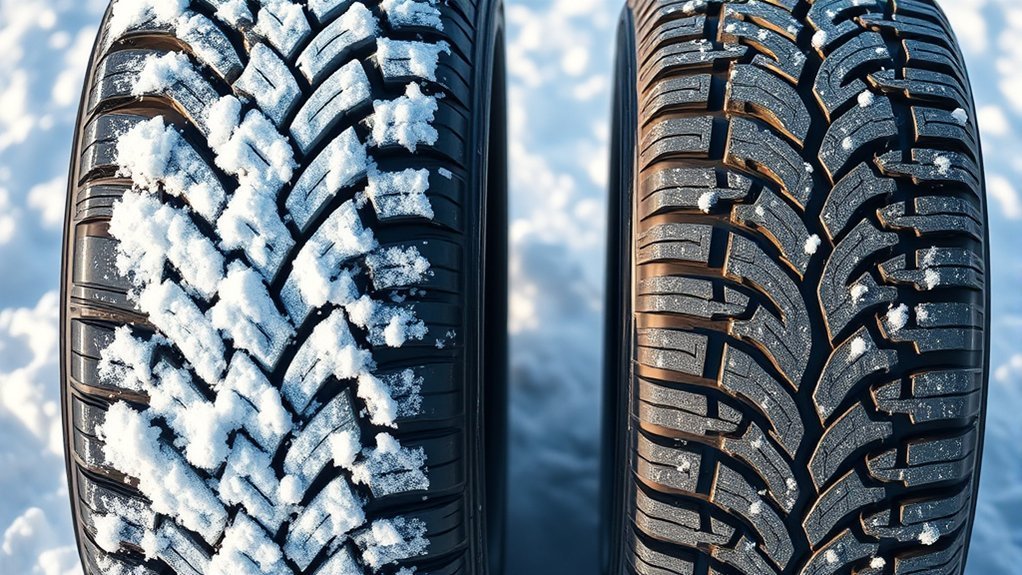
Choosing between 3PMSF and M+S tires starts with understanding what each sidewall marking actually verifies. A 3PMSF mark confirms that the tire met a minimum acceleration-traction requirement on medium-packed snow. M+S mainly identifies a qualifying tread design. Neither symbol, by itself, guarantees excellent braking, cornering, or grip on ice.
Quick Answer
Choose 3PMSF over M+S when you regularly drive on packed snow or face severe winter weather. The 3PMSF mark requires a minimum result in a standardized packed-snow acceleration test. M+S is mainly a tread-design designation. Neither mark alone guarantees strong ice braking, cornering, or complete winter performance.
Key Takeaways
- 3PMSF is performance-based: The tire must meet a minimum acceleration-traction result on medium-packed snow.
- M+S is mainly design-based: It follows qualifying tread-geometry rules but does not require the severe-snow performance threshold.
- 3PMSF is not an ice certificate: Its qualification does not test ice grip, snow braking, or snow cornering.
- The symbol is not the whole tire: Dedicated winter, all-weather, and some all-terrain tires can carry 3PMSF while delivering different real-world results.
- Local laws vary: Check every region you will drive through before relying on either marking.
Last updated: July 17, 2026
3PMSF vs. M+S: Understanding Winter Tire Ratings
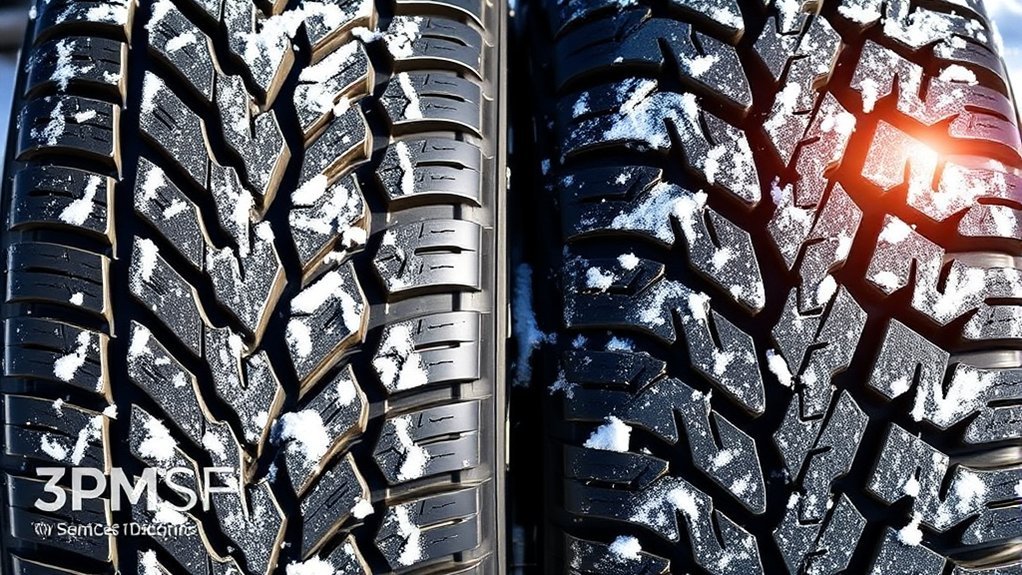
The letters M+S mean Mud and Snow. You may also see the marking written as M/S, M&S, M-S, or MS. Under the U.S. Tire Manufacturers Association definition, an M+S tire must meet specified tread-geometry requirements, including qualifying pockets or slots and at least 25% tread-contact void area.
Those design requirements can help a tire move through loose material more effectively than a plain highway tread. However, the M+S mark does not require the tire to reach the severe-snow performance threshold used for the three-peak mountain snowflake mark.
What the 3PMSF Symbol Means
The three-peak mountain snowflake, commonly shortened to 3PMSF, is a performance-based severe-snow service mark. Under the USTMA severe-snow definition, a qualifying passenger or light-truck tire must achieve a specified snow-grip index against a standard reference tire during a test on medium-packed snow.
In USTMA usage, a tire qualifying for severe-snow service carries an M+S-type marking plus the mountain-and-snowflake pictogram. This means 3PMSF and M+S are not always competing labels. A 3PMSF tire will commonly display both.
What the M+S Symbol Means
M+S tells you something about tread design, but it does not tell you how well that tire stopped, turned, or accelerated during a standardized winter test. Two M+S tires can therefore deliver very different results in light snow, deep snow, slush, wet weather, and cold temperatures.
| Feature | 3PMSF | M+S |
|---|---|---|
| Basic meaning | Severe-snow service performance mark | Mud-and-snow tread designation |
| Qualification | Minimum result in a standardized medium-packed-snow traction test | Specified tread-geometry characteristics |
| Ice performance certified? | No | No |
| Snow braking or cornering certified? | No | No |
| Typical use | Regular packed snow, mountain travel, and more demanding winters | Mild climates, occasional light snow, mud, or a jurisdiction’s minimum legal requirement |
Comparing Traction, Design, and Performance: 3PMSF vs. M+S
The biggest difference is not simply the number of grooves or sipes. The key difference is that 3PMSF requires a defined snow-traction result, while M+S relies mainly on tread-design characteristics.
Traction Performance Comparison
The 3PMSF qualification evaluates longitudinal traction while a tire accelerates on medium-packed snow. Passing that test provides more useful evidence of snow capability than an M+S mark alone. However, it does not rank every qualifying tire from best to worst.
The 3PMSF symbol confirms a minimum acceleration-traction result on medium-packed snow. It does not certify ice grip, snow braking, snow cornering, wet-road grip, noise, comfort, or tread life.
A tire that barely passes the standard and a tire that greatly exceeds it can display the same symbol. For a complete comparison, review reputable model-specific tests covering:
- Braking on packed and loose snow
- Cornering and emergency lane changes
- Ice acceleration and braking
- Wet braking and hydroplaning resistance
- Cold, dry-road handling
- Noise, comfort, fuel economy, and tread wear
Design and Material Differences
Dedicated winter tires commonly use flexible cold-weather compounds, numerous biting edges, and tread patterns designed to clear snow and slush. Those features can improve winter performance, but the 3PMSF symbol itself does not require one exact compound, siping pattern, or tread layout.
Important distinctions include:
- 3PMSF: A performance threshold that manufacturers may reach through different tread, compound, and construction choices.
- M+S: A tread-design designation that does not establish a severe-snow test result.
- Dedicated winter tire: A tire developed primarily for cold, snow, slush, and often ice.
- All-weather tire: A year-round tire that may carry 3PMSF but can trade some extreme-winter ability for warm-weather durability.
- All-terrain tire: A truck or SUV tire that may carry 3PMSF while prioritizing off-road durability and mixed-surface use.
Note: A 3PMSF all-weather or all-terrain tire should not automatically be treated as equal to a dedicated winter tire. Compare the exact models on the surfaces you expect to encounter.
Choosing 3PMSF for Severe Winter Conditions
A 3PMSF tire is the stronger starting point when your route regularly includes packed snow, mountain passes, unplowed roads, or long periods of winter weather. It gives you verified evidence that the tire reached a minimum snow-traction threshold that M+S alone does not provide.
The symbol should still be only one part of your decision. Consider whether a dedicated winter tire offers the braking, cornering, and ice performance needed for your climate. Also check the tire’s size, load index, speed rating, and compatibility with your vehicle.
| Driving conditions | Better starting point | What to verify next |
|---|---|---|
| Little snow, mostly rain, and occasional mild cold | A suitable M+S all-season tire may be adequate | Wet braking, temperature range, and local law |
| Regular packed snow with roads usually plowed | 3PMSF all-weather or winter tire | Snow braking, cornering, and tread depth |
| Frequent ice, freezing rain, or very low temperatures | Dedicated winter tire, often with 3PMSF | Independent ice tests and stud legality where applicable |
| Deep snow, rural roads, or mountain travel | High-performing 3PMSF winter tire | Vehicle clearance, chains, route rules, and emergency supplies |
Warning: No tire symbol makes a slippery road safe at normal dry-road speeds. Slow down, leave additional following distance, and avoid sudden steering, acceleration, or braking.
[Products Worth Considering]

Keep your tires properly inflated with this analog VONDIOR tire pressure gauge, designed for fast, easy readings without batteries. The swiveling, two-axis hose and large glow dial help you measure at any tire angle with instant visibility. Built with a protective rubber shield, it supports durable, low-maintenance use for cars and trucks.

The Continental Grand Prix 5000 is an allround road bike tire engineered for faster rolling, improved ride comfort, and enhanced puncture protection. It features a Vectran Breaker cut-protection layer, Lazer Grip micro-profile tread for confident cornering control, and Active Comfort Technology to damp vibration for smoother rides. BlackChili compound optimizes grip and speed for everyday performance and long-lasting confidence.

Steelman white tire marking crayons provide high-contrast, semi-permanent marks for repairing and inspecting tires and equipment. They write on wet or dry, smooth or coarse surfaces including rubber, metal, glass, and wood, making them ideal for puncture location and damage outlining. The lead- and zinc-free crayons resist weather and fading yet wipe away when you no longer need the marks.
Is M+S Good Enough for Mild Winter Weather?
M+S may be adequate when you experience little snow, roads are cleared quickly, and temperatures remain relatively mild. It can also meet the minimum legal definition of a winter tire in some locations. However, the marking alone does not prove strong performance on packed snow or ice.
M+S can be a reasonable minimum for occasional light snow, but it is not proof of tested severe-snow or ice performance.
An M+S tire may suit you when:
- Snowfall is rare or light
- You can avoid driving during storms
- Main roads are usually plowed and treated
- Your primary winter concerns are rain, mud, or brief slush
- The tire performs well in independent wet and cold-weather tests
- It meets the laws for every route you use
Do not assume one rule applies everywhere. For example, British Columbia regulations can recognize qualifying M+S or three-peak mountain snowflake tires on designated routes. In contrast, Quebec’s winter-tire rules generally require the prescribed winter pictogram or permitted studs for covered vehicles during the mandatory period.
Check the current law before every winter trip, especially when crossing a state, province, territory, or national border.
[Products Worth Considering]

Monitor tire tread wear with a smart, color-coded depth gauge that shows clear condition ranges at a glance. The bar is range marked for fast, easy readings, helping you maintain safer traction and performance. Each gauge is portable with a pocket clip, and the set includes 20 units for daily use and sharing.

This roadside assistance kit helps drivers and passengers in urgent situations after an accident or breakdown, providing practical support while waiting for help. It includes a lightweight, compact tire inflator for fast inflation of standard vehicle tires, plus reinforced jumper cable protection for safer handling. Ideal for winter weather, road trips, camping, and travel, with everything stowed neatly in a trunk bag.

Slip the Powerbuilt tire step over your vehicle’s tire to reach roof racks, engine bays, truck boxes, and more without overreaching. Its adjustable, universal design fits tires with a cross tread width up to 13 inches, including car, truck, RV, and semi tires. The non-slip cheesegrater surface and anti-slip tape provide secure grip while the open design lets mud and debris pass through. Fold-flat storage with rubber bumpers helps keep your tire and the step protected between uses.
Why Choosing the Right 3PMSF Tires Matters for Your Safety
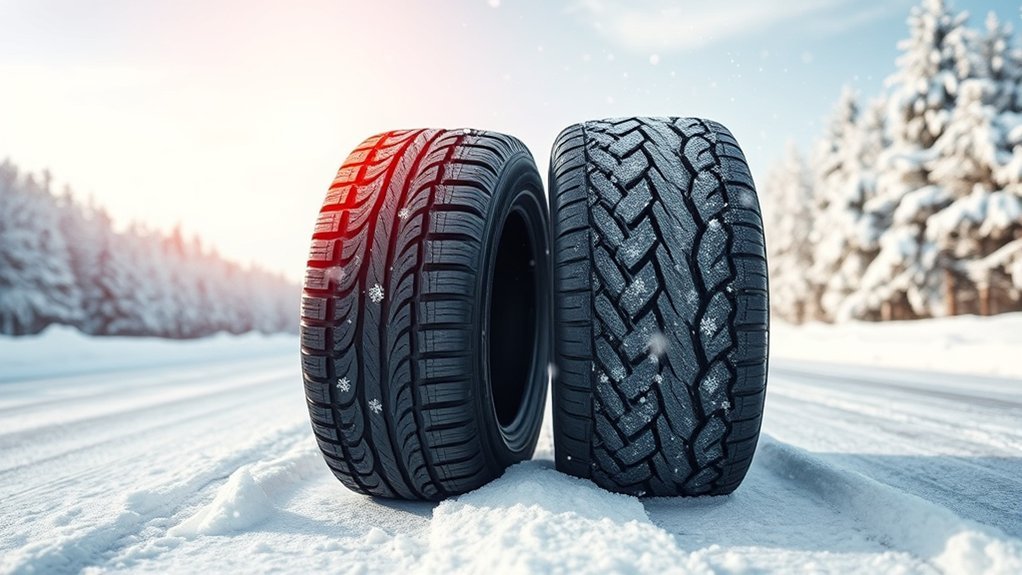
A 3PMSF symbol gives you more evidence of packed-snow capability than M+S alone, but choosing the right model still matters. Tire performance can vary widely even when two products carry the same sidewall mark.
[Products Worth Considering]

Measure tire tread depth quickly and accurately with this LUMITECO dial gauge that reads in 1/32" increments up to 14/32". The color-coded green/yellow/red zones make it easy to judge tire wear and know when replacement is needed. A rugged, compact design with a protective pouch helps keep the gauge ready for use on cars, trucks, motorcycles, and more.

The 22800 wheel stud installer makes replacing wheel studs quick and secure, saving time and effort during tire service. It uses a ratchet or impact wrench to pull new studs firmly into place, helping when existing studs are too long. Compatible with most automotive wheels and light-duty truck wheel studs, it’s designed for easy, tool-assisted installation.

This Hycline 2-pack mountain bike tire set delivers durable, puncture-resistant performance with a high-grip, aggressive tread designed for traction on hard surfaces and confident handling through mud and soil. Includes matching inner tubes and tire levers for easier everyday maintenance and quicker installation after folding storage. Built for a range of riding conditions with reinforced rubber and nylon cord for wear-resistant reliability.
Enhanced Snow Traction
The severe-snow mark confirms that a tire reached the required longitudinal traction result during the applicable packed-snow test. This makes it a useful filter when you compare tires for regular snowy travel.
It does not tell you how far the vehicle will take to stop, how securely it will corner, or how well the tire will recover during an emergency maneuver. Look for complete testing rather than relying on the symbol alone.
Improved Winter Safety
Your safest choice combines the right tire category, verified model performance, correct installation, and cautious driving. Consider these factors before buying:
- Climate: Frequency of snow, ice, freezing rain, slush, and extreme cold
- Road type: Urban streets, highways, unplowed roads, hills, or mountain passes
- Driving schedule: Whether you can stay home during poor weather
- Vehicle requirements: Correct size, load index, speed rating, and manufacturer recommendations
- Model-specific testing: Snow, ice, wet, and dry performance
- Legal requirements: Tire symbols, dates, tread depth, chains, and studs
Note: Transport Canada advises that all-season and summer tires begin losing elasticity below about 7°C, while winter tires retain useful flexibility at lower temperatures. This guidance describes winter tires generally and should not be treated as a separate promise made by every 3PMSF-marked all-weather or all-terrain tire.
Maximizing Winter Driving Safety With the Right Tires
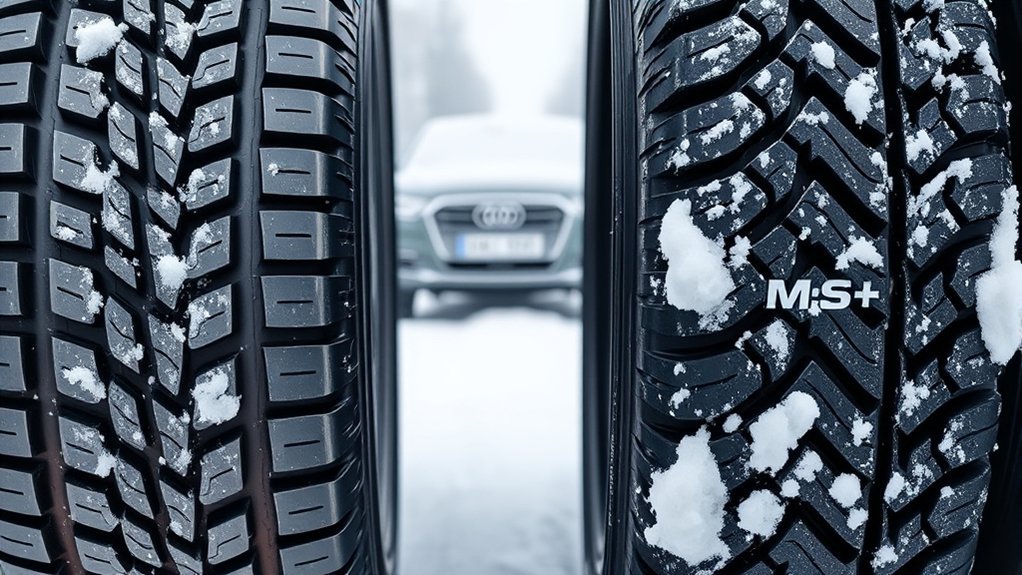
The correct sidewall mark cannot compensate for worn tread, incorrect inflation, mismatched tires, or unsafe speed. Use this checklist before winter driving:
- Install winter tires as a set of four. Transport Canada recommends four winter tires to help maintain balanced control and stability.
- Match the vehicle specification. Use the size, load index, and other requirements listed on the tire-information placard and in the owner’s manual.
- Check pressure when the tires are cold. Use the vehicle manufacturer’s recommended pressure, not the maximum pressure molded into the tire sidewall.
- Monitor tread depth. Transport Canada advises against using tires worn close to 4 mm, or 5/32 inch, on snow-covered roads. Legal minimums vary and may be lower than the depth needed for dependable snow traction.
- Inspect for damage. Replace or professionally inspect tires with bulges, exposed cords, major cuts, cracking, or unusual wear.
- Compare complete test results. Review model-specific snow, ice, wet, and dry testing whenever available.
- Adjust your driving. Reduce speed and increase following distance whenever roads are cold, wet, snowy, or icy.
- Check route equipment rules. Some mountain routes can require chains or other traction devices even when your tires carry 3PMSF.
Pro Tip: Compare tires by exact model and size. Different sizes of the same tire line can have different markings, specifications, and available technologies.
Frequently Asked Questions
Are M+S tires okay for winter driving?
M+S tires may be adequate for occasional light snow, mild temperatures, and well-maintained roads. The mark does not confirm a standardized severe-snow or ice result. Choose 3PMSF or a dedicated winter tire when you regularly face packed snow, ice, mountain routes, or prolonged cold.
Which tire marking shows the best winter traction?
No single marking identifies the best tire on every winter surface. The 3PMSF symbol is more meaningful for packed-snow acceleration than M+S alone, but it does not rate ice grip, braking, or cornering. Use independent model-specific tests to identify the strongest overall performer.
Is 3PMSF better than M+S?
3PMSF provides stronger evidence of packed-snow traction because it requires a performance result. M+S mainly follows tread-design criteria. However, the 3PMSF symbol does not prove that one tire is better in every area, including ice, rain, dry handling, comfort, or tread life.
Are M+S tires good in snow?
Some M+S tires perform acceptably in light snow, while others struggle as conditions become deeper, colder, or more compacted. The mark does not quantify snow performance. Check model-specific testing and consider 3PMSF for regular snowy travel.
Does 3PMSF mean a tire is good on ice?
No. The severe-snow qualification uses medium-packed snow and does not include an ice test. A 3PMSF tire may perform well on ice, but you need separate ice-test results to verify that ability.
Is every 3PMSF tire a dedicated winter tire?
No. Dedicated winter tires commonly carry 3PMSF, but some all-weather and all-terrain tires also qualify. A dedicated winter model may provide better extreme-cold or ice performance, while an all-weather model may offer more convenient year-round use.
Should winter tires be installed in sets of four?
Yes. A matching set of four helps preserve balanced steering, braking, and stability. Mixing tires with major differences in traction, construction, size, or tread depth can make the vehicle less predictable on slippery roads.
Conclusion
Choose 3PMSF when you need verified packed-snow traction beyond an M+S tread designation. Choose a dedicated winter tire when frequent ice, deep snow, severe cold, or demanding routes require more complete winter performance. In mild climates, a well-tested M+S tire may be sufficient, but only when it matches your conditions and local laws.
Do not judge a tire by one symbol alone. Compare the exact model’s braking, cornering, ice, wet-road, and wear results. Install a compatible set of four, maintain the recommended pressure and tread depth, and adjust your speed whenever winter conditions reduce grip.
Sources
- U.S. Tire Manufacturers Association: M+S Snow Tire Definition – supports the M+S tread-geometry and void-area criteria.
- U.S. Tire Manufacturers Association: Severe Snow Use Tire Definition – supports the packed-snow test and 3PMSF qualification explanation.
- Transport Canada: Using Winter Tires – supports four-tire installation, tread-depth, pressure, and cold-weather guidance.
- Transport Canada: Driving Safely in Winter – supports reduced speed, longer following distance, and winter-driving precautions.
- British Columbia Motor Vehicle Act Regulations – supports the province’s recognition of qualifying M+S and three-peak mountain snowflake markings.
- Government of Quebec: Requirements for Winter Tires – supports Quebec’s winter-pictogram and stud requirements.