
Your Toyota Camry can feel stable in rain only when its tires can maintain contact with the road and clear water from the tread. The biggest gains come from using the correct cold tire pressure, keeping enough tread for wet conditions, choosing properly matched tires, correcting uneven wear, and changing your driving style before traction starts to disappear.
Last updated: July 17, 2026.
Quick Answer
Use the cold tire pressure printed on your Camry’s driver-side door-jamb label, measure tread across each tire, and consider replacement near 4/32 inch if you often drive in rain. Keep four properly matched tires, correct alignment problems, slow down, leave a 5-to-6-second gap, and avoid cruise control on wet roads.
Key Takeaways
- Do not assume every Camry needs 30 PSI. Use the model-specific cold pressure on the tire information label.
- The U.S. replacement threshold is 2/32 inch, but wet-road performance can decline well before that point.
- Measure the inner, center, and outer tread because uneven wear can hide a low spot.
- Rotation, balancing, and alignment solve different problems and should not be treated as the same service.
- In heavy rain, reduce speed, increase following distance, avoid standing water, and use smooth steering and braking inputs.
At a Glance
| Time Required | About 15 to 20 minutes for a basic four-tire inspection |
| Difficulty | Easy |
| Tools Needed | Tire-pressure gauge, tread-depth gauge or U.S. quarter, and a flashlight |
| Cost | Usually no cost for inspection; balancing, alignment, repair, and replacement costs vary |
Use the Correct Tire Pressure for Your Camry
Correct inflation helps your tires maintain their intended shape, load capacity, steering response, and contact patch. A single “30 PSI” recommendation cannot cover every Toyota Camry year, trim, wheel size, and tire package. Check the tire and loading information label on the driver-side door jamb or door frame, then use the listed pressure when the tires are cold.
The National Highway Traffic Safety Administration defines a cold reading as one taken after the vehicle has been parked for at least three hours. Do not use the maximum pressure molded into the tire sidewall as your target. That number is a tire limit, not the vehicle manufacturer’s recommended setting.
[Products Worth Considering]

Steelman white tire marking crayons provide high-contrast, semi-permanent marks for repairing and inspecting tires and equipment. They write on wet or dry, smooth or coarse surfaces including rubber, metal, glass, and wood, making them ideal for puncture location and damage outlining. The lead- and zinc-free crayons resist weather and fading yet wipe away when you no longer need the marks.

Monitor tire tread wear with a smart, color-coded depth gauge that shows clear condition ranges at a glance. The bar is range marked for fast, easy readings, helping you maintain safer traction and performance. Each gauge is portable with a pocket clip, and the set includes 20 units for daily use and sharing.

Measure tire tread depth quickly and accurately with this LUMITECO dial gauge that reads in 1/32" increments up to 14/32". The color-coded green/yellow/red zones make it easy to judge tire wear and know when replacement is needed. A rugged, compact design with a protective pouch helps keep the gauge ready for use on cars, trucks, motorcycles, and more.
How to Check the Pressure
- Park before driving: Check the tires after the Camry has been parked for at least three hours.
- Read the door-jamb label: Note the front and rear pressures because they may not always be identical.
- Measure all tires: Remove each valve cap, press the gauge squarely onto the valve, and record the reading.
- Adjust to the label: Add or release air until each tire matches the specified cold pressure.
- Recheck and replace the caps: Confirm the reading and reinstall every valve cap.
Check at least monthly, before long trips, and after a major temperature change. A tire that repeatedly loses pressure may have a puncture, leaking valve, damaged wheel, or bead-seal problem that needs professional inspection.
Warning: A tire-pressure monitoring system is not a substitute for manual checks. It may not warn you until a tire is already significantly underinflated.
Do Loads Require Extra Pressure?
Do not raise pressure simply because the trunk is full or the road is wet. Follow the tire information label and your exact model-year owner’s manual. Toyota publishes year-specific manuals through its official owner resources. Never exceed the vehicle or tire limits, and do not guess at a higher pressure to make the steering feel sharper.
Why Tire Tread Depth Matters in Rain
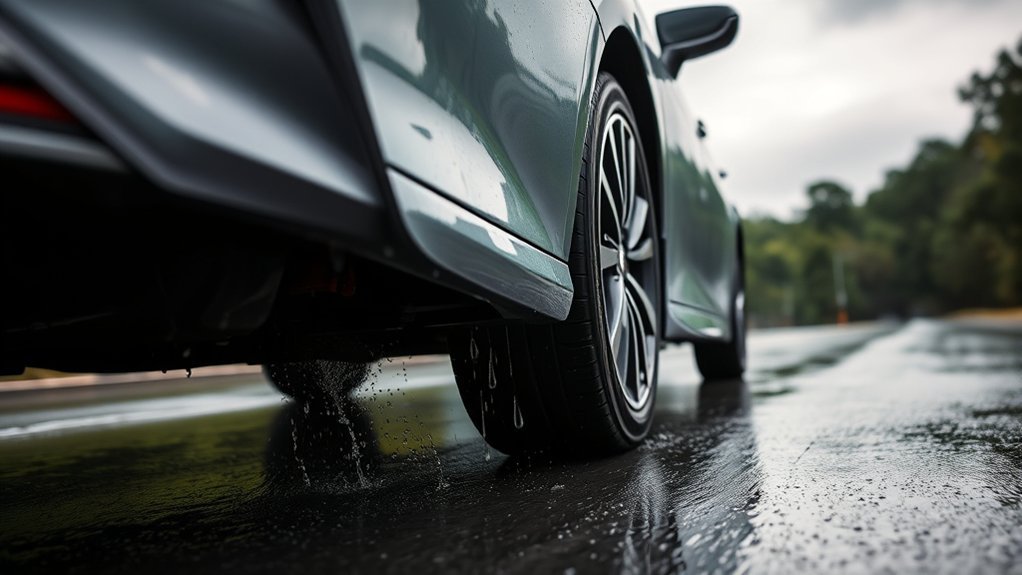
Tread grooves move water away from the contact area so the rubber can stay connected to the pavement. As the grooves become shallower, the tire has less room to evacuate water. That raises the risk of hydroplaning and lengthens wet stopping distances.
NHTSA says tires should be replaced when tread reaches 2/32 inch. That is the minimum wear limit, not a promise of strong rain performance. If wet-road safety is a priority, start planning replacement around 4/32 inch. In controlled testing, AAA found that all-season tires worn to 4/32 inch had substantially longer wet stopping distances and reduced handling compared with new tires.
AAA’s 60-mph wet-pavement test found an average 87-foot increase in passenger-car stopping distance with tires worn to 4/32 inch compared with new tires.
How to Measure Tread Correctly
- Use a tread-depth gauge: Check a main groove near the inner edge, center, and outer edge.
- Repeat around the tire: Measure at several points because wear may not be even around the circumference.
- Record the lowest number: The shallowest safe, measurable area matters most.
- Inspect the wear bars: If the tread is level with the built-in indicators, the tire has reached its replacement limit.
A U.S. quarter can provide a quick 4/32-inch screening check, but a dedicated gauge gives a clearer measurement. If one shoulder is much lower than the rest, check pressure history, alignment, suspension components, and rotation intervals.
Pro Tip: Write down the inner, center, and outer tread measurements for all four tires. A simple record makes developing wear patterns easier to spot before wet handling becomes noticeably worse.
Choose Tires That Match Your Camry and Climate
Wet performance depends on the complete tire design, including tread pattern, compound, casing, size, load rating, and remaining depth. Do not choose a tire only because it has deep-looking grooves or a soft-feeling tread. Use the exact size and minimum load and speed ratings approved for your Camry, then compare reliable wet-braking and hydroplaning test results.
[Products Worth Considering]

The SAFELIFE dial tire tread depth gauge measures tread depth in 1/32 inch increments with clear, easy-to-read 2-inch dial face. Color zones using a traffic light system help you quickly judge whether tread is low, marginal, or ample for safer driving. Built with a durable zinc cast body and a metal detect probe for precise, comfortable use across cars, motorcycles, trucks, and buses.

Accurately measure tire tread depth with a calibrated gauge marked from 0 to 1 inch in 1/32 inch increments. The color-coded bar helps you quickly identify tread condition ranges, supporting safe driving for trucks, motorcycles, automobiles, and passenger vehicles.

The TYAMATE TM8 solar-powered wireless TPMS delivers real-time tire pressure and temperature monitoring with six alarm modes for safer driving. A vibrant color LCD display shows readings clearly while windshield mounting keeps it hands-free and easy to read. With a wide 0–87 PSI range, strong 433.92 MHz signal transmission, and quick sensor pairing, it’s ideal for RV, sedan, SUV, MPV, and truck use.
Look Beyond the Groove Pattern
Circumferential grooves and lateral channels help move water, but tread design works as a complete system. A tire with an aggressive-looking pattern is not automatically safer in rain. Compare independent tests performed in the same size when possible, and prioritize wet braking, wet handling, and hydroplaning resistance over appearance or marketing language.
Do Not Judge the Compound by Softness Alone
Modern tire compounds balance wet grip, dry handling, tread life, temperature range, and rolling resistance. Softer rubber is not automatically better, and it may wear quickly or perform poorly outside its intended temperature range. Choose a tire designed for your climate and use rather than trying to judge compound quality by touch or brand reputation.
All-Season, All-Weather, or Summer Tires?
- All-season tires: A practical choice for many Camry drivers in mild climates, but wet performance varies widely by model.
- All-weather tires: These usually carry the three-peak mountain snowflake symbol and can suit drivers who need stronger winter capability without seasonal swaps.
- Summer tires: They can offer strong warm-weather wet and dry grip, but they are not intended for freezing conditions.
Use four tires with compatible construction, size, type, and tread pattern. Mixing summer, all-season, and winter tires can create unpredictable grip. On Camry AWD models, differences in tire circumference may also affect the drivetrain, so follow the owner’s manual and tire manufacturer’s replacement guidance.
Rotate, Balance, and Align for Even Contact
Rotation, balancing, and alignment are separate services. Rotation changes tire positions to encourage more even wear. Balancing corrects weight differences in a wheel-and-tire assembly. Alignment adjusts wheel angles so the tires track correctly.
- Rotate: Follow the schedule for your exact model year and tire configuration. A fixed 5,000-to-7,500-mile rule may not fit every Camry or tire.
- Balance: Have the assemblies checked if you feel speed-related vibration, after a tire is mounted or repaired, or when a technician identifies imbalance.
- Align: Request an inspection if the Camry pulls, the steering wheel sits off-center, or the tread shows one-sided or feathered wear.
Some Camry models require tire-position registration or tire-pressure-system procedures after rotation. Check the Toyota manual before assuming the system will update itself.
[Products Worth Considering]

These aluminum alloy tire valve stem caps with an O-ring seal help protect valve stems from corrosion while adding a clean, stylish look to your vehicle. The universal fit works across cars, trucks, motorcycles, bicycles, and more, making them an easy upgrade for everyday driving and off-road use. Installation is quick, and the included four-pack keeps all your tires dressed and protected.

Upgrade your Toyota’s wheels with durable aluminum alloy valve stem caps that help protect valve cores from corrosion and direct exposure to road grime, clay, water, and snow. Rubber rings improve sealing to help prevent air leakage and maintain stable tire pressure for safer driving. These caps are easy to install or remove without tools and add a unique, stylish look to your car.

These universal tire valve stem caps help protect valve cores from dust, debris, and moisture while helping maintain stable tire pressure. The corrosion-resistant metal construction and sealed design provide reliable protection in road grime, mud, and winter conditions. Twist-on installation makes them quick to fit on cars, SUVs, trucks, and motorcycles.
Signs Your Tires Need Immediate Attention
Inspect all four tires at least monthly and before long trips. Stop using a tire and seek professional help if you find a bulge, exposed cords, deep cut, sidewall separation, rapid pressure loss, or severe impact damage. These conditions can indicate structural failure, not normal wear.
Also investigate repeated vibration, thumping, pulling, or uneven tread. These symptoms can come from imbalance, alignment errors, damaged wheels, separated belts, suspension wear, or pressure differences. Replacing the tire without correcting the underlying cause may allow the same pattern to return.
Check Age Without Using a Blanket Deadline
The final four digits of the DOT tire identification number show the manufacturing week and year. Age alone does not reveal a tire’s condition, but heat, sunlight, storage, damage, and service history can affect deterioration. Follow both Toyota’s guidance and the tire manufacturer’s limit. NHTSA notes that some vehicle manufacturers recommend replacement at six years regardless of use, while many tire manufacturers set an absolute maximum near ten years.
Note: Fine surface marks on a two-year-old tire do not automatically mean it must be replaced. A qualified tire professional should evaluate cracking, location, depth, age, and any related pressure loss or deformation.
Drive Differently When the Road Is Wet

Even excellent tires have limited grip in standing water. Your speed and steering inputs determine how much traction the tires must provide, so wet-weather technique matters as much as maintenance.
- Reduce speed early: Slow down before deep water, curves, and traffic queues.
- Increase the time gap: Use at least a 5-to-6-second following distance in heavy rain rather than counting car lengths.
- Avoid cruise control: Manual speed control helps you respond quickly when traction changes.
- Use smooth inputs: Accelerate, brake, and steer gradually. Abrupt inputs can overwhelm the available grip.
- Avoid standing water: Puddles may trigger hydroplaning and may hide potholes or road damage.
- Keep visibility systems working: Use headlights as required, keep the windshield clean, and replace wipers that streak or chatter.
NHTSA advises drivers to slow down and increase following distance on slick roads. AAA also recommends avoiding cruise control, hard braking, and sharp turns in wet conditions. Review the full NHTSA severe-weather guidance before driving through heavy rain or flooding.
What to Do if Your Camry Hydroplanes
Hydroplaning occurs when water separates the tire from the pavement and steering or braking response becomes limited. If it happens:
- Stay calm and look where you want the car to go.
- Ease off the accelerator gradually.
- Hold the steering wheel steadily and avoid sudden corrections.
- Do not jam on the brakes while the tires are still sliding on water.
- Once traction returns, reduce speed smoothly and move away from standing water when safe.
This approach matches AAA wet-weather guidance, which recommends easing off the accelerator and steering toward your intended path until grip returns.
Wet-Road Tire Checklist
- Confirm the cold pressure on the door-jamb label.
- Measure inner, center, and outer tread on all four tires.
- Plan wet-weather replacement near 4/32 inch and replace at 2/32 inch.
- Inspect for cuts, bulges, exposed cords, punctures, and uneven wear.
- Confirm all four tires match the Camry’s required size and ratings.
- Investigate vibration, pulling, or an off-center steering wheel.
- Slow down, increase following distance, and turn off cruise control in rain.
- Never drive through a flooded road.
Frequently Asked Questions
How often should I replace my Camry’s tires?
Replace a tire when it reaches 2/32 inch, has unsafe damage, or reaches the age limit set by Toyota or the tire manufacturer. If you frequently drive in rain, begin planning replacement around 4/32 inch because wet braking and hydroplaning resistance may already be reduced.
Can all-season tires handle heavy rain?
Yes, a quality all-season tire can perform well in rain when it has adequate tread, correct pressure, and strong wet-test results. Performance differs by tire model, so do not assume every all-season tire provides the same braking or hydroplaning resistance.
What is the ideal tire pressure for a Toyota Camry?
Use the cold pressure printed on the driver-side tire information label. The correct value varies by model year, trim, wheel size, and tire package, so a universal 30-to-35-PSI answer is not reliable.
Do tire brands significantly affect wet performance?
The specific tire model matters more than the brand name alone. Compare wet braking, wet handling, hydroplaning resistance, size, ratings, and tread depth. A famous brand can sell several tire lines with very different performance goals.
How can I tell if my tires need balancing?
A speed-related vibration in the steering wheel, seat, or floor can point to imbalance, but it can also indicate tire damage, bent wheels, or suspension problems. Ask a technician to inspect the complete wheel-and-tire assembly instead of assuming balancing is the only fix.
Should I use cruise control in the rain?
No. Turn cruise control off on wet or slippery roads so you can adjust speed immediately and respond smoothly if the tires begin to lose traction.
What should I do when my Camry starts hydroplaning?
Ease off the accelerator, look and steer where you want to go, and avoid hard braking or sudden steering. After the tires regain contact, slow down gently and avoid the standing water.
Conclusion
Better wet-road handling starts with accurate, model-specific maintenance rather than a universal PSI number or a favorite tire brand. Use the Camry’s door-jamb pressure, measure tread across every tire, replace damaged or overly worn tires, and correct alignment or balance problems. Then reduce speed and leave more space in rain. These steps give your tires the best chance to maintain grip when water covers the road.
Sources
- NHTSA TireWise — cold pressure, tire inspection, tread limits, age, balance, and alignment guidance
- NHTSA Driving in Severe Weather — rain speed, following distance, and flood safety
- Toyota Owners Manuals and Warranties — model-year-specific tire pressure and maintenance instructions
- AAA Worn-Tire Wet Testing — 4/32-inch wet braking and handling findings
- AAA Wet-Weather Driving Guidance — following distance, cruise control, and hydroplaning recovery
- Michelin Tire Tread Depth Guide — tread measurement and wet-road performance context