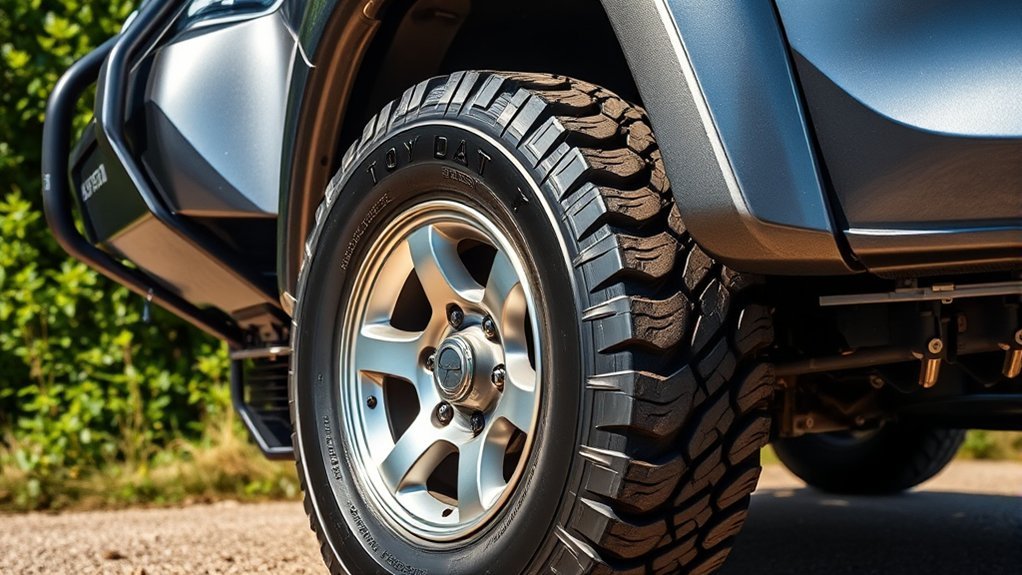
The Toyota Hilux sold across the seventh-generation period did not use one universal tire size. Factory fitment changed by year, market, cab style, drivetrain, trim, wheel package, and load rating. Start with the tire placard or owner’s manual for your exact truck, then match the full size, load capacity, speed symbol, and approved wheel specifications.
Quick Answer
Common seventh-generation Toyota Hilux fitments include 205/70R15, 205/70R16, 255/70R15, 255/70R16, and 265/65R17 on selected versions. Your correct size is the one listed for your exact model on the vehicle placard or in the owner’s manual, with an equal or higher approved load rating.
Key Takeaways
- Do not choose a tire by generation name alone. Confirm the year, market, trim, drivetrain, wheel size, and tire placard.
- The load index is a per-tire capacity code. A replacement tire should meet or exceed the vehicle’s approved requirement.
- Use the vehicle manufacturer’s cold-pressure specification, not a broad online pressure range or the maximum pressure molded on the tire.
- A 33-inch tire is not a universal bolt-on upgrade. Clearance, wheel offset, suspension, gearing, braking, speedometer accuracy, and local rules all matter.
Last reviewed: July 17, 2026
Understanding Toyota Hilux Tire Specifications
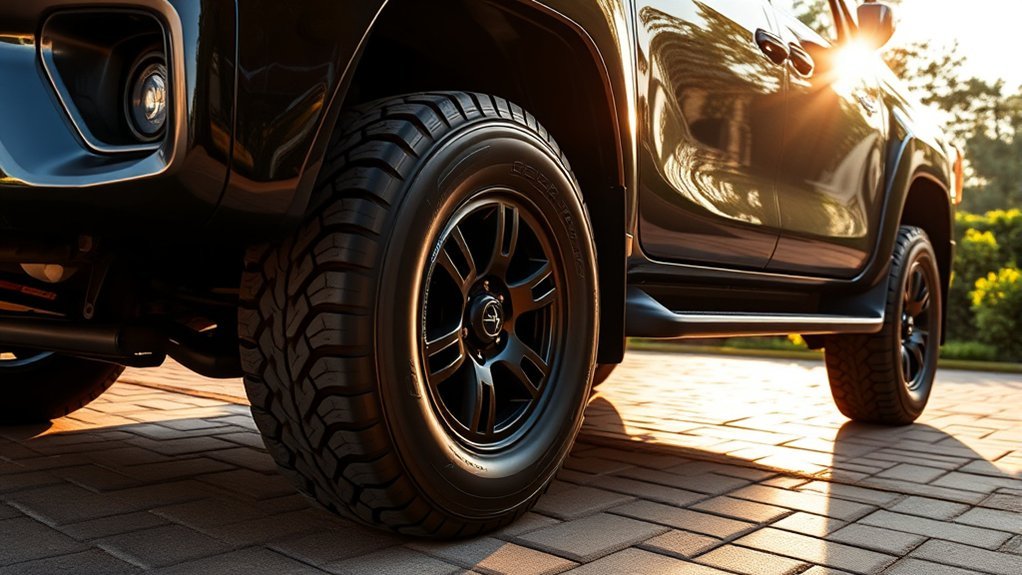
Toyota UK’s current vehicle archive labels the 2005–2016 Hilux as the seventh generation. However, generation naming and model-year cutoffs can differ between markets and older references. That makes the truck’s year, VIN, local specification, and tire placard more reliable than the phrase “7th Gen” by itself.
A complete tire specification includes more than width and wheel diameter. You also need the aspect ratio, construction type, load index or load range, speed symbol, and any commercial-tire marking such as C or LT. The approved rim width and wheel offset must also suit the tire and vehicle.
Note: The size printed on a tire already fitted to a used Hilux may not be the original size. Compare it with the placard, owner’s manual, or Toyota specification for that exact variant.
Common Tire Sizes for the 7th Gen Hilux
Official UK specifications show several factory sizes across the generation. The 2005 range included 205/70R15, 205/70R16, 255/70R15, and 255/70R16, while the updated 2009 Invincible used 265/65R17 tires. These are verified examples, not a universal fitment list for every country.
| Tire size | Verified seventh-generation example | What to confirm |
|---|---|---|
| 205/70R15 | 2005 UK 2WD Single Cab | Load rating, wheel width, pressure, and local trim |
| 205/70R16 | 2005 UK 4WD Single Cab and Double Cab HL2 | Whether the tire requires a commercial or light-truck service rating |
| 255/70R15 | 2005 UK 4WD Double Cab HL3 | Wheel width, arch clearance, and approved load capacity |
| 255/70R16 | 2005 UK 4WD Double Cab Invincible | Exact trim and front/rear pressure specification |
| 265/65R17 | 2009 UK Hilux Invincible | Brake clearance, wheel specification, offset, and placard approval |
Other markets may list sizes such as 205R16 or use different service descriptions. A size such as 265/60R18 appears on later Hilux versions in some markets, but you should not assume it is an original seventh-generation fitment. Always verify the specific vehicle before ordering.
How to Confirm Your Exact Hilux Tire Size
- Read the tire and loading placard: Look on the driver-side door opening, pillar, glove box area, or another location specified for your market.
- Check the owner’s manual: Find the tire-size and cold-inflation section for the exact cab, engine, drivetrain, and load condition.
- Record the complete service description: For example, 265/65R17 112S includes the size, load index, and speed symbol.
- Inspect all four tires and the spare: Mixed sizes, constructions, or load ratings can indicate an earlier non-standard replacement.
- Confirm the wheel specification: Match rim diameter, width, bolt pattern, center bore, offset, load rating, and brake clearance.
- Ask a qualified tire professional when changing size: The fitter should check clearance at full steering lock and through the suspension’s full travel.
How to Read a Hilux Tire Size
Using 265/65R17 as an example:
- 265 is the nominal section width in millimetres.
- 65 is the sidewall height as a percentage of the section width.
- R means radial construction.
- 17 is the wheel diameter in inches.
Numbers and letters after the size form the service description. In 112S, 112 is the load index and S is the speed symbol. Markings such as LT, C, load range, or ply-rating language identify construction and load characteristics that can be especially important on a pickup.
How to Assess Load and Speed Ratings for Your Tires
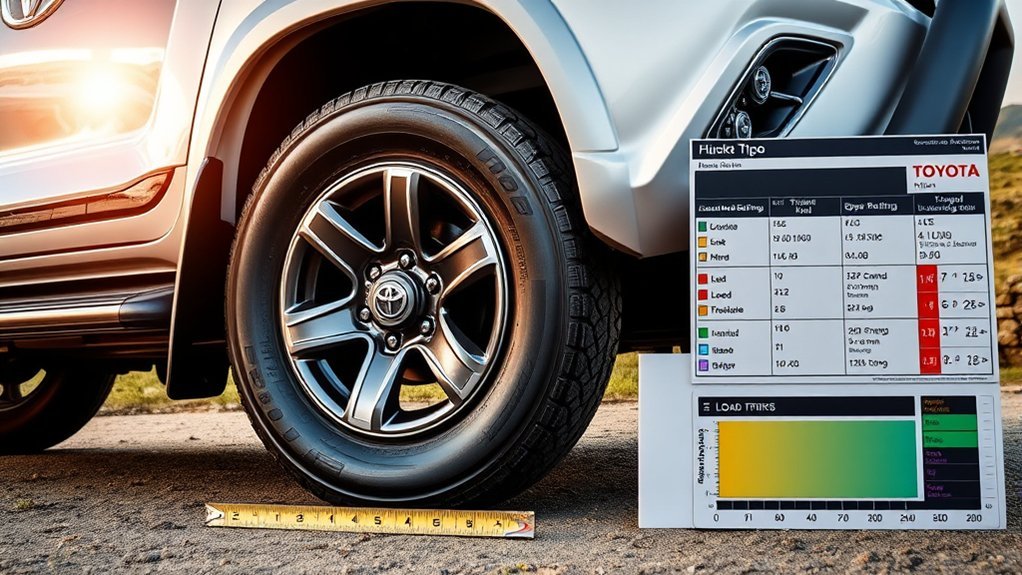
The load index and speed symbol work together, but they describe different limits. The load index is a code for how much one tire can carry under specified conditions. The speed symbol identifies the tire’s tested speed category, not a recommended driving speed.
| Code | Meaning | Important limitation |
|---|---|---|
| 106 load index | 950 kg maximum per tire | Only under the tire maker’s specified conditions |
| 110 load index | 1,060 kg maximum per tire | Do not treat this as the truck’s payload rating |
| 112 load index | 1,120 kg maximum per tire | Axle, wheel, and vehicle limits still apply |
| S speed symbol | Up to 180 km/h under rated conditions | Not permission to exceed legal or safe speeds |
| T speed symbol | Up to 190 km/h under rated conditions | Actual use is limited by road, load, temperature, and tire condition |
Warning: The vehicle’s load must not exceed the tire, wheel, axle, or gross vehicle limits. Do not install a replacement tire with a lower approved load capacity than the vehicle requires. For dual-rated light-truck tires, confirm whether the sidewall shows separate single and dual load values.
A service description such as 106S does not mean “106 mph.” The number is the load index, while the letter is the speed symbol. Likewise, a claim that every seventh-generation Hilux needs a load index from 106 to 112 or a T-rated tire is too broad. Match the exact approved specification for your truck.
Correct Tire Pressure for a 7th Gen Hilux
Do not use a universal range such as 28–52 psi for every Hilux. The correct pressure may differ between front and rear tires and can change with tire size, cab type, axle load, towing, and market specification. A pressure of 350 kPa is about 51 psi, so it cannot accurately describe an entire 28–52 psi range by itself.
Use the manufacturer’s recommended cold pressure from the placard or owner’s manual. “Cold” generally means the truck has been parked for at least three hours or has travelled only a very short distance. Do not use the maximum pressure molded on the tire sidewall as the normal operating target.
- Check all four tires and the spare at least monthly and before a long trip.
- Use an accurate gauge before driving, not immediately after highway or off-road use.
- Follow any separate loaded, unloaded, towing, or high-speed instruction in the manual.
- Recheck pressure after changing tire size or construction with professional approval.
- Replace valve caps and inspect for a slow leak if pressure keeps dropping.
Why Proper Tire Fitment Matters
Safety and Stability
The correct tire keeps the intended load capacity, contact patch, sidewall behaviour, and clearance. An underspecified tire can overheat or become overloaded, while an unsuitable size can rub against suspension, steering, brake, or body components.
Handling, Braking, and Driveline Performance
A major change in overall diameter can alter steering feel, braking response, acceleration, gearing, and the indicated road speed. On four-wheel-drive models, mismatched rolling circumference can also place unnecessary stress on the driveline. Keep all four tires closely matched in size, construction, and wear unless Toyota specifies otherwise.
Wheel Offset and Clearance
Do not assume a +12 offset is correct for every stock seventh-generation Hilux. Offset interacts with wheel width, tire width, steering geometry, bearing load, brake clearance, and body clearance. Aftermarket wheels may be sold in diameters from 16 to 22 inches, but availability does not prove safe compatibility.
A wheel that pushes the tire outward can increase guard contact and steering leverage. A wheel that sits too far inward can contact the upper control arm, suspension, or inner body. Verify the full wheel specification instead of choosing by appearance alone.
Fuel Use and Tire Wear
Heavier wheels, aggressive tread, low pressure, poor alignment, and a larger rolling diameter can increase rolling resistance or change gearing. Correct fitment and pressure help the tire wear evenly and allow the truck to perform as intended, but no single tire size guarantees better fuel economy.
Can You Fit 33-Inch Tires on a Hilux?
A 33-inch tire is roughly 8% larger in diameter than a typical 265/65R17, whose calculated diameter is about 30.6 inches. Actual measured dimensions vary by tire model and approved rim width. Because of that increase, a 33-inch setup is not a universal bolt-on fit for a seventh-generation Hilux.
Depending on the cab, suspension, wheel width, offset, and tire shape, fitting 33s may require some combination of a suspension lift, body mount or guard clearance work, alignment changes, different wheels, and speedometer correction. It can also affect braking, gearing, spare-tire storage, and local roadworthiness or insurance requirements.
Warning: A lift does not automatically create full tire clearance. The fitter must check rubbing at full steering lock, under braking, and through full bump and droop travel with the truck loaded.
[Products Worth Considering]

Measure tire tread depth quickly and accurately with this LUMITECO dial gauge that reads in 1/32" increments up to 14/32". The color-coded green/yellow/red zones make it easy to judge tire wear and know when replacement is needed. A rugged, compact design with a protective pouch helps keep the gauge ready for use on cars, trucks, motorcycles, and more.

Steelman white tire marking crayons provide high-contrast, semi-permanent marks for repairing and inspecting tires and equipment. They write on wet or dry, smooth or coarse surfaces including rubber, metal, glass, and wood, making them ideal for puncture location and damage outlining. The lead- and zinc-free crayons resist weather and fading yet wipe away when you no longer need the marks.

Monitor tire tread wear with a smart, color-coded depth gauge that shows clear condition ranges at a glance. The bar is range marked for fast, easy readings, helping you maintain safer traction and performance. Each gauge is portable with a pocket clip, and the set includes 20 units for daily use and sharing.
Checks Before Fitting 33s
- Measure current clearance at the front and rear of the wheel arch.
- Confirm wheel width, offset, load rating, and brake clearance.
- Compare the new tire’s actual measured diameter and section width, not only its marketing size.
- Check steering lock, suspension travel, mudflaps, body mounts, and inner guards.
- Plan for alignment and speedometer verification after installation.
- Confirm local modification, inspection, and insurance rules before buying.
Seasonal Tire Options for Optimal Performance
Choose the tread type around where and how you drive, then keep the approved size and service rating.
| Tire type | Best suited to | Trade-off |
|---|---|---|
| Highway-terrain | Road use, commuting, towing, and light gravel | Less traction in deep mud or severe off-road terrain |
| All-terrain | Mixed road, gravel, worksite, and moderate trail use | May add noise, weight, and rolling resistance |
| Mud-terrain | Frequent deep mud and demanding off-road use | Usually noisier with less refined wet-road behaviour |
| Dedicated winter tire | Regular snow, ice, and sustained cold conditions | Seasonal storage and changeover are required |
Do not assume that every winter tire must be at least 106S. The required load and speed service description depends on the exact Hilux specification and local winter-tire rules. Use four matching winter tires when required, and confirm that their load capacity is suitable for the truck.
[Products Worth Considering]

Keep your tires properly inflated with this analog VONDIOR tire pressure gauge, designed for fast, easy readings without batteries. The swiveling, two-axis hose and large glow dial help you measure at any tire angle with instant visibility. Built with a protective rubber shield, it supports durable, low-maintenance use for cars and trucks.

The Kurgo Seasonal Tire Tote helps protect your car interior, clothes, and garage from tire grime, brake dust, and residue during seasonal tire changes. Its universal design fits most passenger tires between 22" and 31" in diameter, making storage and transport simpler with less mess. Built for rugged, repeated use, it’s machine washable for easy care and comes with a lifetime warranty.

This professional wheel and rim brush kit makes it easy to lift brake dust, grime, and dirt from wheels and tires without scratching finishes. The brushes feature soft, metal-free wool heads and a flexible 360-degree rim brush design for reaching hard-to-clean areas. Includes multiple brush types plus accessories for thorough car, motorcycle, and general vehicle detailing.
Replacement Tire Checklist
- Size: Match the placard or an approved alternative from Toyota or a qualified fitment professional.
- Load capacity: Use an equivalent or higher approved load index or load range. Never reduce it without explicit vehicle-manufacturer approval.
- Speed symbol: Match the approved requirement and any local winter-tire exception.
- Construction: Confirm passenger, commercial, reinforced, or light-truck construction as applicable.
- Wheel compatibility: Verify rim width, diameter, offset, bolt pattern, center bore, and wheel load rating.
- Axle matching: Use the same size and construction across an axle, and avoid major tread-depth differences on four-wheel-drive models.
- Spare: Check that the spare size, pressure, and load rating remain suitable.
- Installation: Have the tires balanced, the wheel nuts torqued correctly, and the alignment checked when wear or geometry suggests it.
[Products Worth Considering]

The 22800 wheel stud installer makes replacing wheel studs quick and secure, saving time and effort during tire service. It uses a ratchet or impact wrench to pull new studs firmly into place, helping when existing studs are too long. Compatible with most automotive wheels and light-duty truck wheel studs, it’s designed for easy, tool-assisted installation.

These aluminum alloy tire valve stem caps with an O-ring seal help protect valve stems from corrosion while adding a clean, stylish look to your vehicle. The universal fit works across cars, trucks, motorcycles, bicycles, and more, making them an easy upgrade for everyday driving and off-road use. Installation is quick, and the included four-pack keeps all your tires dressed and protected.

The SAFELIFE dial tire tread depth gauge measures tread depth in 1/32 inch increments with clear, easy-to-read 2-inch dial face. Color zones using a traffic light system help you quickly judge whether tread is low, marginal, or ample for safer driving. Built with a durable zinc cast body and a metal detect probe for precise, comfortable use across cars, motorcycles, trucks, and buses.
Maintaining Your Toyota Hilux Tires
- Check pressure monthly: Measure when cold and follow the vehicle placard.
- Inspect tread and damage: Look for uneven wear, cuts, bulges, cracking, punctures, exposed cords, and embedded objects.
- Watch tread depth: Replace tires at the legal limit in your jurisdiction or sooner when wet, snow, or off-road performance has become inadequate. In the United States, NHTSA identifies 2/32 inch, about 1.6 mm, as the replacement threshold.
- Rotate as specified: Follow the owner’s manual because the correct interval and pattern can depend on drivetrain and tire type.
- Correct alignment problems: Feathering, one-sided wear, steering pull, or an off-centre steering wheel can signal an alignment or suspension issue.
- Clean after off-road use: Remove packed mud and inspect the inner sidewalls, wheels, valves, and bead area.
Pro Tip: Photograph the tire placard and save the full service description in your phone. You will have the correct reference when comparing tires away from the truck.
Frequently Asked Questions
What size tyres are on a Mk7 Hilux?
Common verified examples include 205/70R15, 205/70R16, 255/70R15, 255/70R16, and 265/65R17. The exact size depends on the year, country, cab, drivetrain, trim, and wheel package, so check the vehicle placard or owner’s manual.
What size are stock Hilux tires?
There is no single stock size for every seventh-generation Hilux. Toyota used different wheels and tires across 2WD, 4WD, Single Cab, Double Cab, and higher-trim models. Match the complete factory service description, not only the three-part size.
Can you fit 33-inch tires on a Hilux?
Sometimes, but not as a guaranteed bolt-on change. The result depends on tire shape, wheel width and offset, suspension height, body clearance, alignment, and local modification rules. A professional should check full steering and suspension travel before approving the setup.
What tire pressure should a seventh-generation Hilux use?
Use the cold pressure printed on the vehicle’s tire placard or listed in the owner’s manual for the exact tire and load condition. Do not use a generic 28–52 psi range or the tire sidewall’s maximum pressure as the normal target.
Can I use a higher load-index tire?
A tire with an equivalent or higher approved load capacity is generally acceptable when its size, construction, wheel compatibility, pressure requirements, and speed rating also suit the vehicle. A stiffer construction may change ride comfort, so confirm the complete fitment with a qualified tire professional.
Conclusion
The right tire for a seventh-generation Toyota Hilux is not simply the largest size that clears the body. Start with the placard and owner’s manual, then match the full size, load capacity, speed symbol, construction, wheel specification, and cold pressure. If you plan to change diameter or fit 33-inch tires, have the complete setup checked for clearance, braking, alignment, speedometer accuracy, driveline effects, and legal compliance before installation.
Sources
- Toyota UK Media Site: Hilux 7th Generation Archive — generation years and model archive.
- Toyota UK Media Site: 2005 Hilux Technical Specifications — verified 15-inch and 16-inch factory tire sizes.
- Toyota UK Media Site: 2009 Hilux Update — verified 265/65R17 fitment on the Hilux Invincible.
- NHTSA TireWise — tire size, cold pressure, tread depth, inspection, and rotation guidance.
- Michelin: Choosing and Changing Tire Size — load-index and replacement-capacity guidance.
- Continental: Tire Speed Index — speed-symbol definitions.