Last updated: August 18, 2026
Latex vs fiber tubeless sealant is not a true either-or choice. Many fiber-reinforced bicycle sealants also use latex. Latex provides the fast-curing base, while fibers or particles help bridge and reinforce a puncture. Choose by the complete formula, tire size, riding pressure, climate, maintenance interval, and the puncture rating published for that product. For example, Finish Line FiberLink combines natural latex with Kevlar fibers, Peaty’s Holeshot BioFibre combines latex with biodegradable fibers, and SILCA Ultimate combines a latex blend with carbon fibers. Carry a tubeless plug kit for punctures the liquid sealant cannot close.
Quick Verdict: Latex vs Fiber Tubeless Sealant
The most useful comparison is latex-dominant sealant vs fiber-reinforced sealant, not latex vs fiber as mutually exclusive categories. A conventional latex formula can be a simple all-around choice. A fiber-reinforced latex formula adds strands or platelets that help build a stronger structure across a puncture. A true latex-free formula is a separate category and should be chosen only after checking the product label or manufacturer specifications.
| Sealant type | How it seals | Best reason to choose it | What to check before buying |
|---|---|---|---|
| Latex-dominant | Latex cures as sealant reaches the puncture; particles may also assist the clot. | Simple all-around tubeless use with fast sealing. | Published puncture rating, refresh interval, tire compatibility, and operating temperature. |
| Fiber-reinforced latex | Latex forms the adhesive seal while fibers or platelets bridge and reinforce the opening. | Extra mechanical reinforcement without giving up latex clotting. | Fiber material, viscosity, valve-injection guidance, puncture rating, and service interval. |
| Latex-free | Uses a non-latex sealing system rather than natural-latex coagulation. | Useful when a rider specifically needs a verified latex-free formula. | Actual ingredients, sealing method, puncture rating, and maintenance instructions. |
[Products Worth Considering]

This tire repair screw set includes self-tapping plugs and a screwdriver to help you quickly complete tubeless tire repairs for many vehicle types. The set provides two rubber screw diameters for different puncture needs and uses a sealant-coated screw tip to help prevent air leakage and water entry. It’s designed for secure fixing with wear-resistant metal-and-rubber construction.
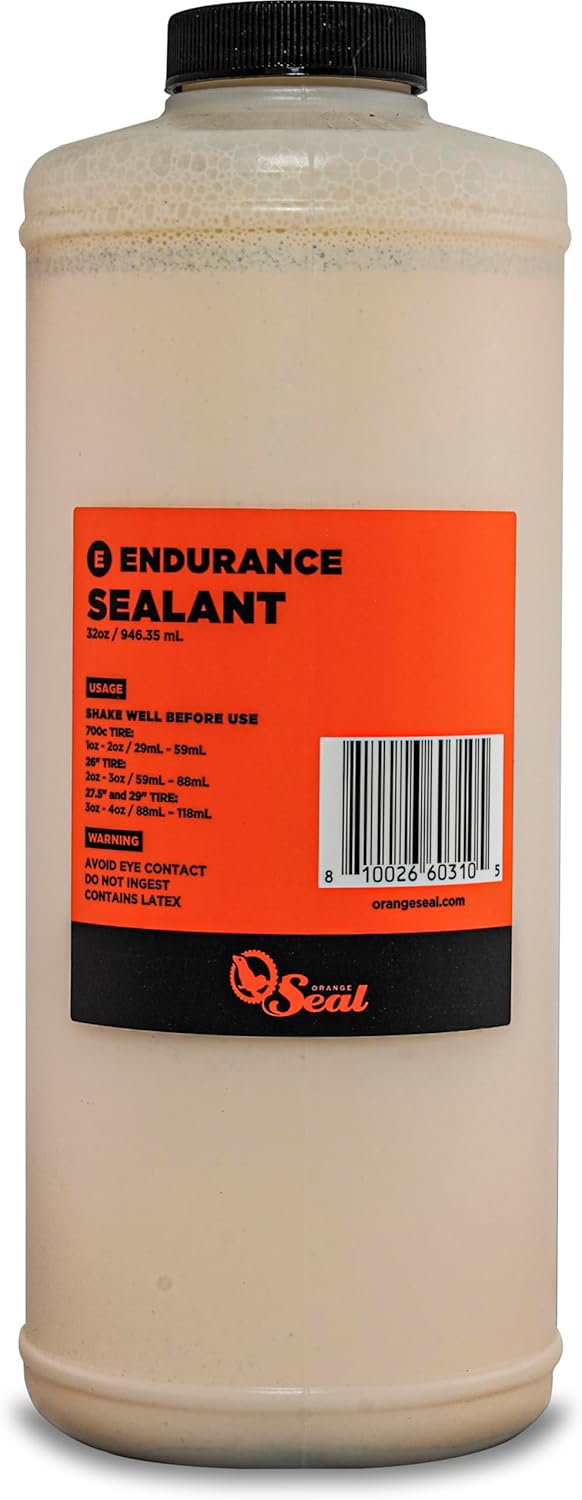
Orange Seal Endurance Formula delivers long-lasting latex protection with a durable sealant that can stay effective for 60–120 days between top-offs. It uses nanite particles to rapidly seal punctures up to 1/4" and slices up to 1/2", helping maintain reliable tubeless performance across MTB, road, CX, and gravel conditions. The biodegradable formula is engineered to work across major tubeless-ready and UST brands and a wide range of rubber compounds.

Rhino USA’s 86-piece tire repair kit provides everything you need for quick, emergency flat repairs, including a reamer and plug insertion tool plus 60 reusable tire plugs. The heavy-duty, metal-handled design helps you fix punctures from nails and screws on tubeless tires for cars, trucks, motorcycles, ATVs, UTVs, and more. A high-visibility compact case stores easily for on-the-go use, with illustrated instructions to help you complete repairs with confidence.
How Sealants Stop a Puncture (Latex vs Fiber Explained)
Latex and fibers can work together in the same sealant. In a latex-based formula, liquid sealant is pushed toward a puncture as air escapes. The latex then cures and helps form an airtight plug. Reinforcing particles or fibers can collect at the opening and give that plug more structure. Finish Line describes this directly in FiberLink: fast-acting natural latex creates the adhesive seal while interlinking Kevlar fibers reinforce it. Peaty’s uses a similar combined approach with latex, biodegradable fibers, and platelets.
Latex Coagulation Mechanism
Latex is the sealing base in many bicycle tubeless formulas. When sealant reaches a puncture, the liquid carrier escapes or evaporates and the latex solids cure into a flexible plug. Some products add crystals, platelets, or other particles to help the material build across the opening. That is why “latex-based” does not mean “particle-free.” Stan’s Original, for example, is a latex-based all-around sealant with a published puncture-sealing claim of up to 6.5 mm.
- Latex provides the fast-curing sealing base in many formulas.
- Particles can help the clot build across a larger opening.
- Heat, dryness, tire casing, and punctures already sealed can shorten service life.
- Check the manufacturer’s refresh schedule instead of assuming every latex sealant lasts the same amount of time.
Fiber Mechanical Patch
Fiber reinforcement is an additive strategy, not proof that a sealant is latex-free. Finish Line FiberLink uses Kevlar fibers with natural latex. Peaty’s Holeshot BioFibre uses biodegradable fibers with latex, and SILCA Ultimate uses carbon fibers with a natural-and-synthetic latex blend. The fibers are carried toward the puncture and help span the opening while the liquid base forms the seal. This can improve structural reinforcement, but the result still depends on the entire formula, tire pressure, puncture shape, and how much liquid sealant remains in the tire.
Speed: Which Seals Faster on a Ride?
You cannot reliably predict sealing speed from the word fiber alone. Some fiber-reinforced products are specifically designed to seal quickly because they combine fibers with fast-acting latex. Finish Line says its FiberLink formula uses fast-acting natural latex plus Kevlar fibers, while Peaty’s describes its BioFibre formulation as a fast, strong seal built from latex, fibers, and platelets. In practice, compare the published pressure range, puncture rating, viscosity, and intended use of the exact product rather than assuming all latex formulas are faster than all fiber formulas.
- Compare complete formulas, not “latex” and “fiber” as opposing categories.
- Higher tire pressure gives escaping air more force, so a seal must hold under the pressure you actually ride.
- Keep enough liquid sealant in the tire for the formula to reach a puncture.
- Carry plugs and inflation for holes that do not seal on their own.
[Products Worth Considering]

Switch to tubeless with this Muc-Off rim tape designed to create an airtight seal for smooth-running setups. The pressure-sensitive adhesive offers the right stretch for strength and durability, while the semi-transparent material helps you locate the valve hole quickly. It includes four seal patches for a secure finishing seal after wrapping.
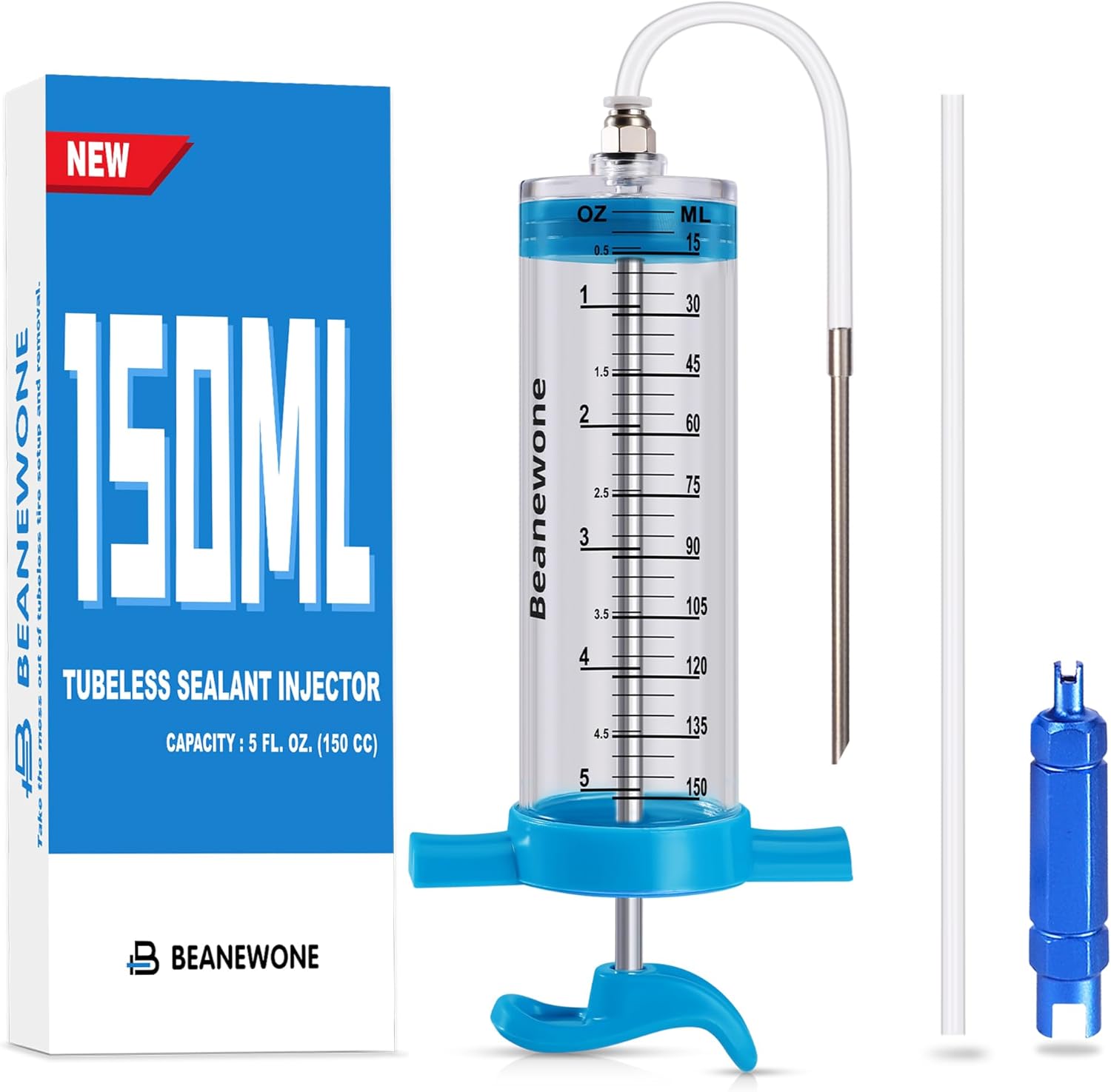
Make tubeless sealant installs faster and cleaner with this 150ml injector and clear measurement body. It connects and disconnects with a simple push-to-connector, then injects sealant directly into Schrader or Presta valve stems after removing the valve core. Includes a valve core remover tool to help you prepare and seal tires with less mess.

CKAuto Universal Tire Repair Kit provides a complete emergency solution for fixing flat tire punctures using plug-style repairs without removing the tire from the rim. The kit includes insertion/probe tools, repair plugs, lubricant, valve accessories, and a convenient carry bag for quick roadside use. Designed for tubeless tires across cars, SUVs, trucks, motorcycles, RVs, and more, it’s easy enough for anyone to perform a proper repair.
Durability and Lifespan: How Long Latex and Fiber Stay Effective
Service life is product-specific. Fiber content alone does not prove that a sealant will last longer. Stan’s Original lists a 2-to-7-month performance window and recommends more frequent monitoring in arid conditions. Peaty’s says Holeshot BioFibre can remain effective for up to six months in temperate climates. SILCA states that its current Ultimate formula lasts six months or more.
Use those numbers as manufacturer guidance, not as a universal timer. Temperature, humidity, tire casing, storage, air top-ups, and the amount of sealant lost while fixing punctures all affect how quickly the remaining liquid dries. Stan’s support guidance recommends a quarterly check or refresh for most riders even though the product can remain liquid longer in some setups.
If low maintenance is your priority, compare the stated service interval of the exact sealant you are considering. Do not assume “fiber” automatically means longer life or “latex” automatically means frequent replacement, because many long-life fiber products are themselves latex-based.
What Puncture Sizes Each Sealant Handles Best
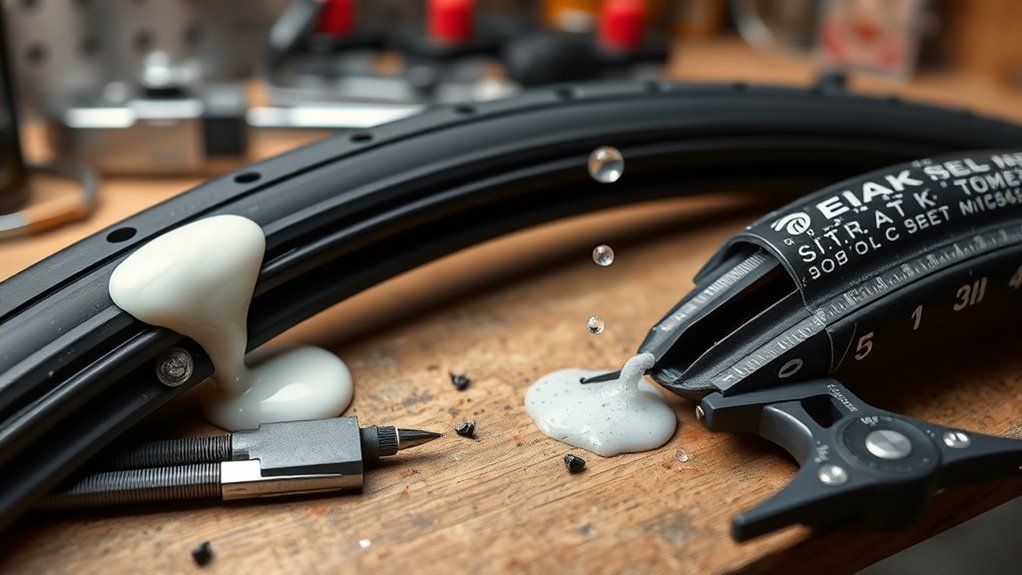
Published puncture limits vary by product, not just by chemistry. Stan’s Original claims sealing up to 6.5 mm. Peaty’s Holeshot BioFibre claims up to 6 mm. SILCA Ultimate claims 6 mm or more. Muc-Off MTB Tubeless Sealant claims up to 6 mm. These are manufacturer ratings, so treat them as selection guidance rather than a guarantee that every hole of that diameter will seal at every pressure.
Small Puncture Performance
For small punctures, the most important requirement is that enough liquid sealant reaches the hole and cures before too much pressure is lost. Latex-based and fiber-reinforced latex formulas can both do this. FiberLink is a useful example because its manufacturer explicitly describes the formula as low viscosity, fast-acting natural latex reinforced with Kevlar fibers. That directly contradicts the idea that fiber-reinforced products must be slow or thick.
- Use the tire maker’s pressure range and the sealant maker’s compatibility guidance.
- Keep the recommended amount of liquid in the tire.
- Refresh dried or depleted sealant before relying on it for puncture protection.
- Judge performance by the exact formula and use case, not a broad chemistry label.
Large Hole Limits
Once a puncture exceeds what the liquid sealant can close, use a tubeless plug rather than repeatedly adding more sealant and hoping the hole will shrink. Manufacturer claims around 6 mm are common among several current formulas, but puncture shape, casing damage, pressure, temperature, and debris can change the result. A long slash or damaged sidewall can be more difficult than a clean round hole of the same nominal width. For remote gravel, mountain biking, or endurance riding, carry a plug tool, inflation, and a backup tube for failures that sealant cannot repair.
Weight, Mess, and Maintenance: Real-World Trade-Offs
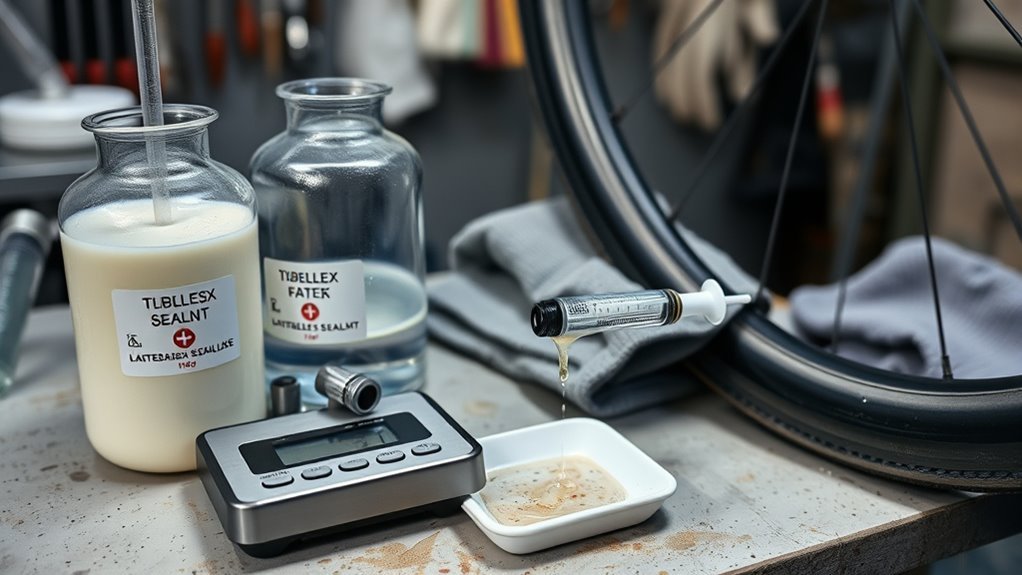
Do not assume that every fiber-reinforced sealant is heavy, thick, or hard to clean. Finish Line specifically describes FiberLink as low viscosity, and Peaty’s says its current BioFibre formula was made thinner for easier setup. The amount you add also changes total system weight, so tire volume and the manufacturer’s dose can matter as much as the presence of fibers.
For maintenance, focus on measurable checks: how much sealant your tire size needs, how often the manufacturer says to inspect it, whether the formula can be injected through the valve, and what the brand says about CO2 use. Stan’s and Finish Line both allow emergency CO2 use but warn that it can reduce sealant life or effectiveness, so refresh the sealant after emergency CO2 use according to the product guidance.
- Use the recommended dose for your tire size.
- Check liquid level on the manufacturer’s schedule.
- Follow product-specific valve-injection instructions.
- Carry a rag or small cleanup item for trailside repairs.
Dosage, Refresh Intervals, and How to Check Sealant at Home
There is no safe one-size-fits-all dose such as 4 to 8 oz for every bicycle tire. Stan’s current volume chart, for example, recommends about 50 ml (1.7 oz) for a 700c x 28 mm tire, 60 ml (2 oz) for 700c x 40 mm, 110 ml (3.7 oz) for a 29 x 2.4 in tire, and 125 ml (4.2 oz) for a 29 x 2.5 in tire. Larger tires need more. Use the chart for the sealant you actually run because formulas and tire casings differ.
| Tire size | Stan’s starting amount |
|---|---|
| 700c x 28 mm | 50 ml (1.7 oz) |
| 700c x 40 mm | 60 ml (2 oz) |
| 29 x 2.4 in | 110 ml (3.7 oz) |
| 29 x 2.5 in | 125 ml (4.2 oz) |
| 26 x 4 in | 175 ml (5.9 oz) |
Do not puncture a good tire just to test sealant at home. Instead, check the remaining liquid on the schedule recommended by the sealant maker, inspect for drying or clumps when the tire is opened, and refresh after significant sealant loss. Stan’s recommends checking or refreshing about every three months for most riders, with more frequent attention in hot or dry conditions. If your tires start losing air faster between rides, inspect the tubeless system rather than waiting for the next puncture.
Best Pick by Rider Type and Riding Conditions
Choose the formula by the problem you need it to solve. Racers should prioritize a formula that seals quickly at their actual tire pressure and can be serviced on their race schedule. Gravel and mountain riders should prioritize puncture reinforcement, sufficient dose for larger tire volume, and a plug kit for damage beyond the liquid sealant’s limit. Riders in hot, dry climates should favor a clearly stated service interval and inspect more often. Anyone who needs to avoid natural latex should verify that the exact product is latex-free rather than assuming a product is latex-free because it contains fibers.
Choose by the complete formula: base chemistry, reinforcement, puncture rating, pressure range, dose, and service interval.
- Competitive racers: prioritize fast sealing at your riding pressure and a maintenance schedule you can follow.
- Endurance gravel riders: prioritize reinforcement, adequate liquid volume, and trailside plug support.
- Mountain bikers: prioritize puncture rating, tire-volume dosage, and low-pressure compatibility.
- Hot-climate riders: prioritize frequent level checks and published service-life guidance.
- Latex-sensitive riders: use only a formula the manufacturer explicitly identifies as latex-free.
[Products Worth Considering]

This 61-piece tire repair screw kit helps you fix punctures quickly by aligning the screw plugs and twisting clockwise, finishing the repair in seconds. The self-sealing plugs create a reliable seal for many roadside situations without needing a jack, wrench, or glue. It includes two plug sizes and a screwdriver in a portable case, making it a convenient option for cars, motorcycles, trucks, bikes, ATVs, and tractors.

Orange Seal regular formula tubeless sealant quickly seals punctures and forms a durable bond inside your tire to help reduce flats. Made with natural latex, it adheres effectively to rubber and seals from the inside out, including the critical bead-to-rim interface for a reliable ride. It seals punctures up to 1/4 inch, slices up to 3/4 inch, and performs in temperatures as low as 11°F across MTB, road, cyclocross, gravel, and e-bike applications.
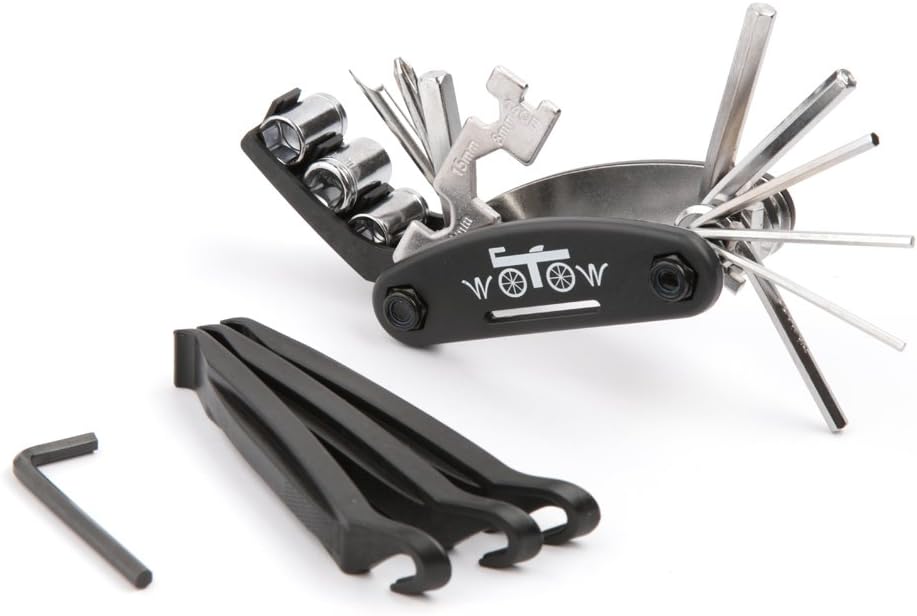
This WOTOW 16-in-1 bicycle multitool is built from corrosion-resistant chrome-vanadium steel for reliable, high-torque performance on the road or trail. It includes multiple hex sizes, a socket extension rod, flat wrench options, a spoke tool, a slot and cross screwdriver, plus three nylon tire levers to help you remove inner tubes and fix flats quickly. The compact folded design makes it easy to carry in a saddlebag or pocket, while an extra Allen wrench helps tighten or loosen stubborn hardware.
Frequently Asked Questions
Can Fiber Tubeless Sealant Contain Latex?
Yes. Fiber-reinforced and latex-based are not mutually exclusive. Finish Line FiberLink uses natural latex with Kevlar fibers, Peaty’s Holeshot BioFibre uses latex with biodegradable fibers, and SILCA Ultimate uses a natural-and-synthetic latex blend with carbon fibers.
Is Fiber-Reinforced Sealant Better Than Latex-Dominant Sealant?
Not automatically. Fibers can reinforce a puncture plug, but overall performance also depends on the latex or non-latex base, viscosity, tire pressure, temperature range, remaining liquid volume, and the size and shape of the puncture. Compare the exact product specifications for your riding conditions.
How Long Does Stan’s Sealant Last?
Stan’s says its Original Tubeless Sealant provides puncture-sealing performance for about 2 to 7 months, with more frequent monitoring needed in arid conditions. Its support guidance recommends checking or refreshing sealant about every three months for most riders. See Stan’s Original Tubeless Sealant specifications and Stan’s sealant support guidance.
How Much Tubeless Sealant Should I Use?
Use the sealant maker’s chart for your tire size. Stan’s current chart lists about 50 ml (1.7 oz) for 700c x 28 mm, 60 ml (2 oz) for 700c x 40 mm, 110 ml (3.7 oz) for 29 x 2.4 in, and 125 ml (4.2 oz) for 29 x 2.5 in. Other brands may specify different amounts.
Can Tubeless Sealant Seal a 6 mm Hole?
Some current manufacturers claim around that range. Stan’s Original claims up to 6.5 mm, Peaty’s Holeshot BioFibre claims up to 6 mm, SILCA Ultimate claims 6 mm or more, and Muc-Off MTB Tubeless Sealant claims up to 6 mm. Treat these as product ratings, not a guarantee for every puncture or pressure.
Does CO2 Affect Tubeless Sealant?
It can, depending on the formula. Stan’s says prolonged CO2 exposure can separate its sealant or reduce sealant life, and Finish Line says emergency CO2 use can reduce FiberLink effectiveness. If you use CO2 during a ride, follow the sealant maker’s instructions for replacing the gas with air or refreshing the sealant afterward.
Manufacturer references checked for this update: Finish Line FiberLink, Peaty’s Holeshot BioFibre, SILCA Ultimate, and Muc-Off MTB Tubeless Sealant.
Conclusion
The key correction is simple: fiber-reinforced sealant is often still latex sealant. Latex forms the sealing base in many products, while Kevlar, cellulose, carbon, or other particles can reinforce the plug. Compare the exact formula’s puncture rating, pressure range, dosage, temperature range, and refresh interval. Keep enough liquid in the tire, inspect it on schedule, and carry a plug kit for punctures the sealant cannot close.