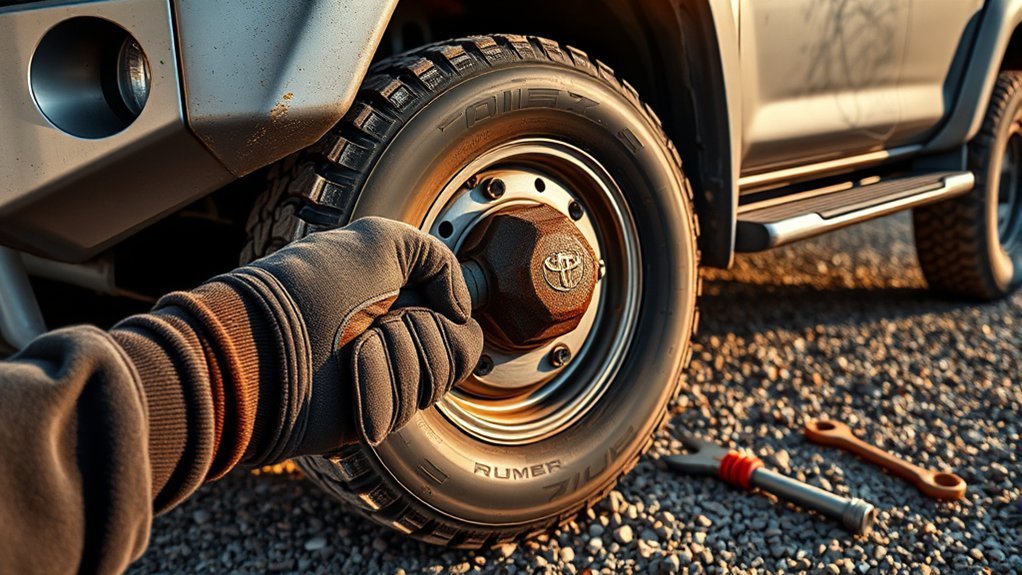
A stuck lug nut on a Toyota 4Runner is usually caused by rust, over-tightening, cross-threading, dirt in the threads, a damaged wheel lock, or a rounded nut. Start with the safest low-risk methods first: park securely, use the correct six-point socket, apply penetrating oil, and use steady pressure with a breaker bar. If the nut rounds off, the stud starts twisting, or you are working in an unsafe roadside spot, stop and call roadside assistance or a tire shop.
Quick Answer
To remove a stuck Toyota 4Runner lug nut, keep the tire on the ground, seat the correct six-point socket fully, apply penetrating oil, wait 10–30 minutes, then use a breaker bar with slow, steady pressure. Do not jump on the wrench or use open flame. If it strips, use a lug nut extractor or call a professional.
Key Takeaways
- Break the lug nut loose while the tire is still touching the ground; fully remove it only after the vehicle is lifted and safely supported.
- Use a six-point socket and breaker bar for removal. Save the torque wrench for reinstalling the wheel to the correct Toyota specification.
- Penetrating oil can help with corrosion, but give it time to work and keep open flame away from sprayed areas.
- A rounded lug nut or stuck wheel lock usually needs an extractor socket, replacement hardware, or professional removal.
- Toyota 4Runner torque specs vary by model year and wheel type, so confirm the value in your owner’s manual before final tightening.
At a Glance
| Time Required | 15–45 minutes if the nut is not damaged; longer or professional help if the nut is rounded, cross-threaded, or seized. |
| Difficulty | Moderate. Stop if the vehicle is unstable, the stud twists, or the nut begins to round off. |
| Tools Needed | Correct six-point socket, breaker bar, penetrating oil, dead-blow or rubber mallet, gloves, eye protection, wheel chocks, jack, jack stands, torque wrench, and lug nut extractor if the nut is damaged. |
| Cost | Usually $0–$60 if you already have tools; more if a shop must remove a stripped nut, replace a wheel stud, or repair wheel damage. |
Warning: Do not work on a 4Runner supported only by a jack, and do not use a propane torch on a wheel after applying penetrating oil. Open flame can damage the wheel, tire, TPMS sensor, brake parts, and nearby finishes. If heat seems necessary, let a professional handle it.
Step-by-Step Guide to Removing Stuck Lug Nuts
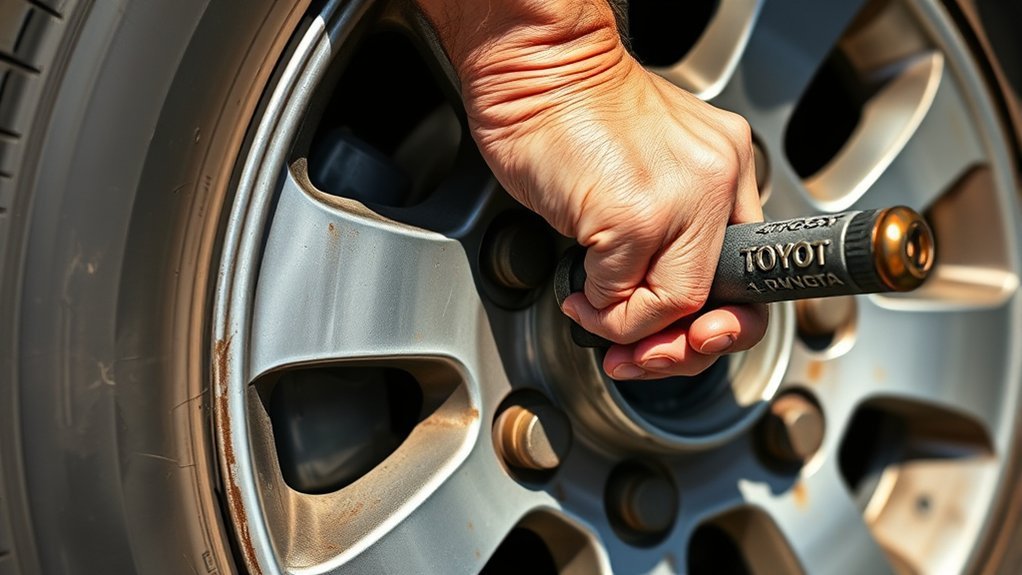
Use this sequence before you try extreme force. The goal is to break the nut loose without rounding it, snapping a wheel stud, damaging the wheel, or making the vehicle unstable.
- Park safely first. Move away from traffic if possible, turn on the hazard lights, shift to Park, set the parking brake, and chock the wheel diagonally opposite the wheel you are working on. If you cannot get to a safe, firm, level spot, call roadside assistance.
- Keep the tire on the ground for the first break-loose attempt. The tire should still be touching the ground when you first loosen the stuck lug nut. This keeps the wheel from spinning and reduces rocking on the jack.
- Use the correct socket. Choose a snug six-point socket, not a loose twelve-point socket. Push it fully onto the lug nut so the flats of the nut are supported evenly.
- Check for a wheel lock. If the stuck nut is a locking lug nut, use the exact wheel-lock key. Do not force a slipping key; it can strip the pattern and make removal harder.
- Apply penetrating oil. Spray the base of the nut where it meets the wheel and, if the lug nut is open-ended, spray the visible threads. WD-40 Specialist Penetrant is designed to penetrate threads and seams on rusted nuts and stuck parts.
- Wait 10–30 minutes. Give the oil time to creep into the threads. Reapply once if the nut is badly corroded.
- Use steady pressure with a breaker bar. Attach the breaker bar so you can pull or press smoothly. Turn counterclockwise to loosen. Avoid bouncing, jumping, or jerking the bar because shock loading can round the nut or break the stud.
- Tap, do not smash. If the nut still does not move, lightly tap the socket or breaker bar head with a dead-blow or rubber mallet to help vibration work the penetrant into the corrosion. Do not hammer the wheel face.
- Stop if the nut rounds or the stud twists. A rounded nut needs an extractor socket. A twisting stud, cracking sound, or wobbling socket means you should stop before more parts are damaged.
- Lift only after the lug nuts are broken loose. Once the nuts are cracked loose, lift the 4Runner only at the Toyota-approved jacking point. If you need to remove the wheel, support the vehicle with properly rated jack stands before putting hands or tools near the wheel well.
Note: OSHA jack guidance says the jack must be rated for the load, the base must be firm, and a raised load should be secured at once. For driveway work, that means using the right jack, a solid surface, wheel chocks, and jack stands when the wheel is coming off.
[Products Worth Considering]

The 22800 wheel stud installer makes replacing wheel studs quick and secure, saving time and effort during tire service. It uses a ratchet or impact wrench to pull new studs firmly into place, helping when existing studs are too long. Compatible with most automotive wheels and light-duty truck wheel studs, it’s designed for easy, tool-assisted installation.

This 1/2-inch drive breaker bar delivers powerful leverage for loosening and tightening stubborn lug nuts and automotive fasteners. The 180-degree flex head helps you reach tight spaces at the angle you need, making tire and brake jobs easier. A spring-loaded ball detent design holds 1/2-inch sockets securely while the chrome-moly head provides durable strength for everyday use.

The Trivd Frol 1/2" air impact wrench delivers high performance torque up to 1500 ft-lbs with a twin hammer impact mechanism for strong, balanced blows. It features an ergonomic grip, compact lightweight design, and quick-stop control with 3 forward speeds up to 8000 RPM plus a reverse speed. Built for demanding automotive repair and tire shop work, the rear exhaust helps keep debris away from the surface.
Essential Tools for Removing Stuck Lug Nuts
The right tool matters more than raw force. A stuck lug nut becomes much harder to remove once the corners are rounded, so start with tools that grip cleanly and apply controlled leverage.
- Six-point socket: Best first choice because it grips the flats of the nut more securely than a twelve-point socket.
- Breaker bar: The main tool for loosening a stuck lug nut. Use steady pressure rather than sudden force.
- Penetrating oil: Helps break rust and corrosion bonds. Let it soak instead of spraying and immediately forcing the nut.
- Dead-blow or rubber mallet: Useful for light tapping and vibration without damaging the wheel finish.
- Lug nut extractor socket: Needed when the nut is rounded, swollen, or too damaged for a normal socket. The nut should be replaced after extraction.
- Wheel-lock key: Required for locking lug nuts. Keep it in the glove box, tool kit, or cargo area so it is available during a flat tire.
- Wheel chocks, jack, and jack stands: Needed if the wheel must come off after the nut is loosened.
- Torque wrench: Use this for reinstalling the wheel to Toyota’s specification, not for breaking the stuck nut loose.
- Gloves and eye protection: Important when using penetrant, extractor sockets, or high-force tools.
Pro Tip: If your socket slips even once, stop and switch to a better-fitting six-point socket or extractor. Repeated slipping rounds the lug nut and can turn a simple job into a stud replacement.
[Products Worth Considering]

Upgrade your wheels with MIKKUPPA M12x1.5 mag seat lug nuts built for secure, corrosion-resistant performance. These closed-end chrome lug nuts are a direct replacement for select Toyota models, including Camry, Corolla, RAV4, Sienna, Avalon, Highlander, Matrix, Venza, and Prius. Triple-chromium plating and cold-forged, heat-treated steel help deliver strength for daily driving and replacement needs.

This car D-wheel lock nut key provides an anti-theft solution for D-shaped wheel lock bolts, helping keep your wheels secure. It features a flower-shaped internal pattern that resists micro-adjustment theft while allowing removal and mounting of compatible locking nuts. Made for reliable performance under high torque, it’s easy to use with standard socket wrench turning for quick tire maintenance and emergency repairs.

These M14x1.5 closed-end chrome lug nuts are a one-piece replacement designed for secure fitment on compatible GM, Ford, and select Chrysler/Dodge models. Featuring a 60-degree conical seat and anti-rust chrome plating, they help resist corrosion and maintain a bright look for everyday driving. Built for long-term durability, they include OEM-style part references and are backed by 12 months of support.
What Not to Do When Removing Lug Nuts?
Most lug nut damage comes from too much force with the wrong tool. Avoid these mistakes before they create a bigger repair.
| What Not to Do | Why It Causes Problems | Better Practice |
|---|---|---|
| Jump on the wrench or bounce on a cheater pipe | Can round the lug nut, bend tools, or snap a stud | Use a quality breaker bar with slow, steady pressure |
| Use a torque wrench to break the nut loose | Can damage the wrench calibration | Use the torque wrench only for final tightening |
| Lift the vehicle before the first loosen attempt | The wheel can spin and the SUV can rock on the jack | Crack the nut loose while the tire is still on the ground |
| Use open flame after spraying penetrant | Can ignite residue or damage the tire, wheel finish, TPMS sensor, and brake parts | Use penetrant, an extractor, or professional removal instead |
| Keep forcing a slipping wheel-lock key | Can strip the lock pattern | Apply inward pressure, use the correct key, or call a tire shop |
How to Handle a Rounded, Stripped, or Locking Lug Nut
If the lug nut is no longer square enough for a normal socket, do not keep trying the same tool. A damaged lug nut needs a different approach.
[Products Worth Considering]

This spare tire tool kit is designed for the 2004 to 2018 Ford F-150 to help you loosen and tighten wheel lug nuts and manage the spare tire and provided jack functions from underneath the vehicle. It includes the lug nut wrench and extension pieces plus a convenient storage carrying case for organized transport. The jack itself is not included.

Upgrade your wheels with MIKKUPPA closed-end lug nuts designed for reliable fit and corrosion resistance. The one-piece, cold-forged and heat-treated steel construction helps resist rust and stripping, while the integrated finish delivers a durable black appearance. Built to OEM standards with a conical 60-degree seat, these nuts provide a secure solution for compatible Ford, Honda, Jeep, and Chevrolet models.

ROBLOCK rubber wheel chocks help prevent vehicle rolling with a non-slip grip for trucks, trailers, RVs, and small aircraft. The chocks include three yellow reflective strips to improve visibility in low-light parking and outdoor use. Lightweight and portable design makes them easy to place in front of or behind a tire during camping, loading, or maintenance.
Rounded or Stripped Lug Nut
Use a lug nut extractor socket sized for the damaged nut. These sockets bite into the outside of the lug nut as you turn counterclockwise. They usually destroy the lug nut during removal, so plan to replace it. After it comes off, inspect the wheel stud threads. If the threads are flattened, cracked, stretched, or cross-threaded, replace the stud before driving.
Stuck Locking Lug Nut
Seat the wheel-lock key fully and keep firm inward pressure on it while turning with a breaker bar. If the key slips, stop. A tire shop can remove a damaged wheel lock with specialty tools before the pattern is completely destroyed.
Nut Turns but Will Not Come Off
If the lug nut turns but does not back off, the stud may be spinning, stripped, or broken behind the wheel. This is no longer a normal driveway removal. Stop and have the wheel hardware inspected.
Warning: Do not drive with a loose, missing, cracked, or partially removed lug nut. A wheel that is not clamped correctly can damage the studs, rotor, hub, and wheel, and it may become unsafe to drive.
Preventing Stuck Lug Nuts in the Future
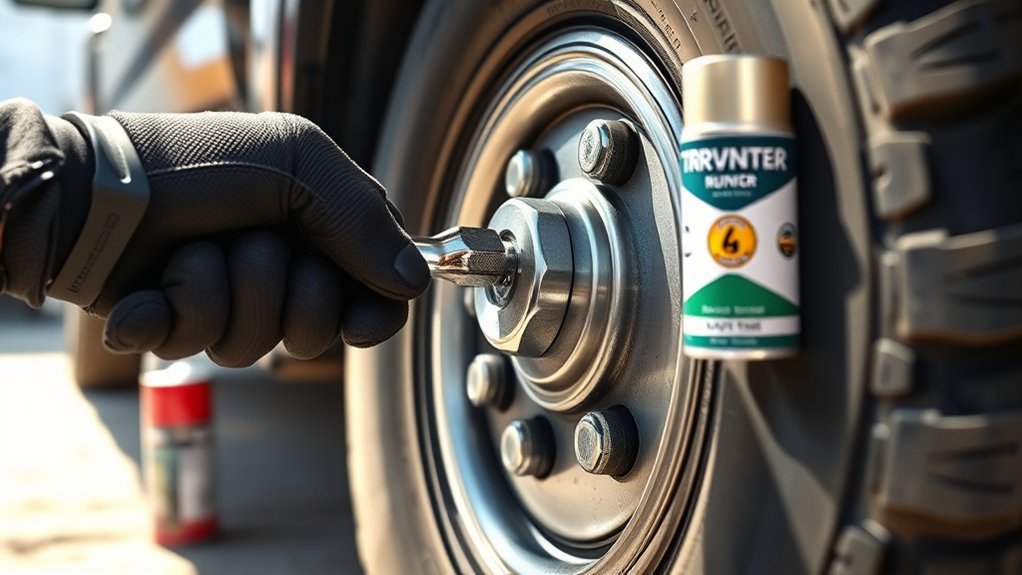
The best prevention is clean hardware and correct torque. Over-tightening is one of the most common reasons lug nuts refuse to move later.
- Hand-start every lug nut. Thread each nut by hand before using a wrench. If it does not spin on smoothly at first, stop and check for cross-threading.
- Use a star pattern. Tighten opposite nuts in stages so the wheel seats evenly against the hub.
- Torque to the correct Toyota specification. Check your exact model year, trim, and wheel type in the Toyota owner’s manual. For example, Toyota’s 2025 4Runner Hybrid flat-tire instructions list different torque values for steel and aluminum wheels.
- Recheck after service. Toyota’s 2025 4Runner Hybrid manual instructs owners to retighten wheel nuts within 100 miles after wheel installation.
- Keep threads clean and dry unless Toyota says otherwise. Do not coat lug studs or lug nut seats with anti-seize unless your Toyota service information or wheel hardware manufacturer specifically calls for it. Lubricated threads can change the clamping force at a given torque reading.
- Use anti-seize carefully on hub contact areas only when appropriate. A very thin film on the hub pilot or wheel-to-hub mating area can help fight corrosion, but keep it off the studs, lug seats, brake rotor friction surface, and brake pads. Permatex describes anti-seize as a product for preventing seizing, galling, and corrosion on metal parts, but lug nut threads need extra caution because torque accuracy matters.
- Replace damaged hardware. A rusty, swollen, rounded, cracked, or mismatched lug nut should be replaced before it strands you later.
- Ask shops to final-torque by hand. Impact tools are useful for removal, but final tightening should be verified with a torque wrench.
Common Causes of Stuck Lug Nuts
Understanding the cause helps you choose the right fix and prevent the problem from returning.
- Rust and corrosion: Moisture, road salt, mud, and age can bond the lug nut to the stud.
- Over-tightening: Too much torque can stretch studs, distort threads, and make future removal difficult.
- Cross-threading: If the nut was started crooked, the threads can bind and tear.
- Dirt or brake dust in the threads: Debris can create extra friction and false torque readings.
- Wrong socket size: A loose socket rounds the lug nut corners and reduces grip.
- Wheel locks: A missing, worn, or slipping wheel-lock key can make a normal tire change impossible.
- Wheel-to-hub corrosion: Sometimes the lug nuts come off, but the wheel itself sticks to the hub. That is a separate issue and should be handled carefully to avoid wheel damage.
Reinstalling the Wheel After Removal
Once the stuck lug nut is off, do not reuse damaged hardware. Safe reinstallation matters as much as removal.
- Clean loose rust and debris from the wheel mounting surface, hub face, and visible stud threads.
- Inspect each stud and lug nut. Replace any part with damaged threads, cracks, heavy corrosion, or rounded corners.
- Mount the wheel flush against the hub.
- Hand-thread each lug nut until it seats. Do not use power tools to start the nuts.
- Snug the nuts in a star pattern.
- Lower the 4Runner until the tire touches the ground enough to prevent spinning.
- Use a torque wrench and tighten in a star pattern to the specification in your Toyota owner’s manual.
- After driving the distance recommended in your manual, recheck the torque.
A stuck lug nut is not a strength contest. The safest method is controlled leverage, correct tool fit, patient penetrant use, and knowing when damaged hardware needs a professional extractor.
Frequently Asked Questions
Does WD-40 help remove locking wheel nuts?
A true penetrating oil can help loosen corrosion around a locking wheel nut, but it will not fix a missing or stripped wheel-lock key. Spray the base of the nut, wait 10–30 minutes, seat the key fully, and apply steady pressure. If the key slips, stop and use a professional wheel-lock removal tool.
How do you remove a locking wheel nut that is stuck?
Use the correct lock key, push inward so the key stays fully seated, and turn counterclockwise with a breaker bar. Do not use an impact wrench on a fragile or slipping lock key. If the pattern is damaged, a tire shop can remove it with specialty extractors.
Should I loosen 4Runner lug nuts before jacking it up?
Yes. Break the lug nuts loose while the tire is still touching the ground. This keeps the wheel from spinning and helps keep the vehicle stable. After the nuts are loosened, lift at the approved jacking point and support the vehicle properly before removing the wheel.
Can I use a propane torch on a stuck lug nut?
It is not recommended for normal DIY driveway or roadside work, especially after applying penetrating oil. Heat can damage the wheel finish, tire, TPMS sensor, brake parts, and nearby materials. If controlled heat is truly needed, have a professional remove the nut.
What torque should Toyota 4Runner lug nuts be tightened to?
Use the torque value in your exact Toyota 4Runner owner’s manual because specifications can vary by model year and wheel type. Toyota’s 2025 4Runner Hybrid flat-tire instructions list 154 ft-lbf for steel wheels and 97 ft-lbf for aluminum wheels, while other 4Runner years may differ.
What if the lug nut is stripped or rounded?
Use a lug nut extractor socket that bites into the damaged nut. Do not reuse that nut afterward. Once it is removed, inspect the wheel stud; if the threads are damaged or stretched, replace the stud before driving.
Conclusion
Removing a stuck Toyota 4Runner lug nut is safest when you work in the right order: secure the SUV, keep the tire on the ground for the first loosen attempt, use a snug six-point socket, apply penetrating oil, and turn a breaker bar with steady pressure. Avoid open flame, jumping on tools, and using a torque wrench as a breaker bar. If the nut strips, the wheel lock slips, the stud twists, or the roadside setting is unsafe, call a professional before the repair becomes more expensive or dangerous.
Sources
- Toyota Owners Manuals & Warranties — official Toyota owner manual lookup for model-year-specific wheel and tire procedures.
- Toyota 2025 4Runner Hybrid flat tire instructions — current Toyota torque examples and retightening guidance for 2025 4Runner Hybrid wheels.
- OSHA 29 CFR 1910.244: Jacks — jack load rating, firm base, and securing raised loads.
- WD-40 Specialist Penetrant — product information on penetrating rusted nuts, bolts, threads, and stuck parts.
- Permatex Lubricants — anti-seize background for preventing seizing, galling, and corrosion on metal parts.
- AAA Club Alliance tire-changing guide — safety guidance for loosening lug nuts before lifting and calling roadside assistance when conditions are unsafe.