
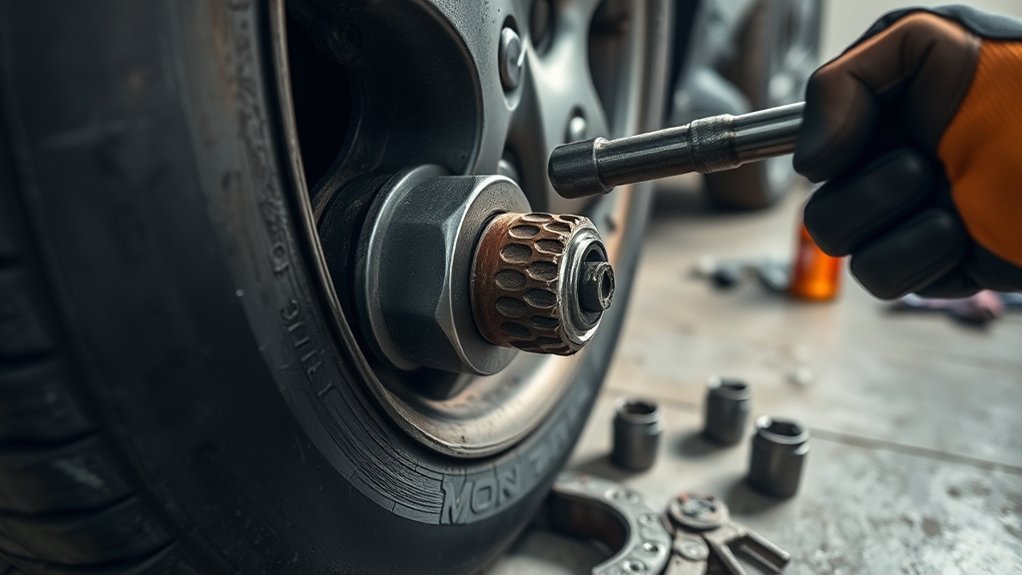
A stripped lug nut can turn a simple tire change into a frustrating job, but the safest approach is to move from gentle methods to more aggressive ones. Start with inspection, penetrating oil, and a tight-gripping socket or extractor. Save heat, cutting, and drilling for last, because those methods can damage the wheel, stud, or nearby parts if they are rushed.
Quick Answer
To remove a stripped lug nut, soak it with penetrating oil, hammer on a tight extractor socket or slightly smaller six-point socket, then turn it counterclockwise with steady pressure from a breaker bar. If it still will not move, use a lug nut removal kit, controlled heat, or careful cutting and drilling as last-resort methods.
Key Takeaways
- Work on a flat, stable surface, set the parking brake, chock the wheels, and support the vehicle safely before applying heavy force.
- Start with the least destructive methods: penetrating oil, a tight six-point socket, a breaker bar, and a reverse-threaded extractor socket.
- Use heat only with extreme care because many penetrants are flammable and nearby tires, TPMS sensors, brake hoses, and wheel finishes can be damaged.
- Cutting, drilling, chiseling, or welding should be last-resort methods when an extractor will not grip.
- After removal, inspect the stud, wheel seat, and threads, then reinstall with clean hardware and a torque wrench set to the vehicle manufacturer’s specification.
At a Glance
| Time Required | 15 minutes to 2 hours, depending on rust, access, and damage |
| Difficulty | Moderate for extractor methods; advanced for heat, drilling, cutting, or welding |
| Tools Needed | Penetrating oil, six-point sockets, hammer, breaker bar, lug nut extractor kit, torque wrench, jack, jack stands, wheel chocks, safety glasses, gloves |
| Cost | About $10–$60 for penetrating oil and extractor sockets; more if a stud, lug nut, wheel, or shop service is needed |
Warning: Do not crawl under a vehicle supported only by a jack. For garage work, use the correct jack points, wheel chocks, and properly rated jack stands. If the vehicle is on a shoulder, slope, soft ground, or near traffic, move to a safer location if possible and call roadside assistance.
Assess the Stripped Lug Nut
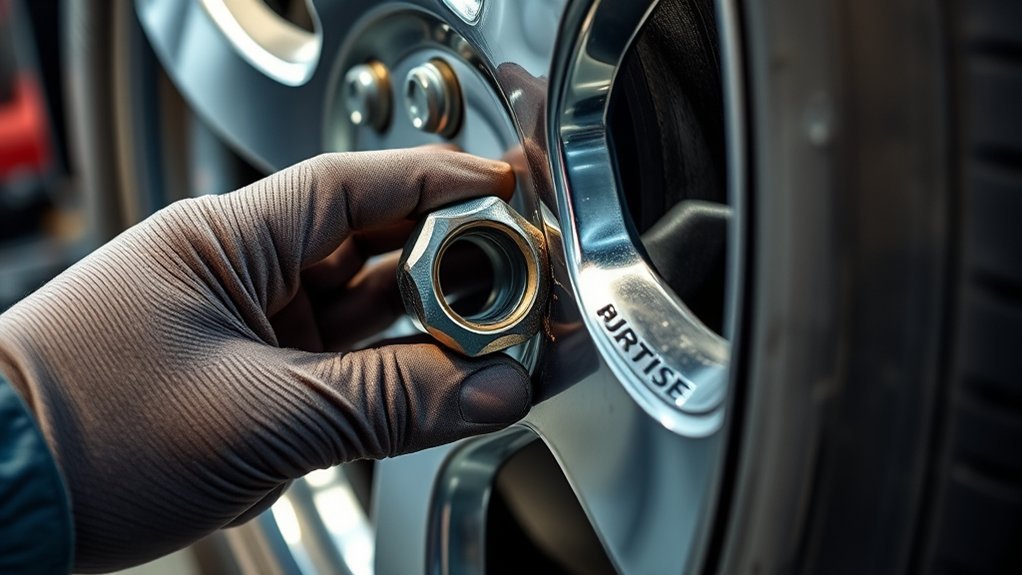
Before you add more force, look closely at the damaged lug nut and the wheel around it. The right method depends on whether the nut is lightly rounded, completely smooth, swollen from a chrome cap, recessed deep in the wheel, cross-threaded, or spinning with the stud.
Check these details first:
- How rounded it is: A slightly rounded nut may still accept a tight six-point socket. A badly rounded nut usually needs an extractor socket.
- How much access you have: Recessed lug nuts are harder to grip with pliers or a chisel, so an extractor socket is usually safer.
- Whether it is a wheel lock: Try the correct wheel-lock key first. Extractors can destroy a locking lug nut.
- Whether the stud spins: If the lug nut and stud spin together, the stud or hub may be damaged and may need professional repair.
- Wheel condition: Look for gouges, cracks, ovaled holes, or damaged lug seats from earlier removal attempts.
Note: A stripped lug nut is often a symptom of the wrong socket size, a worn socket, corrosion, over-tightening, or impact-gun damage. Plan to replace the damaged lug nut after removal instead of reusing it.
Set Up Safely Before Using Force
Heavy force from a breaker bar can move the whole vehicle if it is not supported correctly. Set up the work area before you try to break the lug nut loose.
- Park on flat, solid ground away from traffic.
- Set the parking brake and put the vehicle in Park or in gear for a manual transmission.
- Place wheel chocks on the wheels that stay on the ground.
- If the wheel is still on the ground, loosen the lug nut slightly before lifting. Do not remove it fully yet.
- Lift only at the manufacturer-approved jack point.
- For garage work, support the vehicle with jack stands before removing the wheel or applying major force.
- Wear safety glasses and gloves. Use hearing protection if grinding or cutting.
If the wheel starts shifting, the jack leans, the vehicle rocks, or the lug nut requires extreme force, stop and reset the vehicle safely before continuing.
Gather the Right Removal Tools
You do not need every tool at once, but you should have the basic options ready so you can move from least aggressive to most aggressive without damaging the wheel.
[Products Worth Considering]

The Trivd Frol 1/2" air impact wrench delivers high performance torque up to 1500 ft-lbs with a twin hammer impact mechanism for strong, balanced blows. It features an ergonomic grip, compact lightweight design, and quick-stop control with 3 forward speeds up to 8000 RPM plus a reverse speed. Built for demanding automotive repair and tire shop work, the rear exhaust helps keep debris away from the surface.

This 1/2-inch drive breaker bar delivers powerful leverage for loosening and tightening stubborn lug nuts and automotive fasteners. The 180-degree flex head helps you reach tight spaces at the angle you need, making tire and brake jobs easier. A spring-loaded ball detent design holds 1/2-inch sockets securely while the chrome-moly head provides durable strength for everyday use.

These M14x1.5 closed-end chrome lug nuts are a one-piece replacement designed for secure fitment on compatible GM, Ford, and select Chrysler/Dodge models. Featuring a 60-degree conical seat and anti-rust chrome plating, they help resist corrosion and maintain a bright look for everyday driving. Built for long-term durability, they include OEM-style part references and are backed by 12 months of support.
Essential Removal Tools
- Penetrating oil, such as WD-40 Specialist Rust Release Penetrant or another dedicated penetrant
- Six-point impact sockets in the correct size and one slightly smaller size
- Hammer or dead-blow hammer
- Breaker bar
- Lug nut extractor or bolt-grip removal kit
- Torque wrench for reinstallation
- Replacement lug nut, and a replacement wheel stud if the stud is damaged
Advanced Tools for Severe Damage
- Locking pliers for a protruding nut with enough surface to grab
- Propane or MAP gas torch for controlled heat, only if safe
- Left-hand drill bits or standard drill bits for last-resort drilling
- Cold chisel and punch
- Angle grinder or rotary tool for cutting a slot, only when wheel clearance allows
Pro Tip: Use six-point sockets, not twelve-point sockets, on stubborn lug nuts. A six-point socket contacts more of the nut’s flats and is less likely to round it further.
Soak the Lug Nut With Penetrating Oil
Spray penetrating oil around the base of the lug nut where it meets the wheel stud. If the nut is recessed, use the straw nozzle to aim the oil into the small gap around the nut. Let it sit for at least 10–15 minutes, then reapply. For heavy corrosion, a longer soak can help.
Use only enough oil to wet the threads and the seat area. Wipe away extra oil before using a torch or grinder later. Penetrating oil helps break the rust bond, but it will not repair stripped threads or undo severe over-tightening by itself.
Give the penetrant time to work before you add more force. Rushing usually rounds the nut further and makes the next step harder.
Hammer on a Socket for Better Grip
If the lug nut is rounded but not destroyed, try a tight six-point socket first. Choose a socket that barely fits over the damaged nut. In some cases, the next smaller metric or SAE size will bite better than the original size.
- Hold the socket straight over the lug nut.
- Tap it on with firm, controlled hammer blows until it seats fully.
- Attach a breaker bar.
- Pull counterclockwise with slow, steady pressure.
- If the socket slips, stop before it polishes the nut smooth.
Do not bounce on the breaker bar or jerk it violently. Sudden force can snap a stud, knock the vehicle off balance, or damage the wheel seat.
Use a Lug Nut Removal Kit
A lug nut removal kit is usually the best next step when a normal socket will not grip. These kits use spiral, reverse-threaded extractor sockets that bite into the damaged nut as you turn counterclockwise.
[Products Worth Considering]

This car D-wheel lock nut key provides an anti-theft solution for D-shaped wheel lock bolts, helping keep your wheels secure. It features a flower-shaped internal pattern that resists micro-adjustment theft while allowing removal and mounting of compatible locking nuts. Made for reliable performance under high torque, it’s easy to use with standard socket wrench turning for quick tire maintenance and emergency repairs.

The SEESII cordless impact wrench delivers high tightening and loosening power for fast wheel bolt and industrial bolt work. Its brushless motor and variable-speed 3 forward/2 reverse modes help you control precision installs and stubborn nut removal. A dual-battery system with rapid charging and an included storage case make it ready for home, car, and jobsite use.

Upgrade your wheels with MIKKUPPA closed-end lug nuts designed for reliable fit and corrosion resistance. The one-piece, cold-forged and heat-treated steel construction helps resist rust and stripping, while the integrated finish delivers a durable black appearance. Built to OEM standards with a conical 60-degree seat, these nuts provide a secure solution for compatible Ford, Honda, Jeep, and Chevrolet models.
Reverse-Threaded Socket Kits
Pick the extractor that fits the damaged lug nut as tightly as possible. Too loose, and it will chew the nut without turning it. Too tight, and it may not seat deep enough to grip.
- Match the extractor to the damaged lug nut.
- Hammer the extractor straight onto the nut until it bottoms out.
- Attach a breaker bar or impact-rated hand tool.
- Turn counterclockwise with steady pressure.
- Once the nut is off, drive the damaged nut out of the extractor with a punch if the kit is designed for that.
Hammer-On Extractor Fit
The extractor must sit square to the nut. If it goes on crooked, it can scar the wheel or split the nut unevenly. Keep your face away from the tool path and wear safety glasses, because small metal chips can break loose when the extractor teeth bite.
If the first extractor slips, move to a slightly smaller extractor and reseat it. Do not keep spinning the same loose extractor, because that can remove the remaining metal you need for grip.
Try Heat and a Breaker Bar

Heat can help expand the lug nut and break a rust bond, but it is not the first choice. Use heat only when the vehicle is stable, the area is clear of excess penetrant, and you can keep flame away from the tire, valve stem, TPMS sensor, brake hose, plastic trim, fuel lines, and painted wheel surfaces.
Warning: Many penetrating oils and aerosols are flammable. Wipe away excess product and never spray penetrant into an open flame or onto glowing-hot metal. Keep a fire extinguisher nearby when using heat.
Use controlled heat on the lug nut, not the wheel. Warm the nut briefly, let it cool slightly, then try the extractor and breaker bar again. The goal is controlled expansion, not glowing metal. If you are not comfortable using a torch near a wheel assembly, skip this step and use a professional tire shop or mobile mechanic.
[Products Worth Considering]

Upgrade your wheels with MIKKUPPA M12x1.5 mag seat lug nuts built for secure, corrosion-resistant performance. These closed-end chrome lug nuts are a direct replacement for select Toyota models, including Camry, Corolla, RAV4, Sienna, Avalon, Highlander, Matrix, Venza, and Prius. Triple-chromium plating and cold-forged, heat-treated steel help deliver strength for daily driving and replacement needs.

The 22800 wheel stud installer makes replacing wheel studs quick and secure, saving time and effort during tire service. It uses a ratchet or impact wrench to pull new studs firmly into place, helping when existing studs are too long. Compatible with most automotive wheels and light-duty truck wheel studs, it’s designed for easy, tool-assisted installation.

This spare tire tool kit is designed for the 2004 to 2018 Ford F-150 to help you loosen and tighten wheel lug nuts and manage the spare tire and provided jack functions from underneath the vehicle. It includes the lug nut wrench and extension pieces plus a convenient storage carrying case for organized transport. The jack itself is not included.
Fix a Spinning or Rounded Lug Nut
A rounded lug nut has lost its outer gripping surfaces. A spinning lug nut is different: the nut may be stuck to the stud while the stud spins in the hub. That can mean the stud splines are stripped or the hub area is damaged.
| Problem | Best First Method | When to Stop |
|---|---|---|
| Lightly rounded nut | Hammer on a tight six-point socket | If the socket slips repeatedly |
| Severely rounded nut | Use a reverse-threaded extractor socket | If the extractor cannot seat straight |
| Spinning nut and stud | Apply outward pressure while turning, or seek shop help | If the stud spins freely or the wheel seat is damaged |
| Recessed damaged nut | Extractor socket sized to the recess | If cutting would contact the wheel |
If a stud is spinning, the final repair may require removing the hub or replacing the stud. Do not reinstall the wheel on a damaged or loose stud.
Cut or Drill the Lug Nut
Cutting and drilling are last-resort methods because they can damage the wheel, stud, rotor, or hub. Use them only when extractor sockets fail and you can work accurately.
Drilling Method
- Center punch the lug nut so the drill bit does not walk.
- Start with a small pilot bit, such as 1/8 inch.
- Drill slowly and keep the bit centered.
- Add cutting oil to reduce heat and protect the bit.
- Step up gradually to larger bits until the nut weakens.
- Use a cold chisel to split the weakened nut if needed.
Cutting Method
If the nut protrudes enough, an angle grinder or rotary tool can cut a slot or weaken one side of the lug nut. Protect the wheel surface and stop before cutting into the stud unless you already plan to replace the stud.
Note: If the wheel is expensive, the lug nut is deeply recessed, or the stud is already damaged, a tire shop may be cheaper than repairing grinder marks or a ruined wheel seat.
Reinstall the Wheel and Torque It Correctly
Removal is only half the job. The wheel must go back on with clean hardware and the correct torque. Wheel nuts and bolts need proper torque to prevent loose wheels, broken studs, and possible wheel separation. Use the vehicle manufacturer’s torque specification from the owner’s manual or service information, not a generic guess.
- Clean dirt, rust, and metal chips from the stud, lug seat, and wheel mounting surface.
- Replace the stripped lug nut. Do not reuse it.
- Replace any stud that is bent, cracked, stretched, cross-threaded, or loose in the hub.
- Start every lug nut by hand to avoid cross-threading.
- Snug the lug nuts in a star or crisscross pattern.
- Lower the vehicle until the tire just contacts the ground and cannot spin.
- Use a torque wrench to tighten each lug nut to the manufacturer’s specification in stages.
- Recheck the torque after a short drive if your owner’s manual, wheel maker, or tire shop recommends it.
Warning: Do not coat wheel studs with oil, grease, or anti-seize unless the vehicle or wheel manufacturer specifically allows it. Lubricated threads can change clamp load and make a normal torque reading inaccurate.
Inspect the Stud and Wheel After Removal
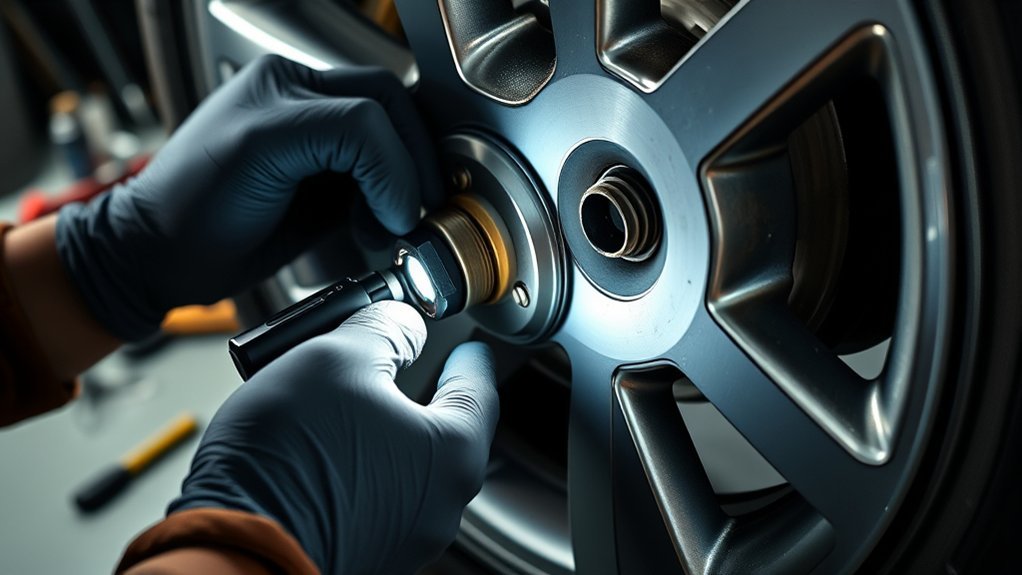
After the lug nut is off, inspect the wheel stud, threads, lug seat, and wheel hole before reinstalling the wheel. This step is important because a damaged stud or deformed wheel seat can keep the wheel from clamping evenly.
- Check stud straightness: Compare it with the surrounding studs.
- Inspect the threads: Look for flattened, torn, rusty, or cross-threaded sections.
- Check the wheel seat: Look for gouges, cracks, ovaling, or crushed metal around the lug hole.
- Clean debris: Remove metal chips, rust, dirt, and old penetrant.
- Replace damaged parts: Do not trust a damaged lug nut or questionable stud to hold the wheel safely.
Prevent Stripped Lug Nuts Next Time
Most stripped lug nuts are preventable. Use the right tools and avoid shortcuts during wheel service.
- Use the correct socket size every time.
- Use six-point sockets for lug nuts, especially on older or corroded hardware.
- Do not use worn sockets that rock on the nut.
- Hand-start lug nuts before using any tool.
- Do not use an impact wrench for final tightening.
- Finish with a torque wrench set to the manufacturer’s specification.
- Replace swollen, cracked, or rounded capped lug nuts before they fail on the road.
- Clean corrosion from the hub and wheel mounting face during tire rotations.
Frequently Asked Questions
How do you get a severely stripped lug nut off?
Use a reverse-threaded lug nut extractor socket. Hammer it squarely onto the stripped nut, then turn it counterclockwise with a breaker bar using steady pressure. If the extractor will not grip, controlled heat, drilling, cutting, or shop removal may be needed.
What should you do if a tire lug nut will not come off?
Stop forcing it with a loose or slipping socket. Spray penetrating oil, let it soak, use a tight six-point socket or extractor, and apply slow pressure with a breaker bar. If the vehicle is unstable, the stud spins, or the wheel may be damaged, call a tire shop or roadside service.
Will WD-40 remove seized lug nuts?
A dedicated WD-40 penetrant can help loosen rusted or seized threads, but it is not a guaranteed fix. It works best when you give it time to soak and combine it with a tight socket or extractor. General-purpose lubricant alone may not free a severely over-tightened or cross-threaded lug nut.
How do you remove a rounded lug nut without damaging the wheel?
Use a tight six-point socket or a lug nut extractor that fits inside the wheel recess without touching the wheel. Keep the socket straight, use steady pressure, and stop if it slips. Avoid grinders and chisels near the wheel unless you can protect the finish and control the cut.
Can you drive with one damaged or missing lug nut?
Do not treat it as safe. A missing or damaged lug nut reduces clamping force on the wheel and can overload the remaining studs. Replace the damaged lug nut or stud before normal driving. If you are stranded, contact roadside assistance instead of driving at speed.
Should you use an impact wrench on a stripped lug nut?
An impact wrench can help in some shop situations, but it can also make a stripped lug nut worse if the socket slips. For DIY removal, a seated extractor socket and breaker bar gives more control. Never use an impact wrench for final wheel torque; finish with a torque wrench.
Conclusion
The best way to remove a stripped lug nut is to work patiently and move from low-risk methods to last-resort methods. Start with penetrating oil, a tight six-point socket, and a breaker bar. If that fails, use a proper lug nut extractor kit. Heat, drilling, cutting, and welding should be reserved for stubborn cases where you can protect the wheel, tire, brake parts, and stud.
Once the lug nut is off, replace damaged hardware and inspect the stud before reinstalling the wheel. Finish with clean threads, a correct tightening pattern, and a torque wrench set to the manufacturer’s specification. That final step is what keeps the repair safe after the stuck lug nut is gone.
Sources
- NHTSA-hosted Wheel Attachment and Torque Requirements bulletin — supports the need for proper wheel fastener torque and warnings about loose wheels, broken studs, and wheel separation.
- Tire Rack: How to Properly Torque Wheel Lug Nuts or Bolts — supports using vehicle-specific torque specs, correct tools, and proper tightening patterns.
- WD-40 Specialist Rust Release Penetrant — supports the use of a dedicated penetrating oil for rusted threads and tight crevices.
- WD-40 Specialist Rust Release Penetrant Safety Data Sheet — supports the heat and flammability warning for aerosol penetrants.
- OSHA 1926.305: Jacks — supports using properly rated lifting equipment and stable support when lifting loads.
- AAA: 5 Steps to Changing a Tire — supports safe roadside setup, using the owner’s manual, and loosening lug nuts before lifting.
