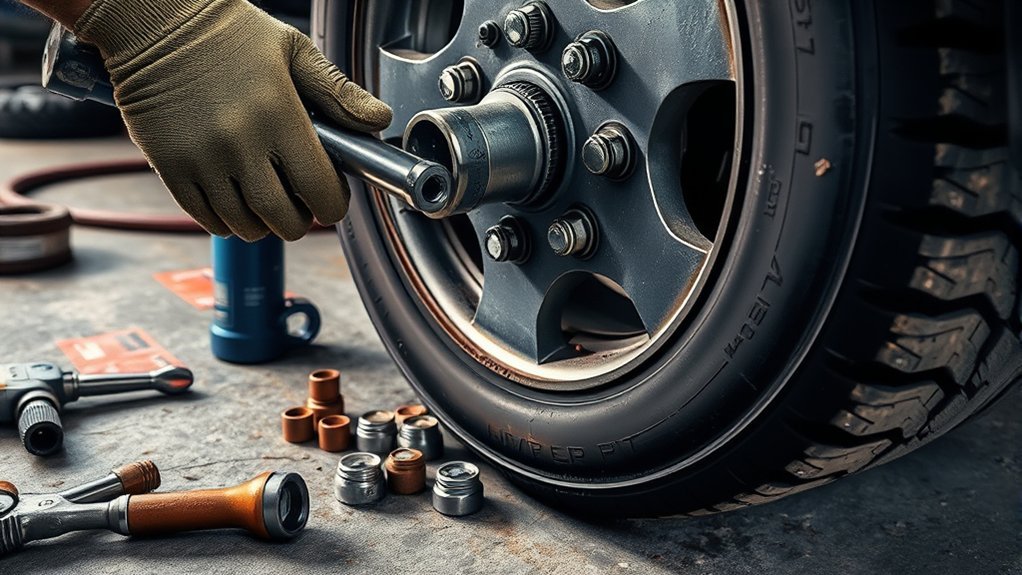
Stuck tire bolts or lug nuts are usually caused by rust, road salt, over-tightening, damaged threads, or using the wrong socket. The safest way to loosen them is to set up the vehicle correctly first, use steady leverage, and save the torque wrench for final tightening—not for breaking nuts loose.
Quick Answer
To unscrew stubborn tire bolts, park on level ground, set the parking brake, chock the wheels, and loosen each nut slightly while the tire is still on the ground. Use the correct six-point socket and a breaker bar. Add penetrating oil, controlled tapping, or careful heat only when needed.
Key Takeaways
- Loosen lug nuts one turn while the wheel is still on the ground, then lift and support the vehicle before full removal.
- Use the exact-size six-point socket, a breaker bar, or a 4-way lug wrench for controlled leverage.
- Penetrating oil, hammer taps, and vibration can help break rust, but keep oil away from brakes and heat sources.
- Use heat only with caution, away from tires, valve stems, brake hoses, TPMS sensors, paint, and wet penetrating oil.
- Reinstall lug nuts by hand first, tighten in a crisscross pattern, use the vehicle maker’s torque spec, and recheck after 50–100 miles.
At a Glance
| Time Required | 15–60 minutes, depending on rust, tool access, and whether the lug nut is rounded or seized. |
| Difficulty | Easy to moderate for normal stuck lug nuts; difficult if the nut is rounded, cross-threaded, or the stud spins. |
| Tools Needed | Wheel chocks, gloves, eye protection, correct six-point socket, breaker bar or 4-way lug wrench, penetrating oil, jack, jack stands, and torque wrench. Optional: impact wrench, hammer, propane torch, rounded-lug removal socket. |
| Cost | $0 if you already own the tools; usually $10–$60 for penetrating oil, a quality socket, or a longer breaker bar. |
How to Loosen Stuck Lug Nuts Safely
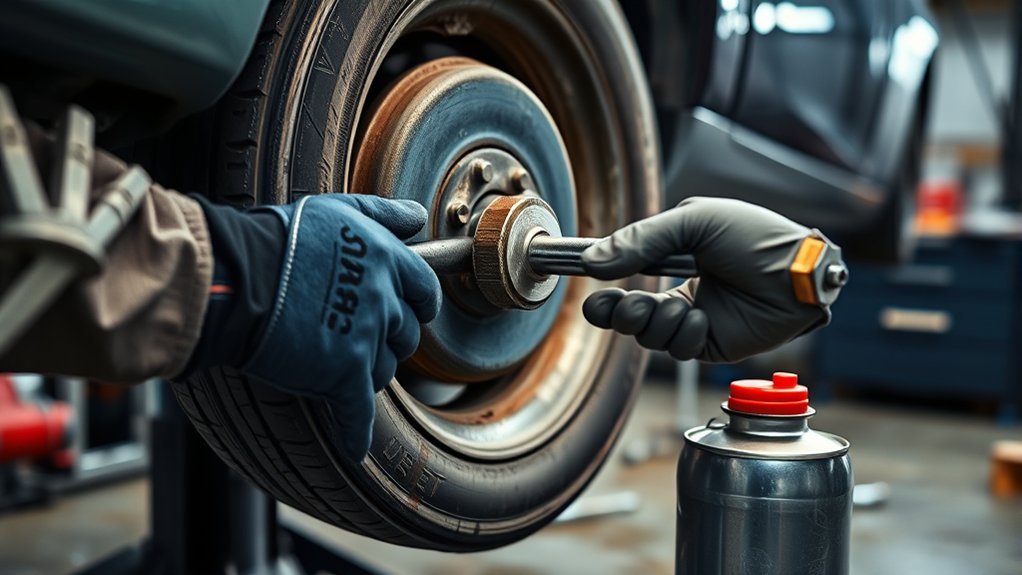
Start with the safety setup. Pull onto solid, level ground, turn on your hazard lights if you are roadside, set the parking brake, and chock the wheel diagonally opposite the tire you are working on. Check the owner’s manual for the correct jack point before lifting. AAA’s tire-change guidance also recommends loosening the wheel nuts while the wheel is still on the ground, then lifting the vehicle afterward. AAA’s tire-change steps are a good reference for that sequence.
Warning: Never put any part of your body under a vehicle held only by a jack. If you must work beyond a basic roadside tire change, support the vehicle with properly rated jack stands on solid ground.
Before lifting, fit the correct socket squarely onto the lug nut and turn counterclockwise. Break each lug nut loose about one turn, but do not fully remove the nuts until the vehicle is lifted and supported. If the wheel has a locking lug nut, find the wheel-lock key before applying force. Forcing the wrong socket onto a lock or decorative cap can damage the nut and make removal harder.
If you are installing a spare or replacement wheel, confirm the wheel and spare are made for the vehicle. Proper tire size, load capacity, and wheel fitment matter before you drive away.
Use the Right Tools for More Torque
Use a breaker bar or 4-way lug wrench when a standard tire iron is not enough. The longer handle increases leverage, which lets you apply steady turning force without jumping on the wrench. A 4-way lug wrench also gives you more hand positions and can help keep the tool aligned.
Use the exact-size six-point socket whenever possible. A loose, shallow, or 12-point socket is more likely to round the nut. Seat the socket fully, keep it straight, and pull or push smoothly. Do not jerk the bar. Sudden force can snap a stud or throw you off balance.
Pro Tip: Do not use your torque wrench as a breaker bar. A torque wrench is a measuring tool for final tightening, and using it to break stuck lug nuts loose can knock it out of calibration.
If you need more reach, a cheater pipe over a breaker bar can add leverage, but use it carefully. Make sure the socket is fully seated, keep your face and hands out of the tool’s slip path, and stop if the lug nut begins to round. An impact wrench can help with removal when used with impact-rated sockets, but do not rely on an impact wrench for final installation torque. Tire Rack notes that impact-gun torque can vary widely and may damage hardware or leave wheels under- or over-tightened. Its wheel torque guide recommends final tightening with a beam or click-type torque wrench.
While the wheel is off, inspect the tire for uneven wear, sidewall damage, and proper tread depth. That inspection will not loosen the lug nut, but it can catch tire problems before the wheel goes back on.
[Products Worth Considering]

Upgrade your wheels with MIKKUPPA closed-end lug nuts designed for reliable fit and corrosion resistance. The one-piece, cold-forged and heat-treated steel construction helps resist rust and stripping, while the integrated finish delivers a durable black appearance. Built to OEM standards with a conical 60-degree seat, these nuts provide a secure solution for compatible Ford, Honda, Jeep, and Chevrolet models.

The 22800 wheel stud installer makes replacing wheel studs quick and secure, saving time and effort during tire service. It uses a ratchet or impact wrench to pull new studs firmly into place, helping when existing studs are too long. Compatible with most automotive wheels and light-duty truck wheel studs, it’s designed for easy, tool-assisted installation.

These M14x1.5 closed-end chrome lug nuts are a one-piece replacement designed for secure fitment on compatible GM, Ford, and select Chrysler/Dodge models. Featuring a 60-degree conical seat and anti-rust chrome plating, they help resist corrosion and maintain a bright look for everyday driving. Built for long-term durability, they include OEM-style part references and are backed by 12 months of support.
Apply Penetrating Oil to Stuck Lug Nuts
If a lug nut will not move with steady leverage, spray a small amount of penetrating oil where the lug nut meets the stud or wheel seat. Let it soak for at least 10–15 minutes. For heavy rust, repeat the application and give it more time.
Use a rag or cardboard to shield the brake rotor, brake pads, wheel finish, valve stem, and nearby sensors from overspray. Penetrating oil is for loosening stuck hardware, not for final wheel installation. Before reinstalling lug nuts, wipe the studs, nut seats, and wheel mounting surfaces clean unless your vehicle’s service information specifically says otherwise. Tire Rack explains that wheel torque specs are generally for clean, dry threads and that lubricated threads or seats can change torque readings.
A tire inflator is still useful after the wheel is back on: check the spare or repaired tire’s pressure before driving, especially if it has been stored for a long time.
[Products Worth Considering]

This 1/2-inch drive breaker bar delivers powerful leverage for loosening and tightening stubborn lug nuts and automotive fasteners. The 180-degree flex head helps you reach tight spaces at the angle you need, making tire and brake jobs easier. A spring-loaded ball detent design holds 1/2-inch sockets securely while the chrome-moly head provides durable strength for everyday use.

This spare tire tool kit is designed for the 2004 to 2018 Ford F-150 to help you loosen and tighten wheel lug nuts and manage the spare tire and provided jack functions from underneath the vehicle. It includes the lug nut wrench and extension pieces plus a convenient storage carrying case for organized transport. The jack itself is not included.

The Trivd Frol 1/2" air impact wrench delivers high performance torque up to 1500 ft-lbs with a twin hammer impact mechanism for strong, balanced blows. It features an ergonomic grip, compact lightweight design, and quick-stop control with 3 forward speeds up to 8000 RPM plus a reverse speed. Built for demanding automotive repair and tire shop work, the rear exhaust helps keep debris away from the surface.
Try Heat, Hammer Taps, and Vibration
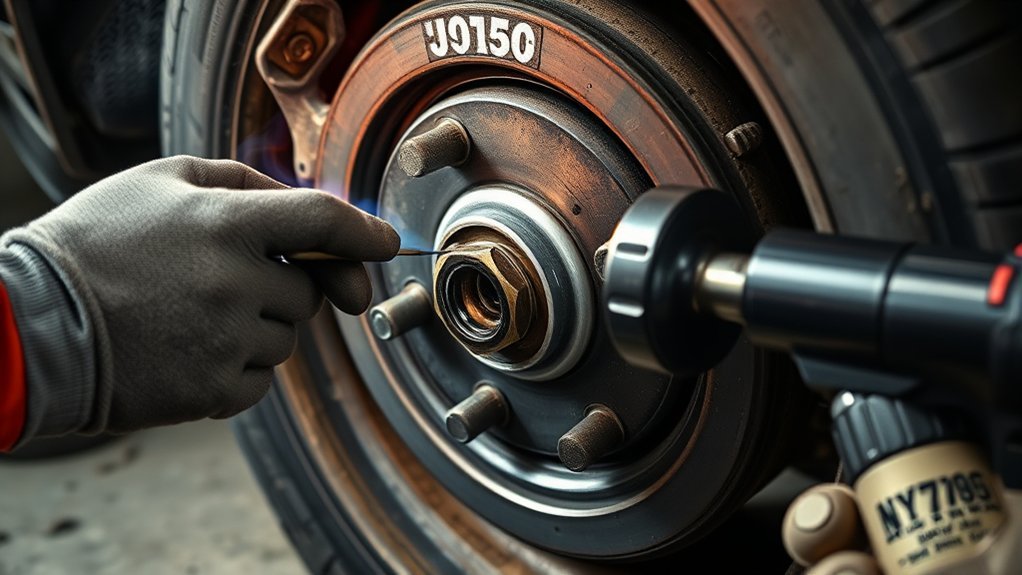
If penetrating oil and a breaker bar are not enough, use vibration before heat. Tap the side of the lug nut and the end of the wrench handle with a hammer to send small shocks through the rust bond. Do not hit so hard that you mushroom the nut, crack the socket, or damage the wheel finish.
Heat can help expand the nut slightly, but it is a higher-risk step. Use a propane torch only if you can keep the flame away from the tire, valve stem, wheel finish, brake hose, ABS wiring, TPMS sensor, and any wet penetrating oil. Heat the nut briefly and evenly, then try the breaker bar again while everything is controlled and aligned.
Warning: Do not use open flame on or near fresh penetrating oil. Let vapors clear, wipe excess oil away, and keep a fire extinguisher nearby. If you are roadside, near dry grass, or unsure what is behind the wheel, skip heat and call for help.
Also confirm that your replacement tire or spare has the correct tire load rating before driving. A loosened lug nut solves only the removal problem; the vehicle still needs a safe wheel and tire assembly.
[Products Worth Considering]

This car D-wheel lock nut key provides an anti-theft solution for D-shaped wheel lock bolts, helping keep your wheels secure. It features a flower-shaped internal pattern that resists micro-adjustment theft while allowing removal and mounting of compatible locking nuts. Made for reliable performance under high torque, it’s easy to use with standard socket wrench turning for quick tire maintenance and emergency repairs.

Upgrade your wheels with MIKKUPPA M12x1.5 mag seat lug nuts built for secure, corrosion-resistant performance. These closed-end chrome lug nuts are a direct replacement for select Toyota models, including Camry, Corolla, RAV4, Sienna, Avalon, Highlander, Matrix, Venza, and Prius. Triple-chromium plating and cold-forged, heat-treated steel help deliver strength for daily driving and replacement needs.

This ecocstm ratchet wrench is designed to make emergency and routine tire changes faster with a 360° rotating head and quick forward/reverse switching. The extended handle provides extra leverage to reduce effort and hand fatigue, while the adapter helps fit many scissor jacks on cars, SUVs, trucks, and vans. Built for reliable performance with durable construction, it’s a practical travel essential for on-the-road preparedness.
Last-Resort Fixes for a Lug Nut That Won’t Budge
If the lug nut still will not move, do not keep adding force blindly. More leverage can help, but it can also round the lug nut, break the stud, or damage the wheel. At this stage, slow down and identify the failure: rusted threads, a rounded nut, a missing wheel-lock key, a cross-threaded stud, or a stud that is starting to spin.
Inspect the wheel and tire condition while you are there. A highway tire such as the Bridgestone Dueler H/L 400 still needs correct fitment, pressure, and safe lug-nut torque before the vehicle goes back on the road.
Heat and Cool Cycles
Heat-and-cool cycles can break some rust bonds, but they should be used carefully and only when nearby parts can be protected. Heat the nut evenly for a short time, let it cool naturally for a minute, then try the breaker bar again. Avoid quenching with water unless you know the wheel, brake, and stud materials can tolerate the thermal shock.
| Step | Action |
|---|---|
| 1 | Wipe away excess penetrating oil and clear flammable vapors. |
| 2 | Apply short, controlled heat to the lug nut only. |
| 3 | Let it cool briefly, then tap the nut to add vibration. |
| 4 | Try steady pressure with the breaker bar while the socket is fully seated. |
If the lug nut starts to deform, stop. A rounded nut is harder to remove and may need a spiral extractor socket, a stud replacement, or professional cutting tools.
Extra Leverage Techniques
For stubborn lug nuts that still will not break free, step up gradually. Use a longer breaker bar, keep the socket square, and apply slow pressure. If you use a pipe over the breaker bar, keep both feet planted and avoid bouncing. Bouncing can snap a stud or cause the tool to slip.
If the nut still resists, add short hammer taps to the wrench to vibrate the rust bond, or switch to an impact wrench for removal. Use only impact-rated sockets with impact tools. Avoid routine torque wrenching here; save the torque wrench for final reassembly.
When to Stop and Call a Mechanic
Stop and call roadside assistance, a tire shop, or a mechanic if the lug nut rounds off, the wheel-lock key is missing, the stud spins, the wheel begins to crack, or you are working on an unsafe roadside shoulder. A shop can use extractor sockets, induction heat, stud replacement tools, or controlled cutting methods without risking more damage.
Tighten Lug Nuts Correctly After the Tire Change
After the wheel is back on, thread each lug nut by hand first. If a nut will not spin on smoothly by hand, stop and inspect the threads. Cross-threading can ruin the stud and make the next removal much harder.
Snug the lug nuts in a crisscross or star pattern so the wheel seats evenly against the hub. Lower the vehicle until the tire just touches the ground and cannot spin, then use a torque wrench to tighten each lug nut to the vehicle maker’s specified setting. Tire Rack states that wheel hardware should be torqued to the recommended specification for the vehicle make, model, and year, and Michelin also recommends using a torque wrench or having a tire specialist check the torque if you do not have one. Michelin’s tire-change guidance backs up that final torque check.
Make this part of your regular tire maintenance routine: torque, pressure, tread depth, and visible wheel damage should all be checked before normal driving resumes.
Proper Torque Setting
A torque wrench should be your final tightening tool. Many passenger cars fall near 80–100 ft-lbs, but that is not a universal rule. Always use the exact torque value listed in the owner’s manual, service manual, door placard, or trusted wheel-fitment documentation for your vehicle and wheel hardware.
Note: Torque values normally assume clean, dry lug seats and threads. Do not apply anti-seize, grease, or oil to lug studs before torquing unless your vehicle’s service information specifically instructs it.
Recheck After Driving
After you drive 50–100 miles, recheck the lug nuts with a torque wrench when the wheels are cool. Tire Rack recommends re-torquing new wheels after the first 50–100 driving miles because clamping loads can change after installation. Recheck in the same crisscross pattern and correct any nut that is below spec.
Final Safety Checklist
- All lug nuts are hand-started correctly and torqued to the vehicle’s specification.
- The wheel sits flush against the hub with no visible gap or wobble.
- The tire is inflated to the correct pressure.
- The spare or replacement tire is safe for the speed and distance you plan to drive.
- Tools, wheel chocks, jack, and old wheel are secured before driving.
- You will recheck torque after 50–100 miles or after the first short trip if anything feels loose or vibrates.
Frequently Asked Questions
What way do you unscrew tire bolts?
Most tire bolts and lug nuts loosen counterclockwise, or to the left. Rare exceptions exist on some older or specialty vehicles, so check the owner’s manual if the nut does not move with normal force.
Why can’t I loosen my lug nuts?
Common reasons include rust, road salt, over-tightening, cross-threading, a damaged stud, the wrong socket size, a wheel lock, or a lug nut that was installed with an impact gun instead of a torque wrench.
What tool is used to remove tire nuts?
Use a lug wrench, 4-way wrench, or breaker bar with the correct six-point socket. For very stubborn nuts, an impact wrench with impact-rated sockets can help with removal, but final tightening should be done with a torque wrench.
Is there a trick to getting lug nuts off?
Yes. Keep the tire on the ground for the first break-loose turn, use the correct socket, apply steady pressure with a breaker bar, add penetrating oil, and use short hammer taps for vibration. If the nut rounds or the stud spins, stop and get professional help.
Can I use heat on a stuck lug nut?
You can use careful, controlled heat on the nut only, but it is not the first step. Keep flame away from tires, valve stems, brake hoses, wiring, TPMS sensors, paint, and penetrating oil. If you cannot heat the nut safely, call a shop.
What should I do if the lug nut is rounded?
Stop using a standard socket. Try a rounded-lug extractor socket if you have one and can use it safely. If the extractor slips, the stud spins, or the wheel is being damaged, have a tire shop or mechanic remove it.
Should lug nuts be lubricated before tightening?
Usually no. Penetrating oil can help removal, but final wheel torque normally assumes clean, dry threads and seats. Lubricating the threads or seats can change clamping force and cause over-torque unless your service manual specifically calls for it.
Conclusion
To unscrew stuck tire bolts safely, start with the vehicle setup, not brute force. Loosen the nuts while the tire is still on the ground, use the correct six-point socket and breaker bar, add penetrating oil or controlled vibration if needed, and use heat only with strict safety precautions. When the wheel goes back on, clean the hardware, tighten in a crisscross pattern, use the manufacturer’s torque spec, and recheck after 50–100 miles.
Sources
- AAA Via: How to Change a Tire — safe setup, wheel chocks, loosening nuts while the wheel is on the ground, and crisscross tightening.
- AAA Your Network: How to Change a Tire — roadside safety, level ground, parking brake, owner’s manual jack points, and body-position warning.
- Tire Rack: How Do I Properly Torque My Wheel Lug Nuts or Bolts? — vehicle-specific torque specs, dry-thread guidance, impact-gun warning, crisscross pattern, and 50–100 mile re-torque.
- Michelin: How to Change a Car Tire — wheel-nut removal aid, torque wrench use, and tire specialist check if a torque wrench is not available.
- NHTSA Safety Recall 21V-398 — safety example showing how incorrect lug-nut torque can damage wheel studs.