
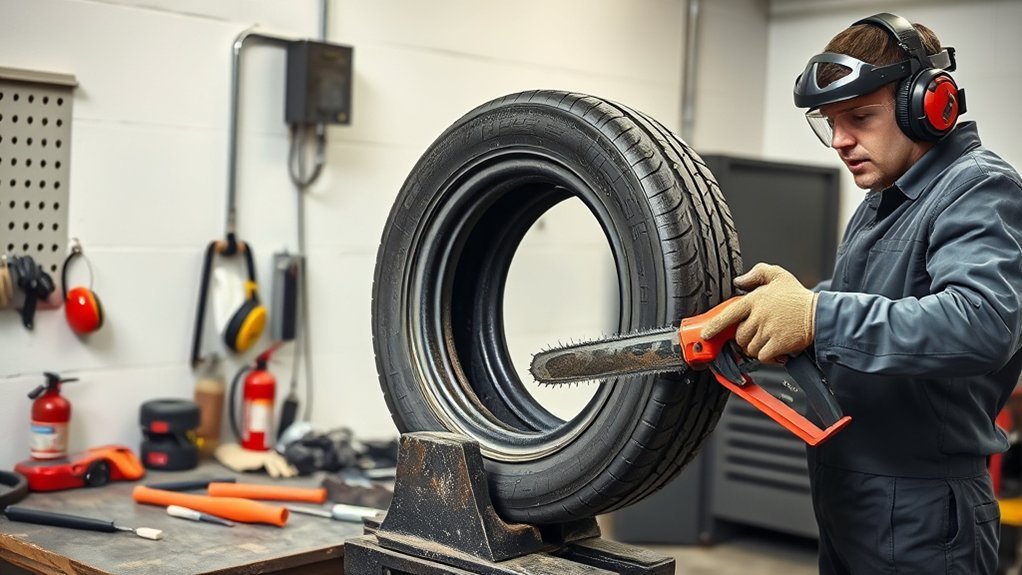
Cutting a scrap tire in half can make it easier to prepare for an approved recycling or disposal method or to use in a suitable non-road project. The safest approach depends on where you need to cut. Before starting, make sure the tire is completely deflated, removed from the wheel, and permanently out of road service. Then check whether you need a sidewall cut, a circumferential “bagel” cut, or another specific pattern.
Quick Answer
To cut a tire in half safely, work only on a fully deflated tire that has been removed from its wheel. Mark the required cut, secure the tire so it cannot roll, use the least aggressive suitable cutting method, and expect steel reinforcement near the tread and bead. Check your recycler or landfill’s rules before cutting.
Key Takeaways
- Completely deflate the tire and remove it from the wheel before preparing it for cutting.
- Decide what “in half” means for your project or disposal facility before making the first cut.
- A sharp utility knife can handle some rubber-only sidewall cuts, but reinforced tread and bead areas are much harder to cut.
- Steel belts and bead wires can create sharp exposed strands, flying debris, blade binding, and other hazards.
- Wear eye protection, suitable gloves, sturdy footwear, and any additional PPE required for the tool and cutting conditions.
- Recycling and disposal requirements vary by state and facility, so confirm the required tire condition before doing unnecessary cutting.
At a Glance
| Time Required | Varies by tire size, reinforcement, and the required cut; reinforced tread takes considerably longer than a simple rubber-only sidewall cut. |
| Difficulty | Moderate for rubber-only sidewall work; high for cuts through tread, belts, or bead wire. |
| Tools Needed | Marking tool, stable blocks or clamps, sharp utility knife for suitable rubber-only cuts, and appropriate PPE. Reinforced cuts may be better handled by a recycler or dedicated tire-cutting machine. |
| Cost | Often little or no additional tool cost if you already have suitable equipment and PPE; recycling or disposal fees vary by location. |
Warning: Never cut an inflated tire or attempt to cut a tire while it is still mounted on a wheel. OSHA requires complete deflation before demounting rim-wheel assemblies. If your tire is still on its rim, a tire shop has the proper equipment to demount it. Once a tire has been intentionally cut, never reinstall it on a vehicle.
What Tools Do You Need to Cut a Tire?
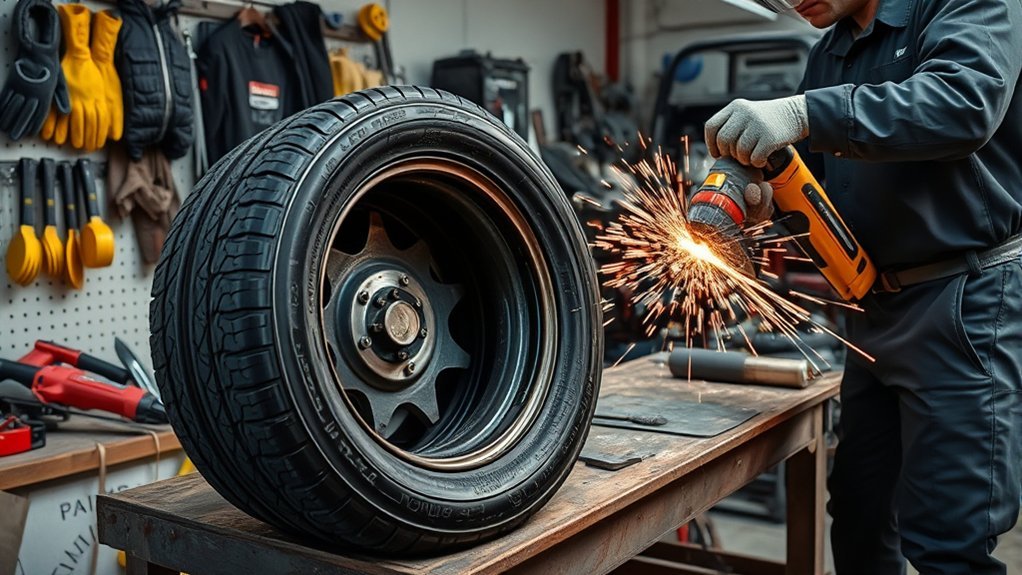
The right tool depends on which part of the tire you need to cut. A tire is not just a thick piece of rubber. The tread, body plies, sidewall, and bead have different construction, and modern radial tires commonly use steel reinforcement.
The U.S. Tire Manufacturers Association explains that tire belts commonly contain polyester and steel, while steel wire hoops are embedded in the bead. That is why a blade that passes easily through a flexible sidewall can stop or bind when it reaches the tread or bead.
Treat the tread and bead as reinforced areas, not as ordinary rubber. Exposed steel strands can remain razor-sharp after the cut.
For a rubber-only sidewall cut, a sharp utility knife or retractable box cutter can be practical when you can keep the cutting path away from reinforced areas. Make repeated controlled passes instead of trying to force the blade through in one stroke.
For a cut that must pass through the tread or heavy reinforcement, a dedicated tire-cutting machine or professional tire recycler is the safer choice. The Federal Highway Administration notes that tire-processing operations use specialized cutting machines to slit tires or separate the sidewalls from the tread.
A reciprocating saw is sometimes used for reinforced scrap-tire cutting, but it introduces additional blade-binding, debris, noise, and tool-control hazards. Use one only if you are experienced with the tool and the tool and blade manufacturer identifies the setup as suitable for the materials being cut.
Do not treat an angle grinder, Dremel, or circular saw as an automatic upgrade simply because the tire contains steel. High-speed cutting can create heat, smoke, flying particles, and kickback. OSHA notes that hand and power tools can cause severe injuries when improperly selected, maintained, or used.
Note: EPA specifically warns against using a saw or torch to cut a tire while removing a rim because of the risk of igniting the tire. If the tire is still mounted, stop and have it professionally demounted instead of cutting around the wheel.
[Products Worth Considering]

Rubber Care delivers a beautiful dark black satin/matte finish on tires and other rubber or plastic surfaces, drying to the touch without oily shine. Its ceramic aircraft-grade formula helps repel dirt and brake dust residue, keeping surfaces cleaner longer. Triple nano ceramic polymer technology provides best-in-industry UV protection, restoring and protecting rubber while also working on weather stripping and de-ice boot care.

Steelman white tire marking crayons provide high-contrast, semi-permanent marks for repairing and inspecting tires and equipment. They write on wet or dry, smooth or coarse surfaces including rubber, metal, glass, and wood, making them ideal for puncture location and damage outlining. The lead- and zinc-free crayons resist weather and fading yet wipe away when you no longer need the marks.

Malco tire mounting and demounting lubricant is a ready-to-use tire lube formulated to reduce friction during tire installation for passenger cars, light trucks, farm tires, and heavy-duty equipment. It provides rust-inhibiting protection to help reduce corrosion on rims and wheels, and helps support proper tire bead seating during inflation to reduce air leakage. The silicone-free, soap-free formula is whitewall safe to help prevent discoloration on whitewall tires and sensitive sidewall markings.
What Does Cutting a Tire in Half Mean?
Before making a cut, determine the shape you actually need. “Cut a tire in half” can describe several different operations, and they do not require the same amount of cutting.
- Sidewall removal: The two sidewalls are cut away from the tread ring. This minimizes cutting through the main tread belts but still requires care around the bead area.
- Circumferential or “bagel” cut: The tire is divided around its circumference. Some waste programs use this terminology for approved processing.
- Crosscut: The complete tire is cut across its diameter to produce two open sections. This requires cutting through reinforced tread and bead areas and is substantially harder.
For disposal, do not assume any one pattern is acceptable nationwide. For example, the Missouri Department of Natural Resources permits specific processed-tire configurations for landfill disposal, while rules elsewhere can differ.
Pro Tip: Call the recycler, landfill, or local waste department before cutting a tire for disposal. You may discover that the facility accepts the whole tire, requires a specific cut, or prefers that its own processor handle it.
How Do You Start the First Cut?
Start by confirming that the tire is scrap, completely deflated, and removed from its wheel. OSHA’s rim-wheel servicing standard requires tires to be completely deflated before demounting. Although this project begins after demounting, the same basic precaution keeps stored pressure out of your work area.
Next, inspect the tire and mark the complete cutting line with chalk or a visible marker. Do not rely on a universal measurement such as “1 inch from the tread.” Tire dimensions and internal construction vary, so the correct line depends on whether you are removing a sidewall, making a disposal cut, or preparing the tire for another permitted use.
Place the tire on a stable work surface and secure it with blocks, clamps, or another restraint that prevents rolling without putting someone’s hands near the cutting path. Keep electrical cords and loose objects away from the blade area.
If you are making a rubber-only sidewall cut, create the initial opening with a sharp utility knife while keeping your free hand out of the blade’s path. Use several controlled passes rather than excessive force.
Once an opening develops, a wooden dowel or similar nonmetallic spacer can help hold flexible rubber apart and reduce pinching. Reposition the tire itself when the cutting angle becomes awkward instead of twisting your wrist or reaching across the cutting line.
[Products Worth Considering]

The Trivd Frol 1/2" air impact wrench delivers high performance torque up to 1500 ft-lbs with a twin hammer impact mechanism for strong, balanced blows. It features an ergonomic grip, compact lightweight design, and quick-stop control with 3 forward speeds up to 8000 RPM plus a reverse speed. Built for demanding automotive repair and tire shop work, the rear exhaust helps keep debris away from the surface.

This tire inflator with pressure gauge delivers long-lasting performance with a durable rubber-protected gauge and sturdy build. The longer hose and 360 swivel air chuck help you seal the valve securely and keep your hands free while measuring, inflating, or deflating. It’s battery-free for reliable use and provides ±2 PSI accuracy in the mid-range for most typical tires, with universal compatibility for 1/4 NPT compressor outputs.

This oesee 8-piece wheel care kit helps you clean, scrub, and dry wheels safely with purpose-built brushes and towels. The scratch-free microfiber wheel brush lifts brake dust and grime, while the stiff pro-grip tire brush removes tire browning and embedded dirt. A twist loop microfiber drying towel and an applicator help achieve a streak-free finish and cleaner, more even product application.
How Do You Cut the Sidewall?
For sidewall removal, mark a continuous line around the sidewall at the position required for your project. Stay clear of the steel-reinforced bead next to the wheel opening and avoid drifting into the reinforced tread area unless the chosen method is designed to handle it.
- Secure the tire. Place it flat or support it in a stable cradle so it cannot roll.
- Start in flexible rubber. Use a sharp knife to create a controlled opening in a suitable rubber-only section.
- Use shallow passes. Let the blade progressively deepen the cut rather than forcing it.
- Keep the cut open. If the rubber begins pinching the blade, place a wooden spacer behind the cutting point.
- Rotate the tire. Bring each new section toward you instead of cutting from an awkward posture.
- Inspect the finished edge. Look for exposed cords or steel strands before picking up the section with bare hands.
If the blade encounters reinforcement that it cannot cut predictably, stop rather than applying more force. A slipping knife can be more dangerous than a slow cut.
How Do You Cut a Tire in Half?
To cut a tire completely in half, first decide whether you need a circumferential cut or a crosscut. Both can pass through much stronger material than a simple sidewall cut.
Mark the entire cut before starting. Secure the tire so it cannot roll, bounce, or collapse into the blade. Complete easier rubber sections first where the design allows, then reassess before entering the tread or bead.
Modern tire construction can include steel belts under the tread and steel wire in the bead. The USTMA describes these components as structural parts of the tire, which explains why cutting resistance can change abruptly as the blade moves from sidewall rubber into a reinforced section.
If your planned cut requires passing through substantial steel reinforcement, a professional recycler or tire processor with dedicated cutting equipment is the safer option. FHWA describes scrap-tire processors using purpose-built machines with cutting or shearing action to produce slit tires and tire shreds.
If an experienced user chooses a reciprocating saw for an off-rim scrap tire, the tire must remain firmly restrained, the tool and blade must be suitable for the materials being cut, and the operator should stop immediately if the blade binds, the tire begins moving, or the cutting area produces smoke or excessive heat.
Warning: Never use an open flame or torch to cut a tire. Stop any cutting method that begins producing smoke or visibly overheating the rubber. Tire fires are difficult to extinguish and can release harmful pollutants.
What Safety Gear Do You Need?
Wear PPE that protects you from the hazards created by both the tire and the cutting tool. OSHA’s hand and power tool guidance notes that improperly used tools can cause severe injuries, while its tool standards address flying objects, abrasive material, and harmful dust.
- Safety glasses: Protect your eyes from rubber particles, metal strands, and other debris.
- Face protection: Add appropriate face protection when the chosen tool can throw fragments.
- Cut-resistant work gloves: Protect against the cut edge and exposed reinforcement while still allowing a secure grip.
- Sturdy work shoes or boots: Protect your feet if the tire or a cut section falls.
- Long sleeves and durable clothing: Reduce direct skin exposure to sharp wire and debris.
- Hearing protection: Use it when operating noisy power equipment.
- Respiratory protection when required: Avoid creating smoke or unnecessary dust. If the work generates an airborne hazard, use protection appropriate to that hazard rather than assuming an ordinary dust mask is sufficient.
Inspect your tools before use and keep guards or other manufacturer-supplied safety components in place. OSHA also emphasizes selecting and maintaining hand and power tools properly.
[Products Worth Considering]

Adam’s Pro Tire Hex Grip applicators are molded foam sponges designed for precise, even tire dressing application. The ergonomic grip helps you spread product without overapplying, reducing sling that can splash onto paint and helping keep your hands clean during wheel and trim detailing. They’re durable, washable, and reusable for repeated detailing sessions.

This 3-piece wheel brush set makes it easy to clean wheels and tires with soft, scratch-free brushes designed for lifting brake dust and grime. The flexible rim brush bends up to 360 degrees to reach hard-to-access areas for a thorough clean, while the comfortable grip helps control during detailing. A dedicated detailing brush supports gentle cleaning for sensitive surfaces, including interior use.

This professional wheel and rim cleaning brush set lifts brake dust, grime, and dirt with soft, scratch-free microfiber and synthetic wool fibers. The rim brush bends up to 360 degrees for easy access to hard-to-reach areas around spokes, lips, and faces. Ideal for thorough cleaning of car, truck, motorcycle, bicycle, RV, and more wheel and tire surfaces.
What If the Tire or Tool Causes Problems?
Stop cutting when the setup stops behaving predictably. Forcing the next inch of material is rarely worth losing control of the blade.
- The blade keeps binding: Stop the tool, remove it safely, open the completed section with a wooden spacer, and improve support before restarting.
- The tire rolls or jumps: Stop and improve the restraints. Do not have a helper hold the tire close to the cutting area.
- You reach steel wire: Expect a sharper finished edge and greater cutting resistance. Do not pull exposed wire with bare hands.
- The rubber starts smoking: Stop immediately and allow the work and tool to cool. Change to a lower-heat method or professional processing.
- The tool struggles or stalls: Do not compensate by forcing it harder. The material may be unsuitable for that tool or blade.
- The tire is still mounted on a rim: Do not continue. Have the assembly professionally demounted.
How Should You Dispose of Tire Pieces?
Check local requirements before deciding how small the tire needs to be. The EPA’s Used Tires Quick Start Guide explains that tire programs vary by state and that some landfills require used tires to be shredded or cut. Others charge special handling fees or use different acceptance rules.
EPA reported in its 2025 used-tire guide that 48 states had laws or regulations specifically addressing scrap-tire management, reinforcing why local requirements should be checked before disposal.
| Option | Action | Result |
|---|---|---|
| Tire retailer or recycler | Ask whether whole or processed tires are accepted | Usually the simplest responsible option |
| Local collection program | Follow the program’s size, quantity, and preparation rules | Avoids rejected loads |
| Landfill where permitted | Confirm whether cutting or shredding is required | Matches local disposal requirements |
| Approved reuse | Use the material only in an appropriate, lawful application | Can extend the useful life of scrap material |
Collect loose rubber and exposed wire so they do not become puncture or litter hazards, but package the material according to the receiving facility’s instructions rather than assuming it must be bagged.
The EPA recommends seeking a tire recycler and notes that used tires can be processed for applications such as civil engineering products. Never dump tires illegally or burn them.
Frequently Asked Questions
What Is the Easiest Way to Cut a Tire in Half?
The easiest method depends on the cut. A sharp utility knife can work for suitable rubber-only sidewall sections, while cuts through reinforced tread or bead wire are much harder. For a complete reinforced cut, a tire recycler or dedicated tire-cutting machine is safer and more predictable than improvising with a high-speed tool.
What Tool Can I Use to Cut a Tire?
For an off-rim, fully deflated scrap tire, a sharp utility knife may be suitable for flexible sidewall rubber. Reinforced areas require equipment capable of handling both rubber and metal. A professional tire cutter is the preferred option for difficult cuts; experienced users sometimes use an appropriately configured reciprocating saw.
How Do You Safely Cut a Tire?
Work only on a scrap tire that is completely deflated and removed from its wheel. Mark the cut, secure the tire, keep your hands outside the blade path, wear appropriate eye, hand, foot, hearing, and respiratory protection for the chosen method, and stop if the tire moves, the blade binds, or the rubber starts overheating.
Can You Cut a Tire While It Is Still on the Rim?
Do not use this DIY process on a tire that is still mounted. Have the tire fully deflated and professionally demounted first. EPA notes that safe rim removal can require specialized equipment and specifically warns against using a saw or torch to cut a tire while removing a rim.
Why Is a Tire Harder to Cut Near the Tread?
The tread area of a radial tire commonly contains reinforcing belts, often including steel. The bead also contains strong steel wire. Those components make reinforced areas much tougher to cut than flexible sidewall rubber and can leave sharp metal strands along the finished edge.
Do Tires Have to Be Cut Before Disposal?
Not everywhere. EPA guidance says some landfills require tires to be cut or shredded, but tire-management rules vary by state and facility. Contact the recycler, landfill, or local waste agency before cutting so you know the exact preparation requirement.
Is Slashing One Tire a Felony?
Not automatically. Intentionally damaging another person’s tire may be prosecuted as vandalism, criminal mischief, or a similar offense, but whether it is a misdemeanor or felony depends on the jurisdiction, value of the damage, circumstances, and sometimes prior offenses. For example, New York distinguishes misdemeanor and felony criminal-mischief offenses partly by the amount of property damage. This is general information, not legal advice.
Conclusion
Cutting a tire becomes much more manageable once you know where the reinforcement is and which cut you actually need. Start only with a completely deflated, off-rim scrap tire, secure it so it cannot move, and use the least aggressive tool that can safely perform the required cut.
Do not force a blade through steel reinforcement, keep your safety gear on while handling exposed edges, and stop if the tire begins smoking or the tool loses control. If the job requires cutting through substantial tread or bead reinforcement, a tire recycler with dedicated processing equipment is the safer choice. Finally, confirm local recycling or disposal rules before cutting so the finished pieces are actually accepted.
Sources
- U.S. Environmental Protection Agency — Used Tires Quick Start Guide — tire handling, recycling, disposal, state regulation, and rim-removal safety.
- OSHA — 29 CFR 1910.177, Servicing Multi-Piece and Single-Piece Rim Wheels — complete deflation and tire-service safety procedures.
- OSHA — Hand and Power Tools — general cutting and power-tool hazards.
- U.S. Tire Manufacturers Association — How a Tire Is Made — belts, body plies, bead wire, tread, and sidewall construction.
- Federal Highway Administration — Scrap Tires Material Description — professional tire cutting, slit tires, shredding, and exposed steel reinforcement.
- Missouri Department of Natural Resources — Scrap Tires — example of state-specific tire cutting and disposal requirements.

