
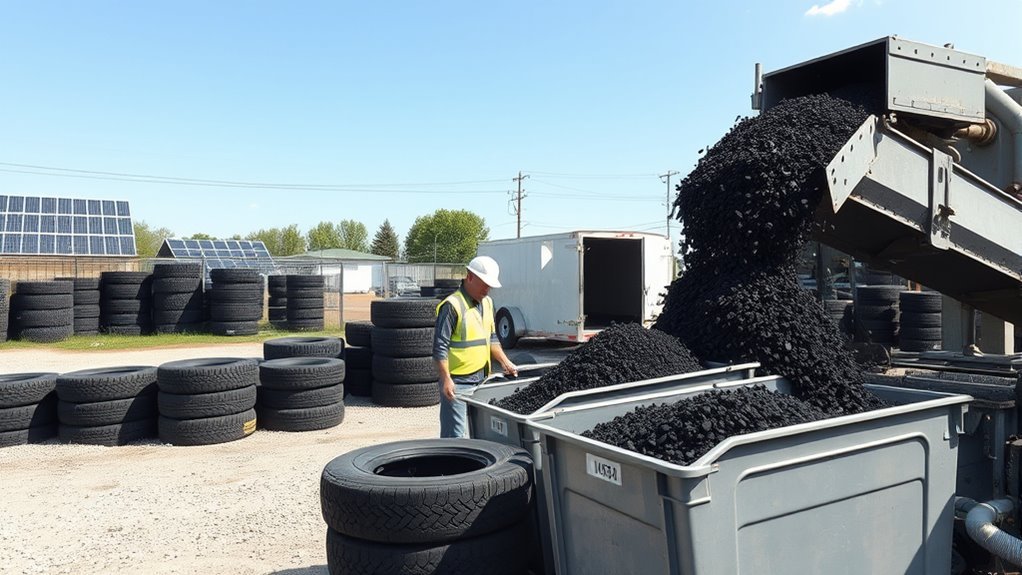
Old tires should never be tossed in regular trash, dumped outdoors, or burned. The safest way to dispose of tires responsibly is to use an approved recycling path: a tire retailer, municipal collection event, licensed scrap-tire hauler, or certified recycler. The right choice depends on how many tires you have, whether they are still mounted on rims, and what your local rules require.
Quick Answer
Recycle tires by taking them to a tire retailer, municipal drop-off, local collection event, licensed scrap-tire hauler, or certified recycler. Call ahead to confirm fees, quantity limits, rim rules, and paperwork. Keep tires dry, remove debris when possible, and ask for a receipt or proof of proper handling.
Key Takeaways
- Start with a tire shop or municipal recycling program; these are usually the easiest legal options for a small household load.
- Rules vary by state and city, so confirm accepted tire types, rim requirements, fees, and quantity limits before you go.
- Good tires may be reused or retreaded; worn-out tires may become ground rubber, rubber-modified asphalt, tire-derived aggregate, molded products, or tire-derived fuel.
- Businesses and large cleanups should use licensed haulers and keep receipts, manifests, or chain-of-custody records.
At a Glance
| Time Required | 10–30 minutes to confirm options; drop-off time depends on distance and wait times |
| Difficulty | Easy for 1–4 passenger tires; moderate for bulk loads or business disposal |
| Tools Needed | Gloves, tarp or cargo liner, tie-down straps for transport, phone for confirmation, receipt folder for business records |
| Cost | Often free with new-tire installation or special collection events; otherwise fees vary by location, tire size, rims, and quantity |
Quick Steps to Recycle Tires Responsibly
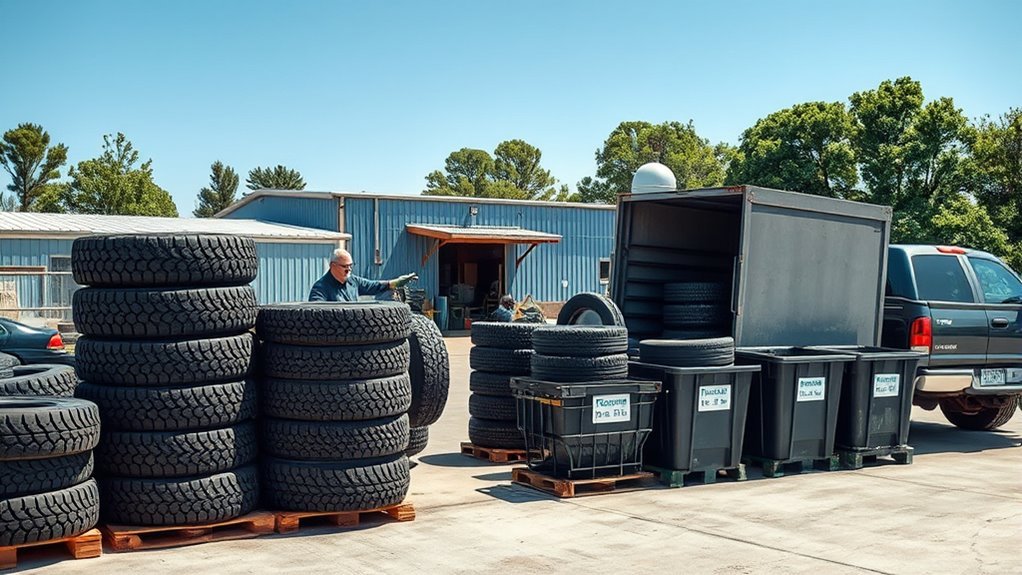
- Check local rules first. Scrap-tire laws are handled mainly at the state and local level. The U.S. EPA notes that most states have laws or regulations for scrap tire management, including requirements for haulers, storage, manifests, and cleanup programs.
- Choose a legal drop-off option. Call a tire retailer, municipal recycling center, county solid-waste office, or licensed tire recycler. Ask whether they accept passenger tires, truck tires, motorcycle tires, farm tires, or tires on rims.
- Confirm the fee. Retailers may include tire disposal in installation charges. Municipal programs may be free on event days, while recyclers and drop-off centers may charge by tire, by weight, or by tire size.
- Prepare the tires. Remove mud, standing water, loose debris, and wheel weights if required by the facility. Do not cut, shred, or alter tires unless the recycler tells you to.
- Transport safely. Keep tires secured in the vehicle so they cannot roll, shift, or fall out. If you are hauling many tires, ask whether your state requires a registered scrap-tire hauler.
- Keep proof. Ask for a receipt, ticket, invoice line item, or manifest, especially for business loads, rentals, estate cleanouts, or contractor work.
Warning: Do not burn tires, dump them on vacant land, leave them near waterways, or hide them in household trash. Tire piles can create fire hazards, collect mosquito-breeding water, and lead to fines or cleanup liability.
Where to Drop Off Old Tires Near You
The best tire drop-off option depends on whether you are disposing of a few household tires or managing a larger load. Always call or check the website before you drive, because hours, fees, rim rules, and tire limits change by location.
[Products Worth Considering]

Secure your vehicle during transport with this 4-pack of heavy-duty tire tie down straps designed for trailers and hauling. The ratchet system with flat hooks and D-rings helps you tension the straps quickly, while the wheel-friendly design protects tires. With high break strength and corrosion-resistant hardware, these straps provide reliable, confidence-inspiring tie-down security for cars, trucks, and UTVs.

This metal-free wheel and tire cleaning brush uses dense, fluffy synthetic wool to safely clean rims, spokes, fenders, and engine areas without worrying about damaging surfaces. Its flexible, comfortable design helps you reach detailed areas while maintaining durability, and the extra absorbent fibers work well with wheel spray cleaners for faster cleanup. Reusable and washable performance helps prevent grime and build-up for cleaner vehicles and easier maintenance at home.

Suds Lab WB Premium Detailing Wheel Brush delivers a scratch-free clean using ultra-soft microfiber bristles that lift brake dust, dirt, and grime without swirling. The ergonomic non-slip handle helps you deep-clean rims, wheels, and tires with reduced hand fatigue while reaching tight contours. It’s reusable and machine washable for long-term detailing, and works across cars, trucks, SUVs, and motorcycles plus multi-purpose cleaning tasks.
Retailer Take-Back Programs
If you are buying new tires, the easiest option is usually the tire retailer or installer. Many shops take your old tires at the same appointment and include the recycling or disposal charge in the installation invoice. Before approving the work, ask where the tires go, whether the fee is per tire, and whether you can receive an invoice showing proper handling.
Retailer take-back is best for normal tire replacement because you avoid storing old tires at home and the shop already works with a tire processor, hauler, or recycler.
Municipal Drop-Off Centers and Collection Events
City, county, and solid-waste agencies often run tire collection events or accept tires at recycling centers. These programs may have resident-only rules, daily limits, rim restrictions, or pre-registration. Some events are free or reduced-cost because state tire fees help fund tire cleanup and recycling programs.
Search your city or county website for “scrap tire collection,” “tire recycling,” or “solid waste tires.” If your state environmental agency has a scrap-tire page, use it to confirm local contacts and rules.
Certified Recyclers and Scrap-Tire Haulers
Use a certified recycler or licensed scrap-tire hauler when you have more tires than a public drop-off allows, when you manage tires for a business, or when you are cleaning up an abandoned pile. Ask for documentation showing where the tires will be processed. For larger loads, a manifest or pickup receipt helps prove the tires were handled legally.
Pro Tip: When comparing options, ask four questions: “Do you accept tires on rims?”, “What is the tire limit?”, “What is the fee per tire or per ton?”, and “Can I get a receipt or manifest?”
Choose the Right Recycling Method: Reuse, Retread, Shredding, and Energy Recovery
Not every old tire should follow the same path. Some tires still have safe resale or retread value, while damaged or worn-out tires need material recovery or regulated energy recovery.
| Method | Best For | What It Becomes | What to Check |
|---|---|---|---|
| Reuse or resale | Tires that are still safe and legal | Used tires for continued service | Tread depth, age, damage, and local safety rules |
| Retreading | Sound casings, especially commercial truck tires | A tire with a new tread layer | Casing condition and retreader inspection standards |
| Shredding or grinding | Most worn-out tires | Crumb rubber, tire-derived aggregate, molded goods, mulch, or asphalt material | Facility acceptance rules and end-use markets |
| Energy recovery | Tires unsuitable for higher-value reuse | Tire-derived fuel for permitted industrial users | Permits, emissions controls, and current state and federal rules |
According to the U.S. Tire Manufacturers Association’s 2023 End-of-Life Tire Management Report, 79% of U.S. end-of-life tires were reclaimed or recycled in 2023, up from 71% in 2021.
[Products Worth Considering]

The SAFELIFE dial tire tread depth gauge measures tread depth in 1/32 inch increments with clear, easy-to-read 2-inch dial face. Color zones using a traffic light system help you quickly judge whether tread is low, marginal, or ample for safer driving. Built with a durable zinc cast body and a metal detect probe for precise, comfortable use across cars, motorcycles, trucks, and buses.

Accurately measure tire tread depth with a calibrated gauge marked from 0 to 1 inch in 1/32 inch increments. The color-coded bar helps you quickly identify tread condition ranges, supporting safe driving for trucks, motorcycles, automobiles, and passenger vehicles.

This 3-piece wheel and tire brush set makes it easy to clean light, medium, and heavy dirt from wheels, rims, tires, and exterior surfaces. It includes both soft and stiff bristle options for gentle scrubbing and tough grime removal, helping lift brake dust and road buildup. The long-handle design supports comfortable cleaning across cars, trucks, SUVs, RVs, motorcycles, and more, with simple care instructions to restore brush shape.
Shredding Benefits Explained
Shredding and grinding turn tires into usable material instead of leaving them as bulky waste. Recycled tire rubber can be used in molded products, rubberized flooring, playground and athletic surfaces, rubber-modified asphalt, automotive parts, and civil engineering applications.
Ground tire rubber is especially useful because it creates markets for worn-out tires. The Federal Highway Administration describes tire-derived fuel, ground tire rubber, and civil engineering applications as common ways to reuse rubber from old tires. The U.S. Tire Manufacturers Association also reports growth in ground rubber markets, including rubber-modified asphalt.
Retread vs. Energy Recovery
Choose retreading when the tire casing is strong enough to pass inspection. Retreading extends the useful life of a tire casing and reduces the need for new raw materials. It is most common for commercial truck, bus, and fleet tires, not everyday passenger tires that are already too worn or damaged.
Energy recovery is different. Tire-derived fuel is used by some permitted industrial facilities, including cement kilns, pulp and paper mills, utilities, boilers, and tire-to-energy facilities. As of 2026, the EPA has also proposed changes for certain recovered scrap tires used as fuel in cement kilns; because that action is a proposed rule, businesses should verify current federal and state requirements before relying on it.
Note: “Energy recovery” does not mean open burning. It refers to regulated industrial use at permitted facilities with fuel-handling and emissions requirements.
Prepare and Store Tires for Recycling Pick-Up or Drop-Off
Good preparation makes drop-off faster and reduces the chance of rejection. Facilities may refuse tires that are filled with mud, contaminated with trash, mixed with hazardous materials, or delivered outside their posted rules.
Before You Load the Tires
- Remove standing water to reduce mosquito risk.
- Brush off heavy mud, rocks, and loose debris.
- Separate tires by type if you have passenger, truck, farm, motorcycle, or off-road tires.
- Confirm whether rims must be removed. Some facilities accept tires on rims; others charge more or refuse them.
- Do not mix tires with oil, paint, chemicals, batteries, household trash, or construction debris.
- Count the tires and write down the sizes if you are arranging pickup.
Safe Short-Term Storage
Store tires in a dry, shaded, ventilated area until drop-off. Keep them away from ignition sources, standing water, and public access. Stack them neatly so they cannot tip or roll. For businesses, keep tires in a designated area and document the number added or removed.
If you manage tires for a shop, property cleanup, fleet, farm, or community event, check your state rules for storage limits, registration, hauler licensing, financial assurance, and manifest requirements. The EPA notes that state scrap-tire programs commonly include hauler and processor requirements, manifests, and storage or pile cleanup rules.
Tire Recycling Costs, Fees, and Possible Savings
Tire recycling costs vary widely. Your final cost depends on location, tire size, rims, quantity, whether you are a resident or business, and whether a retailer or government program subsidizes the service.
- New tire installation: The retailer may include disposal or recycling in the installation invoice.
- Municipal collection events: These may be free, reduced-cost, or limited to a set number of tires per household.
- Drop-off centers: Fees may be charged per tire, by weight, or by tire type.
- Business pickup: Licensed haulers may charge for container rental, pickup, weight, tire size, or processing.
- State tire fees: Some states collect tire-related fees to fund scrap-tire cleanup, enforcement, market development, and recycling programs.
To save money, avoid last-minute disposal. Pre-register for collection events, keep tires sorted, remove rims if required, and bring proof of residency when public programs require it. If you are replacing tires, compare the retailer’s installation and disposal package instead of only comparing the tire price.
Note: A cheap hauler is not a good deal if the tires are dumped illegally. For larger loads, use a licensed or approved provider and keep paperwork.
[Products Worth Considering]
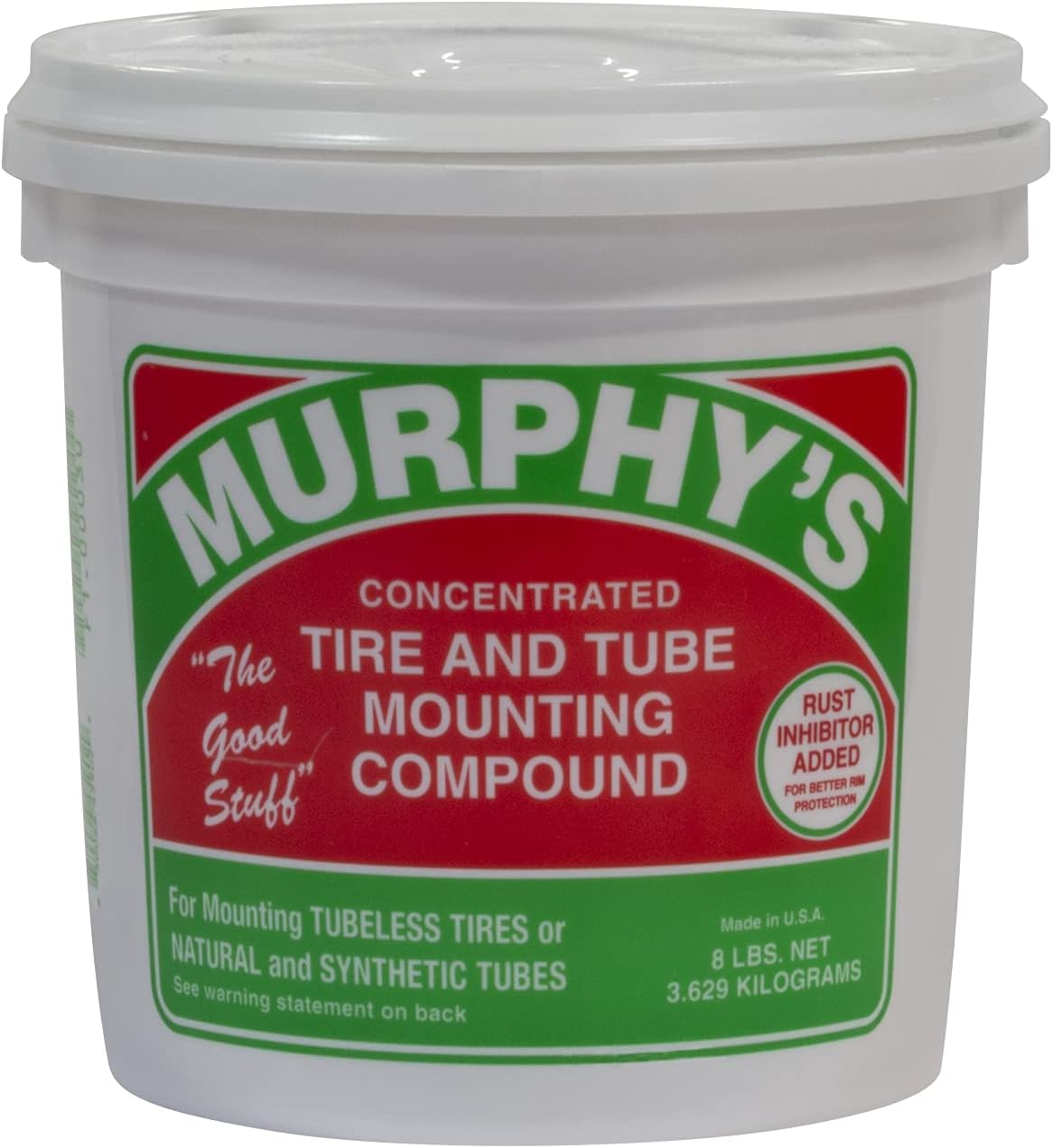
A concentrated tire and tube mounting compound designed to help simplify mounting rubber tires and tubes on passenger, semi truck, construction, and OTR applications. Its ultra-thick formula packs beads effectively and includes rust inhibitors to help protect against corrosion during use.

Measure tire tread depth quickly and accurately with this LUMITECO dial gauge that reads in 1/32" increments up to 14/32". The color-coded green/yellow/red zones make it easy to judge tire wear and know when replacement is needed. A rugged, compact design with a protective pouch helps keep the gauge ready for use on cars, trucks, motorcycles, and more.

Secure your load with this 4-pack reflective ratchet tie down strap set designed for towing and transporting cars, trucks, and UTVs. The reflective polyester webbing helps improve nighttime visibility, while the ratchet with chain anchors and D-rings provides dependable tensioning. Heavy-duty build offers a high break strength for added confidence, and the included storage bag makes it easy to organize and carry.
Scaling Tire Reuse for Businesses and Communities
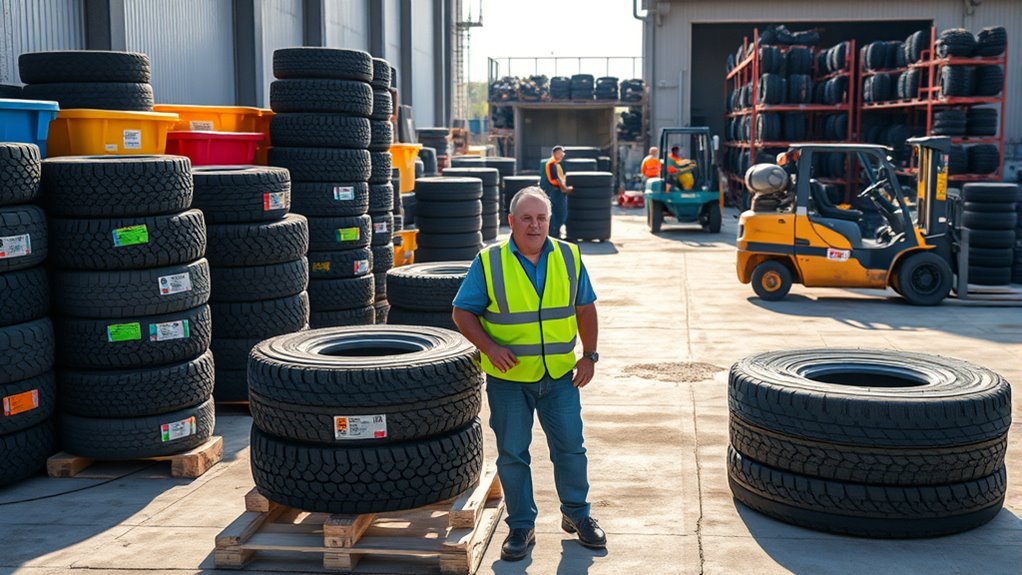
Businesses, municipalities, and community groups can make tire disposal easier by building repeatable systems instead of handling tires one pile at a time. The goal is simple: collect tires legally, move them safely, document the chain of custody, and send them to the highest practical use.
| Action | Outcome |
|---|---|
| Retailer take-back programs | Convenient recycling during tire replacement |
| Municipal collection events | Lower dumping risk and better resident access |
| Licensed hauler contracts | Cleaner records and regulatory compliance |
| Recycler partnerships | Better routing to reuse, ground rubber, asphalt, aggregate, or fuel markets |
| Public education | Fewer abandoned tires and safer neighborhoods |
Business Recordkeeping Checklist
If your business handles tires regularly, keep a simple file for each pickup or drop-off. Include the date, tire count, tire type, hauler or facility name, invoice, receipt, manifest if required, and final destination if provided. These records help with audits, customer questions, insurance claims, and proof that your tires were not illegally dumped.
Community Program Ideas
Communities can reduce illegal dumping by holding scheduled tire amnesty days, publishing a list of approved tire drop-off locations, working with retailers, and sharing clear rules on rims, limits, fees, and residency. Outreach works best when residents know exactly where to go and what it will cost before tires pile up in garages, alleys, fields, or roadside areas.
Common Mistakes to Avoid
- Assuming the landfill takes tires. Many landfills ban whole tires or require special handling.
- Dropping tires after hours. Leaving tires outside a gate may count as illegal dumping even if the site accepts tires during business hours.
- Forgetting rim rules. Tires on rims can cost more or be refused.
- Using an unverified hauler. If tires are dumped, the generator may still face questions or liability.
- Ignoring quantity limits. Household programs may accept only a small number of tires per visit or event.
- Letting tires collect water. Standing water in tires can attract mosquitoes and create public-health concerns.
Frequently Asked Questions
Who is the biggest tire recycling company?
Liberty Tire Recycling describes itself as having the largest network of tire recycling facilities in North America. It collects scrap tires, processes usable tires for resale, and turns other tires into raw materials such as crumb rubber, industrial feedstock, rubberized asphalt products, flooring, mulch, and athletic surfaces.
How can you make money from recycling tires?
You can make money from tires only when you have a legal, reliable outlet. Common business models include tire collection, resale of safe used tires, commercial retreading, selling processed rubber material, supplying tire-derived aggregate, or making products from recycled rubber. Before starting, check state hauler, storage, processing, zoning, and environmental requirements.
What does America do with old tires?
In the United States, old tires are commonly reclaimed or recycled into tire-derived fuel, ground rubber, rubber-modified asphalt, molded rubber goods, tire-derived aggregate, civil engineering material, and other products. USTMA reported that 79% of U.S. end-of-life tires were reclaimed or recycled in 2023.
Can I put old tires in the trash?
Usually, no. Many communities do not accept whole tires in regular trash or curbside bins. Use a tire retailer, municipal recycling center, collection event, licensed hauler, or approved recycler instead. Always check local rules before setting tires out for pickup.
Do tires need to be removed from rims before recycling?
It depends on the facility. Some recyclers and municipal programs accept tires on rims, while others charge extra or require rims to be removed. Call ahead so you do not arrive with tires the site will reject.
What should I do if I find illegally dumped tires?
Report the location to your city, county solid-waste department, state environmental agency, or local code-enforcement office. Do not move a large dump site yourself unless you own the property and have confirmed cleanup, transport, and disposal requirements.
Conclusion
Responsible tire disposal is simple when you use the right channel: a retailer, municipal program, licensed hauler, or certified recycler. Check local rules first, prepare the tires, confirm fees and limits, and keep proof of proper handling. For a few household tires, a retailer or local collection event is usually easiest. For businesses or larger loads, documentation and licensed providers are essential.
Handled correctly, old tires can become useful materials such as ground rubber, rubber-modified asphalt, molded products, tire-derived aggregate, or regulated industrial fuel. Handled poorly, they can create fire hazards, mosquito problems, illegal dumping, and avoidable fines. Choose the legal recycling route and keep tires moving into safe, productive reuse.
Sources
- U.S. Tire Manufacturers Association — 2023 End-of-Life Tire Management Report page — current U.S. end-of-life tire recycling and reclaiming rates, main markets, and market shares.
- U.S. EPA — Scrap Tire Laws and Statutes — state-level scrap tire laws, typical program features, fees, hauler rules, manifests, and cleanup programs.
- Federal Highway Administration — Responsible Use of Recycled Tire Rubber in Asphalt Pavements — ground tire rubber, asphalt applications, and common recycled tire rubber uses.
- U.S. EPA — Tire Crumb Exposure Characterization Report — tire crumb rubber uses in athletic, recreational, and ground-cover applications.
- Federal Register — EPA proposed rule on recovered scrap tires used in cement kilns — 2026 proposed regulatory changes for certain recovered scrap tires used as non-waste fuel.
- Liberty Tire Recycling — Tire Collection and Processing — example of large-scale tire collection, processing, reuse, and tire remediation services.
