
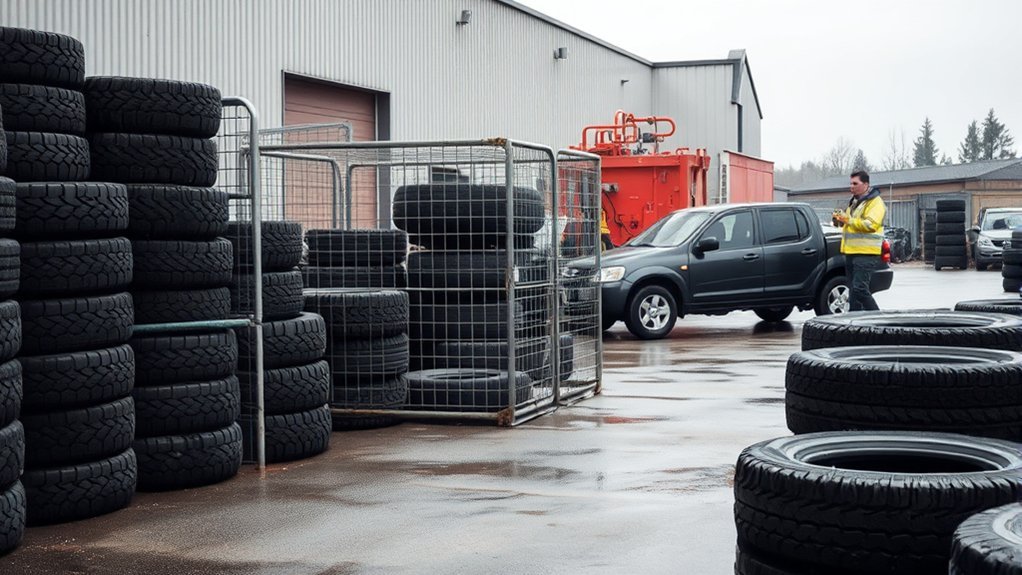
You can recycle old tires through tire retailers, licensed or registered tire recyclers, municipal waste programs, and community collection events. Fees vary widely by location, tire size, quantity, and whether the tire is still mounted on a rim. Before loading your vehicle, confirm the facility’s rules, hours, fees, and any limits on how many tires you can transport or drop off.
Quick Answer
Recycle old tires by leaving them with a tire retailer when replacing them, taking them to an approved recycler or waste facility, or using a community tire collection event. Disposal may be free or may cost a few dollars to $20 or more per passenger tire, depending on the location, rim status, and local program.
Key Takeaways
- Start with your city, county, or state environmental agency to find approved tire recycling locations and current collection events.
- Tire shops and retailers are often the easiest disposal option when you’re buying replacement tires, although fees and take-back laws vary by state.
- Always confirm tire type, size, rim status, quantity limits, residency rules, hours, and fees before driving to a drop-off site.
- Facility rules are not universal. A recycler that rejects solid, foam-filled, or large OTR tires does not mean every recycler rejects them.
- Large tire loads can trigger hauling, registration, manifest, or appointment requirements, so check state rules before transporting them.
- According to the U.S. Tire Manufacturers Association, 79% of the 264 million net scrap tires generated in the U.S. in 2023 entered end-use markets.
At a Glance
| Time Required | About 10–30 minutes to confirm a location and prepare a small household load, plus travel and drop-off time |
| Difficulty | Easy for a few passenger tires; more planning may be required for large, commercial, OTR, or industrial tires |
| Tools Needed | Vehicle with enough cargo space, gloves, and straps or another safe way to secure the tires during transport |
| Cost | Free at some resident collection events; otherwise fees commonly vary by facility, tire type, rim status, quantity, and local regulations |
Where Can You Recycle Old Tires?
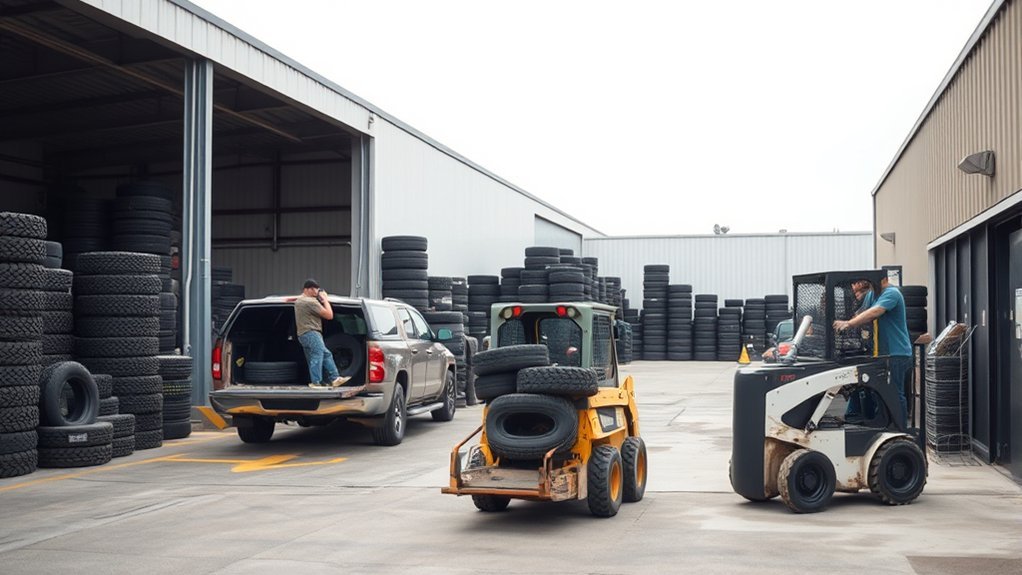
You can recycle old tires at several types of local collection points, but the best option depends on where you live, the number of tires you have, and the tire type.
Start with your city or county solid-waste website or your state’s environmental agency. These sources can point you toward registered tire processors, recyclers, collection sites, and current community events.
Tire retailers and automotive service shops are another practical option. If you’re replacing tires, ask whether the shop will keep the old ones and whether a separate disposal fee applies. Requirements differ by state. For example, Illinois EPA says retailers in Illinois must accept used tires for recycling in a quantity equal to the number of new tires purchased, although a separate disposal charge may still apply.
Commercial recyclers can handle tires directly from the public in many areas. Colorado Tire Recyclers, for example, accepts several categories including passenger, light-truck/SUV, semi-truck, commercial-fleet, and industrial tires.
In Los Angeles County, the official CleanLA tire recycling page lists commercial drop-off options in Compton, Santa Fe Springs, and Los Angeles as well as free resident collection events.
Before you leave home, confirm the tire type, quantity, rim status, drop-off rules, current fees, hours, and whether residency or an appointment is required.
Pro Tip: Call or check the facility’s official website on the same day you plan to visit. Tire fees, hours, accepted sizes, and quantity limits can change without much notice.
[Products Worth Considering]

Upgrade your garden cart, wagon, trolley, or hand truck with solid puncture-guarded tires that help prevent flats for worry-free pushing. Textured tread improves stability, grip, and shock absorption for smoother, safer travel over outdoor surfaces. Built with strong polyurethane and durable bearing components for long-lasting performance and confident handling.

Slip the Powerbuilt tire step over your vehicle’s tire to reach roof racks, engine bays, truck boxes, and more without overreaching. Its adjustable, universal design fits tires with a cross tread width up to 13 inches, including car, truck, RV, and semi tires. The non-slip cheesegrater surface and anti-slip tape provide secure grip while the open design lets mud and debris pass through. Fold-flat storage with rubber bumpers helps keep your tire and the step protected between uses.

A concentrated tire and tube mounting compound designed to help simplify mounting rubber tires and tubes on passenger, semi truck, construction, and OTR applications. Its ultra-thick formula packs beads effectively and includes rust inhibitors to help protect against corrosion during use.
How to Recycle Old Tires Step by Step
- Count the tires. Know whether you have one tire, a full vehicle set, or a larger load. Quantity can affect appointments and hauling rules.
- Identify the tire type. Note whether each tire is passenger, light truck/SUV, commercial truck, semi, OTR, industrial, solid, foam-filled, or another specialty type.
- Check whether the rims are attached. Many recyclers charge more for tires mounted on wheels because additional handling is required.
- Find an approved destination. Start with your city, county, state environmental agency, tire retailer, or a registered commercial recycler.
- Confirm the rules before driving. Ask about price, accepted tire sizes, quantity limits, residency requirements, paperwork, payment methods, and appointment rules.
- Check hauling requirements for larger loads. State law may regulate transporting multiple waste tires.
- Secure the tires for transport. Do not leave loose tires where they can shift, obstruct your view, fall from a truck bed, or become a road hazard.
- Keep your receipt if one is provided. Businesses and large-volume generators may have additional recordkeeping requirements.
Warning: Large tire loads may be regulated. In California, anyone transporting 10 or more waste or used tires generally needs a valid CalRecycle waste-tire hauler registration unless an exemption applies. Other states use different thresholds and rules, so check before loading a large quantity.
How Much Does Tire Disposal Cost?
Once you’ve found a nearby tire recycling location, check its current disposal fee. There is no single nationwide price.
Costs may depend on tire diameter, tire class, whether the rim is attached, the number of tires, and the facility’s processing method. Community events may be free for eligible residents, while private recyclers generally charge a fee.
There is no universal tire-disposal price: the same passenger tire may be free at a resident collection event and cost several dollars or more at a commercial recycler.
For a current example, Colorado Tire Recyclers lists a 15–17-inch passenger tire at $3.25 without a rim and $9 with a rim. It lists a 19.5-inch tire at $12 without a rim and $17 on a rim, while a semi tire is $14.50 without a rim and $32 on a rim. These are that company’s published rates, not national averages.
Los Angeles County’s CleanLA page currently lists different prices. Daniels Tire Service in Santa Fe Springs is listed at $4.50 per passenger tire, $6.50 per light-truck tire, and $15 per commercial tire. American Reclamation in Los Angeles is listed at $20 per passenger tire and $60 per OTR tire, with added charges for tires with rims.
Some facilities use weight-based pricing. CleanLA currently lists Crumb Rubber Manufacturers in Compton at $139 per ton with a $10 minimum charge.
These published rates can change. Always verify the exact price for your tire type and quantity before you make the trip.
Note: A state tire fee charged when you purchase a new tire is not necessarily the same thing as a retailer’s disposal fee for your old tire. Depending on the state, both can appear separately.
[Products Worth Considering]

The 22800 wheel stud installer makes replacing wheel studs quick and secure, saving time and effort during tire service. It uses a ratchet or impact wrench to pull new studs firmly into place, helping when existing studs are too long. Compatible with most automotive wheels and light-duty truck wheel studs, it’s designed for easy, tool-assisted installation.

Make hard-to-reach areas easier to access with the MAXXHAUL truck tire service step featuring an adjustable width and height. The foldable design stores compactly, while the serrated non-slip platform provides secure footing for tire-related maintenance. It fits most stock tire sizes up to 31-inch diameter with a 300-lb capacity.

Malco tire mounting and demounting lubricant is a ready-to-use tire lube formulated to reduce friction during tire installation for passenger cars, light trucks, farm tires, and heavy-duty equipment. It provides rust-inhibiting protection to help reduce corrosion on rims and wheels, and helps support proper tire bead seating during inflation to reduce air leakage. The silicone-free, soap-free formula is whitewall safe to help prevent discoloration on whitewall tires and sensitive sidewall markings.
What Tires Are Accepted for Recycling?
Many tire recyclers accept passenger tires, light-truck and SUV tires, commercial truck tires, semi-truck tires, and some industrial or off-road tires. However, acceptance rules vary significantly.
Do not assume that one recycler’s exclusions apply everywhere. For example, Colorado Tire Recyclers currently states that it does not accept solid or foam-filled tires and does not take OTR tires with a bead over 1.5 inches. Another recycler may have different equipment and different limits.
Community events can be more restrictive than commercial facilities. Los Angeles County’s CleanLA program says its free resident events accept rims but do not accept tires from businesses or tractor-sized tires.
Other programs may limit the number of passenger tires per household, require proof of residency, exclude oversized tires, or require advance approval for commercial loads.
If you’re unsure what you have, read the size information on the tire’s sidewall and describe the tire accurately when calling the facility.
- Passenger car tires
- Light-truck and SUV tires
- Commercial and semi-truck tires
- Motorcycle or trailer tires, where accepted
- OTR and industrial tires only at facilities equipped to handle them
- Tires on rims only when the facility specifically accepts them
Drop Off Tires at Colorado Tire Recyclers
Colorado Tire Recyclers, LLC provides one useful example of how a commercial tire recycler handles public drop-offs. The company accepts passenger, light-truck/SUV, semi-truck, commercial-fleet, and industrial tires.
Freshness update: The company announced that beginning August 10, 2026, it was moving all operations to 11919 E 37th Ave., Denver, CO 80239. Because the move is recent, confirm the address before traveling.
Its published drop-off hours are Monday through Friday, 8:00 a.m. to 3:30 p.m., with the last drop at 3:30 p.m. The company also says customers bringing more than 50 tires should call for an appointment so staff can prepare for the load.
| Tire Type | Published Cost | Notes |
|---|---|---|
| Passenger 15–17″ | $3.25 each | Without rim |
| Passenger 15–17″ on rim | $9.00 each | Extra handling |
| 19.5″ tire | $12.00 / $17.00 on rim | Verify before drop-off |
| Semi tire | $14.50 / $32.00 on rim | Published current rate |
| More than 50 tires | Varies | Call for a drop-off appointment |
For current drop-off details or a collection quote, use the company’s official website or call its listed numbers, including 303-660-0090 and 303-853-0789. Treat these rates as a local example rather than a nationwide pricing guide.
Find Free Tire Recycling Events
You may be able to avoid disposal fees by using a free tire recycling event run by your county, city, public-works department, or another local agency.
Free events often have stricter eligibility rules than commercial recyclers. They may be limited to residents, restrict the number of tires, prohibit business-generated tires, or exclude tractor and oversized tires.
Before you go, confirm the event date, location, tire limit, accepted sizes, whether rims are allowed, and whether identification or proof of residency is required.
Check Local Event Schedules
Start with your county public-works or solid-waste calendar instead of relying on an old blog post or social-media notice. Event dates can change, and one-time collection days quickly become outdated.
For example, as of September 3, 2026, Los Angeles County lists a tire recycling event in Glendora on September 19 and events in Littlerock, Lancaster, Quartz Hill, and Palmdale on October 24. The previously listed South Gate Park event on August 22 has already passed.
- Search your city or county solid-waste calendar.
- Check your state’s environmental agency or recycling directory.
- Confirm the event has not been canceled or moved.
- Read quantity, residency, and tire-size restrictions before loading your vehicle.
Bring Required Tire Details
A little preparation can prevent a refused load. Count the tires and know whether they are passenger, truck, commercial, or specialty tires. Also check whether rims are attached.
If the event requires registration, a voucher, proof of residency, or an appointment, complete that requirement before leaving home.
When transporting the tires, secure them so they cannot roll around the passenger compartment or fall from an open truck bed or trailer.
Verify Accepted Tire Types
Free events usually publish an acceptance list. Read it carefully rather than assuming all rubber tires qualify.
For example, Los Angeles County says its free collection events accept rims but do not accept tires from businesses or tractor-sized tires. Other counties may use different rules.
- Confirm accepted tire types and sizes.
- Check the maximum number of tires allowed.
- Verify whether rims are accepted.
- Confirm residency or identification requirements.
- Review any hauling rules that apply to the quantity you’re transporting.
Find Tire Recycling Centers in Your Area
Finding a tire recycling center near you is usually easiest through an official state or local source.
Search your state environmental agency for phrases such as “scrap tire collection sites,” “used tire processors,” or “waste tire recyclers.” These lists are more useful than relying on an old directory because tire businesses can move, close, or change what they accept.
In California, Los Angeles County currently lists commercial facilities in Compton, Santa Fe Springs, and Los Angeles, with published passenger-tire prices ranging from $4.50 at one listed facility to $20 at another. Those rates demonstrate why comparing local options matters.
In Metro Chicago, the Illinois EPA’s current processor list includes Illinois Tire Recycling and Liberty Tire Recycling/Lakin General Corp., among other registered commercial processors. Illinois EPA specifically notes that its listing is informational and not an endorsement.
In Colorado, Colorado Tire Recyclers publishes direct public drop-off rates and hours. Other states maintain similar processor, recycler, or waste-facility directories.
Always check local regulations before transporting or dropping off a large load. A facility being listed does not necessarily mean it accepts every tire type from every customer.
Get Pick-Up Service for Large Tire Loads
If you have dozens, hundreds, or thousands of waste tires, a commercial pickup service may be more practical than hauling them yourself.
Do not assume that a specific tire count automatically requires pickup. For example, Colorado Tire Recyclers says loads of more than 50 tires require an appointment for drop-off, while pickup service is available separately by quote.
For commercial or large residential cleanup projects, contact a registered recycler or hauler and describe the complete load before requesting service.
[Products Worth Considering]

Clean wheels and rims with soft feathered bristles that safely remove dirt and road grime while helping restore original luster. The short non-slip handle makes it easy to scrub in tight wheel wells, and the brush is suitable for vehicles and hard-to-reach areas. It can also be soaked and rubbed to help restore bristles to their shape after use.

Steelman white tire marking crayons provide high-contrast, semi-permanent marks for repairing and inspecting tires and equipment. They write on wet or dry, smooth or coarse surfaces including rubber, metal, glass, and wood, making them ideal for puncture location and damage outlining. The lead- and zinc-free crayons resist weather and fading yet wipe away when you no longer need the marks.

Measure tire tread depth quickly and accurately with this LUMITECO dial gauge that reads in 1/32" increments up to 14/32". The color-coded green/yellow/red zones make it easy to judge tire wear and know when replacement is needed. A rugged, compact design with a protective pouch helps keep the gauge ready for use on cars, trucks, motorcycles, and more.
Scheduling Large Tire Pick-Ups
Large-load pricing and availability depend on more than tire count. The recycler may need to know whether the tires are loose or mounted, whether they are passenger or commercial tires, and whether its truck can safely access the property.
- Request a pickup quote.
- Provide an accurate tire count or estimated quantity.
- Identify passenger, truck, OTR, industrial, or mixed tires.
- State whether rims are attached.
- Give the pickup address and access details.
- Ask whether loading assistance is included.
- Confirm applicable hauling or manifest paperwork.
Quote Details For Hauls
The more complete your information is, the more useful the quote will be.
| What You Provide | Why It Matters |
|---|---|
| Tire count | Determines truck capacity and service size |
| Location | Affects travel distance and route cost |
| Tire type and size | Changes weight, handling, and processing requirements |
| Rim status | Mounted tires may require extra handling |
| Access details | Helps determine whether a collection truck can reach the load |
| Timing needs | Allows the recycler to offer an available service window |
Ask whether the quote includes transportation, loading, processing, rim handling, fuel or distance charges, and required documentation. Businesses should also confirm that the hauler and receiving facility meet applicable state requirements.
Can You Sell or Donate Usable Tires?
Sometimes. A tire that has not reached the end of its useful life may have resale or reuse value, but remaining tread alone does not prove that it is safe.
Before selling or donating a tire for road use, check its condition carefully and consider having it inspected by a qualified tire professional. The National Highway Traffic Safety Administration advises consumers to stop using tires with worn tread, cuts, cracks, bulges, irregular wear, or other physical damage. Tire aging also matters, and some vehicle and tire manufacturers recommend replacing tires after six to ten years regardless of remaining tread.
- Check the DOT Tire Identification Number to determine the manufacturing date.
- Do not sell a tire with exposed cords, bulges, deep cracking, severe irregular wear, or other obvious damage for road use.
- Ask a tire shop whether it buys or accepts used tires.
- Use local marketplaces only when you can accurately describe the tire’s size, age, tread, repair history, and condition.
- Confirm that a charity or nonprofit actually accepts whole tires before transporting them.
Warning: Do not describe a used tire as “safe” based only on tread depth. Aging, internal damage, improper repairs, overloading, underinflation, heat, and storage history can affect a tire even when the tread still looks usable.
Processed tire rubber can be used in products such as molded rubber goods, pavement materials, sports surfaces, and other applications. That is different from directly donating an old whole tire for use on a playground or sports field.
What Happens After Tires Are Recycled?
After collection, end-of-life tires can enter several markets. Depending on the facility and tire condition, they may be processed into ground rubber, used in civil-engineering applications, retreaded or reused where suitable, or reclaimed for energy.
The latest comprehensive U.S. data from the U.S. Tire Manufacturers Association’s 2023 End-of-Life Tire Management Report estimates that the United States generated 264 million net scrap tires in 2023. About 207 million tires, or 79%, entered end-use markets.
In 2023, about 79% of U.S. end-of-life tires entered end-use markets—207 million out of 264 million net scrap tires generated, according to USTMA.
Tire Sorting And Processing
Facilities first evaluate and sort tires according to condition, type, size, and intended end market. Tires selected for material processing may then be shredded or ground into smaller pieces.
Processing equipment can separate major tire components. Magnets are commonly used to remove steel, while fiber and rubber are separated through additional processing steps.
- Rubber can become ground or crumb rubber for manufactured products and pavement applications.
- Steel can be recovered for metal recycling.
- Fiber may be separated for appropriate end uses or disposal.
- Larger tire shreds can be used as tire-derived aggregate in some civil-engineering projects.
The processing method depends on the end market, so not every recycler produces the same material.
Recycled Tire End Uses
Ground tire rubber has several established uses, including molded rubber products and rubber-modified asphalt. The Federal Highway Administration documents the use of crumb rubber in asphalt systems, although performance varies by mixture, construction method, climate, and project design.
USTMA’s 2023 data show that tire-derived fuel was the largest end-use market, representing about 33% of end-of-life tires, while ground-rubber markets accounted for roughly 28%.
Tire-derived aggregate can also be used in selected civil-engineering applications such as lightweight fill, drainage systems, and other engineered projects.
Recycled tire crumb has also been used on sports surfaces and playing fields. Because questions have been raised about chemical exposure from recycled tire crumb, the U.S. EPA and other federal agencies have studied potential exposure. EPA notes that this research is not itself a complete risk assessment, so broad claims that tire crumb is categorically “safe” should be avoided.
Why Proper Tire Disposal Matters
Proper disposal keeps tires out of illegal dumps and unmanaged piles, where they can create serious environmental and public-health problems.
The U.S. EPA reported in March 2026 that approximately 48 million abandoned scrap tires remained in stockpiles in at least 23 states and Tribal lands. EPA identifies tire-pile fires and habitats for disease-carrying animals as major concerns.
Standing water is another reason not to leave tires outdoors indefinitely. The CDC recommends emptying, covering, turning over, or removing items such as tires that can hold water because mosquitoes lay eggs in or near standing water.
State and local governments also regulate tire dumping, transportation, storage, and disposal. Using an approved retailer, collection program, recycler, processor, or registered hauler helps keep the tires in managed end-use streams and can help you avoid illegal-disposal penalties.
- Reduces unmanaged tire piles and illegal dumping
- Reduces standing-water mosquito habitat
- Reduces the risk associated with tire-pile fires
- Supports material recovery and other managed end uses
- Helps you comply with state and local disposal rules
Sources
- U.S. Tire Manufacturers Association — 2023 End-of-Life Tire Management Report — national generation, end-use rate, and tire-market data.
- U.S. Environmental Protection Agency — Scrap Tire Pile Cleanup Update — abandoned-tire stockpile and fire/public-health concerns.
- National Highway Traffic Safety Administration — TireWise — tire aging, damage, tread, and replacement guidance.
- Los Angeles County Public Works / CleanLA — Tire Recycling — current collection events, local facility fees, and event rules.
- CalRecycle — Waste Tire Hauler Requirements — California requirements for transporting 10 or more waste/used tires.
- Michigan EGLE — Scrap Tires — Michigan collection-site, processor, and scrap-tire program guidance.
Frequently Asked Questions
Does It Cost to Dispose of Old Tires?
Often, yes, but not always. Commercial recyclers and tire shops may charge per tire, by tire size, by rim status, or by weight. Municipal collection events may be free for eligible residents. Check the exact fee before traveling because prices differ significantly between facilities.
Are Scrap Tires Worth Money?
Most worn-out household tires are more likely to cost money to dispose of than generate scrap value. A genuinely serviceable used tire may have resale value, but condition, age, size, tread, repair history, and local demand matter. Damaged or aged tires should not be represented as roadworthy.
How Do You Dispose of Tires in Michigan for Free?
Free disposal is not guaranteed statewide. Michigan communities periodically offer collection events, and some events may accept tires at no cost or under special local programs. Check Michigan EGLE’s recycling resources and your county or municipal waste program for current dates, fees, registration requirements, and quantity limits. If no free event is available, use a registered scrap-tire collection site, processor, recycler, retailer, or other compliant destination.
Will Walmart Dispose of Old Tires?
Walmart Auto Care Centers offer tire disposal as a service option in connection with tire installation at participating locations. Walmart’s current service information says tire disposal can be added during an appointment. Availability and charges can vary, so confirm the disposal option when booking with your local Auto Care Center.
Can I Put Old Tires in My Regular Trash?
Do not assume you can. Many states and local waste systems restrict or prohibit whole tires in normal landfill or curbside trash streams. Use your local solid-waste authority, tire retailer, registered recycler, or approved collection program to find the legal option where you live.
Can You Recycle Tires That Are Still on the Rims?
Some facilities accept tires on rims, while others require the tire to be removed first. A higher fee is common when additional handling or wheel separation is needed. Ask before removing the rim yourself because the recycler may already accept the complete tire-and-wheel assembly.
How Many Old Tires Can I Transport at Once?
The answer depends on state law. Small household loads are generally simpler, but transporting larger quantities may require registration, manifests, or use of a registered tire hauler. California, for example, generally regulates transport of 10 or more waste or used tires unless an exemption applies. Check your state’s rules before moving a large load.
Conclusion
Recycling old tires is usually straightforward once you know your tire type, quantity, and local rules. You can leave tires with a retailer, use a commercial recycler, attend a free collection event, or arrange pickup for a large load. Prices and acceptance rules vary, so verify the destination before traveling. Using an approved disposal or recycling option keeps tires out of illegal piles, reduces fire and mosquito problems, and helps useful tire materials reach managed end markets instead of being dumped.
