
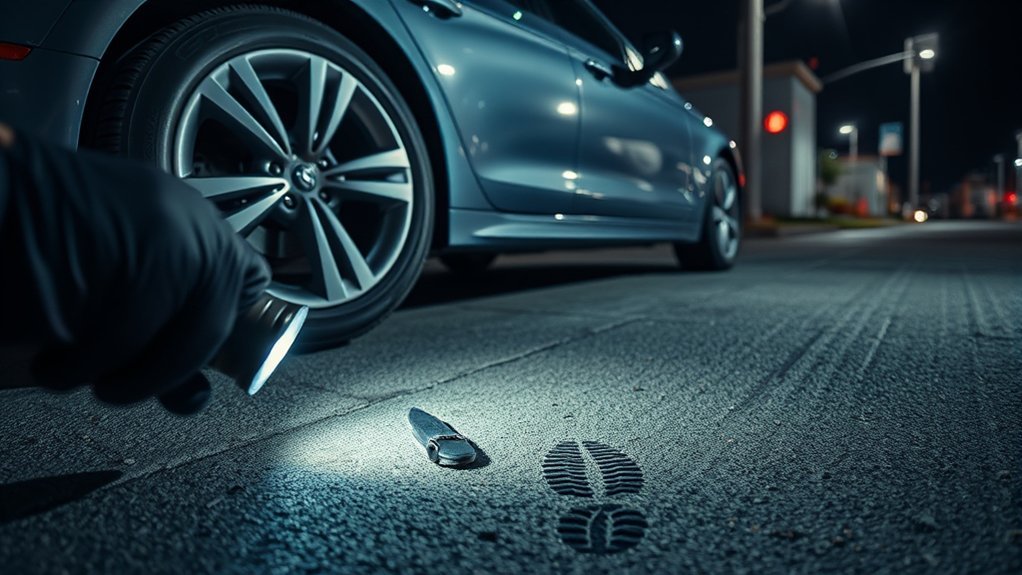
To prove someone slashed your tires, you need more than a suspicious-looking cut. Start by documenting the untouched vehicle, every damaged tire, the surrounding area, and the time you discovered the problem. Then preserve surveillance footage, witness details, messages, repair records, and the damaged tire when practical. A tire professional can document whether the damage is consistent with cutting, while video, eyewitnesses, admissions, threats, timing, and other evidence may help identify who caused it.
Quick Answer
To prove tire slashing, separate two questions: was the damage deliberate, and who caused it? Photograph the untouched scene, preserve original files and the damaged tire, obtain surveillance and witness details, get a written tire-shop inspection, and file a police report. Cut shape alone may be a clue, but it does not identify the person responsible.
Key Takeaways
- Photograph every damaged tire, the entire vehicle, nearby objects, and the surrounding scene before repairs or cleanup.
- Keep original photos, videos, messages, voicemails, and surveillance files instead of relying only on edited or cropped copies.
- Cut shape can help a tire professional describe the damage, but it cannot by itself prove vandalism or identify a suspect.
- Ask witnesses for contact information and what they personally observed, and request nearby surveillance footage quickly.
- Report suspected property damage to local law enforcement and keep the incident or case number.
- Keep tire-service records, replacement receipts, the DOT date code, and a written professional inspection when available.
At a Glance
| Time Required | About 20–45 minutes for initial documentation; additional time for police, video requests, and tire inspection |
| Difficulty | Easy to moderate |
| Tools Needed | Phone or camera, flashlight, notepad, ruler or measuring tape, and access to secure file storage |
| Cost | Initial documentation is usually free; towing, inspection, repair, or replacement costs vary |
Warning: Do not drive on a visibly flat, cut, bulging, or structurally damaged tire. Use an appropriate spare or roadside/towing service. If you believe the vandal may still be nearby or you are in immediate danger, move to a safe location and call 911. Do not confront a suspected person.
Note: This article provides general U.S. information, not legal advice. Offense names, evidence rules, surveillance access, recording-consent laws, police procedures, and insurance requirements can vary by state and locality.
How to Spot a Slashed Tire
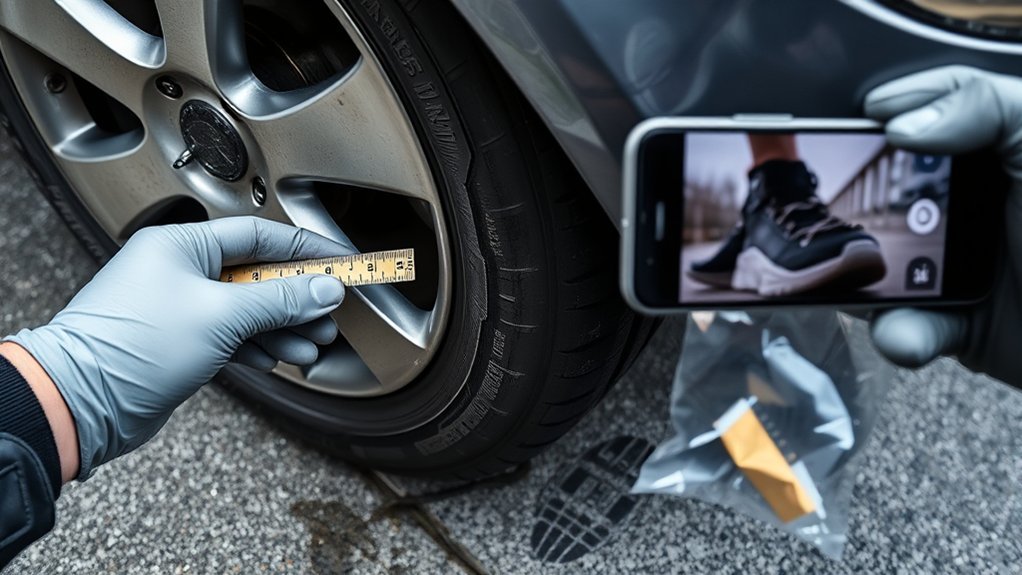
Start by documenting any unusual cut, puncture, tear, or sidewall damage. A straight or sharply defined opening may be consistent with contact from a cutting object, but appearance alone does not prove that someone intentionally slashed the tire.
A cut pattern can be an important clue, but the strongest case combines the tire damage with evidence showing when, how, and by whom it occurred.
Notice whether the tire has suddenly lost pressure. A large opening can release air quickly, while a smaller injury may leak more gradually. The deflation rate depends on the size, location, tire construction, and nature of the damage, so rapid air loss by itself does not prove slashing.
Check the nearby ground for nails, screws, broken material, sharp debris, wheel damage, curb marks, or other clues that could help explain the injury. Do not assume an object caused the damage merely because it is nearby.
Look at the cut edges and location, but treat those observations as clues rather than a diagnosis. Road hazards, curb impacts, potholes, and sharp debris can also cause cuts or tears that look unusual.
Multiple injuries affecting several tires can establish a pattern that investigators or a tire professional may consider alongside surveillance video, witness accounts, threats, or other evidence.
If you hear hissing or popping, safely document when and where you heard it. Those sounds may help establish when pressure was being lost, but they do not establish who caused the damage.
Take Photos of Every Tire Angle
Photograph the vehicle before moving it when doing so is safe. Capture high-resolution images of every tire, including the tread, sidewalls, wheel, valve area, and visible damage.
Use wide shots to show the entire vehicle, parking position, pavement, curb, driveway, nearby objects, and surrounding area. This context can become important when someone later needs to understand where the damage occurred.
Then take close-ups that clearly show the injury. Keep the original image files and avoid editing the master copies.
Capture Sidewall Damage
Photograph sidewall damage from several angles and distances. Start with the complete wheel and tire, then move closer so the edges and location of the damage are visible.
A suspected slashed tire may have a defined cut or gash, but do not label the damage as intentional based only on its appearance. A qualified tire professional may be able to document whether the injury is consistent with a cut, impact, road hazard, or another mechanism.
Include wider shots of the wheel well and vehicle so the location of each damaged tire is clear.
If you see a knife, blade, sharp object, broken material, or other suspicious item nearby, photograph it where it is rather than picking it up. Tell responding law enforcement about it.
Your phone or camera may store creation-time metadata, but also write down the date and time you discovered the damage. Device timestamps can be changed and should not be your only timeline record.
Use steady lighting and several angles so shadows do not hide the opening.
Together, these images can help an investigator, insurer, or tire professional evaluate the damage and its timeframe.
Photograph Tread Cuts
Document tread injuries as carefully as sidewall damage. Small punctures can be difficult to see, especially when a nail, screw, or other object is still embedded.
Use these steps:
- Photograph the full tire from multiple sides.
- Take close-ups of each cut, puncture, tear, or embedded object.
- Place a ruler or measuring tape beside the injury when you can do so without disturbing it.
- Record the discovery date and time separately and preserve the original image files.
Measurements can help a tire professional describe the injury. However, do not confuse a measurement with proof of vandalism.
For repair decisions, the U.S. Tire Manufacturers Association states that eligible puncture repairs are limited to the repairable tread area and injuries no greater than 1/4 inch (6 mm) in diameter. That rule applies to qualifying punctures, not to every cut or gash.
Clear photographs preserve the tire’s visible condition before repair, replacement, towing, or handling changes it.
Pro Tip: Keep an untouched set of original photos and videos. Make copies for cropping, brightening, emailing, or adding annotations. Preserving the originals makes it easier to show that the underlying evidence was not altered.
Include Wide Area Context
After close-ups, step back and photograph the full scene. Include the entire wheel well, pavement, curb, driveway or parking space, and surrounding area. If small sharp objects or debris are nearby, show their position in the frame before anyone moves them.
Document all four tires even if only one appears damaged. That can show whether the incident is isolated or whether several tires share a pattern.
| Photo focus | Why it matters |
|---|---|
| Front angle | Shows the overall condition and location of the damage |
| Side angle | Shows cuts, punctures, and sidewall injuries |
| Rear angle | Provides another view of placement and surrounding damage |
| Full scene | Connects the tire to the parking location and surroundings |
| All four tires | Can reveal whether multiple tires were affected |
Wide shots can make a police report, professional inspection, or insurance claim easier to understand because they preserve the scene rather than showing only an isolated hole.
Preserve the Scene and Damaged Tire
If you believe the damage may be criminal, avoid unnecessary handling before you document it. Do not insert objects into a cut, pull out an embedded item, scrub the tire, or clean nearby marks merely to get a better photograph.
Do not collect a suspicious knife, blade, or other object yourself unless leaving it in place creates an immediate safety hazard. Photograph it, keep other people away when practical, and tell police where it is.
If the tire must be removed, ask the shop not to discard it until you know whether police, your insurer, or an attorney needs it. Keep the repair or replacement invoice and record who took possession of the tire.
If you keep the damaged tire yourself, store it somewhere dry and secure where it will not be altered, cleaned, cut apart, or accidentally discarded.
[Products Worth Considering]

The JACO FlowPro Tire Inflator measures, inflates, and airs down tires up to 100 PSI with battery-free operation and ±2% accuracy after calibration. It features a glowing pressure dial for night visibility, a heavy-duty steel build with a hybrid hose, and a precision push-to-inflate thumb trigger. The patented Lightning Air Chuck locks on for a secure seal, and the kit includes quick-connect hardware for easy inline use with your air compressor.

TP-M13W combination repair unit kit includes wrapped stems with matching patches for fast, reliable tire repairs. It’s suitable for both radial and bias ply tires and is designed for chemical or heat vulcanization. Gray vulcanizing gum with blue backing helps create a strong bond, with the stem portion wrapped for added effectiveness.

Steelman white tire marking crayons provide high-contrast, semi-permanent marks for repairing and inspecting tires and equipment. They write on wet or dry, smooth or coarse surfaces including rubber, metal, glass, and wood, making them ideal for puncture location and damage outlining. The lead- and zinc-free crayons resist weather and fading yet wipe away when you no longer need the marks.
Check for Security Camera Footage
Look for cameras on nearby homes, businesses, parking facilities, doorbells, garages, and other properties that face the vehicle or likely approach routes.
Ask the owner or manager as soon as possible whether footage exists for the relevant period. Retention periods vary greatly, so prompt contact can reduce the chance that useful video is overwritten.
Write down when you discovered the damage and determine the narrowest reasonable incident window. That makes footage easier to locate.
Locate Nearby Cameras
Walk the area only when it is safe and identify cameras that appear to cover the vehicle, street, driveway, parking aisle, entrance, or exit.
- Identify nearby exterior cameras.
- Ask whether they cover the vehicle or approach route.
- Give the owner the relevant date and approximate time window.
- Record the business or property name and when you made the request.
Some businesses may have parking-lot or building cameras even when no camera is obvious from the street. Public or traffic-camera footage may also exist in some locations, although access and retention policies vary.
Do not enter private property without permission or assume that a private camera owner must give you direct access. If the owner does not want to provide a copy to you, ask whether they can preserve it for law enforcement.
Request Recorded Footage
Speak politely with the owner, manager, landlord, or security office and ask them to preserve the relevant recording. Provide a narrow date and time range whenever possible.
If they agree to share it, ask for the original exported file when their system allows it rather than a phone recording of a monitor. A police officer or investigator may be able to request footage directly when an owner cannot release it to you.
| Action | Purpose |
|---|---|
| Identify camera locations | Find likely sources of evidence |
| Contact the owner promptly | Reduce the risk of footage being overwritten |
| State a specific time window | Make review faster and more accurate |
| Record the source | Document where the video came from |
| Respect access rules | Avoid trespass, privacy, or ownership disputes |
Preserve Video Evidence
Once you obtain potentially useful footage, preserve it carefully. The National Institute of Standards and Technology emphasizes maintaining digital-evidence integrity and documenting its original source.
- Save the original exported clip without editing it.
- Record who supplied the file and when you received it.
- Keep at least one secure backup.
- Make a separate working copy if you need to trim, brighten, annotate, or share the video.
- Avoid converting the original into another format unless necessary.
A useful recording might show the act itself, a person’s clothing, a vehicle, an approach or escape route, or activity around your car before and after the tire lost pressure.
Even footage that does not clearly show a person’s face can become important when combined with witness statements, timing, messages, or other evidence.
Look for Witnesses and Clues
Ask neighbors, passersby, employees, delivery workers, parking attendants, or other people who were nearby whether they personally saw or heard anything unusual around your vehicle.
Get the name and contact details of anyone who may have useful information. Ask open questions such as what they saw, when they saw it, and where they were standing rather than telling them what you think happened first.
Witnesses may remember a person near the vehicle, an argument, a vehicle arriving or leaving, a popping or hissing sound, or someone examining the tires.
Next, document physical clues such as broken material, tire marks, wheel or curb damage, footprints, discarded objects, or other items near the vehicle. Photograph them where they are.
Do not assume that a sharp object on the ground caused the tire damage, and do not handle a suspicious object simply to inspect it more closely.
Also note nearby security cameras that may have recorded the vehicle or surrounding area.
When you keep witness information, photographs, physical observations, and the timeline organized together, you create a stronger factual record than tire photographs alone.
Preserve Texts, Calls, and Records
Save texts, voicemails, emails, social media messages, and other communications that could establish timing, threats, harassment, admissions, disputes, or knowledge of the damage.
- Take screenshots showing the sender, message, and surrounding conversation.
- Keep the original message thread or account data whenever possible.
- Save relevant voicemails and call logs.
- Write down each important call’s date, time, participants, and what was said while your memory is fresh.
- Keep copies of social posts or messages that could later be deleted.
A threat or argument can show possible motive or context, but it does not by itself prove that the person damaged the tire. Treat it as one piece of the evidence.
Keep original files rather than only cropped screenshots. Store backups so losing or replacing your phone does not erase the record.
Note: If you are considering secretly recording a live phone call or private conversation, check the law where the participants are located first. Recording-consent requirements vary by jurisdiction. Saving an existing voicemail or message you already received is different from secretly making a new recording.
Report the Slashed Tire to Police
Report suspected intentional property damage to the local law-enforcement agency where it occurred. USAGov’s crime-reporting guidance directs people reporting theft or other property crime to local law enforcement.
If you are in immediate danger, call 911. For a past incident with no immediate threat, many departments use a non-emergency phone number or online reporting system.
Provide the location, approximate time window, photographs, witness contact information, surveillance footage, relevant communications, tire-shop findings, and a factual description of anything suspicious you observed.
Avoid presenting speculation as fact. If you suspect someone, explain why and give police the evidence supporting that suspicion.
Ask for the report, incident, or case number and save copies of any documents or correspondence. A police report creates an official record, although filing one does not guarantee that an officer will identify a suspect, make an arrest, or conduct a particular type of investigation.
If the tire damage is part of continuing threats, stalking, or repeated property damage, tell law enforcement about the broader pattern rather than reporting each event without context.
What Actually Proves Who Slashed the Tires?
The evidence needed to show that a tire was deliberately damaged is different from the evidence needed to identify the person who did it.
A tire inspection might show that the injury is consistent with cutting. That can help establish what happened to the tire, but it usually does not identify the offender.
Evidence connecting a specific person to the incident may include:
- Clear surveillance video: footage showing the person damaging the tire or approaching it with a visible action tied to the damage.
- Eyewitness testimony: someone who personally observed the act or relevant events.
- An admission: a message, voicemail, lawful recording, or statement acknowledging responsibility.
- Corroborating communications: threats or statements combined with stronger evidence showing opportunity and timing.
- Timeline evidence: footage, records, or witnesses placing the person at the vehicle when the damage occurred.
- Physical or forensic evidence: evidence collected and evaluated by law enforcement or qualified forensic personnel.
- A repeated pattern: multiple incidents supported by footage, witnesses, communications, or other facts that connect them.
Motive alone is not proof. Neither is a prior argument, suspicion, or the fact that someone had an opportunity to approach your vehicle.
The strongest cases usually combine independent pieces of evidence that point in the same direction.
Get a Professional Tire Inspection
Before the damaged tire is discarded, ask a qualified tire shop to inspect it. Tell the technician you are documenting suspected vandalism and ask for the findings on the work order or invoice.
Useful documentation may include:
- The tire brand, model, size, and DOT Tire Identification Number.
- The location of each cut, puncture, tear, or impact mark.
- Whether the tire was driven while flat.
- Whether internal cords or the inner liner are damaged.
- Whether the damage is repairable under the shop’s and tire manufacturer’s repair policy.
- The replacement or repair cost.
A technician should avoid claiming who caused the damage unless they actually have evidence supporting that conclusion. Their most useful role is documenting the tire’s physical condition and professional repair assessment.
Keep the invoice and photographs with your police or insurance records.
[Products Worth Considering]

Measure tire tread depth quickly and accurately with this LUMITECO dial gauge that reads in 1/32" increments up to 14/32". The color-coded green/yellow/red zones make it easy to judge tire wear and know when replacement is needed. A rugged, compact design with a protective pouch helps keep the gauge ready for use on cars, trucks, motorcycles, and more.

Monitor tire tread wear with a smart, color-coded depth gauge that shows clear condition ranges at a glance. The bar is range marked for fast, easy readings, helping you maintain safer traction and performance. Each gauge is portable with a pocket clip, and the set includes 20 units for daily use and sharing.

Accurately measure tire tread depth with a calibrated gauge marked from 0 to 1 inch in 1/32 inch increments. The color-coded bar helps you quickly identify tread condition ranges, supporting safe driving for trucks, motorcycles, automobiles, and passenger vehicles.
How to Tell Slashing From a Puncture
You can look for differences between a cut, puncture, impact injury, and ordinary wear, but there is no single visual test that proves deliberate slashing.
A nail or screw puncture is commonly found in the tread and may leave a relatively small opening. A sidewall may instead show a cut, tear, abrasion, bulge, or impact-related injury. However, the location and appearance alone do not establish intent.
Sidewall damage can result from deliberate cutting, road debris, curb contact, pothole impacts, or other causes. A professional inspection is especially valuable when the cause is disputed.
Clean Cuts Vs Punctures
A sharply defined cut can be consistent with a cutting object, while a nail or screw often creates a smaller puncture in the tread. Those are useful observations, not a definitive vandalism test.
- Photograph whether the opening has defined, torn, abraded, or irregular edges.
- Record whether the injury is in the tread, shoulder, or sidewall.
- Check for embedded debris without removing it.
- Document whether one tire or several tires were affected.
- Ask a professional to inspect the tire internally when appropriate.
Air-loss speed is also not conclusive. Both accidental and intentional injuries can produce a fast or slow leak.
For repair purposes, USTMA guidance says qualifying puncture injuries must be confined to the repairable tread area and no greater than 1/4 inch (6 mm) in diameter. That repair criterion should not be used as a test of criminal intent.
Sidewall Damage Clues
Carefully document sidewall cuts, tears, abrasions, bubbles, exposed cords, and other visible injuries.
Multiple similar cuts may be relevant to an investigation, especially when several tires are affected, but a pattern still needs to be evaluated with the rest of the evidence.
There is no reliable 1.5 cm width or depth threshold that proves a tire was slashed. Measure the injury for documentation, not as a vandalism test.
A puncture or cut in the sidewall is also important from a safety standpoint because the sidewall is outside the normal puncture-repair area described by USTMA.
Photograph nearby debris, wheel marks, curb contact, or other evidence that might support or contradict your first explanation.
A professional tire inspection, surveillance footage, witnesses, and the incident timeline are more persuasive than relying on the shape of the cut alone.
Check Tire Age and Prior Damage
Photograph the tire’s DOT Tire Identification Number because it helps establish exactly which tire was inspected and when it was manufactured.
According to the National Highway Traffic Safety Administration, the last four digits of the TIN on tires manufactured since 2000 indicate the week and year of manufacture. For example, a code ending in 0308 indicates the third week of 2008.
Check both sidewalls if you cannot find the complete TIN on the side facing outward.
Tire age does not prove or disprove vandalism, but it can matter when evaluating alternative causes such as deterioration or previous damage.
- Photograph the complete DOT code.
- Record existing cracking, repairs, punctures, bulges, or unusual wear.
- List prior flats, patches, leaks, or impact damage.
- Keep tire-purchase and service receipts when available.
These records can show the tire’s documented condition before and after the incident.
Do not use six years as a universal automatic replacement or repair cutoff. NHTSA notes that some vehicle and tire manufacturers recommend age-based replacement at approximately six to ten years regardless of treadwear. Follow the applicable vehicle and tire manufacturer’s guidance.
Can a Slashed Tire Be Repaired?
Many deliberate sidewall cuts will require tire replacement, but repairability depends on the exact injury, its location, the condition of the tire, whether it was driven while flat, and the tire manufacturer’s repair policy.
USTMA recommends considering repair only when a qualifying puncture is confined to the repairable tread area and is no greater than 1/4 inch (6 mm) in diameter. The tire must be removed from the wheel so the interior can be inspected.
| Damage type | Likely action |
|---|---|
| Qualifying tread puncture up to 6 mm | May be repairable after professional off-wheel inspection |
| Long tread cut or gash | Professional inspection; may require replacement |
| Sidewall or shoulder cut/puncture | Outside the normal industry puncture-repair area; replacement is generally required |
| Internal damage from driving flat | Often requires replacement after inspection |
| Older tire | Follow tire/vehicle manufacturer age guidance and professional inspection rather than a universal six-year rule |
A proper repair is also more than applying an external plug. USTMA guidance calls for removing the tire, inspecting it internally, filling the puncture injury with an appropriate stem or plug, and sealing the inner liner with a patch or approved combination repair unit.
Do not drive on a flat or visibly damaged tire to reach a repair shop. Use an appropriate spare, roadside assistance, or towing service.
Document Costs and Contact Insurance
Keep every financial document related to the incident, including towing charges, inspection fees, replacement-tire invoices, mounting and balancing charges, and other directly related expenses.
If you carry comprehensive auto insurance, vandalism may be covered subject to your policy terms and deductible. The National Association of Insurance Commissioners lists vandalism among losses commonly covered by comprehensive auto coverage.
Before disposing of a damaged tire, ask your insurer whether it needs photographs, an inspection, a police report, or the actual tire retained until the claim is reviewed.
Provide factual documentation rather than trying to prove a particular suspect yourself. Your policy, deductible, exclusions, and insurer’s claim requirements determine whether reimbursement is available.
Prevent More Slashed Tire Damage
You cannot eliminate the risk of vandalism, but you can make your vehicle easier to monitor and create better evidence if another incident occurs.
When possible, park in a well-lit area covered by a home camera, building camera, or other lawful surveillance system.
- Inspect your tires regularly so you have a better record of their previous condition.
- Use a parking-mode dashcam or exterior camera where lawful and practical.
- Keep cameras positioned to capture the vehicle and likely approach routes.
- Drive cautiously around potholes, curbs, and sharp road debris so accidental tire damage is less likely to confuse the situation.
- Repair or replace unsafe tires promptly.
- If vandalism is repeated, save evidence from every incident under a single organized timeline.
Routine tire care does not prevent another person from deliberately damaging a tire, but it can help establish that the tire was intact before a new incident.
Good prevention combines safer parking, useful camera coverage, regular tire checks, and consistent documentation rather than confronting a suspected vandal.
If you believe the same person is repeatedly targeting you or your vehicle, document the pattern and discuss the full history with local law enforcement.
[Products Worth Considering]

A concentrated tire and tube mounting compound designed to help simplify mounting rubber tires and tubes on passenger, semi truck, construction, and OTR applications. Its ultra-thick formula packs beads effectively and includes rust inhibitors to help protect against corrosion during use.

Black Magic Tire Wet delivers a deep wet-look shine that makes tires appear dark, rich, and freshly detailed. Its long-lasting formula helps resist rain, dust, and road grime for weeks of glossy protection, not days. Apply by spraying onto clean, dry tires—no buffing or wiping required—with a low-sling design to reduce splatter on paint and wheels.

The Trivd Frol 1/2" air impact wrench delivers high performance torque up to 1500 ft-lbs with a twin hammer impact mechanism for strong, balanced blows. It features an ergonomic grip, compact lightweight design, and quick-stop control with 3 forward speeds up to 8000 RPM plus a reverse speed. Built for demanding automotive repair and tire shop work, the rear exhaust helps keep debris away from the surface.
What Not to Do After Suspected Tire Slashing
- Do not confront a suspected vandal. Preserve evidence and use police channels instead.
- Do not drive on a visibly unsafe tire. Further damage can create a safety hazard and make the original injury harder to assess.
- Do not clean the tire before documenting it.
- Do not pull out embedded objects simply to inspect the hole.
- Do not pick up suspicious tools or objects unnecessarily.
- Do not edit your only copy of a photo or video. Keep the original.
- Do not publicly accuse someone as a fact when you only have suspicion.
- Do not discard the damaged tire until police, the insurer, and the repair shop no longer need it.
Frequently Asked Questions
What Evidence Is Needed for Tire Slashing?
Useful evidence includes photographs of the untouched vehicle and tire damage, surveillance footage, witness contact information, relevant messages or threats, a police report, service records, repair invoices, and a professional tire inspection. To identify a particular person, you need evidence linking that person to the incident rather than the cut pattern alone.
Do Police Investigate Tire Slashing?
They may. Intentional tire damage can be reported as property damage, vandalism, criminal mischief, or a similar offense depending on local law. The type of response or investigation depends on the jurisdiction, available evidence, damage, and circumstances. Filing a report creates an official record but does not guarantee an arrest or investigation outcome.
How Can You Tell if Someone Slashed Your Tires?
A defined cut, several similar injuries, or damage to multiple tires may raise suspicion, but there is no visual pattern that proves intent by itself. Road hazards and impacts can also cut tires. Photograph the damage and ask a qualified tire professional to inspect it while you gather video, witnesses, messages, and other evidence.
Is Slashing Someone’s Tires a Criminal Offense?
Intentional destruction or damage to another person’s property generally falls within vandalism, criminal mischief, or similar property-damage laws. The FBI’s crime-reporting definition of vandalism includes willfully or maliciously damaging private property without the owner’s consent. Exact charges, monetary thresholds, penalties, and restitution rules depend on state and local law.
Should You Keep a Slashed Tire as Evidence?
Often, yes, at least until you confirm that police, your insurer, and any legal representative do not need it. Photograph the tire before removal, ask the shop not to discard it, and store it securely without cleaning or altering the damaged area.
Can a Tire Shop Confirm That a Tire Was Slashed?
A qualified technician can document the injury’s location, size, internal condition, repairability, and whether the damage appears consistent with cutting or another physical mechanism. That professional opinion can support your documentation, but it usually cannot establish who caused the damage without additional evidence.
Does Insurance Cover Slashed Tires?
Comprehensive auto coverage commonly includes vandalism, but coverage depends on your policy, deductible, exclusions, and claim requirements. Contact your insurer before discarding the tire and ask what photographs, police documentation, receipts, or inspections it requires.
Should You Touch a Knife or Sharp Object Found Near the Tire?
Generally, avoid handling a suspicious object unnecessarily. Photograph its location and tell law enforcement about it. Moving or handling an object can change or contaminate potential evidence. If the object creates an immediate safety hazard, prioritize personal safety and explain any necessary movement to police.
Conclusion
If you believe someone slashed your tires, document the scene before it changes. Photograph every tire and the surrounding area, preserve original photos and video, save relevant communications, locate witnesses and cameras, and obtain a professional tire inspection.
Most importantly, separate suspicion from proof. A cut can help establish what happened to a tire, but identifying who caused it usually requires independent evidence such as surveillance video, an eyewitness, an admission, or several facts that corroborate one another.
Report suspected intentional property damage to local law enforcement, keep the case number and repair records, and check with your insurer before the damaged tire is discarded. A careful factual record gives police, insurers, and other decision-makers much stronger evidence than the appearance of the tire alone.
Sources
- National Highway Traffic Safety Administration — TireWise — DOT Tire Identification Number, tire-age, inspection, and safety guidance.
- U.S. Tire Manufacturers Association — Tire Repair Basics — repairable tread area, 6 mm puncture limit, off-wheel inspection, and proper repair procedure.
- National Institute of Standards and Technology — Digital Evidence Preservation — preserving original digital files, integrity, backups, and evidence-source documentation.
- USAGov — Report a Crime — emergency and non-emergency crime-reporting guidance and local law-enforcement reporting.
- FBI Crime Data Explorer — federal crime-reporting definition of destruction, damage, and vandalism of property.
- National Association of Insurance Commissioners — Auto Insurance — general comprehensive-coverage information, including vandalism losses.
