If a tire has been stabbed, slashed, or deliberately cut, treat it as both a safety problem and a possible vandalism incident. The tire may lose air quickly, the sidewall may be structurally weakened, and the vehicle may be unsafe to drive. Your best move is to document the damage, avoid driving on the tire, report the incident when appropriate, and have the tire inspected or replaced by a qualified tire professional.
Last updated: August 18, 2026
Quick Answer
A stabbed or slashed tire can lose air fast and may be unsafe even if it still looks partly inflated. Sidewall cuts, shoulder damage, long slashes, and exposed cords are not standard repair candidates for passenger and light-truck tires. Do not drive on a visibly damaged tire. Take photos, check for witnesses or footage, file a report if vandalism is reasonably suspected, and arrange professional inspection or replacement. A clean-looking cut can be a clue, but appearance alone does not prove vandalism.
Key Takeaways
- A slashed tire can cause rapid air loss, poor handling, rim damage, or sudden tire failure.
- Cuts in the sidewall or shoulder area are not considered safe standard repair candidates for normal passenger and light-truck service.
- Industry guidance limits proper repairs to small punctures in the repairable tread area, not long slashes or sidewall cuts.
- If vandalism is suspected, photograph the tire, nearby scene, license plate area, and any possible evidence before moving the vehicle if it is safe to do so.
- Comprehensive auto insurance may cover intentionally slashed tires, but your deductible, policy language, and documentation matter.
At a Glance
| Time Required | 10–20 minutes to document the damage; longer if you need police, roadside assistance, towing, or a tire replacement appointment. |
| Difficulty | Easy for documentation; moderate if you need to install a spare; best handled by a tire shop if the tire is cut or fully deflated. |
| Tools Needed | Phone camera, flashlight, tire-pressure gauge, gloves, notepad, roadside assistance app or phone number, and your insurance information. |
| Cost | Documentation is free. Replacement cost depends on tire size and type. Insurance may help if vandalism is covered, but the deductible may be more than one tire. |
Warning: Do not drive on a tire that has a visible cut, exposed cords, sidewall damage, or rapid air loss. A damaged tire can fail suddenly and may also damage the wheel rim. Do not repeatedly reinflate a visibly cut tire just to test whether it can be driven.
What Happens If a Tire Is Stabbed or Slashed?
When a tire is deliberately cut, the most immediate risk is loss of inflation pressure. A small puncture in the tread may leak slowly, but a wide cut or sidewall slash can let air escape quickly. Once the tire is underinflated, the sidewall flexes more than it should, heat builds up, and the tire can become unsafe even before it looks completely flat.
The risk is higher when the damage is on the sidewall. The sidewall supports the tire’s shape and absorbs road forces. A cut there can weaken the tire’s structure, and a normal patch or plug cannot restore the original strength. That is why sidewall and shoulder damage in normal passenger and light-truck service means replacement rather than a standard puncture repair.
Repairability at a Glance
| Damage | Standard Repair? | Best Next Step |
|---|---|---|
| Small round puncture in repairable tread area, no larger than 1/4 inch or 6 mm | May be repairable | Demount and inspect the tire; repair only if it meets manufacturer and industry limits. |
| Shoulder or belt-edge damage | No standard puncture repair | Take the tire out of service and arrange replacement. |
| Sidewall cut or puncture | No standard passenger/light-truck repair | Replace the tire. |
| Long slash, exposed cords, overlapping damage, or tire driven flat | No | Do not drive on it; use a safe spare, roadside assistance, or towing. |
NHTSA TireWise reports that 511 people died on the road in tire-related crashes in 2024, which is a reminder that tire damage should be treated as a real safety issue, not just an inconvenience.
How Do You Tell If Your Tire Was Slashed?

To assess whether a tire may have been deliberately damaged, inspect it from a safe position and document what you see. A clean cut, several damaged tires, fresh damage discovered after the vehicle was parked, witness information, or usable camera footage may raise suspicion of vandalism. However, appearance alone cannot prove intentional damage. Road debris, curb impacts, valve-stem leaks, bead leaks, potholes, tire aging, and previous damage can also cause flats.
Look for these signs and record them without assuming the cause:
- A visible cut or slit in the sidewall.
- Rapid deflation after the vehicle was parked.
- Multiple cuts on one tire or more than one tire.
- Exposed cords, separated rubber, or a flap-like opening.
- No nail, screw, or obvious road object in the tread.
- Nearby suspicious debris, other vehicle damage, witness information, or surveillance coverage.
Note: A flat tire is not automatically vandalism. Use photos, repair-shop findings, witness statements, and camera footage before drawing conclusions or accusing someone of causing the damage.
What Does a Slashed Tire Look Like?
A tire that may have been deliberately cut can show a slit, gash, or elongated opening in the rubber, often on the sidewall. The opening may be short and narrow or may spread wider as pressure falls. Exposed internal cords, separated rubber, or a large split are signs of serious damage regardless of what caused it.
Edge shape can be a clue, but it is not proof of vandalism. A road impact or sharp debris can also create unusual cuts and tears. Photograph the damage before the tire is removed, then ask a tire professional to document whether the injury appears consistent with a road hazard, impact, structural failure, or external cutting.
If the tire is already flat or visibly cut, do not reinflate it simply to see whether it can be driven. Use an approved spare if conditions are safe, or arrange roadside assistance or towing.
What Should You Do After Tire Vandalism?
After suspected tire vandalism, focus on safety first, then evidence, then repair or replacement. The goal is to protect yourself, preserve useful documentation, and avoid making the damage worse.
[Products Worth Considering]

This tire repair kit provides fast emergency puncture repair without removing the tire from the rim, helping you get back on the road quickly. Its screw plug system is designed for punctures in both tread and sidewall and includes a complete patch plug tool set with essential accessories. A portable storage bag makes it easy to carry for cars, trucks, SUVs, motorcycles, and heavy-duty applications.
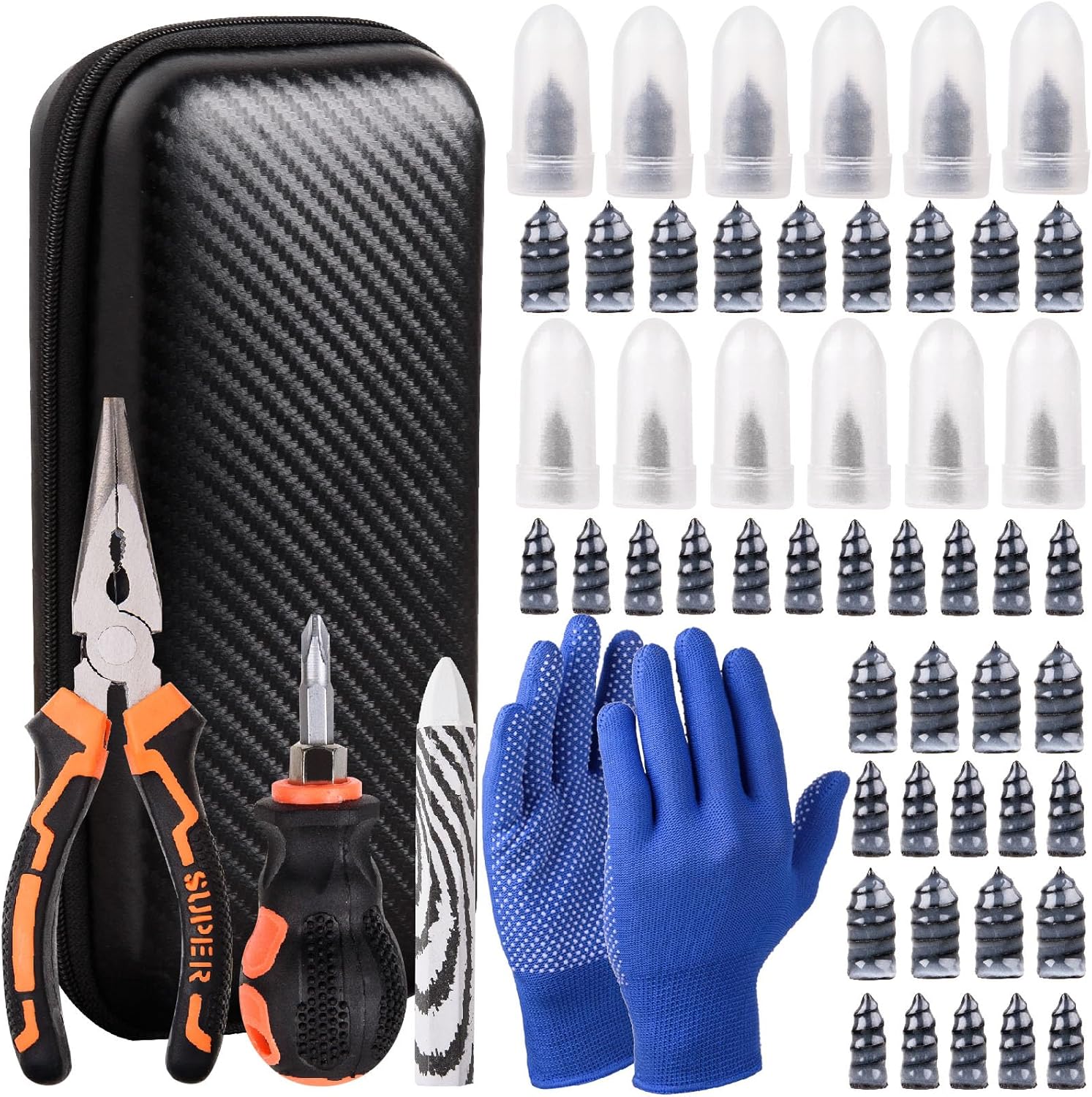
This tire sidewall puncture repair kit fixes flats fast without removing the tire, helping you get back on the road in minutes. It includes self-tapping repair nails, essential tools, gloves, and a portable storage bag for convenient roadside use. Designed for tubeless tires, it helps create a tight, leak-resistant seal for cars, motorcycles, trucks, SUVs, and ATVs.

TireJect Off-Road Tire Sealant Kit provides 5-in-1 sealing to help fix tread punctures up to 3/8", sidewall punctures up to 3/8", bead leaks, slow leaks, and minor dry rot on low-speed tires. It permanently seals with liquid rubber, recycled tire particles, and Aramid fibers, making it ideal for flats caused by thorns, nails, and screws. The included dispensing cap attaches to the valve stem for a no-mess installation, along with a metal valve core remover tool and valve stem cap. This kit is for off-road use only.
1. Get to a Safe Position
If you discover the damage before driving, leave the vehicle parked if it is in a safe location. If you notice the problem while driving, slow down gradually, avoid sudden braking, turn on your hazard lights, and pull over somewhere safe. Do not continue driving to “see if it holds air.”
2. Document the Damage
Take clear photos before the tire is removed, if it is safe to do so. Photograph the whole vehicle, the damaged tire, closeups of the cut, the license plate area, the ground around the tire, and any nearby objects. Take wide shots that show where the vehicle was parked, lighting conditions, and nearby cameras.
- Capture the tire from several angles.
- Include a closeup of the tread and sidewall.
- Photograph all four tires, even if only one appears damaged.
- Write down the date, time, location, and when you last saw the tire intact.
- Ask nearby businesses, neighbors, or property management about security footage.
Pro Tip: If you see a possible sharp object near the tire, photograph it where it is. Avoid handling it unless safety requires moving it, because police or your insurer may ask about the scene.
3. File a Police Report if Vandalism Is Suspected
Tire slashing may be treated as vandalism, criminal mischief, malicious mischief, or a similar property-damage offense, but the exact law and possible charge depend on the jurisdiction and facts. If you reasonably suspect intentional damage, a police report can create an official record and may help with an insurance claim. If there is an immediate threat to personal safety, use the appropriate emergency service. Otherwise, use the local non-emergency or online reporting method when available and keep the report or incident number.
This article is general information, not legal advice. If you are accused of damaging a tire or you need advice about a local criminal or civil case, speak with a qualified attorney in your area.
4. Contact Your Insurance Company
If someone intentionally damaged your tire, comprehensive auto insurance may cover repair or replacement as vandalism, minus your deductible. Progressive’s current tire-damage guidance, for example, states that slashed tires can fall under comprehensive coverage and that the number of damaged tires does not determine coverage. Liability-only coverage generally does not pay for damage to your own vehicle. Your own insurer and policy terms control your claim, so compare the replacement cost with your deductible before deciding whether to file.
Useful details for an insurance claim include:
- Police report or incident number.
- Photos of the tire and scene.
- Repair-shop diagnosis.
- Replacement invoice or estimate.
- Any witness names or camera footage availability.
5. Arrange Towing, Spare-Tire Use, or Replacement
If the tire is flat, cut on the sidewall, or visibly damaged, call roadside assistance or a tow service. Use a spare only if it is properly inflated, not cracked, and approved for your vehicle. Compact temporary spares are meant for limited use, so follow the speed and distance limits printed on the spare or listed in your owner’s manual.
Can You Fix a Slashed Tire?
Most true slashes cannot be safely repaired. A proper passenger or light-truck tire repair is not just an outside plug. The tire must be removed from the wheel so the inside can be inspected and the injury can be evaluated before a repair is approved.
The U.S. Tire Manufacturers Association recommends considering repair only when damage is limited to the repairable tread area and the puncture is no greater than 1/4 inch, or 6 mm, in diameter. It also requires the tire to be removed for inspection and says a plug alone is not an acceptable repair. The Tire Industry Association likewise says shoulder and sidewall damage are not repairable under standard passenger/light-truck puncture-repair procedures.
Long cuts, multiple slashes, sidewall gashes, exposed cords, overlapping injuries, and damage from being driven flat are replacement situations rather than simple puncture repairs. For a broader service-time breakdown, see TubeTyre’s guide to how long a tire repair takes.
Warning: A plug-only repair, a can of sealant, or an outside-in temporary fix should not be treated as a permanent repair for a damaged tire. These methods can leave internal damage uninspected and are not substitutes for an approved professional repair.
[Products Worth Considering]

Mosconly tire repair glue and nail kit delivers an elastic, waterproof bond for quick sidewall puncture repairs. The adhesive cures securely to help prevent peeling, flaking, and tearing, while the included nails support a strong, seamless repair. Designed for easy roadside use, it works on car, motorcycle, bike, and other tire types, with full curing within 24 hours.

Measure tire tread depth quickly and accurately with this LUMITECO dial gauge that reads in 1/32" increments up to 14/32". The color-coded green/yellow/red zones make it easy to judge tire wear and know when replacement is needed. A rugged, compact design with a protective pouch helps keep the gauge ready for use on cars, trucks, motorcycles, and more.

The SAFELIFE dial tire tread depth gauge measures tread depth in 1/32 inch increments with clear, easy-to-read 2-inch dial face. Color zones using a traffic light system help you quickly judge whether tread is low, marginal, or ample for safer driving. Built with a durable zinc cast body and a metal detect probe for precise, comfortable use across cars, motorcycles, trucks, and buses.
Repair May Be Possible Only When
- The damage is a small puncture in the repairable tread area.
- The puncture is within the tire manufacturer’s repair limits and no larger than applicable industry limits.
- The tire can be removed from the wheel and inspected inside.
- No sidewall, shoulder, belt-edge, run-flat, aging, or internal damage is found.
- A trained technician uses an industry-standard stem-and-patch or combination repair.
Replacement Is Usually Needed When
- The cut is in the sidewall or shoulder.
- The damage is a slash or tear rather than a small round tread puncture.
- The tire cords are visible.
- The tire was driven while flat or severely underinflated.
- There are multiple cuts or overlapping injuries.
- The tire is old, cracked, bulging, unevenly worn, or below safe tread depth.
When Should You Replace a Slashed Tire?
Replace a slashed tire when the cut is on the sidewall or shoulder, the tire will not hold air, the damage exposes cords, or a tire technician says it is outside safe repair limits. You should also replace a tire that suffered damaging run-flat operation because internal sidewall damage may not be visible from the outside.
Age matters too. NHTSA TireWise notes that some vehicle and tire manufacturers recommend replacement at six to 10 years regardless of remaining tread. Check the DOT Tire Identification Number on the sidewall; the last four digits show the week and year the tire was made. For example, “2324” means the tire was made in the 23rd week of 2024.
If only one tire is damaged, ask the tire shop whether replacing one tire is enough. On some vehicles, especially all-wheel-drive vehicles, mismatched tread depth can affect drivetrain operation. The correct choice depends on your vehicle, tire size, remaining tread depth, and vehicle or tire manufacturer guidance.
[Products Worth Considering]

TP-M13W combination repair unit kit includes wrapped stems with matching patches for fast, reliable tire repairs. It’s suitable for both radial and bias ply tires and is designed for chemical or heat vulcanization. Gray vulcanizing gum with blue backing helps create a strong bond, with the stem portion wrapped for added effectiveness.

This screw-in tire plug kit provides a fast, no-tire-removal fix for tubeless flat tires by aligning and screwing the plugs into the puncture. Built for a reliable, airtight seal, the thick rubber plugs create a durable repair that helps prevent slow leaks. The kit includes two plug sizes for handling different puncture widths and comes in a compact case for quick roadside use.

ZEHXI’s 60 pack screw-in tire plug kit uses high-grade rubber plugs with sealing threads to help repair minor punctures quickly without removing the tire. The set includes two plug sizes, so you can match different puncture openings and keep repairs organized in a transparent case. A handy screwdriver is included for fast installation, helping drivers get more mileage from existing tires while being ready for flat-tire emergencies.
How Can You Prevent Tire Slashing?
You cannot eliminate the risk of vandalism, but you can reduce opportunity and make evidence easier to collect. Park in well-lit areas, garages, monitored lots, or places covered by visible cameras. At home, motion lights, driveway cameras, and clear sightlines can discourage tampering and make an incident easier to document.
Prevention steps that help include:
- Park under lighting or near active entrances when possible.
- Use a garage, driveway camera, or monitored parking lot if available.
- Avoid leaving the vehicle in isolated areas for long periods.
- Check tires regularly for cuts, cracks, bulges, nails, or pressure loss.
- Keep valve caps installed and replace missing caps.
- Do not ignore threats, disputes, or repeated minor vandalism; document patterns early.
- Report suspicious activity to property management or local authorities when appropriate.
Note: Cameras do not prevent every incident, but they can provide timestamps, vehicle descriptions, and direction of travel that may help police or insurers.
Frequently Asked Questions
Is slashing one tire a felony?
Not always. Tire slashing may be prosecuted as vandalism, criminal mischief, malicious mischief, or a similar property-damage offense. Whether it is a misdemeanor, felony, or another level of offense depends on the applicable state or local law, the value of the damage, intent, prior conduct, and other facts. This is general information, not legal advice.
Can a sharp object cut through a tire?
A tire can be damaged by sharp road debris or intentional external damage, but the appearance of a cut does not by itself prove how it happened. If your tire is damaged, focus on safety, documentation, and professional inspection rather than trying to recreate or test the damage.
Is slashing 3 tires an insurance myth?
Yes. The claim that three tires are not covered but four tires are covered is generally a myth. If the damage resulted from covered vandalism and your policy includes comprehensive coverage, the number of damaged tires is not normally the deciding factor. Your deductible, policy terms, and documentation still apply.
Can you tell if someone stabbed your tire?
Sometimes there are clues, such as fresh sidewall damage discovered after parking, several damaged tires, witness information, or camera footage. However, a clean-looking cut alone cannot prove vandalism because road hazards, impacts, old damage, valve leaks, and other failures can also cause flats. Photograph the scene and ask a tire shop for a written diagnosis.
Can a sidewall cut be patched?
A sidewall cut is not considered a standard repair candidate for normal passenger and light-truck service. USTMA and TIA repair guidance limits standard puncture repair to the repairable tread area. A damaged sidewall tire should be taken out of service and professionally evaluated for replacement.
Will insurance cover a slashed tire?
It may if you have comprehensive coverage and the damage qualifies as vandalism under your policy. You will usually be responsible for the applicable deductible, so a claim may or may not make financial sense for one tire. Ask your insurer what documentation is required and how your specific policy handles the loss.
Can you drive on a slashed tire?
Do not drive on a tire with a visible slash, sidewall cut, exposed cords, severe pressure loss, or other structural damage. Driving while flat or badly underinflated can create additional tire and wheel damage. Use an approved spare if conditions are safe, or arrange roadside assistance or towing.
How fast does a slashed tire lose air?
There is no fixed deflation time. A large cut that penetrates the tire can cause rapid pressure loss, while a shallow surface cut that does not penetrate the inner liner may leak slowly or not leak at all. Do not use deflation speed alone to decide whether a damaged tire is safe; visible structural damage still needs professional inspection.
Conclusion
A stabbed or slashed tire is more than an ordinary flat because it can involve structural damage, sudden pressure loss, unsafe handling, and possible vandalism. Do not drive on a visibly cut tire. Photograph the damage, preserve camera or witness information, report suspected vandalism when appropriate, and have the tire professionally inspected. For normal passenger and light-truck tires, sidewall or shoulder damage, exposed cords, long slashes, and injuries outside standard repair limits mean replacement rather than a routine puncture repair.
Sources
- U.S. Tire Manufacturers Association – Tire Repair Basics – proper puncture repair limits, 1/4-inch/6 mm guidance, demount inspection requirements, and combined plug-and-patch repair guidance.
- Tire Industry Association – Tire Repair – shoulder and sidewall repair limits, plug-only warnings, and professional inspection guidance.
- NHTSA TireWise – tire safety, tire aging, DOT Tire Identification Number guidance, tread depth, and tire-related crash data.
- FindLaw – Vandalism – general discussion of vandalism and the way property-damage offenses vary by jurisdiction.
- Progressive – Does Car Insurance Cover Tire Damage? – comprehensive coverage for vandalism, deductibles, liability-only limitations, and the three-tire myth.
- Cornell Legal Information Institute – Restitution – general legal definition of restitution.