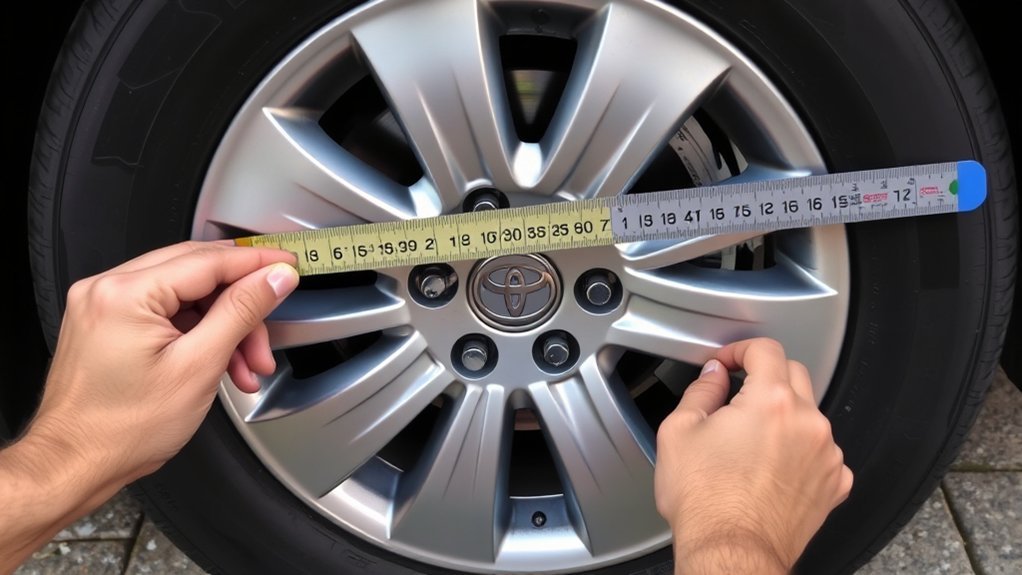
Measuring wheel size on your Toyota Camry helps you buy wheels that fit the tires, clear the brakes, sit correctly in the wheel well, and keep the car safe to drive. The safest method is to check the factory size first, then confirm the wheel’s stamped markings or measure the bare wheel carefully if the markings are missing.
Because Camry wheel specs vary by model year, trim, market, and brake package, do not rely on one online number alone. Use your owner’s manual, the Tire and Loading Information label on the driver’s doorjamb, and the measurements below before ordering replacement or aftermarket wheels.
Quick Answer
To measure Toyota Camry wheel size, confirm the factory tire and wheel information first, then read the wheel stamp if visible. Wheel diameter and width are measured at the tire bead seats, not the outside lip. Offset is the distance from the mounting pad to the wheel centerline.
Key Takeaways
- Read the wheel stamp first when possible. A marking like 17x7J ET45 tells you diameter, width, bead profile, and offset.
- Measure wheel diameter and width at the bead seats. The outer rim lip can add extra width and give you the wrong number.
- Backspacing is not the same as offset. Backspacing is measured in inches, while offset is usually listed in millimeters.
- Many Camry models use a 5×114.3 bolt pattern, 60.1 mm center bore, and M12x1.5 lug nuts, but you should verify your exact year and trim before buying wheels.
- If you remove a wheel, use safe lifting steps and tighten the wheel nuts to the torque listed in your owner’s manual.
At a Glance
| Time Required | 10 to 20 minutes per wheel |
| Difficulty | Easy for basic size checks, moderate if you remove the wheel |
| Tools Needed | Tape measure, straightedge, caliper, flashlight, notepad, wheel chocks, jack, jack stand, lug wrench, and torque wrench if removing the wheel |
| Cost | Free if you already own the tools; low cost for a tape measure or caliper |
How to Measure Wheel Size: A Step-by-Step Guide
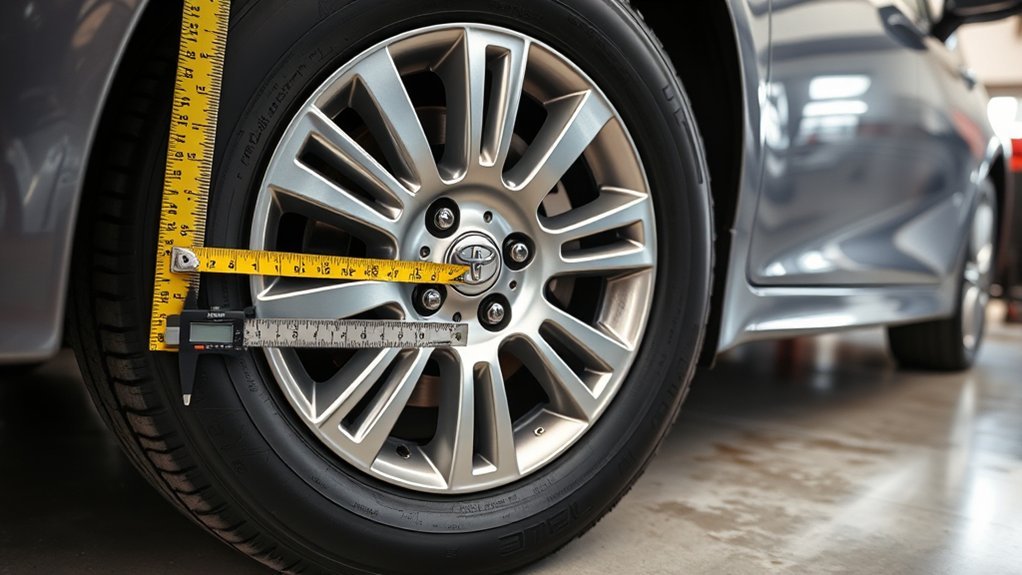
Start with the information Toyota already provides for your Camry. The NHTSA TireWise guide recommends checking the owner’s manual or the Tire and Loading Information label on the driver’s side door edge or doorjamb for the correct tire size and pressure. This does not always list every wheel measurement, but it gives you the factory tire size your wheels must support.
After that, inspect the back side or inner barrel of the wheel. Many wheels have stamped or cast markings such as 17x7J, 18×7.5J, or ET45. These markings are often more accurate than measuring a mounted wheel with a tape measure.
- Find the wheel marking. A marking like 17x7J ET45 means 17-inch diameter, 7-inch nominal width, J bead profile, and +45 mm offset.
- Measure diameter if the marking is missing. Measure across the bead-seat area where the tire seals, not across the outer rim lip. This is easiest with the tire removed from the wheel.
- Measure width. Measure bead seat to bead seat across the inner barrel. Do not include the outer lips.
- Measure backspacing. Lay the wheel face down on a soft surface, place a straightedge across the rear lip, and measure down to the mounting pad.
- Calculate offset if needed. Find the wheel centerline, compare it with the mounting pad, then convert the result to millimeters.
- Confirm bolt pattern and center bore. These must match your Camry or the wheel may not mount safely.
Warning: If you remove a wheel, park on level ground, set the parking brake, chock the opposite wheels, use the correct jack point, and never place any part of your body under a car supported only by a jack. Use a torque wrench when reinstalling the wheel nuts.
Measuring Wheel Width Correctly
Wheel width is the inside bead-seat measurement, not the full outside-to-outside width of the rim. That detail matters because the outer lips add extra width and can make a 7-inch wheel look closer to 8 inches when measured incorrectly.
Place the wheel face down on a clean, soft surface. Use a caliper or a tape measure to measure from one bead seat to the opposite bead seat. If the tire is still mounted, you may not be able to measure this exactly, so the stamped wheel size is usually the better reference.
Width affects tire fitment, sidewall shape, and clearance near the strut, fender, and suspension. A tire does not fit every wheel with a similar number. Check the tire maker’s approved rim-width range before pairing a new tire with a Camry wheel. Tire Rack explains that tires are designed for a range of rim widths, and section width can change as rim width changes.
Pro Tip: Clean the inside of the wheel and use a flashlight before measuring. Wheel stamps can hide under brake dust, adhesive weight residue, or old balancing marks.
Understanding Wheel Offset: What It Is and Why It Matters
Wheel offset tells you where the wheel sits compared with the hub mounting surface. Tire Rack defines wheel offset as the distance from the hub mounting surface to the wheel centerline, measured in millimeters. The wrong offset can cause rubbing, poor brake clearance, heavier steering feel, or uneven tire wear.
Key Offset Types
Offset can be positive, zero, or negative. Most modern front-wheel-drive sedans, including many Toyota Camry models, use positive-offset wheels. That does not mean every Camry uses the same offset, so always verify your year, trim, and wheel package.
| Offset Type | What It Means | Fitment Effect |
|---|---|---|
| Positive offset | Mounting pad sits toward the wheel face. | Wheel tucks farther inward toward the brakes and suspension. |
| Zero offset | Mounting pad lines up with the wheel centerline. | Wheel sits evenly inward and outward from the hub. |
| Negative offset | Mounting pad sits toward the back side of the wheel. | Wheel pushes outward and may rub the fender on a Camry. |
How to Calculate Offset From Backspacing
Backspacing and offset describe the same wheel position from different angles. Discount Tire explains that backspacing is the distance from the mounting surface to the back lip of the wheel, while offset is the distance from the mounting surface to the centerline.
Use this basic formula when you have the wheel off the car:
Offset in inches = backspacing − half of the measured overall wheel width. Then multiply the answer by 25.4 to convert inches to millimeters.
For the best result, measure the full outside-to-outside wheel width when calculating centerline from backspacing. Do not use the nominal width stamped on the wheel unless you account for the rim lips, because the stamped width is the bead-seat width.
Impact on Handling
The way your wheels sit relative to your Camry’s body and suspension affects steering feel, tire clearance, brake clearance, and ride quality. More positive offset usually tucks the wheel inward. Less positive or negative offset pushes it outward. Either change can create problems if the wheel no longer clears the strut, fender, brake caliper, or inner liner.
| Fitment Choice | Likely Result |
|---|---|
| Correct offset | Good brake, fender, and suspension clearance with normal steering behavior. |
| Too much positive offset | Wheel may sit too far inward and contact suspension or brake parts. |
| Too little positive offset | Wheel may stick outward and rub the fender or liner during turns or bumps. |
| Wrong width and offset together | Higher chance of rubbing, uneven tire wear, vibration, or poor handling. |
Tools You Need for Accurate Measurements
You can read basic wheel markings with only a flashlight, but accurate manual measurement needs a few simple tools. A tape measure works for quick checks, while a caliper gives cleaner width and bore measurements.
[Products Worth Considering]

Upgrade your wheels with MIKKUPPA M12x1.5 mag seat lug nuts built for secure, corrosion-resistant performance. These closed-end chrome lug nuts are a direct replacement for select Toyota models, including Camry, Corolla, RAV4, Sienna, Avalon, Highlander, Matrix, Venza, and Prius. Triple-chromium plating and cold-forged, heat-treated steel help deliver strength for daily driving and replacement needs.

Upgrade your wheels with MIKKUPPA closed-end lug nuts designed for reliable fit and corrosion resistance. The one-piece, cold-forged and heat-treated steel construction helps resist rust and stripping, while the integrated finish delivers a durable black appearance. Built to OEM standards with a conical 60-degree seat, these nuts provide a secure solution for compatible Ford, Honda, Jeep, and Chevrolet models.
Black Magic Intense Foam Wheel & Tire Cleaner uses a high-foaming action to lift away dirt, grime, and brake dust without scrubbing. The color-changing formula helps show contaminants being dissolved as foam turns from white to brown. Safe for all wheel types and even wheel wells, it leaves a like-new, slick finish with a fresh cherry scent.
Essential Measuring Tools
- Tape measure: Useful for quick diameter, overall width, and backspacing checks.
- Caliper: Better for center bore, wheel width, and small measurements.
- Straightedge: Needed to measure backspacing from the rear wheel lip to the mounting pad.
- Flashlight: Helps you read stamped markings inside the wheel barrel.
- Wheel chocks: Help keep the vehicle from moving if you remove a wheel.
- Jack and jack stand: Needed only if you remove the wheel. Use the correct jack point.
- Torque wrench: Needed when reinstalling wheel nuts to the specification in your owner’s manual.
Understanding Measurement Units
Wheel diameter and width are usually listed in inches, such as 17×7. Offset is usually listed in millimeters, such as ET45. Bolt pattern is usually listed as lug count by bolt-circle diameter, such as 5×114.3.
When converting offset from inches to millimeters, multiply by 25.4. For example, 1 inch equals 25.4 mm. Small differences matter because a 5 mm to 10 mm offset change can affect brake, fender, and suspension clearance.
Common Mistakes to Avoid When Measuring Wheels
Wheel-measurement mistakes usually happen when you measure the wrong part of the rim or assume every Camry uses the same fitment. Avoid these common errors before you buy new wheels.
- Measuring the outside lip for diameter: Use the bead-seat diameter or the stamped wheel size instead.
- Measuring outer lip to outer lip for nominal width: Wheel width is bead seat to bead seat.
- Confusing backspacing with offset: Backspacing is one measurement. Offset requires comparing the mounting pad with the wheel centerline.
- Ignoring bolt pattern: A wheel with the wrong bolt pattern will not mount correctly.
- Ignoring center bore: A bore that is too small will not fit over the hub. A larger bore may need proper hub-centric rings.
- Skipping brake clearance: Diameter, width, and offset do not guarantee caliper clearance on every trim.
- Using one forum number for all Camrys: Verify by year, trim, wheel package, and market.
Note: The tire size on the sidewall, such as P215/55R17, tells you the tire’s rim diameter requirement. It does not tell you wheel width, offset, center bore, or bolt pattern.
Importance of Proper Wheel Size for Performance
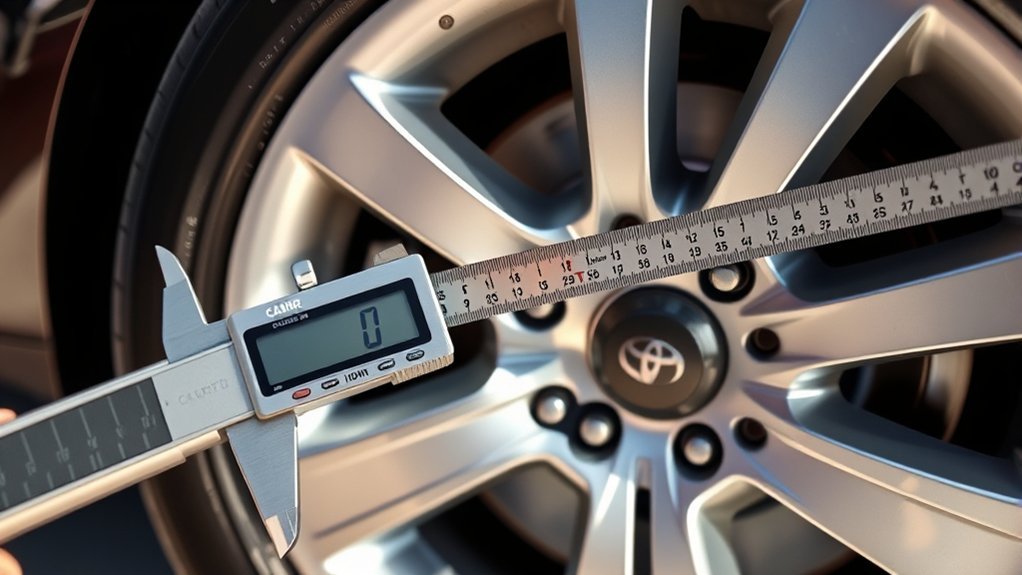
Proper wheel size affects how your Toyota Camry steers, brakes, rides, and wears tires. A wheel that is too wide, too far inward, or too far outward can rub during turns or suspension travel. A wheel that does not clear the brake caliper can be unsafe even if the bolt pattern matches.
Diameter also matters because the tire and wheel must share the same rim diameter. Discount Tire notes that the key wheel-fitment dimensions are diameter, width, bolt pattern, and offset. If you change wheel diameter, choose a matching tire size that keeps overall tire diameter close to factory size so speedometer accuracy, ride height, and clearance stay within a safe range.
Tire pressure still matters after you choose the correct wheel. The U.S. Tire Manufacturers Association explains that proper inflation helps tires support the vehicle and helps you control it. Check pressure when tires are cold and follow the pressure listed on the Camry’s label or owner’s manual, not the maximum number molded on the tire sidewall.
Tips for Choosing the Right Wheels
Choosing the right wheels for your Toyota Camry is not only about style. You need the correct size, load rating, bolt pattern, center bore, lug hardware, and brake clearance.
- Match your year and trim: Use your Camry’s exact model year, trim, drivetrain, and original wheel package when checking fitment.
- Confirm diameter and width: Recent Camry models commonly use 17-, 18-, or 19-inch wheels, but older models and different markets may vary.
- Check offset range: Stay close to proven Camry fitments unless a wheel specialist confirms clearance.
- Verify bolt pattern: Many Camrys use 5×114.3, but confirm before buying.
- Verify center bore: Many Camrys use a 60.1 mm center bore. Do not assume without checking.
- Verify lug hardware: Many Camrys use M12x1.5 lug nuts, but wheel seat type also matters.
- Choose the right material: Steel wheels are often durable and budget-friendly. Alloy wheels are often lighter and offer more styling choices.
- Check load rating: Each wheel must be rated to support the vehicle safely.
- Keep TPMS in mind: If your Camry has tire pressure monitoring sensors, make sure the new wheel setup supports them.
[Products Worth Considering]

This 3-piece wheel brush set makes it easy to clean wheels and tires with soft, scratch-free brushes designed for lifting brake dust and grime. The flexible rim brush bends up to 360 degrees to reach hard-to-access areas for a thorough clean, while the comfortable grip helps control during detailing. A dedicated detailing brush supports gentle cleaning for sensitive surfaces, including interior use.

This professional wheel and rim cleaning brush set lifts brake dust, grime, and dirt with soft, scratch-free microfiber and synthetic wool fibers. The rim brush bends up to 360 degrees for easy access to hard-to-reach areas around spokes, lips, and faces. Ideal for thorough cleaning of car, truck, motorcycle, bicycle, RV, and more wheel and tire surfaces.

These M14x1.5 closed-end chrome lug nuts are a one-piece replacement designed for secure fitment on compatible GM, Ford, and select Chrysler/Dodge models. Featuring a 60-degree conical seat and anti-rust chrome plating, they help resist corrosion and maintain a bright look for everyday driving. Built for long-term durability, they include OEM-style part references and are backed by 12 months of support.
When to Consult a Professional for Measurements
Consult a wheel or tire professional if your measurements do not match the factory information, the wheel has no readable markings, or you are changing diameter, width, or offset. A professional can test brake clearance, confirm hub fit, check lug-seat compatibility, and help you choose a tire size that keeps overall diameter close to factory.
You should also get help if the wheel is bent, cracked, heavily corroded, or missing TPMS parts. Damaged wheels can leak air or vibrate even when the size is correct.
If you remove and reinstall a wheel yourself, tighten the wheel nuts in a star pattern and use the torque value listed in your exact owner’s manual. Toyota owner documentation commonly lists wheel nut torque in the tire and wheel specifications section, but you should confirm the value for your specific Camry year and wheel type.
Before You Buy: Fitment Checks
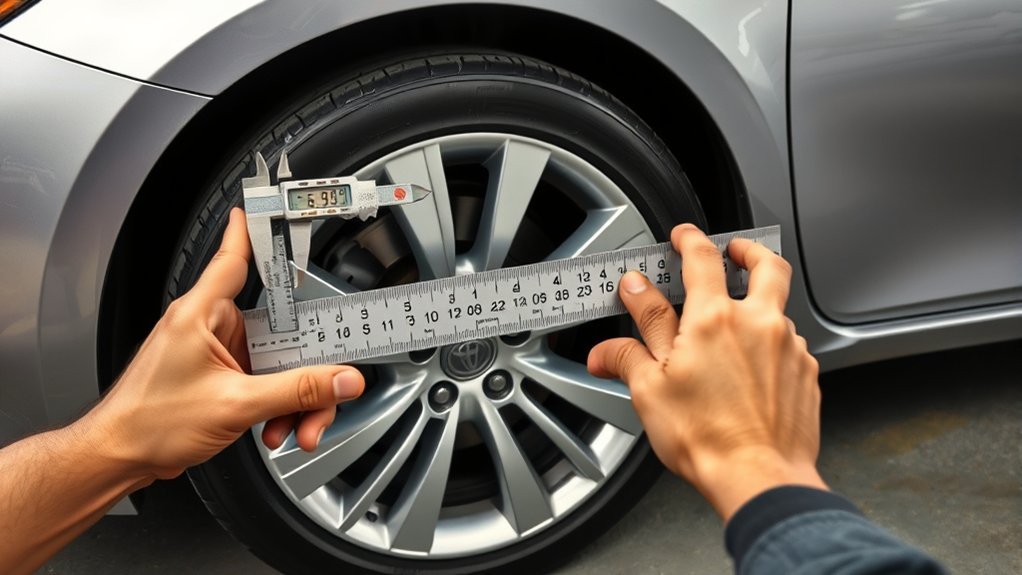
Before ordering new Camry wheels, write down every measurement in one place. This prevents you from choosing a wheel that looks right online but fails at the hub, brakes, or fender.
| Fitment Item | What to Check |
|---|---|
| Diameter | Must match the tire’s rim diameter, such as 17-inch tire on a 17-inch wheel. |
| Width | Must fall within the tire’s approved rim-width range. |
| Offset | Must keep the wheel clear of brakes, struts, suspension, fenders, and liners. |
| Bolt pattern | Must match exactly. Many Camrys use 5×114.3, but verify your exact vehicle. |
| Center bore | Must fit over the hub. Many Camrys use 60.1 mm, but confirm before buying. |
| Lug nuts | Thread pitch and seat style must match the wheel and vehicle. |
| TPMS | New wheels must support the correct sensors if your Camry uses TPMS. |
[Products Worth Considering]

Clean wheels and rims with soft feathered bristles that safely remove dirt and road grime while helping restore original luster. The short non-slip handle makes it easy to scrub in tight wheel wells, and the brush is suitable for vehicles and hard-to-reach areas. It can also be soaked and rubbed to help restore bristles to their shape after use.

This 3-piece wheel and tire brush set makes it easy to clean light, medium, and heavy dirt from wheels, rims, tires, and exterior surfaces. It includes both soft and stiff bristle options for gentle scrubbing and tough grime removal, helping lift brake dust and road buildup. The long-handle design supports comfortable cleaning across cars, trucks, SUVs, RVs, motorcycles, and more, with simple care instructions to restore brush shape.

Replace worn wheelchair rear tires with a universal 24x1 no-flat polyurethane foam option designed to mount tightly on 24-inch rims without the tire falling off. Installation is made easier with included tools and multiple methods, including using a pry bar or softening the tire in hot water to reduce resistance. The package includes two tires plus tie ropes for convenient fitting and handling.
Frequently Asked Questions
Can I use a tape measure for wheel measurements?
Yes, you can use a tape measure for quick checks, but it is not the most precise tool. Use it for backspacing and general width checks. Use a caliper for center bore and smaller measurements. When possible, read the stamped wheel size instead of relying only on manual measurement.
What if my measurements differ from the factory specifications?
Double-check that you measured the bead seats, not the outer lips. Also confirm whether the wheels are aftermarket. If the numbers still differ, ask a tire or wheel professional to inspect the setup before you order replacements.
How often should I check my wheel size?
You do not need to measure wheel size on a fixed schedule. Check it when buying wheels or tires, replacing a damaged wheel, changing to aftermarket wheels, or confirming whether the current wheels are factory size.
Does wheel size affect fuel efficiency?
Yes, it can. Heavier wheels, wider tires, or tires with higher rolling resistance can reduce fuel economy. Incorrect tire pressure can also hurt fuel economy and tire wear, so follow the pressure listed on your Camry’s door label or owner’s manual.
Can I measure wheels without removing them from the car?
You can read tire size, inspect visible markings, and estimate some dimensions while the wheel is on the car. For accurate wheel width, backspacing, offset, and center bore, remove the wheel or ask a shop to measure it safely.
What does ET mean on a wheel?
ET is the offset marking. For example, ET45 means the wheel has a positive 45 mm offset. On many Camry setups, staying close to the original offset helps maintain proper brake, fender, and suspension clearance.
Conclusion
Measuring your Toyota Camry’s wheel size correctly starts with the factory information, then moves to the wheel stamp and careful measurement. Focus on bead-seat diameter, bead-seat width, offset, bolt pattern, center bore, and lug hardware. If any number does not match your owner’s manual, door label, or trusted fitment data, get professional help before buying or installing wheels.
The right wheel setup helps your Camry maintain safe clearance, smooth steering, stable braking, and even tire wear. Take a few extra minutes to measure carefully now so you can avoid rubbing, vibration, TPMS issues, or costly returns later.
Sources
- NHTSA TireWise — backs up using the owner’s manual or Tire and Loading Information label for tire size and pressure.
- Discount Tire Wheel Size Basics — backs up wheel diameter, width, bolt pattern, and offset definitions.
- Tire Rack Wheel Offset Guide — backs up positive, zero, and negative offset definitions.
- Discount Tire Offset and Backspacing Guide — backs up the difference between offset and backspacing.
- Tire Rack Rim Width Range Guide — backs up tire-to-wheel rim-width compatibility guidance.
- U.S. Tire Manufacturers Association Tire Care Essentials — backs up tire pressure, control, and tire-care guidance.