Measuring wheel offset on a Honda Accord is a simple tape-measure job, but the details matter. You need the wheel’s overall width, its backspacing, and a clean centerline calculation before you can compare the result with the factory-style offset for your Accord’s year, trim, and wheel size.
Quick Answer
To measure Honda Accord wheel offset, place the wheel face down, measure its total outside width, divide that number by two to find the centerline, then measure backspacing from the rear rim lip to the hub mounting pad. Offset equals backspacing minus centerline, converted to millimeters.
Key Takeaways
- Wheel offset is the distance between the hub mounting surface and the wheel centerline.
- Backspacing and offset describe wheel position from different reference points, so do not treat them as the same number.
- Honda Accord offset varies by model year, trim, and wheel size; do not assume every Accord uses +55mm offset.
- Always test-fit aftermarket wheels and check brake, suspension, fender, and full-lock steering clearance before driving.
At a Glance
| Time Required | 10–20 minutes per wheel |
| Difficulty | Easy if the wheel is removed from the car |
| Tools Needed | Straight edge, tape measure or ruler, notepad, calculator, soft towel or cardboard |
| Cost | $0 if you already own a tape measure and straight edge |
Why Wheel Offset Matters for Your Honda Accord
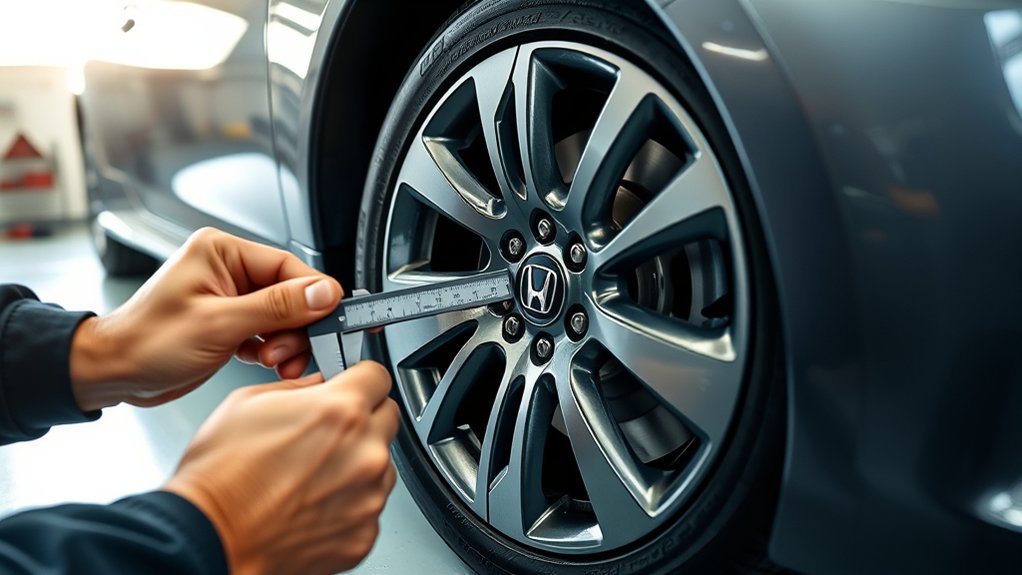
Wheel offset affects where the wheel and tire sit inside the Accord’s wheel well. The wrong offset can move the tire too far inward toward suspension and brake parts, or too far outward toward the fender. That can cause rubbing, poor steering feel, uneven tire wear, or extra stress on wheel bearings and suspension components.
Tire Rack defines wheel offset as the distance from the wheel’s hub mounting surface to the centerline of the wheel. A positive offset tucks the wheel inward, a negative offset pushes it outward, and zero offset places the mounting surface even with the centerline.
For a Honda Accord, the safest goal is not simply “more aggressive” or “more flush.” The goal is a wheel that matches the car’s bolt pattern, center bore, load rating, tire size, brake clearance, suspension clearance, and offset range for your exact model year.
Warning: Do not buy wheels based on offset alone. A wheel can have a reasonable offset and still fail to clear the Accord’s brake calipers, struts, fenders, or inner liners.
Getting to Know Wheel Offset and Its Types
Wheel offset is usually stamped as ET followed by a number, such as ET45 or ET50. “ET” is the wheel industry’s common offset marking. The number is measured in millimeters.
Positive Offset
A positive offset means the mounting surface is toward the front face of the wheel. Most modern front-wheel-drive sedans, including many Honda Accord wheels, use positive offset. Higher positive offset usually tucks the wheel farther inward.
Zero Offset
Zero offset means the mounting surface lines up with the wheel centerline. This is less common on modern Accord fitments.
Negative Offset
A negative offset means the mounting surface is toward the back side of the wheel. This pushes the wheel outward and creates a deeper-dish look, but it is usually not practical for a Honda Accord without major fitment changes.
Essential Tools for Accurate Measurement
You do not need specialty equipment to measure offset, but you do need to measure carefully. Gather these tools before you start:
- A straight edge, level, or flat board long enough to span the back of the rim
- A tape measure or ruler with inch and millimeter markings
- A calculator for inch-to-millimeter conversion
- A towel, cardboard sheet, or soft mat to protect the wheel face
- A notepad to record wheel width, backspacing, and final offset
Work on a flat surface and clean dirt or brake dust from the rim lips before measuring. Even a small angle in the straight edge can change your final offset number.
[Products Worth Considering]

The 22800 wheel stud installer makes replacing wheel studs quick and secure, saving time and effort during tire service. It uses a ratchet or impact wrench to pull new studs firmly into place, helping when existing studs are too long. Compatible with most automotive wheels and light-duty truck wheel studs, it’s designed for easy, tool-assisted installation.

This professional wheel and rim brush kit makes it easy to lift brake dust, grime, and dirt from wheels and tires without scratching finishes. The brushes feature soft, metal-free wool heads and a flexible 360-degree rim brush design for reaching hard-to-clean areas. Includes multiple brush types plus accessories for thorough car, motorcycle, and general vehicle detailing.

This professional wheel and rim cleaning brush set lifts brake dust, grime, and dirt with soft, scratch-free microfiber and synthetic wool fibers. The rim brush bends up to 360 degrees for easy access to hard-to-reach areas around spokes, lips, and faces. Ideal for thorough cleaning of car, truck, motorcycle, bicycle, RV, and more wheel and tire surfaces.
Find Your Accord Factory Wheel Specs First
Before measuring or buying new wheels, identify the factory wheel and tire package on your Accord. The current 2026 Honda Accord specifications list 17 x 7.5J wheels with 225/50R17 tires and 19 x 8.5J wheels with 235/40R19 tires, depending on trim. Honda’s public specs list wheel and tire sizes, but they may not publish offset for every wheel.
For offset, look for the ET marking on the back of the wheel or use a reliable fitment database for your exact year and trim. For example, Wheel-Size lists 2026 Accord OE examples as 17 x 7.5J ET45 and 19 x 8.5J ET50. Treat these as examples only; always verify your actual wheel stamping or your vehicle-specific fitment data.
| Example Accord wheel | Factory tire example | Example OE offset listing |
|---|---|---|
| 17 x 7.5J | 225/50R17 | ET45 on some 2026 Accord fitments |
| 19 x 8.5J | 235/40R19 | ET50 on some 2026 Accord fitments |
Note: Older Accord wheels may use different offsets, widths, tire sizes, and bolt-pattern details. Always check your specific model year instead of copying specs from another generation.
[Products Worth Considering]

This oesee 8-piece wheel care kit helps you clean, scrub, and dry wheels safely with purpose-built brushes and towels. The scratch-free microfiber wheel brush lifts brake dust and grime, while the stiff pro-grip tire brush removes tire browning and embedded dirt. A twist loop microfiber drying towel and an applicator help achieve a streak-free finish and cleaner, more even product application.

The SPTA wheel and tire brush kit makes it easy to remove dirt from wheels, rims, and hard-to-reach areas without needing a high pressure washer. Ergonomic handles and soft, chemical-resistant bristles help you clean faster while reducing the risk of scratching. The set is versatile for cars, trucks, motorcycles, bicycles, RVs, boats, and more.

This 3-piece wheel brush set makes it easy to clean wheels and tires with soft, scratch-free brushes designed for lifting brake dust and grime. The flexible rim brush bends up to 360 degrees to reach hard-to-access areas for a thorough clean, while the comfortable grip helps control during detailing. A dedicated detailing brush supports gentle cleaning for sensitive surfaces, including interior use.
Step-by-Step Guide to Measuring Wheel Width
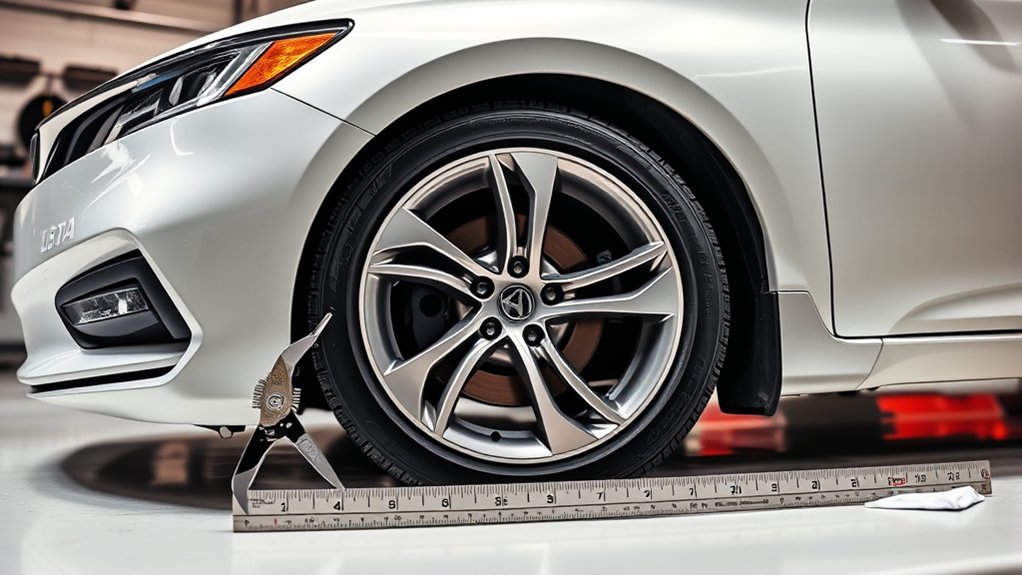
Wheel width can be confusing because the stamped size, such as 17 x 7.5J, refers to the bead-seat width, not the total outside width from lip to lip. For offset measurement, use the total physical width if you are measuring the wheel by hand.
- Remove the wheel from the car and place it face down on a towel or cardboard.
- Make sure the wheel sits flat and the rear lip is easy to reach.
- Measure from the outer edge of one rim lip to the outer edge of the opposite rim lip.
- Write down this total outside width in inches or millimeters.
- Divide the total outside width by two to find the wheel centerline.
| Stamped wheel width | Approximate total outside width | Why it matters |
|---|---|---|
| 7.5 in. | About 8.5 in. | Rim lips add width beyond the stamped bead-seat size. |
| 8.5 in. | About 9.5 in. | Using only stamped width can make the offset calculation wrong. |
Measuring Wheel Backspacing
Backspacing is the distance from the hub mounting surface to the back lip of the wheel. It tells you how much of the wheel sits inward toward the suspension.
- Keep the wheel face down on a protected, flat surface.
- Lay a straight edge across the rear rim lip so it touches both sides evenly.
- Measure straight down from the bottom of the straight edge to the hub mounting pad.
- Record the number as backspacing.
- Use the same unit you used for wheel width, or convert before calculating offset.
Pro Tip: Measure backspacing twice from different points on the straight edge. If the two numbers do not match, the straight edge is probably tilted or the wheel is not sitting flat.
Calculating Offset: The Simple Formula Explained
Once you have total wheel width and backspacing, calculate offset with this formula:
Offset = Backspacing − Wheel Centerline
If your measurements are in inches, convert the final result to millimeters:
Offset in mm = (Backspacing in inches − Centerline in inches) × 25.4
If your measurements are already in millimeters, subtract centerline from backspacing and keep the result in millimeters.
Worked Example
Suppose you measure a 17 x 7.5 wheel and the total outside width is about 8.5 inches. Half of that is a 4.25-inch centerline. If the backspacing is 6.02 inches, the offset calculation is:
- 6.02 − 4.25 = 1.77 inches
- 1.77 × 25.4 = 44.96mm
- Rounded result: ET45
That result matches the kind of positive offset used on many Accord-style fitments.
How to Check Clearance Before Driving
Aftermarket wheel fitment is not finished when the offset number looks close. The wheel and tire assembly still needs a physical clearance check.
- Install the wheel by hand and confirm it seats flat against the hub.
- Check spoke clearance around the brake caliper.
- Check inner barrel clearance near suspension arms, struts, and brake lines.
- Turn the steering wheel fully left and fully right to check front tire clearance.
- Lower the car to ride height and recheck fender and liner clearance.
- Confirm the wheel load rating, tire load rating, and lug-seat type match the vehicle.
- After driving, recheck fastener torque according to the wheel or vehicle manufacturer’s instructions.
The NHTSA-hosted aftermarket wheel installation guidelines advise installers to review manufacturer information, test-fit wheels, and check load ratings, offset, and clearance before installation. They also advise a fastener torque check within the first 100 miles or 2–3 days after installation.
Avoid These Common Mistakes in Wheel Offset Measurement
Most wheel-offset mistakes come from mixing units, using the wrong width, or skipping the test fit. Use this checklist before trusting your number.
| Common Mistake | Why It Causes Problems | Better Method |
|---|---|---|
| Using stamped width as total width | Stamped width does not include the outer rim lips. | Measure total outside width or add about 1 inch to stamped width. |
| Calling offset “backspacing” | They use different reference points and often different units. | Measure both separately, then calculate offset. |
| Mixing inches and millimeters | The final offset number becomes inaccurate. | Convert before subtracting, or convert only the final inch result to mm. |
| Measuring with a tilted straight edge | A small angle can change the backspacing reading. | Use a rigid straight edge that touches both rear rim lips evenly. |
| Skipping front and rear checks | Brake, steering, and suspension clearance can differ by axle. | Test-fit on the exact corner where the wheel will be used. |
Selecting Offset for Honda Accord Custom Builds
Choosing offset for a custom Honda Accord build is a balance between fitment, handling, clearance, and appearance. A lower positive offset pushes the wheel outward for a more flush look. A higher positive offset tucks the wheel inward and may improve fender clearance, but it can reduce inner clearance near struts or suspension parts.
[Products Worth Considering]

Upgrade your wheels with MIKKUPPA closed-end lug nuts designed for reliable fit and corrosion resistance. The one-piece, cold-forged and heat-treated steel construction helps resist rust and stripping, while the integrated finish delivers a durable black appearance. Built to OEM standards with a conical 60-degree seat, these nuts provide a secure solution for compatible Ford, Honda, Jeep, and Chevrolet models.

These M14x1.5 closed-end chrome lug nuts are a one-piece replacement designed for secure fitment on compatible GM, Ford, and select Chrysler/Dodge models. Featuring a 60-degree conical seat and anti-rust chrome plating, they help resist corrosion and maintain a bright look for everyday driving. Built for long-term durability, they include OEM-style part references and are backed by 12 months of support.

This heavy-duty bicycle rim liner provides complete tube protection by shielding the inner tube from rim spoke holes and sharp metal burrs that can cause flats. Made from premium, wear-resistant PVC, it lays flat with optimized 18 mm width and 0.50 mm thickness for edge-to-edge coverage. Installation is quick with flexible stretch placement and a secure, non-slip fit.
Ideal Offset Range
There is no single perfect offset for every Honda Accord. Start with the factory offset for your exact year, trim, and wheel size. Then compare any aftermarket wheel by looking at both offset and width. A 19 x 8.5 ET50 wheel and a 17 x 7.5 ET45 wheel will sit differently even though both are positive-offset wheels.
For a mild daily-driver setup, stay close to the factory-style offset and tire diameter. For a flush setup, use a fitment calculator and test-fit the wheel before mounting all four tires. For an aggressive stance, expect a higher chance of rubbing, fender work, alignment changes, or faster tire wear.
Visual Aesthetic Considerations
A positive offset keeps the wheel tucked for a clean factory-style look. A slightly lower positive offset can move the wheel closer to flush with the fender. Too little offset can push the tire past the body line and make the car look unfinished, especially if the tire rubs or the alignment has to be compromised.
| Fitment Goal | Typical Offset Direction | Main Risk |
|---|---|---|
| OEM-like comfort | Close to factory offset | Lowest risk when tire size also matches |
| Flush street look | Slightly lower positive offset | Fender or liner rubbing |
| Aggressive stance | Much lower positive offset | Poor clearance, extra wear, and alignment compromises |
Performance Impact Analysis
Offset changes can alter track width, scrub radius, steering feel, and the load path through suspension and wheel-bearing parts. A small change may be fine when the wheel width and tire size are also appropriate. A large change can make the Accord tramline, rub under compression, or wear tires unevenly.
Note: Alignment settings, lowering springs, tire model, and tire width can change fitment even when two wheels have the same offset.
Frequently Asked Questions
What does +35 offset mean on a rim?
A +35 offset means the wheel’s hub mounting surface is 35 millimeters outward from the wheel centerline, toward the front face of the wheel. Compared with a higher positive offset, a +35 wheel usually sits farther outward.
How much is a 12 mm offset in inches?
A 12 mm offset is about 0.47 inches because 12 divided by 25.4 equals 0.472. Wheel offset is normally listed in millimeters, so keep the final offset number in mm when comparing wheels.
Where is the offset stamped on a Honda Accord wheel?
Look on the back side of the wheel spokes or inner barrel for a marking such as ET45, ET50, or another ET number. You may also see the wheel size, such as 17×7.5J or 19×8.5J.
Can I measure offset with the tire still mounted?
You can sometimes estimate it, but measuring is easier and more accurate with the tire removed. A mounted tire can block the rim lips and make the straight edge harder to place correctly.
Is backspacing the same as offset?
No. Backspacing measures from the hub mounting surface to the back lip of the wheel. Offset measures from the hub mounting surface to the wheel centerline. They are related, but they are not the same measurement.
Will a lower offset make my Honda Accord rub?
It can. Lower positive offset pushes the wheel outward, which may improve stance but can create fender or liner rubbing. The final result depends on wheel width, tire size, ride height, alignment, and suspension travel.
Conclusion
Measuring Honda Accord wheel offset comes down to three numbers: total wheel width, centerline, and backspacing. Once you calculate the offset in millimeters, compare it with the factory-style specs for your Accord’s year, trim, and wheel size. A close offset is a good start, but safe fitment also requires checking tire size, brake clearance, suspension clearance, fender clearance, load rating, and lug-seat compatibility before you drive.
Sources
- Tire Rack — What Is Wheel Offset? — supports wheel offset definition and positive/zero/negative offset explanations.
- Discount Tire — Understanding Wheel Offset and Backspacing — supports backspacing definition and measurement method.
- Honda Newsroom — 2026 Honda Accord Specifications & Features — supports current Accord wheel and tire size examples.
- Honda Info Center — 2026 Accord Wheels and Tires — supports trim-level wheel and tire context.
- Wheel-Size — 2026 Honda Accord Wheel & Tire Sizes — supports OE offset examples by wheel size.
- NHTSA-hosted WTC/SEMA Aftermarket Wheel Installation Guidelines — supports test-fit, clearance, load-rating, and torque-recheck safety guidance.