
For most Honda Accord models with same-size, non-directional tires, the correct tire rotation pattern is the forward cross. That means the front tires move straight to the rear, while the rear tires move to the front and cross sides. Rotating your Accord tires on schedule helps even out front-tire wear, protect handling, and spot tire problems before they become expensive.
Quick Answer
Use the forward cross tire rotation pattern on a Honda Accord with same-size, non-directional tires: front tires go straight back, rear-left moves to front-right, and rear-right moves to front-left. Rotate about every 5,000 to 8,000 miles, or when your Honda Maintenance Minder or tire wear says it is time.
Key Takeaways
- Most Honda Accord models use a front-wheel-drive forward cross pattern when all four tires are the same size and are not directional.
- A practical rotation interval is 5,000 to 8,000 miles, but your owner’s manual, Honda Maintenance Minder, tire warranty, and wear pattern come first.
- Do not cross directional tires; rotate them front-to-rear on the same side unless the tires are dismounted and remounted.
- Check tire pressure, tread depth, sidewall damage, and uneven wear during every rotation.
- Use jack stands and a torque wrench, or have a shop do the rotation if you are not set up to lift the car safely.
At a Glance
| Time Required | 30 to 60 minutes for a careful DIY rotation; less at a tire shop or service center |
| Difficulty | Moderate DIY job because the vehicle must be lifted and supported safely |
| Tools Needed | Owner’s manual, wheel chocks, floor jack, jack stands, lug wrench or breaker bar, torque wrench, tire pressure gauge, tread-depth gauge |
| Cost | Often free with tire service or maintenance packages; commonly low-cost at a shop; DIY cost is mainly tools |
Why Tire Rotation Matters for Your Honda Accord

Your Honda Accord puts a lot of work on the front tires. They handle most of the steering load, much of the braking load, and, on most Accord models, the drive power. That is why the front tires often wear faster than the rear tires.
Regular tire rotation moves each tire to a different position so the set wears more evenly. This can help your Accord track straighter, ride smoother, maintain better wet-road traction, and get more life from the full set of tires.
According to NHTSA TireWise, poor tire maintenance, including failing to rotate tires, can contribute to flats, blowouts, and tread separation.
Tire rotation is also a good time to inspect tire pressure, tread depth, sidewall damage, and uneven wear. The National Highway Traffic Safety Administration recommends checking tire pressure at least once a month when tires are cold and replacing tires when tread is worn down to 2/32 inch.
When to Rotate Your Honda Accord Tires
A good rule for many Honda Accord owners is to rotate the tires about every 5,000 to 8,000 miles, or sooner if uneven wear appears. If your Accord has a Honda Maintenance Minder, follow its service reminder. If your tires have a separate warranty schedule, follow that too.
Many drivers pair tire rotation with oil changes because it is easier to remember. That works well if your oil-change interval is close to your tire rotation interval. If you drive very little, rotate at least about every six months so the tires are inspected on a regular schedule.
Note: Always check the owner’s manual for your exact Accord model year, trim, wheel size, and tire type. Honda’s official manual lookup is available through Honda Owners.
Rotate sooner if you notice the front tires wearing faster than the rears, feathered tread edges, cupping, vibration, or one tire becoming louder than the others. These signs can mean the tires need rotation, but they can also point to alignment, balance, or suspension issues.
Correct Honda Accord Tire Rotation Pattern

For most Honda Accord models with front-wheel drive, same-size wheels, and non-directional tires, use the forward cross pattern. The front tires move straight back. The rear tires move forward and cross sides.
| Tire Position Before Rotation | Move It To |
| Front left | Rear left |
| Front right | Rear right |
| Rear left | Front right |
| Rear right | Front left |
A rear-wheel-drive rotation pattern is not normally needed for a Honda Accord. If you are reading general tire advice for another vehicle, RWD vehicles often use a different pattern, but Accord owners should stay with the pattern that matches their actual drivetrain, tire size, and tire construction.
When Not to Use the Forward Cross Pattern
The forward cross pattern works only when the tires can safely change sides. Some tire and wheel setups need a different approach.
- Directional tires: If the sidewall has a rotation arrow, keep each tire on the same side and move it front-to-rear only, unless the tire is dismounted and remounted.
- Staggered tire sizes: If the front and rear tires are different sizes, do not rotate front-to-rear unless your owner’s manual and tire shop confirm it is allowed.
- Compact spare tire: Do not include a temporary compact spare in the rotation.
- Full-size matching spare: Only include it if it matches the other tires in size, type, load rating, and tread depth, and your owner’s manual allows a five-tire rotation.
Warning: If you are unsure whether your tires are directional, staggered, or safe to cross, do not guess. Check the tire sidewall and owner’s manual, or ask a qualified tire technician before rotating them.
[Products Worth Considering]

The ETENWOLF T600 digital tire pressure gauge delivers precise, manually calibrated readings to ANSI B40.7 Grade 2A standards with ±0.5% PSI accuracy. Its 360° rotating nozzle and display hold make it easy to check pressures from any angle, while a bleed button helps dial tires to the perfect level. With a 0–250 PSI range and support for PSI, BAR, and KPA, it’s a convenient tool for maintaining tire performance across many vehicles and seasons.
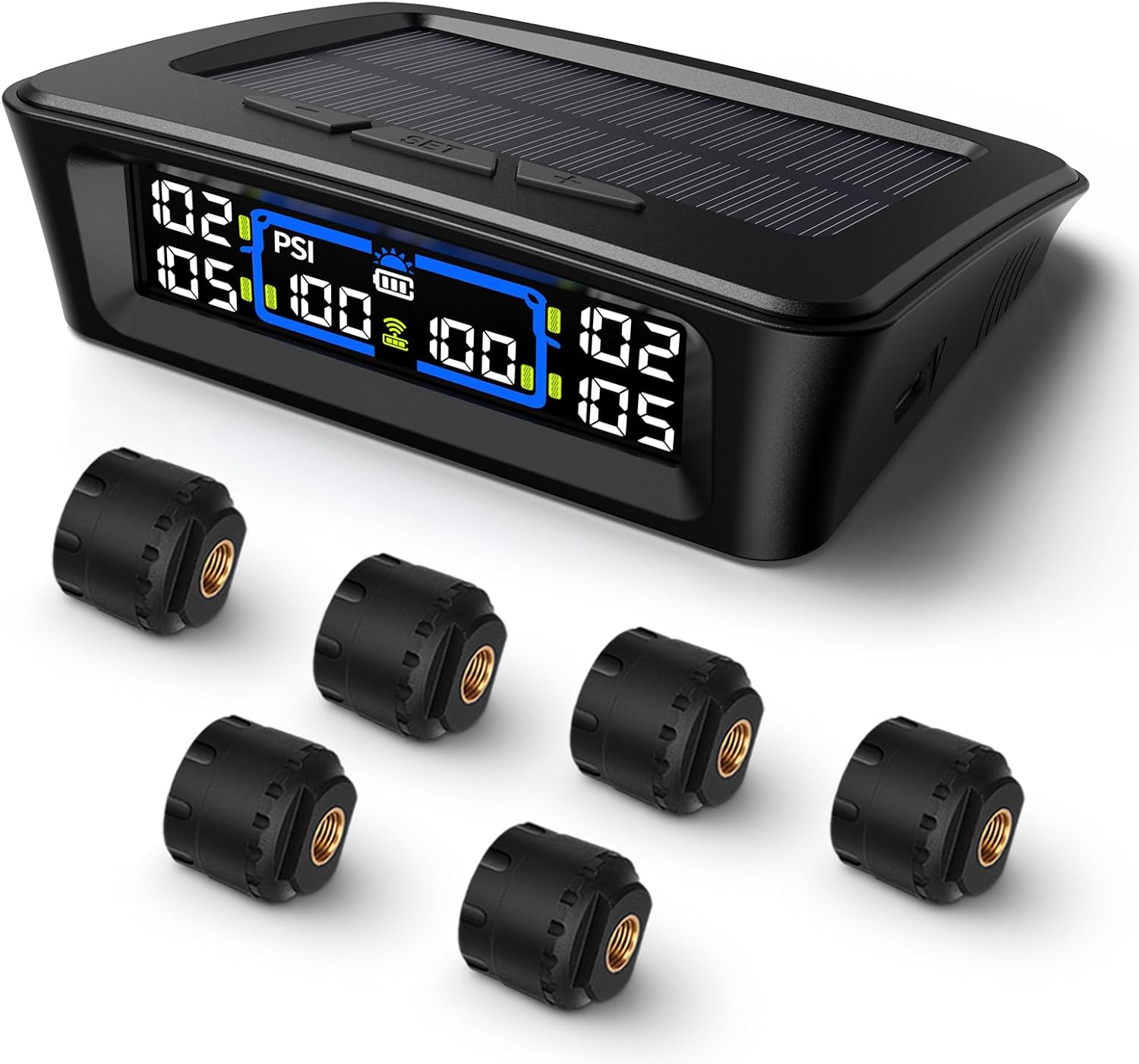
The Tymate TM12 RV TPMS delivers real-time tire pressure and temperature monitoring with a stable 433Hz display for safer long-distance driving. It supports simultaneous monitoring across vehicle and trailer zones, includes six alarm modes for pressure, temperature, leakage, battery, and signal loss, and features easy DIY installation with auto calibration. Power is supplied via USB-C charging or solar recharging, with a wide 0–144 PSI range and up to 50 ft signal coverage for RVs and towable trailers.

Monitor tire tread wear with a smart, color-coded depth gauge that shows clear condition ranges at a glance. The bar is range marked for fast, easy readings, helping you maintain safer traction and performance. Each gauge is portable with a pocket clip, and the set includes 20 units for daily use and sharing.
How to Rotate Honda Accord Tires Safely
You can rotate your Accord tires at home if you have the right tools and a safe work area. Work on level ground, set the parking brake, and chock the wheels before lifting the car.
- Check the pattern first. Confirm that all four tires are the same size and are not directional before using the forward cross pattern.
- Loosen the lug nuts slightly. Break them loose while the tires are still on the ground, but do not remove them yet.
- Lift and support the vehicle. Use the correct jacking points from the owner’s manual, then support the Accord with jack stands.
- Remove the wheels. Keep each wheel organized by its starting position so you do not mix up the pattern.
- Inspect each tire. Look for nails, bulges, cracks, exposed cords, uneven wear, and low tread depth.
- Move the tires to the new positions. For forward cross, front tires go straight back and rear tires cross to the front.
- Hand-start the lug nuts. Tighten them lightly in a star pattern so the wheel seats evenly.
- Lower the vehicle and torque the lug nuts. Use a torque wrench and the specification in your owner’s manual or wheel documentation.
- Set tire pressure cold. Use the pressure on the driver-door tire placard, not the maximum pressure printed on the tire sidewall.
- Reset or check TPMS if required. Some Accord systems need calibration after rotation or pressure adjustment. Follow the dashboard menu or owner’s manual for your model year.
Warning: Never work under or around a vehicle supported only by a jack. A jack is for lifting. Jack stands are for support.
Pro Tip: Many Accord model years commonly use an 80 lbf-ft wheel-nut torque value, but do not treat that as universal. Confirm the exact value in your owner’s manual, especially if you have aftermarket wheels.
[Products Worth Considering]

The SAFELIFE dial tire tread depth gauge measures tread depth in 1/32 inch increments with clear, easy-to-read 2-inch dial face. Color zones using a traffic light system help you quickly judge whether tread is low, marginal, or ample for safer driving. Built with a durable zinc cast body and a metal detect probe for precise, comfortable use across cars, motorcycles, trucks, and buses.

Measure tire tread depth quickly and accurately with this LUMITECO dial gauge that reads in 1/32" increments up to 14/32". The color-coded green/yellow/red zones make it easy to judge tire wear and know when replacement is needed. A rugged, compact design with a protective pouch helps keep the gauge ready for use on cars, trucks, motorcycles, and more.

The Dr.Roc spare tire tool kit helps you release, lower, or raise your spare tire with reliable extension tools and a lug nut wrench. It is made from rustproof automotive-grade steel and includes an organized carry case for convenient storage. Designed for compatibility with select GM models from the late 1990s through 2019, it uses upgraded extension components to install and remove spare tires with less hassle.
Signs Your Honda Accord Needs a Tire Rotation Now
Your Accord may need a tire rotation sooner than the mileage schedule if the tires are wearing unevenly. Look for these signs during normal driving and monthly tire checks:
- Front tires look more worn than rear tires: This is common on front-wheel-drive cars and usually means rotation is due.
- Feathered tread edges: Tread blocks feel smooth one way and sharp the other way, often from alignment or toe wear.
- Cupping or scalloping: Dips around the tread can point to worn suspension parts, balance problems, or delayed rotations.
- Steering wheel vibration: A shake at highway speed may require balancing, not just rotation.
- One tire is louder: Noise from one corner can mean irregular wear, a damaged tire, or a wheel bearing issue.
- The car pulls to one side: Rotation may help if tire wear is uneven, but alignment or tire pressure should also be checked.
If uneven wear returns quickly after rotation, schedule an alignment and suspension inspection. Tire rotation can spread wear more evenly, but it cannot fix a bent wheel, bad alignment, worn shocks, or damaged suspension parts.
What to Check During Every Tire Rotation
A tire rotation is more useful when you treat it as a quick tire health inspection. Before reinstalling each wheel, check these items:
- Tread depth: Replace tires when tread reaches 2/32 inch. For wet-weather confidence, many drivers replace earlier.
- Tire pressure: Check pressure when tires are cold, ideally before driving or after the car has been parked for at least three hours.
- Sidewall damage: Bulges, cracks, cuts, or exposed cords mean the tire needs professional inspection.
- Embedded objects: Nails or screws may cause a slow leak even if the tire still looks inflated.
- Valve stems: Check for cracking, leaks, or missing valve caps.
- Wear pattern: Inner-edge wear, outer-edge wear, center wear, and cupping all tell you something about pressure, alignment, or suspension.
Do not rely only on the tire pressure monitoring system. TPMS warns you when a tire is significantly underinflated, but it is not a replacement for monthly pressure checks with a gauge.
Tire Rotation vs. Alignment vs. Balancing
Tire rotation, alignment, and balancing are related, but they solve different problems.
- Tire rotation changes tire positions to even out wear across the set.
- Wheel balancing corrects weight imbalance in the wheel and tire assembly, often felt as vibration at speed.
- Wheel alignment adjusts suspension angles so the tires meet the road correctly and the car tracks straight.
If your Accord has vibration, pulling, crooked steering wheel position, or rapid edge wear, do not assume rotation alone will fix it. Have the tires, wheels, alignment, and suspension checked.
[Products Worth Considering]

The Trivd Frol 1/2" air impact wrench delivers high performance torque up to 1500 ft-lbs with a twin hammer impact mechanism for strong, balanced blows. It features an ergonomic grip, compact lightweight design, and quick-stop control with 3 forward speeds up to 8000 RPM plus a reverse speed. Built for demanding automotive repair and tire shop work, the rear exhaust helps keep debris away from the surface.

Accurately measure tire tread depth with a calibrated gauge marked from 0 to 1 inch in 1/32 inch increments. The color-coded bar helps you quickly identify tread condition ranges, supporting safe driving for trucks, motorcycles, automobiles, and passenger vehicles.

This 1/2-inch drive breaker bar delivers powerful leverage for loosening and tightening stubborn lug nuts and automotive fasteners. The 180-degree flex head helps you reach tight spaces at the angle you need, making tire and brake jobs easier. A spring-loaded ball detent design holds 1/2-inch sockets securely while the chrome-moly head provides durable strength for everyday use.
Top Tire Rotation Tips for Your Honda Accord
Keep your Honda Accord’s tire rotation simple and consistent. Use the forward cross pattern for same-size, non-directional FWD setups, keep a written record of the mileage, and inspect all four tires every time.
- Rotate on schedule, not only when the tires look worn.
- Set all tire pressures to the driver-door placard value when cold.
- Use a torque wrench, not just an impact wrench.
- Recheck lug-nut torque after the first short drive if your wheel or service guidance recommends it.
- Reset or calibrate TPMS if your Accord model requires it after rotation.
- Replace tires in sets when tread depth difference becomes too large for safe, predictable handling.
When replacing only two tires, ask the tire shop where the better pair should go for your tire type, road conditions, and vehicle setup. Many tire-safety organizations recommend keeping the better pair on the rear axle to help reduce oversteer risk in wet conditions.
Frequently Asked Questions
What is the correct tire rotation pattern for a Honda Accord?
For most Honda Accord models with same-size, non-directional tires, use the forward cross pattern. Move the front-left tire to rear-left, front-right to rear-right, rear-left to front-right, and rear-right to front-left. Check your owner’s manual first if your tires are directional, staggered, or aftermarket.
How often should I rotate Honda Accord tires?
A practical interval is about every 5,000 to 8,000 miles, or sooner if uneven wear appears. Follow your Honda Maintenance Minder, owner’s manual, and tire warranty schedule for the most accurate interval for your exact Accord and tire set.
Does the 2018 Honda Accord tell you which tire is low?
Do not rely on the warning light to identify the exact tire. Some systems give more detail than others, but TPMS is mainly a warning that at least one tire may be significantly underinflated. Check all four tires with a pressure gauge and use the driver-door placard pressure. Then follow the owner’s manual if TPMS calibration is required.
Can I rotate directional tires using the forward cross pattern?
No. Directional tires have a rotation arrow on the sidewall and must keep rolling in the correct direction. Rotate them front-to-rear on the same side unless a tire shop dismounts and remounts them correctly.
Do I need an alignment every time I rotate tires?
No. Tire rotation and alignment are different services. Rotate tires on schedule, but get an alignment if your Accord pulls to one side, the steering wheel is off-center, or the tires show rapid inner-edge, outer-edge, feathering, or cupping wear.
Conclusion
Regular tire rotation is one of the easiest ways to help your Honda Accord’s tires wear evenly. For most same-size, non-directional Accord tire setups, the forward cross pattern is the right choice: front tires move straight back, and rear tires cross to the front. Keep the schedule close to 5,000 to 8,000 miles, check pressure and tread depth during every rotation, and use the owner’s manual whenever your tire type, wheel size, or TPMS setup is different.
Sources
- NHTSA TireWise: Tire Safety Ratings and Awareness — tire pressure, tread depth, TPMS limits, rotation interval guidance, and tire safety maintenance.
- Honda Owners Manual Search — model-year owner’s manual lookup for exact Accord tire pressure, TPMS, jacking, and wheel-nut guidance.
- 49 CFR § 571.138: Tire Pressure Monitoring Systems — federal TPMS standard for passenger vehicles.
- NHTSA Recalls — tire and vehicle recall lookup for safety-related defects.