
Quick Answer
You can top off a nitrogen-filled tire with regular air whenever needed. The mix is safe; it simply lowers the nitrogen concentration and may reduce some of nitrogen’s small pressure-retention benefits. Never keep driving on an underinflated tire just to preserve nitrogen purity. Inflate to the vehicle placard pressure.
Key Takeaways
- Regular air is already about 78% nitrogen, so mixing the two gases is not unusual or dangerous.
- Nitrogen may leak through the tire casing a little more slowly, but punctures, valves, beads, and wheels can still cause pressure loss.
- Both nitrogen-filled and air-filled tires change pressure as temperature changes.
- Check pressure when the tires are cold and use the vehicle placard or owner’s manual, not the maximum pressure molded on the tire sidewall.
Can You Mix Nitrogen and Air in Tires?
Yes. The U.S. Tire Manufacturers Association says nitrogen and air can be mixed in any proportion, and that air should be added when nitrogen is not readily available if that is what it takes to restore the correct pressure.
Mixing changes the gas concentration, not the tire’s required pressure. A tire that started with a high-nitrogen fill will contain more oxygen and moisture after you add regular compressed air, but it can still be used normally.
Correct inflation pressure matters more than preserving a high nitrogen percentage.
Warning: Do not delay inflation because only regular air is available. Driving on an underinflated tire can increase heat buildup and damage the tire internally.
If a tire repeatedly loses pressure, topping it off is not the full fix. Check for a puncture, leaking valve, bead leak, or wheel problem.
How Do Nitrogen and Air Differ in Tires?
Nitrogen and compressed air both support the tire by creating pressure inside it. The main differences are gas composition, moisture content, and how quickly some gas can permeate through the tire casing.
Ordinary air is about 78% nitrogen. A nitrogen service uses a much higher concentration of nitrogen and is typically drier than shop air. Continental explains that all gases in a tire still respond to temperature changes; dry nitrogen mainly reduces moisture-related variation rather than eliminating temperature effects.
| Feature | Difference |
|---|---|
| Gas composition | Regular air is about 78% nitrogen; a nitrogen fill uses a higher nitrogen concentration |
| Moisture | Nitrogen service is typically drier than ordinary compressed air |
| Pressure loss through the casing | Nitrogen can reduce permeation slightly, but other leaks still matter |
| Temperature response | Both change pressure with temperature; dry nitrogen can reduce moisture-related variation |
Michelin states that compressed air and nitrogen can be mixed and that either can deliver normal tire performance when the correct recommended pressure is maintained.
What Happens When You Top Off Nitrogen Tires With Air?
When you add regular air to a nitrogen-filled tire, you dilute the nitrogen concentration. Nothing needs to be reset, and the tire does not suddenly become unsafe or unusable.
The practical change is small for most passenger vehicles. Adding air introduces more oxygen and potentially more water vapor, so some of the pressure-retention and moisture-control benefits associated with a high-nitrogen fill may be reduced.
The target pressure does not change. If the placard calls for a certain cold pressure, use that same value whether the tire contains air, nitrogen, or a mixture.
You also do not need to purge the tire just because you topped it off with air. Purging and refilling is only relevant if you specifically want to restore a higher nitrogen concentration.
[Products Worth Considering]

Autel MX TPMS sensors combine 315MHz and 433MHz in a single easy-to-install press-in design for faster tire service. They support wireless programming with strong signal performance, and the sensors are clone-able for streamlined replacement. Built for reliability and tested to SAE standards, each sensor includes a series number for quality control.

This TPMS relearn tool helps you quickly activate, match, and reset GM tire pressure sensors to keep the vehicle monitoring system working properly. It clears tire pressure alarms and dashboard warning lights after sensor replacement or tire rotation, and supports learning for common 315/433 MHz TPMS sensors. Designed for simple one-button operation, it can help you avoid unnecessary trips to repair shops.

This tire inflator with pressure gauge delivers long-lasting performance with a durable rubber-protected gauge and sturdy build. The longer hose and 360 swivel air chuck help you seal the valve securely and keep your hands free while measuring, inflating, or deflating. It’s battery-free for reliable use and provides ±2 PSI accuracy in the mid-range for most typical tires, with universal compatibility for 1/4 NPT compressor outputs.
Is It Safe to Mix Nitrogen and Air in Tires?
Yes. Mixing nitrogen and air is safe for normal passenger-car and light-truck tire service. The bigger safety issue is running with the wrong pressure, not the fact that the gases are mixed.
Use clean inflation equipment, keep the valve cap installed, and stop driving if the tire is visibly damaged, rapidly losing pressure, or unable to hold the recommended pressure.
Safety Of Mixing Gases
Nitrogen is an inert, non-flammable gas, while ordinary air already contains mostly nitrogen. Combining them does not create a hazardous chemical reaction inside a normal tire.
What can cause trouble is unrelated to mixing: damaged tires, excessive load, serious underinflation, contaminated equipment, or a leak that goes unrepaired. If a tire is low, add whichever approved inflation gas is available and then investigate abnormal pressure loss.
Tire Pressure Effects
The correct tire pressure comes from the vehicle manufacturer, not from the gas you use. NHTSA recommends checking tire pressure at least monthly when the tires are cold and using the pressure shown on the Tire and Loading Information label or in the owner’s manual.
NHTSA defines a cold check as one made after the vehicle has not been driven for at least three hours. That gives you a more consistent reading because driving heats the tires and raises pressure.
Do not use the maximum pressure molded on the tire sidewall as the vehicle’s normal target. That marking is not a substitute for the vehicle placard specification.
When Should You Add Air to Nitrogen Tires?
Add air whenever a nitrogen-filled tire is below the manufacturer’s recommended cold pressure and nitrogen is not conveniently available. Waiting for a nitrogen source is not worth driving underinflated.
Check all four tires regularly and before a long trip. If a reading is low, add air in small amounts, recheck with an accurate gauge, and stop when you reach the placard value.
If one tire needs frequent top-offs while the others remain stable, have it inspected. Repeated pressure loss can point to a puncture, valve leak, bead leak, or wheel damage.
Pro Tip: Keep your own tire-pressure gauge in the vehicle. It lets you verify the reading after using a service-station inflator and makes gradual pressure loss easier to spot.
[Products Worth Considering]

Keep your tires properly inflated with this analog VONDIOR tire pressure gauge, designed for fast, easy readings without batteries. The swiveling, two-axis hose and large glow dial help you measure at any tire angle with instant visibility. Built with a protective rubber shield, it supports durable, low-maintenance use for cars and trucks.
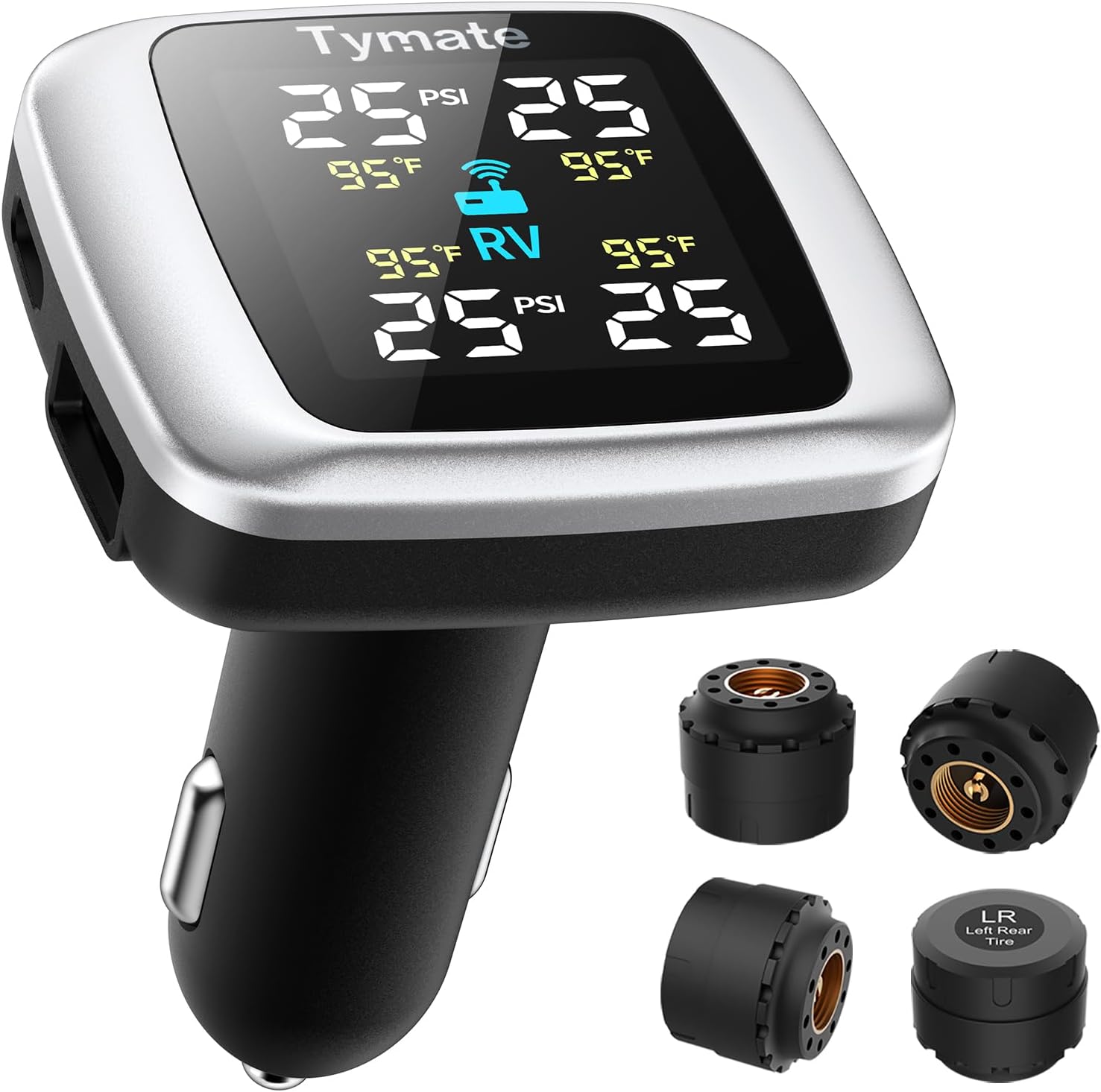
Tymate TM7 is a wireless tire pressure monitoring system that delivers real-time pressure and temperature readings for safer driving. It includes four external sensors, a bright color LCD display with adjustable backlight, and six alarm modes for high/low pressure, fast leakage, high temperature, and sensor signal or battery issues. The system covers a wide 0–144 PSI range and plugs into your vehicle’s cigarette lighter socket for quick DIY setup.

This AUTOWN flat tire repair kit is designed for quick, reliable puncture repairs using a plug kit and spiral probe tool to simplify installation. Built for durability and safe handling, it offers strong adhesion and flexibility to help maintain tire air tightness. With a portable storage case and a multi-vehicle approach, it’s suitable for cars, motorcycles, ATVs, tractors, lawn mowers, RVs, jeeps, and trucks.
How Do You Maintain Mixed Nitrogen-Air Tires?
Maintain mixed nitrogen-air tires the same way you maintain air-filled tires: check pressure cold, use the vehicle placard as the target, and watch for unusual pressure loss. You do not need a special gauge just because nitrogen is present.
If you prefer to keep a higher nitrogen concentration, top off with nitrogen when it is practical. If regular air is the convenient option, use it rather than allowing the tire to remain low.
[Products Worth Considering]

TireJect Off-Road Tire Sealant Kit provides 5-in-1 sealing to help fix tread punctures up to 3/8", sidewall punctures up to 3/8", bead leaks, slow leaks, and minor dry rot on low-speed tires. It permanently seals with liquid rubber, recycled tire particles, and Aramid fibers, making it ideal for flats caused by thorns, nails, and screws. The included dispensing cap attaches to the valve stem for a no-mess installation, along with a metal valve core remover tool and valve stem cap. This kit is for off-road use only.

Malco tire mounting and demounting lubricant is a ready-to-use tire lube formulated to reduce friction during tire installation for passenger cars, light trucks, farm tires, and heavy-duty equipment. It provides rust-inhibiting protection to help reduce corrosion on rims and wheels, and helps support proper tire bead seating during inflation to reduce air leakage. The silicone-free, soap-free formula is whitewall safe to help prevent discoloration on whitewall tires and sensitive sidewall markings.

The Topeak SmartGauge D2 delivers precise digital tire pressure readings for bikes, motorcycles, and sports equipment up to 250 psi (17 bar). Its rotating SmartHead works with both Presta and Schrader valves, so you can check pressure quickly without adapters. The LCD display makes it easy to read results in psi, bar, or kg/cm² with an included CR2032 battery for immediate use.
Checking Tire Pressure
Use a reliable gauge and check every tire under similar cold conditions. Compare each reading with the manufacturer’s recommended pressure, then correct any tire that is high or low.
| Check item | Action |
|---|---|
| Gauge accuracy | Use a reliable digital, dial, or stick gauge |
| Reading consistency | Check all tires when cold and under similar conditions |
| Unexpected pressure loss | Recheck the tire and inspect for leaks if the loss keeps returning |
A TPMS warning should prompt a pressure check, but do not wait for the warning light before maintaining your tires. A normal gauge is still the best tool for routine pressure checks.
Refilling With Nitrogen
If you want to keep using nitrogen, measure the tire first and add nitrogen only until it reaches the recommended cold pressure. There is no benefit to overinflating the tire to compensate for future pressure loss.
You do not need to purge a mixed tire for ordinary driving. A tire shop may purge and refill it only if the goal is to restore a higher nitrogen concentration.
After filling, reinstall the valve cap and recheck the reading. The pressure target remains the same no matter how much nitrogen is in the mixture.
Monitoring Pressure Changes
Pressure still changes over time because of temperature, natural permeation, punctures, valve leakage, bead leakage, or wheel problems. Nitrogen does not prevent those issues.
Compare trends among all four tires. If one tire consistently loses pressure faster than the others, treat that as a possible leak rather than simply topping it off indefinitely.
For ordinary passenger-car use, the benefit of nitrogen is modest. Consumer Reports’ 12-month test of 31 tire models found that air-filled tires lost an average of 3.5 psi from an initial 30 psi, while nitrogen-filled tires lost 2.2 psi. Both groups still lost pressure, so routine checks remained necessary.
Frequently Asked Questions
Does Tire Pressure Monitoring Work Differently With Nitrogen-Filled Tires?
No. A vehicle’s TPMS responds to tire-pressure conditions, so the recommended pressure does not change just because the tire contains nitrogen. You should still check pressure manually because TPMS is a warning system, not a replacement for routine tire-pressure maintenance.
Can Mixed Tires Affect Fuel Economy?
Not directly if the tires are kept at the same correct pressure. Fuel economy is affected by inflation pressure and rolling resistance, not by the fact that air and nitrogen are mixed. Any benefit comes from maintaining proper pressure consistently.
Will Temperature Changes Alter Nitrogen Tire Pressure Faster?
No. Both nitrogen and ordinary air change pressure as tire temperature changes. Dry nitrogen can reduce pressure variation linked to moisture, but it does not stop the normal pressure rise and fall caused by heating and cooling.
Do Mixed Tires Need Special Maintenance Equipment?
No. You can check a mixed nitrogen-air tire with a normal tire-pressure gauge and add regular compressed air with a standard inflator. Special nitrogen equipment is only needed if you specifically want to add a higher-concentration nitrogen fill.
Can I Switch Back to All Air Later?
Yes. You do not need a special conversion to use regular air after nitrogen. Simply maintain the correct placard pressure with air; the nitrogen concentration will decrease as air is added over time. A purge is optional if you later want a specific gas concentration.
Is Nitrogen Worth Using in Passenger-Car Tires?
It can offer a small pressure-retention advantage, but it is not necessary for normal passenger-car tire service. The practical value depends on cost and convenience. Regardless of the gas, regular cold-pressure checks and prompt correction of leaks matter more.
Conclusion
You can mix nitrogen and air in tires without harming them. If a nitrogen-filled tire is low, restore the correct pressure with whichever suitable inflation source is available, then keep checking it regularly. Nitrogen purity is secondary; correct pressure, leak repair, and sound tire condition are what protect handling, wear, and safety.
Sources
- U.S. Tire Manufacturers Association: Mixing nitrogen and air, normal tire-service guidance, pressure maintenance, and underinflation risk.
- National Highway Traffic Safety Administration TireWise: Cold-pressure checks, vehicle placard pressure, and routine tire-pressure maintenance.
- Michelin USA: Compatibility of nitrogen and compressed air and pressure-maintenance guidance.
- Continental Tires: Temperature effects, moisture, and normal passenger-car use of nitrogen.
- Consumer Reports: 12-month comparison of pressure loss in air-filled and nitrogen-filled tires.

![[2026NEW] 5000A Jump Starter with Air Compressor (150PSI)](https://m.media-amazon.com/images/I/71oG4PFNsmL._AC_SL1500_.jpg)