
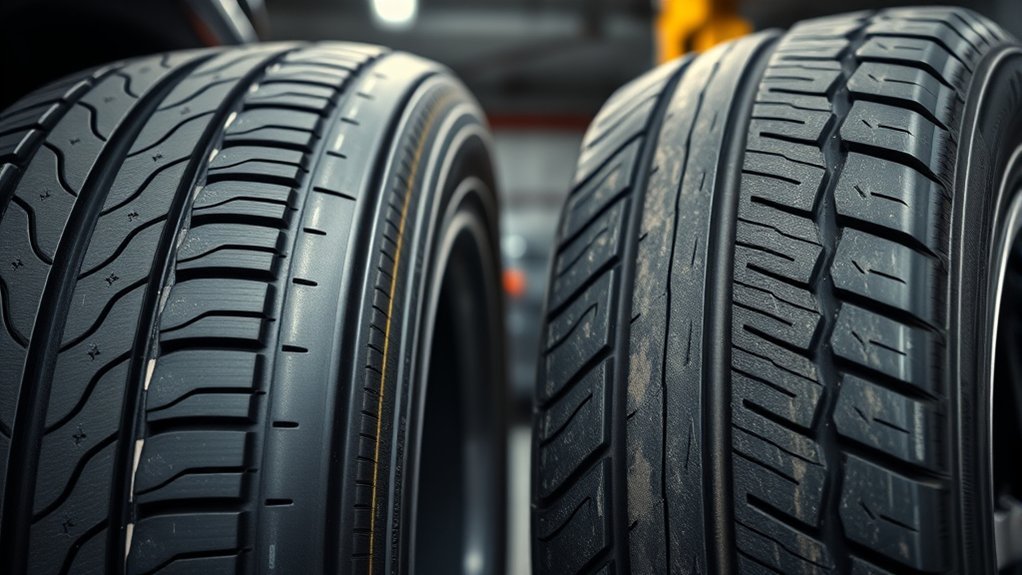
Tire age matters because a tire can lose important material properties even when plenty of tread remains. Heat, oxygen, sunlight, ozone, storage conditions, and repeated flexing can change the rubber and internal bonds over time, making age a separate safety factor from tread wear. That is why an older, low-mileage tire still deserves careful inspection.
Quick Answer
As tires age, oxidation, heat, environmental exposure, and repeated stress can make their materials less flexible and more vulnerable to fatigue. Check the DOT date code, tread, pressure, cracking, bulges, vibration, and air loss together. Follow your vehicle and tire maker’s age guidance rather than judging safety from tread depth alone.
Key Takeaways
- A tire can age internally even when its tread still looks deep and its sidewall appears normal.
- Age-related hardening can reduce traction, but hydroplaning also depends heavily on tread depth, water depth, speed, inflation, and tread design.
- For tires made since 2000, the final four digits of the DOT Tire Identification Number show the production week and year.
- There is no universal age at which every tire suddenly becomes unsafe; manufacturer and vehicle-maker recommendations differ.
- Low-mileage vehicles and spare tires deserve special attention because their tread may remain unworn while the tire continues to age.
What Happens to Rubber as Tires Age?
)
As tires age, their rubber and the bonds between tire components change through chemical reactions and repeated mechanical stress. The process does not depend on mileage alone, so a tire can age while being driven, stored, or sitting on a seldom-used vehicle.
NHTSA tire-aging research describes two major service-related mechanisms: thermo-oxidative degradation and fatigue from repeated stressing of tire components. Oxygen can diffuse into tire materials, while heat speeds chemical reactions that change their properties.
Those reactions can involve polymer-chain changes, oxidation, antioxidant depletion, and crack initiation or growth. As material properties change, the tire may respond differently to deformation and repeated loading.
Sunlight, warm climates, storage conditions, inflation pressure, load, impacts, and road hazards also affect how a tire ages. The rate is therefore not identical for every tire.
That point matters: calendar age is useful, but it is not a complete condition test. Two tires manufactured on the same day can age differently if one spends years in heat and poor storage while the other receives better care.
How Aging Reduces Tire Grip and Flexibility?
Aging can make tire compounds harder and less able to deform as designed. That can reduce the rubber’s ability to conform to small irregularities in the road and may reduce traction during braking, acceleration, or cornering.
A tire develops grip through a combination of its compound, tread design, tread depth, construction, temperature, road surface, and load. As the compound changes with age, its contribution to that grip can change even when the grooves still look usable.
You may notice reduced wet-weather traction, a different steering feel, or changes in ride quality. However, these symptoms are not proof of age-related damage by themselves. Alignment problems, imbalance, irregular wear, suspension faults, or internal tire damage can create similar symptoms.
A tire’s tread depth tells you how much tread remains; it does not tell you the full condition of the rubber and internal structure.
This is why age, condition, performance, and tread depth should be checked together rather than treated as competing measurements.
How Old Tires Perform in Wet and Hot Weather?
Older tires can have a smaller performance margin in demanding conditions because aged rubber may be less flexible and internal materials may have experienced years of heat and mechanical stress. Wet roads and high temperatures can expose weaknesses that are less obvious during gentle driving in mild weather.
It is important, however, to separate rubber aging from tread wear. They can occur together, but they affect performance in different ways.
Wet Grip Declines
An aged or damaged tire may lose wet-weather grip as its tread compound changes. Michelin notes that reduced grip, longer braking distances, or decreased wet traction can be signs that a tire is no longer performing as intended.
Hydroplaning is more complicated. Tire age does not, by itself, make the tread grooves physically shallower. Water evacuation depends strongly on tread depth and design, vehicle speed, standing-water depth, tire pressure, and other conditions.
So an old tire can have two separate concerns at once: the compound may provide less adhesion, while worn tread may have less capacity to move water away from the contact area. Keeping plenty of visible tread does not automatically rule out the first problem.
Heat Speeds Aging and Adds Stress
Heat is a major factor in tire aging because higher temperatures accelerate chemical reactions within tire materials. Repeated deformation while driving also creates heat and mechanical stress.
This is one reason hot climates, underinflation, overloading, sustained high speeds, and heavy towing deserve extra attention. They can increase the thermal and mechanical demands placed on a tire.
An older tire does not automatically overheat simply because of its calendar age. The safer conclusion is that a tire whose materials have already degraded has less reason to be pushed beyond its intended pressure, load, speed, or service conditions.
How to Check Tire Age With DOT Codes
You can determine a tire’s manufacture date from its DOT Tire Identification Number, or TIN. For modern tires, the final four digits identify the production week and year.
The NHTSA TireWise guidance recommends checking both sides of the tire because the complete TIN and date code may not be visible on the outward-facing sidewall.
[Products Worth Considering]

Steelman white tire marking crayons provide high-contrast, semi-permanent marks for repairing and inspecting tires and equipment. They write on wet or dry, smooth or coarse surfaces including rubber, metal, glass, and wood, making them ideal for puncture location and damage outlining. The lead- and zinc-free crayons resist weather and fading yet wipe away when you no longer need the marks.

Measure tire tread depth quickly and accurately with this LUMITECO dial gauge that reads in 1/32" increments up to 14/32". The color-coded green/yellow/red zones make it easy to judge tire wear and know when replacement is needed. A rugged, compact design with a protective pouch helps keep the gauge ready for use on cars, trucks, motorcycles, and more.

The Continental Grand Prix 5000 is an allround road bike tire engineered for faster rolling, improved ride comfort, and enhanced puncture protection. It features a Vectran Breaker cut-protection layer, Lazer Grip micro-profile tread for confident cornering control, and Active Comfort Technology to damp vibration for smoother rides. BlackChili compound optimizes grip and speed for everyday performance and long-lasting confidence.
DOT Code Location
Look along the tire sidewall for a marking beginning with DOT. Depending on how the tire is mounted, the full identification number may face the wheel well.
- Find the letters “DOT” on the sidewall.
- Look for the complete TIN, not just a shorter marking.
- If you do not see a four-digit date at the end, inspect the opposite sidewall.
- Check every tire, including a full-size or temporary spare.
Dirt and brake dust can make molded characters hard to read, so clean the area gently if needed. Do not assume all four tires are the same age simply because they were installed together.
Reading Date Codes
For a tire manufactured since 2000, read the final four digits as week, then year. The first two digits show the production week; the final two show the year.
For example, a code ending in 2321 means the tire was manufactured during the 23rd week of 2021. The code gives you the manufacture date, not the purchase date or installation date.
Check all four road tires separately. A previous owner, puncture replacement, or axle-by-axle tire purchase can leave a vehicle with tires of different ages.
Decoding Production Week
The date code is straightforward once you isolate the final digits. For modern tires, the first pair represents a numbered week of the year and the second pair identifies the year.
- 1223 = 12th week of 2023
- 4809 = 48th week of 2009
- A three-digit date code indicates a tire manufactured before 2000.
A tire carrying a pre-2000 three-digit date code is far beyond the service-life limits currently used by major tire manufacturers. It should not be treated as serviceable simply because its tread looks deep.
If the date code is damaged or unreadable, have a tire professional help identify the tire rather than estimating its age from appearance.
Signs Tire Age Is Hurting Safety
Age-related deterioration is not always visible, but several changes deserve immediate attention. Cracks, bulges, unusual air loss, vibration, noise, or a change in handling can indicate that a tire needs professional inspection regardless of its age.
Watch for:
- Cracks or splits in the tread, shoulder, or sidewall.
- Bulges or bubbles, which can indicate internal structural damage.
- Repeated pressure loss that cannot be explained by normal pressure variation.
- New vibration or noise that appears while driving.
- Changes in steering or grip, especially if the vehicle previously felt normal.
- Irregular tread wear, which may point to inflation, alignment, balance, or suspension problems.
Do not rely on surface appearance alone. NHTSA specifically notes that you cannot determine tire aging simply by looking at the tire, and the U.S. Tire Manufacturers Association advises drivers to consider changes such as increased air loss, noise, or vibration as reasons to seek professional inspection.
Note: If you find a bulge, significant cracking, exposed cords, unexplained pressure loss, or a sudden change in vibration or handling, have the tire inspected by a qualified tire professional. Do not wait for an age milestone before addressing visible damage or abnormal behavior.
When to Replace Tires Based on Age
There is no single calendar age at which every tire changes from safe to unsafe. Service life depends on tire design, use, heat, storage, pressure, load, damage, maintenance, and the vehicle manufacturer’s requirements.
NHTSA says some vehicle and tire manufacturers recommend replacing tires at six to 10 years old regardless of treadwear. Manufacturer guidance therefore matters more than a generic one-size-fits-all rule.
| Source | Age Guidance | What It Means |
|---|---|---|
| NHTSA | Some vehicle and tire makers recommend replacement at 6–10 years regardless of treadwear. | Follow the guidance for your vehicle and tires rather than assuming every brand uses the same limit. |
| Michelin | Professional inspection at least yearly after 5 years of service; replacement by 10 years from manufacture as a precaution. | Five years is an inspection point, not a guarantee that a tire remains usable until year ten. |
| Continental | Tires manufactured more than 10 years earlier should be removed from service, including spares. | Damage, wear, or vehicle-specific guidance may require replacement sooner. |
Michelin’s replacement guidance calls for a thorough professional inspection at least yearly after five years of service and precautionary replacement ten years after manufacture. Continental’s tire service-life guidance also recommends replacing tires more than ten years from manufacture while emphasizing that damage or service conditions can require earlier replacement.
That does not make ten years a target. Replace a tire sooner if it reaches its tread limit, develops damage, suffers an unrepairable injury, repeatedly loses pressure, or no longer meets the vehicle or tire maker’s service requirements.
Age deserves extra attention on collector cars, recreational vehicles, seasonal cars, trailers, and other low-mileage vehicles. Their tires may accumulate years much faster than they accumulate tread wear.
[Products Worth Considering]

The SAFELIFE dial tire tread depth gauge measures tread depth in 1/32 inch increments with clear, easy-to-read 2-inch dial face. Color zones using a traffic light system help you quickly judge whether tread is low, marginal, or ample for safer driving. Built with a durable zinc cast body and a metal detect probe for precise, comfortable use across cars, motorcycles, trucks, and buses.

Monitor tire tread wear with a smart, color-coded depth gauge that shows clear condition ranges at a glance. The bar is range marked for fast, easy readings, helping you maintain safer traction and performance. Each gauge is portable with a pocket clip, and the set includes 20 units for daily use and sharing.

Accurately measure tire tread depth with a calibrated gauge marked from 0 to 1 inch in 1/32 inch increments. The color-coded bar helps you quickly identify tread condition ranges, supporting safe driving for trucks, motorcycles, automobiles, and passenger vehicles.
How to Extend Tire Life Safely
You cannot stop tire aging, but good maintenance can reduce avoidable heat, stress, irregular wear, and environmental damage. The goal is not to stretch a tire beyond its safe service life; it is to keep it in proper condition while it remains serviceable.
- Check cold inflation pressure monthly. Use the vehicle manufacturer’s pressure shown on the door placard or owner’s information, not the maximum pressure molded into the tire sidewall.
- Inspect the tread and sidewalls. Look for cuts, cracking, bulges, embedded objects, irregular wear, and other damage.
- Check the spare. A spare can age even when it has never touched the road.
- Rotate tires as your vehicle maker recommends. Some vehicles use staggered tire sizes or other setups that limit rotation options.
- Correct alignment or balance problems. Pulling, uneven wear, or vibration can shorten useful tire life and may indicate another problem.
- Avoid overloading and curb or pothole impacts. Both can stress or damage the tire structure.
- Store unused tires properly. Keep them in a clean, cool, dry area away from direct sunlight, petroleum products, and ozone-producing equipment.
For stored tires, proper conditions matter because age alone cannot predict the exact usable life of an individual tire. Heat, sunlight, chemicals, service history, pressure, load, speed, and road damage all contribute to the final condition.
[Products Worth Considering]

Measure tyre tread depth precisely with a digital gauge that reads in both MM and inches, helping you monitor safe driving conditions. The large LCD screen is easy to operate, and the compact tool fits for cars, trucks, and motorcycles. It provides high accuracy with a 0-25.4mm range and includes a 1-year warranty for added peace of mind.

Rubber Care delivers a beautiful dark black satin/matte finish on tires and other rubber or plastic surfaces, drying to the touch without oily shine. Its ceramic aircraft-grade formula helps repel dirt and brake dust residue, keeping surfaces cleaner longer. Triple nano ceramic polymer technology provides best-in-industry UV protection, restoring and protecting rubber while also working on weather stripping and de-ice boot care.

A concentrated tire and tube mounting compound designed to help simplify mounting rubber tires and tubes on passenger, semi truck, construction, and OTR applications. Its ultra-thick formula packs beads effectively and includes rust inhibitors to help protect against corrosion during use.
Frequently Asked Questions
How Do Storage Conditions Affect Tire Aging?
Storage conditions can speed up or slow down tire deterioration. Heat, sunlight, moisture, petroleum products, and ozone-producing equipment can damage tire materials, so unused tires should be kept in a clean, cool, dry location away from those exposures.
Does Tire Age Matter More Than Tread Depth?
Neither tire age nor tread depth replaces the other as a safety check. Tread depth affects water evacuation and available tread, while age and service conditions can affect rubber and internal materials, so both need to be considered along with damage and performance.
Can Spare Tires Age Faster Than Regular Tires?
Spare tires do not inherently age faster, but they can become old without showing normal tread wear because they are rarely used. Heat, storage location, inflation, and environmental exposure still affect them, so check their DOT date, pressure, and condition regularly.
Do Tire Warranties Cover Age-Related Failure?
Warranty coverage depends on the tire manufacturer and the specific policy. Warranties distinguish covered manufacturing or workmanship issues from tread wear, damage, maintenance, misuse, and other conditions, so review the warranty for your exact tire before assuming an age-related problem is covered.
Are Older Tires Safe for Occasional Driving?
An older tire is not automatically safe or unsafe simply because the vehicle is driven occasionally. Low mileage can leave plenty of tread while the tire continues to age, so use its DOT date, condition, service history, performance, and manufacturer guidance to decide whether it should remain in service.
Conclusion
Tire age is one part of tire safety that tread depth cannot reveal by itself. Check the DOT date, pressure, tread, visible condition, and changes in how the tire behaves, then follow the replacement guidance for your vehicle and tire brand. If an older tire develops cracking, bulges, repeated air loss, vibration, or other damage, have it inspected rather than waiting for a calendar deadline.
Sources
- National Highway Traffic Safety Administration — TireWise: Tire aging, tread, maintenance, DOT date codes, and age-based replacement guidance.
- NHTSA Tire Aging Test Development Project: Technical explanation of thermo-oxidative degradation, fatigue, oxygen, heat, and material-property changes.
- U.S. Tire Manufacturers Association — Tire Facts: Service-life factors, DOT date-code interpretation, inspection, storage, and warning signs.
- Michelin — When to Replace Tires: Five-year inspection guidance, ten-year precautionary replacement guidance, and performance warning signs.
- Continental Tire — How Long Does a Tire Last?: Tire service-life factors, inspection advice, and ten-year replacement recommendation.
