Can You Fill Tires With Helium? The Science Explained
Yes, you can fill tires with helium, but it is not a practical choice for normal driving. A tire can be brought to the correct pressure with helium, yet helium passes through elastomer barriers more readily than the gases normally used in tires. That can make long-term pressure retention worse, while the small reduction in gas weight provides no meaningful improvement in acceleration, fuel economy, braking, or handling. For everyday use, properly maintained compressed air—or nitrogen if you prefer it—is the better option.
Quick Answer
Yes, a tire can be inflated with helium to the same pressure as air, but it is a poor choice. Helium permeates elastomer barriers more readily, so pressure can fall faster. The tiny reduction in gas weight does not create a useful performance benefit. For road vehicles, use air or nitrogen and follow the vehicle placard PSI.
Key Takeaways
- A tire can physically be inflated with helium, but that does not make helium a good inflation gas.
- Helium can permeate tire elastomers more readily than nitrogen, making long-term pressure retention a major drawback.
- The tire’s inflation pressure—not the low mass of helium—is what matters for carrying the vehicle’s load.
- Helium does not provide a meaningful road-going advantage in traction, braking, handling, or fuel economy.
- Compressed air is the simplest choice; nitrogen is optional, but either still requires regular cold-pressure checks.
Can You Fill Tires With Helium?
Technically, yes. If helium is introduced through a tire valve and the tire is brought to the vehicle’s specified inflation pressure, the tire will initially be pressurized just as it would with air or nitrogen.
The problem is not that helium cannot create pressure. The problem is retaining that pressure efficiently over time. Modern tubeless tires use an innerliner designed to slow gas loss. These liners commonly rely on low-permeability rubber compounds such as halobutyl-based materials. ExxonMobil’s tire-material guidance identifies innerliner composition and air retention as important parts of tire performance.
Helium is also a very light, monatomic gas. That makes it attractive as a thought experiment: if helium makes a balloon float, could it make a vehicle tire lighter? It can reduce the mass of the gas inside the tire, but the tire, wheel, brake assembly, suspension, and vehicle weigh vastly more than the inflation gas. The resulting weight difference is too small to create a useful road-performance advantage.
Note: Helium is monatomic, so technically it is better to say helium atoms rather than “helium molecules.” The NIST Chemistry WebBook lists helium as He with a molar mass of 4.002602 g/mol.
[Products Worth Considering]
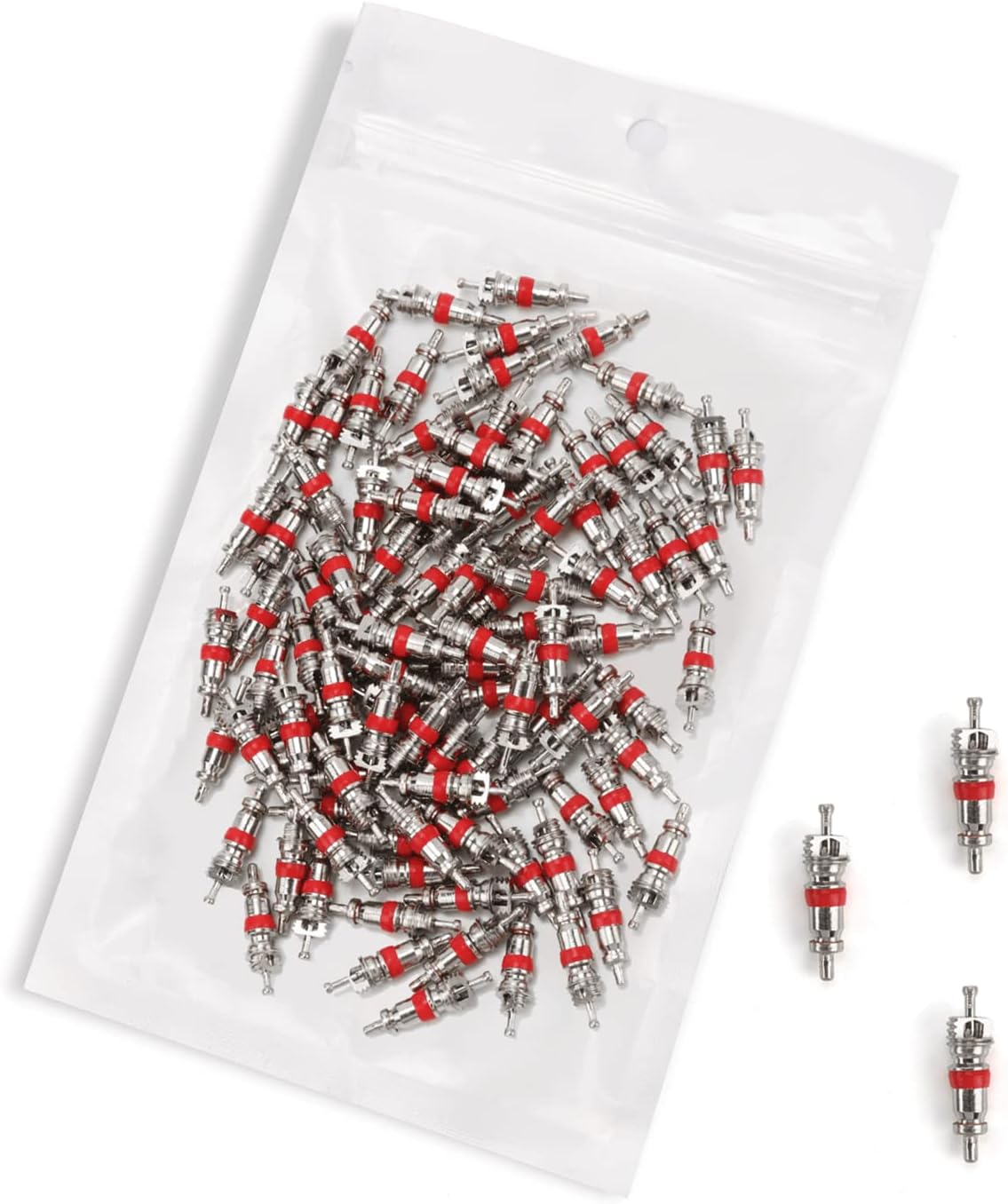
Replace worn Schrader valve cores with durable, nickel-plated replacements designed to resist rust and corrosion for a longer service life. Each core is 100% leakage tested and rated for up to 300 PSI, helping maintain a safe, reliable tire pressure system. Universal fit makes them suitable for cars, RVs, ATVs, motorcycles, bicycles, and many refrigeration/air conditioning applications.

Keep your tires properly inflated with this analog VONDIOR tire pressure gauge, designed for fast, easy readings without batteries. The swiveling, two-axis hose and large glow dial help you measure at any tire angle with instant visibility. Built with a protective rubber shield, it supports durable, low-maintenance use for cars and trucks.

Milton S-921 pencil tire pressure gauge helps you maintain optimal tire pressure for passenger cars with accurate readings in PSI and kPa. It features a built-in deflator valve for convenient pressure adjustments, plus a single chuck head and nylon indicator bar for easy use on the go. Built from durable plated brass and designed for reliable performance, it’s a practical road trip and cold-weather maintenance tool.
How Helium Affects Tire Pressure
All pneumatic tires gradually lose some inflation gas. The gas does not need a visible puncture to escape because small amounts can permeate through the tire’s polymeric innerliner over time. Valve cores, bead areas, wheels, punctures, and other sealing surfaces can create additional leak paths.
Helium is particularly troublesome because its transport through elastomer materials can be much greater than that of gases such as nitrogen. Peer-reviewed research has measured the permeation of helium, oxygen, and nitrogen through materials including butyl rubber, while other butyl-rubber barrier studies show large differences between the gases. The important point is that permeability depends on both the gas and the rubber compound, not simply on the idea that tiny particles pass through visible microscopic holes.
A classic Bureau of Standards study of gas permeability through rubber described gas transport as a material-dependent process and noted that the relative penetration rates cannot be explained simply from gas density or viscosity. Modern tire compounds are different from the historic rubber samples in that study, but the underlying lesson still applies: gas permeability is a property of the gas-and-polymer system.
Helium’s main tire problem is pressure retention. It can create the required pressure, but keeping that pressure over normal service intervals is less practical than using air or nitrogen.
If helium permeates out faster, the tire eventually becomes underinflated unless you check and refill it more often. That is the real safety concern. NHTSA recommends checking tire pressure at least once a month when the tires are cold and using the pressure specified by the vehicle manufacturer.
Does Helium Make Tires Lighter or Faster?
Helium does reduce the mass of the inflation gas, but it does not make a normal vehicle meaningfully lighter or faster. Only the gas inside the tire changes; the mass of the tire, wheel, brake, hub, suspension, passengers, cargo, and vehicle remains the same.
At the same tire pressure and temperature, using a gas with a lower molar mass reduces the mass of gas contained in the tire. However, that savings is small compared with the total rotating and vehicle mass. It is therefore not a practical substitute for genuinely lighter wheels, tires, or vehicle components.
The gas also does not provide additional traction. Tire grip primarily depends on factors such as tread compound, tread design, road surface, temperature, load, alignment, and maintaining the correct inflation pressure.
Likewise, there is no established everyday fuel-economy advantage from helium. Maintaining the correct pressure matters far more because an underinflated tire can increase rolling resistance and reduce tire life.
If you want better road performance, focus on the vehicle manufacturer’s recommended pressure, correct alignment, suitable tires, proper tread condition, and appropriately sized wheels rather than changing to helium.
Safety Risks of Helium Tires
Helium itself is not the reason a properly inflated tire would suddenly fail. The more realistic risk is allowing the tire to lose enough pressure that it operates underinflated.
Underinflation increases tire flex and heat generation and can harm handling, durability, and fuel efficiency. NHTSA therefore treats correct tire pressure as a central part of tire safety and tells drivers to use the vehicle manufacturer’s recommended cold inflation pressure rather than guessing from the tire sidewall.
Warning: Helium is normally supplied in a high-pressure cylinder. Do not improvise with unapproved regulators, fittings, hoses, or damaged cylinders just to experiment with tire inflation. OSHA treats compressed-gas cylinders as a serious physical hazard, and inert gases can also displace oxygen in enclosed spaces.
If a tire is already losing pressure abnormally, changing the inflation gas is not a repair. Inspect the tire, wheel, bead, valve stem, and valve core and have a qualified tire technician locate the leak.
Why Helium Doesn’t Work Well in Real Tires
Helium fails the practical test for three reasons: it is harder to retain, it provides no meaningful driving advantage, and it adds cost and maintenance without solving an existing tire problem.
Rapid Helium Permeation
Rubber is not a perfect gas barrier. Tire makers use specialized innerliner compounds precisely because controlling gas permeability matters.
Published studies of butyl rubber and related elastomers have measured substantially different permeability for helium, oxygen, and nitrogen. A Journal of Applied Polymer Science study measured diffusion and permeation coefficients for helium, oxygen, nitrogen, hydrogen, and other gases across several elastomers, including butyl rubber.
That is more accurate than saying helium simply “slips through holes.” Gas transport through an elastomer involves diffusion through the polymer and gas solubility within it. Tire formulation, liner thickness, temperature, pressure, aging, and construction can all influence the real loss rate.
For a driver, however, the practical result is simple: helium is a poor choice when the goal is to keep tire pressure within specification for weeks or months with normal maintenance.
Pressure Retention, Not Uneven Gas Mixing, Is the Problem
A helium-filled tire does not become unstable because helium somehow refuses to remain evenly mixed inside it. Gases mix normally inside the tire.
The pressure changes for two much simpler reasons:
- Gas can gradually leave the tire through permeation or conventional leaks.
- Tire pressure rises and falls as the gas temperature changes.
Adding air or another inflation gas can restore the correct pressure. The drawback is that if helium is leaving the tire rapidly, you may have to perform that correction far more often than you would want.
The gas mixture may change after repeated air top-offs, but that does not make the tire impossible to calibrate. Your pressure gauge still measures the tire’s pressure, and the goal remains the same: set the cold tire pressure to the vehicle manufacturer’s specification.
No Real Performance Gain
At the correct pressure, changing from air to helium does not create a meaningful road-performance advantage. The small reduction in inflation-gas mass is outweighed by the practical disadvantage of poorer pressure retention.
| Factor | Compressed Air | Nitrogen | Helium |
|---|---|---|---|
| Pressure retention | Good with normal maintenance | Can reduce permeation-related pressure loss | Poor choice for long-term retention |
| Availability | Excellent | Available at many tire shops | Specialty supply |
| Maintenance | Monthly pressure checks | Monthly pressure checks still recommended | Likely requires more frequent monitoring |
| Meaningful road-performance gain | Baseline | Main benefit is pressure/moisture management | No established practical gain |
| Best use | Normal road vehicles | Optional alternative where dry nitrogen is desired | Testing/specialized applications, not routine tire service |
What Happens to Helium Tire Pressure in Cold Weather?
Cold temperatures lower tire pressure regardless of whether the tire contains air, nitrogen, or helium. The ideal-gas relationship described by NASA connects pressure, temperature, volume, and the amount of gas present.
For a tire whose volume changes only modestly, cooling the gas lowers its pressure. Heating it raises the pressure. Helium does not need a special “cold-weather contraction” explanation.
Helium’s separate disadvantage is long-term permeation. A cold tire could therefore show lower pressure because of normal temperature change, gas loss over time, or both.
[Products Worth Considering]

This tire inflator with pressure gauge delivers long-lasting performance with a durable rubber-protected gauge and sturdy build. The longer hose and 360 swivel air chuck help you seal the valve securely and keep your hands free while measuring, inflating, or deflating. It’s battery-free for reliable use and provides ±2 PSI accuracy in the mid-range for most typical tires, with universal compatibility for 1/4 NPT compressor outputs.

This AUTOWN flat tire repair kit is designed for quick, reliable puncture repairs using a plug kit and spiral probe tool to simplify installation. Built for durability and safe handling, it offers strong adhesion and flexibility to help maintain tire air tightness. With a portable storage case and a multi-vehicle approach, it’s suitable for cars, motorcycles, ATVs, tractors, lawn mowers, RVs, jeeps, and trucks.

This Dr.Roc tire valve stem puller tools set helps install or remove snap-in tubeless valve stems safely and efficiently. It includes ozone-resistant EPDM snap-in valve stems, a valve stem installer, and a valve core remover for quick core removal or installation during tire service. Designed for reliable tubeless tire repair on motorcycles, ATVs, lawn equipment, cars, and trucks.
What Tire Pressure Should You Use?
Use the vehicle manufacturer’s recommended cold tire pressure. In most passenger vehicles, you will find it on the Tire and Loading Information label on the driver’s door jamb or in the owner’s manual.
Do not use an experimental gas to justify changing the recommended PSI. At a given tire size and load, proper inflation pressure is what allows the tire to carry the vehicle as designed.
NHTSA recommends checking all tires when cold at least once a month. “Cold” generally means the vehicle has been parked long enough that driving has not significantly heated the tires.
Pro Tip: Check pressure before driving or after the vehicle has been parked for several hours. Use the door-jamb placard pressure, not the maximum pressure molded on the tire sidewall.
Better Tire Inflation Alternatives to Helium
For normal passenger vehicles, the two practical choices are compressed air and nitrogen.
Compressed air is inexpensive, easy to find, and completely suitable for tires when you maintain the correct pressure. Because ordinary air already contains mostly nitrogen, there is no need to seek a specialty gas simply to drive safely.
Nitrogen can offer somewhat slower permeation-related pressure loss and provides a dry inflation gas. However, nitrogen does not make a tire maintenance-free. Michelin notes that nitrogen-filled tires can still lose pressure through the tire/rim interface, valve, wheel, and other leak paths, so routine pressure checks remain necessary.
You can also mix compressed air with nitrogen when you need to correct a low tire. Maintaining the proper pressure is more important than preserving a particular nitrogen concentration.
Helium adds cost and inconvenience without solving a problem that compressed air already handles effectively.
Frequently Asked Questions
How Does Helium Compare to Nitrogen for Tire Inflation?
Nitrogen is far more practical. It is already the largest component of ordinary air, can reduce pressure loss caused by gas permeation, and is commonly available from tire-service providers. Helium is much lighter, but that does not produce a useful vehicle-performance gain, while its poorer retention in elastomer systems makes maintenance more difficult.
Can Helium Leak Through Rubber Faster Than Air?
Helium can permeate elastomer barriers much more readily than nitrogen and is therefore a poor gas for long-term tire-pressure retention. The exact rate depends on the tire’s innerliner compound, thickness, temperature, pressure, construction, valve condition, and other leak paths, so there is no single loss rate that applies to every tire.
Would Helium Affect Tire Pressure Differently in Cold Weather?
Not in the way often claimed. Cooling lowers the pressure of any tire inflation gas according to the normal relationship between gas pressure and temperature. Helium’s greater permeation tendency is a separate long-term pressure-retention issue rather than a special cold-weather contraction effect.
Are There Legal Rules About Using Helium in Tires?
In the United States, federal tire standards focus on tire performance, labeling, load ratings, maximum permissible inflation pressure, and vehicle placard information rather than naming helium as a prohibited inflation gas. That does not mean every use is automatically acceptable: state inspection rules, tire or vehicle warranties, commercial-fleet requirements, and workplace compressed-gas rules can differ. The safest approach is to follow the vehicle and tire manufacturers’ specifications.
Can Tire Valves Handle Helium the Same Way as Air?
A normal tire valve can contain pressurized helium initially, but that does not mean the complete tire-and-wheel assembly is optimized for long-term helium retention. Valve cores, valve seals, the bead, the wheel, and the tire itself can all contribute to pressure loss, so there is little practical reason to use helium.
Will Helium-Filled Tires Improve Fuel Economy?
There is no meaningful everyday fuel-economy benefit. Helium reduces only the mass of the inflation gas, which is a tiny part of the vehicle’s total mass. Maintaining the manufacturer’s recommended tire pressure has a far greater effect on rolling resistance and efficient operation.
Should I Use Air or Nitrogen in My Tires?
For most drivers, regular compressed air is the simplest choice. Nitrogen is also acceptable and may reduce natural pressure loss through the tire material, but it does not eliminate the need for pressure checks. Whichever you use, set the tires to the vehicle manufacturer’s recommended cold inflation pressure.
Conclusion
You can fill tires with helium, but there is little reason to do it. Helium can produce the required tire pressure, yet it is harder to retain in elastomer barriers and provides no meaningful everyday advantage in speed, handling, traction, or fuel economy.
The better approach is simple: use compressed air or nitrogen, inspect tires regularly, and keep them at the vehicle manufacturer’s recommended cold pressure. That gives the tire the pressure it needs without the extra cost, maintenance, and compressed-gas handling involved with helium.
Sources
- National Highway Traffic Safety Administration — Tire Safety — recommended cold tire pressure, pressure checks, and inflation safety.
- Michelin — How to Check Tire Pressure — compressed air versus nitrogen and continued pressure-maintenance requirements.
- Fitch et al., Journal of Applied Polymer Science — Permeation of Several Gases Through Elastomers — measurements of helium, oxygen, nitrogen, and other gases through elastomers including butyl rubber.
- ExxonMobil Product Solutions — Tire Innerliners and Air Retention — role of halobutyl innerliners in tire pressure retention.
- NASA Glenn Research Center — Ideal Gas Equation of State — relationship among gas pressure, temperature, volume, and mass.
- Occupational Safety and Health Administration — Compressed Gases — safe handling requirements and hazards associated with compressed-gas cylinders.
[Products Worth Considering]

This multi-function tire valve stem removal tool set makes it fast to remove, install, bleed, and clean valve cores for easier tire maintenance. It includes valve core removers, a 4-way spool tool, replacement valve caps, and spare cores to handle replacements and repairs with confidence. Universal compatibility suits cars, trucks, motorcycles, bicycles, and more for roadside convenience.
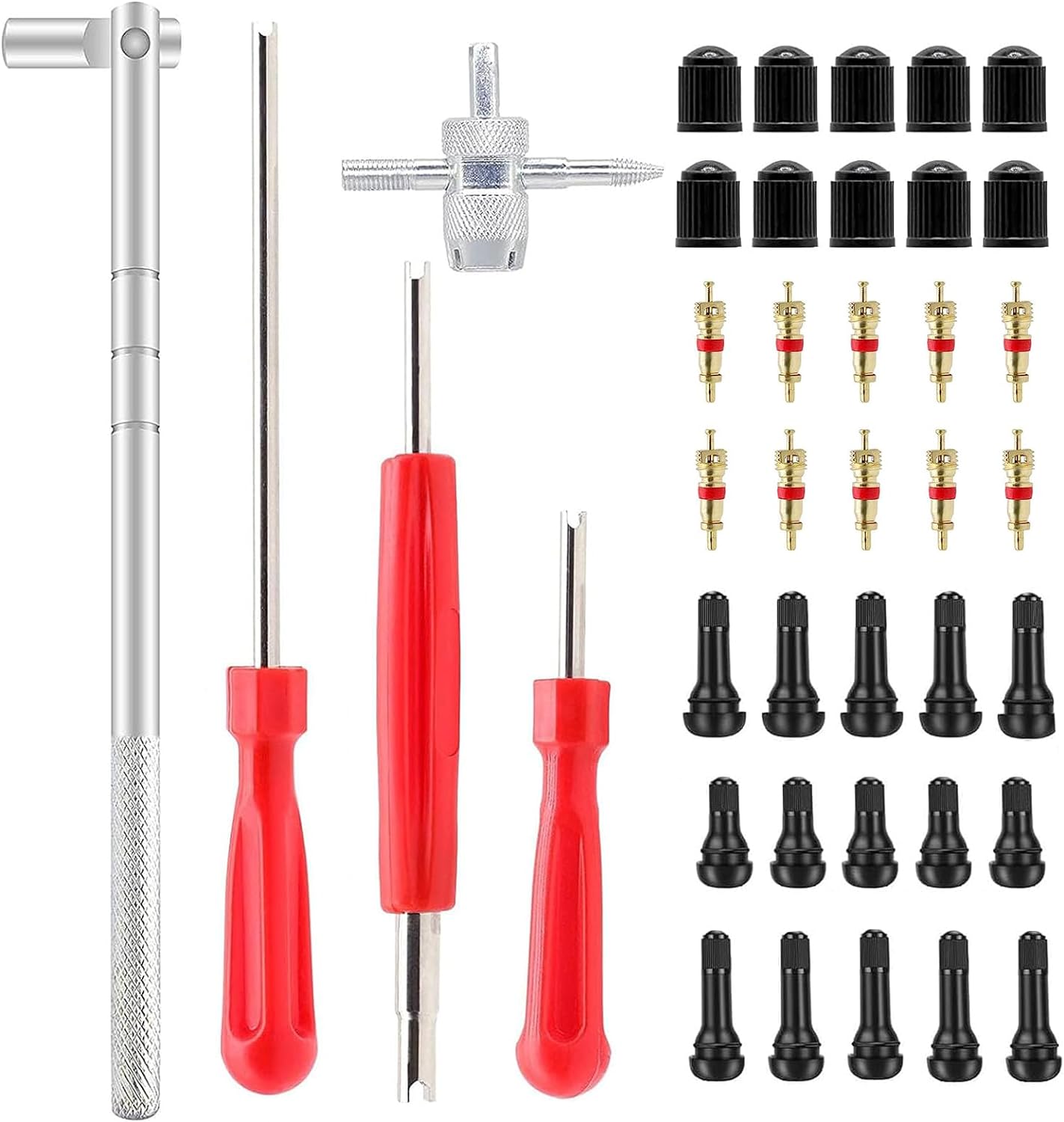
This ZHSMS valve stem puller and installer tool set makes it easy to remove and install tire valve stems without damaging wheels or valves. It uses a leverage design to save effort and includes valve stem tools plus removable valve core functionality for quick tire repairs. Compatible with tubeless tires for passenger cars, motorcycles, ATVs, off-road vehicles, and trucks.
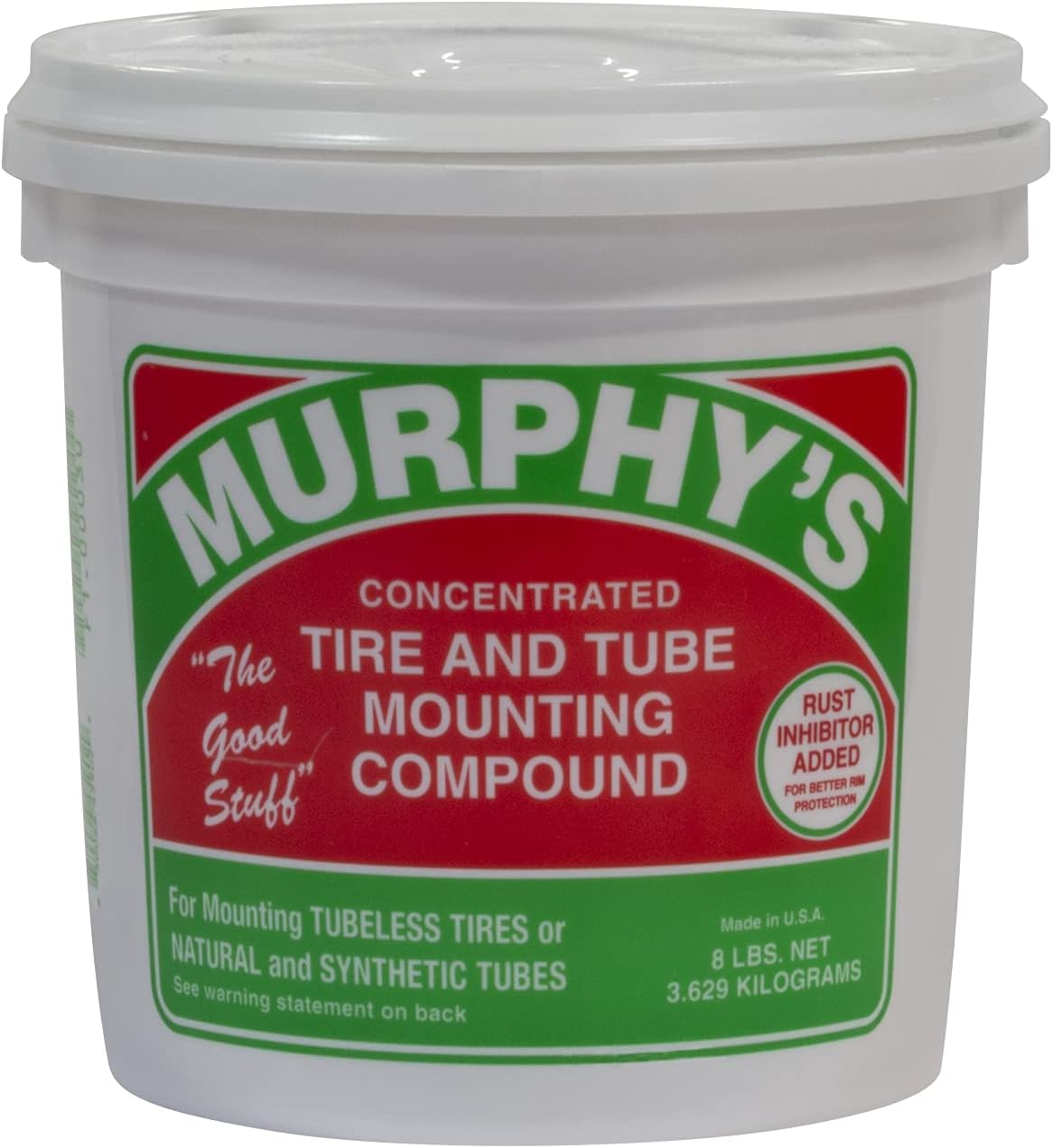
A concentrated tire and tube mounting compound designed to help simplify mounting rubber tires and tubes on passenger, semi truck, construction, and OTR applications. Its ultra-thick formula packs beads effectively and includes rust inhibitors to help protect against corrosion during use.

Related Articles

What Are Bulletproof Tires and How Do They Work?
Gripping insight into bulletproof tires reveals how they keep armored vehicles moving after damage—discover the engineering behind their surprising limits.
Read More
Can You Drive on Tires With Cords Showing?
Hoping to keep driving on tires with cords showing, but what’s really at risk may surprise you.
Read More
What Is Hydroplaning? Causes and How to Prevent It
Glide into the surprising causes of hydroplaning and the simple ways to stop it before your tires lose grip.
Read More