
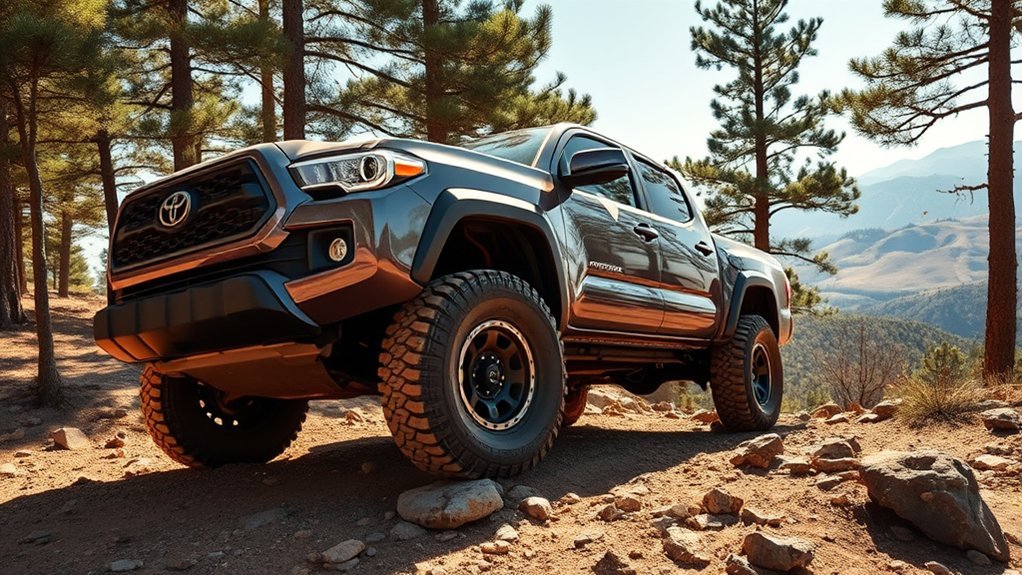
All-terrain tires can make your Toyota Tacoma more capable on gravel, dirt, shallow mud, and uneven access roads without turning every highway trip into a noisy commute. The right choice depends on your model year, factory tire specification, load needs, winter conditions, and how much time you actually spend off pavement.
Last reviewed: July 17, 2026. Tire specifications and availability can vary by size, so confirm every specification for the exact tire you plan to install.
Quick Answer
Choose all-terrain tires for your Toyota Tacoma when you regularly drive on gravel, trails, job sites, or unpaved roads but still need dependable highway manners. Match the complete factory size, load index, and speed rating unless a qualified installer confirms an alternative fitment. Check noise, tire weight, 3PMSF status, warranty, and clearance before buying.
Key Takeaways
- Use the tire size and cold-pressure specification on your Tacoma’s driver-door placard as the starting point.
- Match or exceed the required load index, but do not assume the heaviest LT tire is automatically the best choice.
- All-terrain tires improve loose-surface traction but can add weight, noise, rolling resistance, and steering effort.
- A 3PMSF symbol confirms a severe-snow qualification, but it does not guarantee dedicated winter-tire performance on ice.
- Larger tires can affect clearance, gearing, braking, speedometer accuracy, fuel use, spare-tire fit, and suspension components.
Key Features of All-Terrain Tires for Tacoma Owners

An all-terrain tire uses larger tread blocks, wider voids, reinforced shoulder areas, and additional biting edges to balance paved-road use with traction on gravel, dirt, shallow mud, and light snow. The tread is normally less open than a mud-terrain tire, which helps reduce vibration and road noise.
The most important specification is not how aggressive the tread looks. It is whether the exact tire size has the correct load index, speed rating, wheel-width range, and overall diameter for your Tacoma. For more background on interpreting load ratings, use the same placard-first approach regardless of the Toyota model.
P-Metric Versus LT-Metric Tires
P-metric and Euro-metric tires are often lighter and more compliant, which can support smoother highway driving and lower unsprung weight. LT-metric tires are designed for light-truck service and may offer higher load capacities, tougher construction, and additional load-range choices.
An LT tire can also be heavier and stiffer. That may increase impact harshness, braking effort, steering weight, and fuel consumption. Select the construction that matches your actual loads and terrain rather than choosing a high load range only because it sounds stronger.
Note: Load range and “ply rating” are not substitutes for the tire’s load index. Compare the exact load capacity at the approved pressure for the specific tire size.
Tread Pattern and Sidewall Design
Wider tread voids help release loose soil, gravel, and mud. Stone ejectors can reduce rock retention, while siping adds biting edges for wet and snowy surfaces. Reinforced shoulder blocks and sidewall features may improve resistance to cuts or chipping during low-speed trail use.
More aggressive tread does not automatically mean better performance everywhere. Large tread blocks can reduce steering precision or wet-pavement refinement, while a dense, highway-focused pattern may pack with mud more quickly.
Benefits of All-Terrain Tires for Versatile Driving
All-terrain tires are useful when your Tacoma must handle both paved roads and loose surfaces. Compared with a typical highway all-season tire, a suitable A/T tire can offer better traction on gravel, forest roads, construction sites, shallow mud, and uneven approaches.
The stronger construction available in some sizes may also suit drivers who carry tools, camping equipment, or towing-related tongue weight. However, tires do not increase the Tacoma’s published payload, towing capacity, gross vehicle weight rating, or axle ratings. Those limits always remain in force.
Some all-terrain tires carry the Three-Peak Mountain Snowflake symbol. This shows that the tire passed a standardized severe-snow traction requirement. It does not mean that every 3PMSF tire performs equally, and it is not a guarantee of strong ice traction. For a related Toyota-focused discussion, see the benefits and limitations of 3PMSF all-terrain tires.
Warning: Do not exceed your Tacoma’s payload, towing, axle, wheel, or tire limits. A higher-capacity replacement tire does not increase the vehicle’s certified ratings.
All-Terrain Versus All-Season Tires: Which Is Right for You?
Your normal driving environment should determine the category. All-terrain tires make sense when unpaved driving is frequent enough to justify their extra tread depth, stronger construction, and loose-surface traction. All-season or highway-terrain tires usually suit drivers who spend nearly all their time on pavement.
[Products Worth Considering]

Monitor tire tread wear with a smart, color-coded depth gauge that shows clear condition ranges at a glance. The bar is range marked for fast, easy readings, helping you maintain safer traction and performance. Each gauge is portable with a pocket clip, and the set includes 20 units for daily use and sharing.

These aluminum alloy tire valve stem caps with an O-ring seal help protect valve stems from corrosion while adding a clean, stylish look to your vehicle. The universal fit works across cars, trucks, motorcycles, bicycles, and more, making them an easy upgrade for everyday driving and off-road use. Installation is quick, and the included four-pack keeps all your tires dressed and protected.

The 22800 wheel stud installer makes replacing wheel studs quick and secure, saving time and effort during tire service. It uses a ratchet or impact wrench to pull new studs firmly into place, helping when existing studs are too long. Compatible with most automotive wheels and light-duty truck wheel studs, it’s designed for easy, tool-assisted installation.
Performance on Different Surfaces
| Driving condition | All-terrain tire | Highway/all-season tire |
|---|---|---|
| Dry highway | Capable, but may feel heavier or less precise | Usually quieter and more responsive |
| Wet pavement | Varies significantly by tread and compound | Often optimized for water evacuation and braking |
| Gravel and dirt | Better tread bite and damage resistance | Suitable for occasional maintained roads |
| Mud | Better than highway tires, but performance varies | Tread may clog quickly |
| Snow | Choose an exact size carrying the 3PMSF mark | Depends on whether the tire is severe-snow rated |
| Ice | Limited unless specifically designed for winter use | Dedicated winter tires normally remain preferable |
All-terrain tires cannot replace careful driving, four-wheel-drive judgment, recovery equipment, or a dedicated winter tire where ice and severe winter conditions are common.
Comfort, Noise, and Fuel Use
Road comfort depends on the tread pattern, casing, tire weight, load range, pressure, wheel size, and pavement. A moderate all-terrain tire can remain comfortable on long trips, while a heavy LT tire with an aggressive tread may transmit more vibration and impact harshness.
| Tire Type | Typical Comfort | Typical Noise | Loose-Surface Ability |
|---|---|---|---|
| Highway/all-season | High | Low | Low to moderate |
| Moderate all-terrain | Moderate to high | Low to moderate | Moderate to high |
| Aggressive A/T or hybrid | Moderate | Moderate | High |
| Mud-terrain | Low to moderate | High | Very high in suitable terrain |
Heavier tires and more aggressive tread can increase rolling resistance. Regular cold-pressure checks help maintain safety and reduce avoidable fuel loss. You can review the broader relationship between tire categories and fuel efficiency, but always use your Tacoma’s placard pressure rather than a pressure copied from another vehicle.
Current All-Terrain Tire Examples for Tacoma Owners
No single tire is best for every Tacoma. The examples below represent different levels of road refinement, off-road aggression, snow qualification, and warranty coverage. Fitment and warranty terms must be checked for the exact size.
| Tire line | Category | Useful for | Verified points | Main consideration |
|---|---|---|---|---|
| BFGoodrich All-Terrain T/A KO3 | All-terrain | Gravel, trails, snow, and mixed daily use | 3PMSF-rated; 50,000-mile U.S. limited treadwear warranty | Weight, ride, and availability vary by size |
| Yokohama GEOLANDAR A/T4 | All-terrain | Drivers seeking road comfort and off-road durability | 3PMSF-rated; limited treadwear warranty of up to 65,000 miles | Warranty mileage depends on construction and size |
| Toyo Open Country A/T III | All-terrain | Wet roads, snow, gravel, and mixed highway use | 3PMSF-rated; 65,000-mile P/Euro-metric and 50,000-mile LT/flotation limited warranties | Exact construction changes ride and load characteristics |
| Nitto Ridge Grappler | Hybrid-terrain | A more aggressive appearance and stronger trail focus | Variable-pitch tread, stone ejectors, and reinforced tread blocks | It is not the same category as a conventional mild A/T tire |
The older BFGoodrich KO2, Yokohama A/T-S, and other previous-generation products may still appear in inventories. Confirm the production date, warranty eligibility, and whether a newer equivalent is available before purchasing old stock.
For another overview of all-terrain tire features, focus on the tread and construction principles rather than assuming a RAV4-listed size also fits a Tacoma.
[Products Worth Considering]

Upgrade your 2024-2026 Tesla Model 3 Highland with REEVAA all-weather mud flaps designed for seamless fit along the original body lines. The set of four delivers strong splash protection against mud, gravel, and road debris while using OEM-grade durable materials. Installation is non-destructive with original hole positions and snap-in clips, and the aerodynamic design helps minimize impact on efficiency.

Secure your vehicle during transport with this 4-pack of heavy-duty tire tie down straps designed for trailers and hauling. The ratchet system with flat hooks and D-rings helps you tension the straps quickly, while the wheel-friendly design protects tires. With high break strength and corrosion-resistant hardware, these straps provide reliable, confidence-inspiring tie-down security for cars, trucks, and UTVs.

The Topeak SmartGauge D2 delivers precise digital tire pressure readings for bikes, motorcycles, and sports equipment up to 250 psi (17 bar). Its rotating SmartHead works with both Presta and Schrader valves, so you can check pressure quickly without adapters. The LCD display makes it easy to read results in psi, bar, or kg/cm² with an included CR2032 battery for immediate use.
Performance and Durability
Durability depends on more than the brand name. Tire construction, load, inflation, alignment, wheel balance, driving speed, road temperature, gravel exposure, towing frequency, and rotation practices all affect wear.
A mileage warranty is a limited warranty under specified conditions. It is not a promise that every owner will receive that mileage. LT sizes and P-metric sizes within the same product family may carry different warranty terms.
The best Tacoma tire is not the largest or most aggressive option. It is the tire that preserves load capacity, clearance, braking control, and highway stability while meeting your actual off-road needs.
Price and Value Comparison
Compare prices only after choosing an exact size and specification. A useful quote should include:
- The complete tire size, load index, speed rating, and load range.
- Mounting and computerized balancing.
- New valve stems or TPMS service kits when needed.
- Disposal and shop fees.
- Road-hazard coverage and exclusions.
- Alignment inspection or adjustment.
- Manufacturer rebate eligibility.
- Warranty service availability during travel.
A cheaper tire can become more expensive when installation, shipping, balancing, or warranty service is excluded. A higher-priced tire is not automatically better if its extra weight or aggressive construction does not match your driving.
Choosing the Right Size for All-Terrain Tires
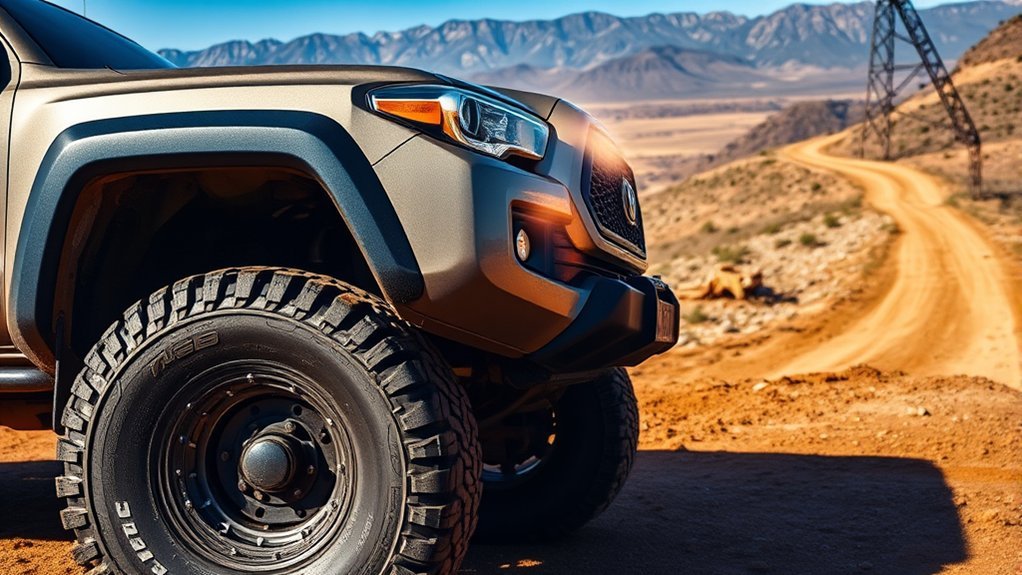
Tacoma tire sizes vary by generation, year, trim, drivetrain, wheel package, and suspension. For example, Toyota lists 245/70R17 110T and 265/70R17 115T among different 2024 Tacoma configurations. Those examples do not apply to every Tacoma.
Start with the Tire and Loading Information label on the driver-door opening and your model-year owner’s manual. The Toyota Tacoma maintenance data demonstrates why the full specification matters, not simply whether the wheel is 16, 17, or 18 inches.
Tacoma Tire Fitment Checklist
- Confirm the original size: Record the full placard size, such as 245/70R17, rather than only the wheel diameter.
- Match the load requirement: The replacement tire should meet or exceed the required load index for the vehicle and intended loading.
- Check the speed rating: Do not install a lower rating without understanding the handling and speed limitations.
- Verify wheel compatibility: Confirm the approved rim-width range and wheel load rating.
- Measure overall diameter: A small change can affect gearing, speedometer readings, clearance, braking, and shift behavior.
- Inspect full-lock clearance: Check the front tires at full left and right steering lock, including suspension compression.
- Check the rear clearance: Confirm space around the leaf springs, shocks, inner fenders, and mud flaps.
- Confirm spare-tire fit: A significantly different spare diameter can cause drivetrain or handling problems, especially on four-wheel-drive models.
- Retain TPMS operation: Confirm sensor compatibility and correct relearn procedures.
- Consider alignment: Tire-size or suspension changes may require an alignment inspection.
The same principle applies when reviewing an OEM baseline tire size on another Toyota: the placard, wheel, load requirement, and clearance must all agree.
Warning: A tire that physically mounts on the wheel may still be unsafe or unsuitable. Do not rely only on online appearance, another owner’s setup, or a general “fits Tacoma” product listing.
What Larger Tires Can Change
Increasing overall diameter may reduce engine response and alter effective gearing. A heavier tire also adds rotating and unsprung mass, which can affect acceleration, braking, steering feel, ride quality, and fuel use.
Larger tires may rub the body mount, fender liner, mud flap, upper control arm, or suspension components. A lift or leveling kit does not automatically create enough clearance through the entire steering and suspension range.
Pro Tip: Ask the installer to document the new tire’s measured diameter, weight, load index, approved wheel-width range, and clearance at full steering lock before installation.
Essential Maintenance Tips for All-Terrain Tire Life
Check Cold Tire Pressure Monthly
Use the cold inflation pressure printed on the Tacoma’s driver-door placard. “Cold” generally means the vehicle has been parked long enough for the tires to return close to ambient temperature. Do not use the maximum pressure molded into the tire sidewall as the normal vehicle pressure.
The National Highway Traffic Safety Administration recommends checking all tires, including the spare, at least monthly. TPMS is a warning system and does not replace manual pressure checks.
Rotate and Inspect the Tires
Follow the rotation interval and pattern in your Tacoma manual and the tire manufacturer’s warranty requirements. NHTSA gives 5,000 to 8,000 miles as general guidance when rotation is recommended, or sooner if irregular wear appears.
During each rotation, inspect for:
- Feathering or cupping.
- Uneven shoulder wear.
- Cuts, cracks, bulges, punctures, or exposed cords.
- Stones trapped deeply in the tread.
- Missing tread blocks or off-road chipping.
- Wheel damage and missing balance weights.
- Signs of rubbing inside the wheel well.
Wet-road and loose-surface performance can decline before a tire reaches the minimum replacement threshold. NHTSA states that tires should be replaced by 2/32 inch of remaining tread. Replace them earlier if damage, irregular wear, poor wet traction, or winter needs justify it.
Choosing a design with reliable wet traction remains important, but maintenance and correct pressure are equally necessary.
Alignment and Balancing
Have the alignment checked if the Tacoma pulls, the steering wheel is off-center, the tread wears unevenly, or the suspension has been modified. New tires should be balanced during installation. Persistent vibration may indicate imbalance, wheel damage, tire uniformity problems, or worn suspension components.
Airing Down for Off-Road Use
Reducing pressure can enlarge the contact patch and improve compliance on some low-speed trails. There is no single safe off-road pressure for every Tacoma, tire, wheel, load, or terrain.
Excessive pressure reduction can unseat a bead, damage a wheel, overheat the sidewall, reduce steering response, or cause the tire to contact the wheel well. Use an accurate gauge, drive slowly, inspect the sidewalls, and carry a compressor.
Warning: Reinflation is required before normal highway driving. Never use a low trail pressure at highway speed or while carrying loads beyond the tire’s capacity at that pressure.
Check Tire Age and Recalls
Read the DOT Tire Identification Number on the sidewall to identify the manufacturing date. Inspect aging tires for cracking, deformation, vibration, or changes in performance, and follow the vehicle and tire manufacturers’ replacement guidance.
You can also search NHTSA’s tire-recall database. A tire with adequate tread may still require replacement if it is recalled, physically damaged, improperly repaired, or no longer safe for service.
Real-World Expectations for Tacoma Owners
All-terrain tires involve tradeoffs rather than a universal upgrade. You may gain traction and damage resistance on gravel or trails while accepting extra weight, a firmer ride, slightly slower acceleration, or additional road noise.
- Daily commuters: A moderate all-terrain tread generally makes more sense than a heavy hybrid or mud-terrain design.
- Frequent gravel-road drivers: Prioritize cut-and-chip resistance, stone ejection, stable tread blocks, and appropriate load capacity.
- Snow-belt drivers: Confirm the 3PMSF mark on the exact size and consider dedicated winter tires for frequent ice or severe conditions.
- Off-road drivers: Consider sidewall protection, tread voids, recovery needs, and safe pressure management.
- Towing or hauling drivers: Match the required load index and pressure without exceeding the Tacoma’s vehicle ratings.
Tread design and depth strongly affect loose-surface performance. The same principles discussed for gravel-road traction apply, but the Tacoma’s heavier loads and truck-specific fitment must be considered separately.
Where to Buy Tacoma All-Terrain Tires
Buy from a seller that can confirm the complete fitment and provide installation or warranty support. Do not select a tire solely because a marketplace page says it fits a Tacoma.
| Retailer type | Main benefit | What to verify |
|---|---|---|
| Toyota dealer | Access to factory specifications and vehicle service history | Aftermarket selection, installation price, and warranty terms |
| Independent tire specialist | Fitment experience and local road knowledge | Alignment capability, road-hazard service, and exact-size availability |
| Discount Tire or a regional chain | Broad installation network and service access | Package exclusions, certificates, and warranty transfer rules |
| Tire Rack or another tire-focused online seller | Detailed size comparisons and shipment to installers | Shipping, installer charges, returns, and warranty procedure |
| Amazon or another marketplace | Seller choice and customer feedback | Authorized seller status, production date, exact specification, returns, and installation |
Before paying, ask the seller to write the complete tire specification on the quote. Confirm that all four tires match unless the vehicle manufacturer specifies otherwise.
Wet-road safety also depends on tread design, depth, pressure, and speed. Review the principles behind hydroplaning resistance, but rely on size-specific testing and specifications for your Tacoma.
[Products Worth Considering]
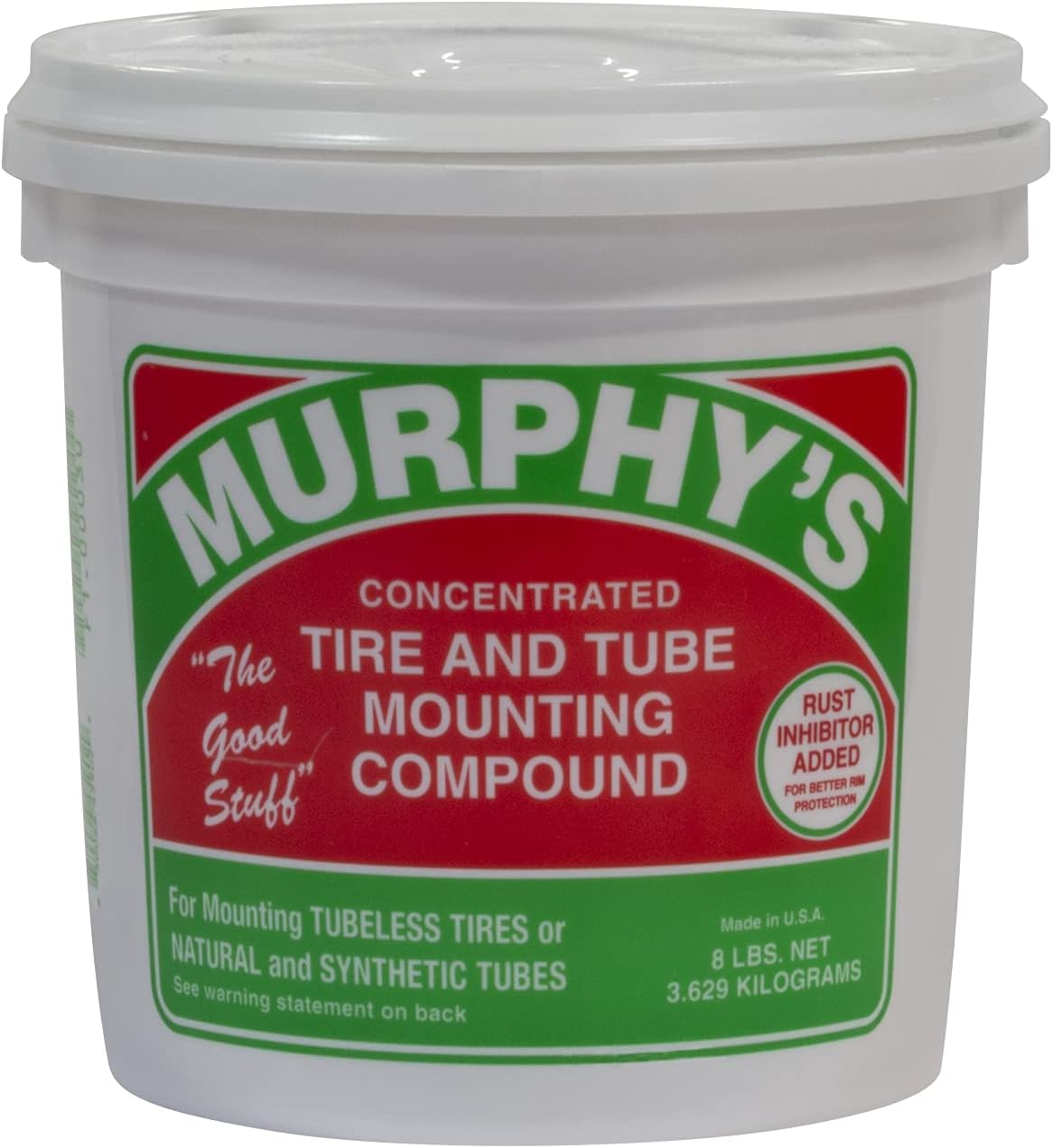
A concentrated tire and tube mounting compound designed to help simplify mounting rubber tires and tubes on passenger, semi truck, construction, and OTR applications. Its ultra-thick formula packs beads effectively and includes rust inhibitors to help protect against corrosion during use.

The SAFELIFE dial tire tread depth gauge measures tread depth in 1/32 inch increments with clear, easy-to-read 2-inch dial face. Color zones using a traffic light system help you quickly judge whether tread is low, marginal, or ample for safer driving. Built with a durable zinc cast body and a metal detect probe for precise, comfortable use across cars, motorcycles, trucks, and buses.
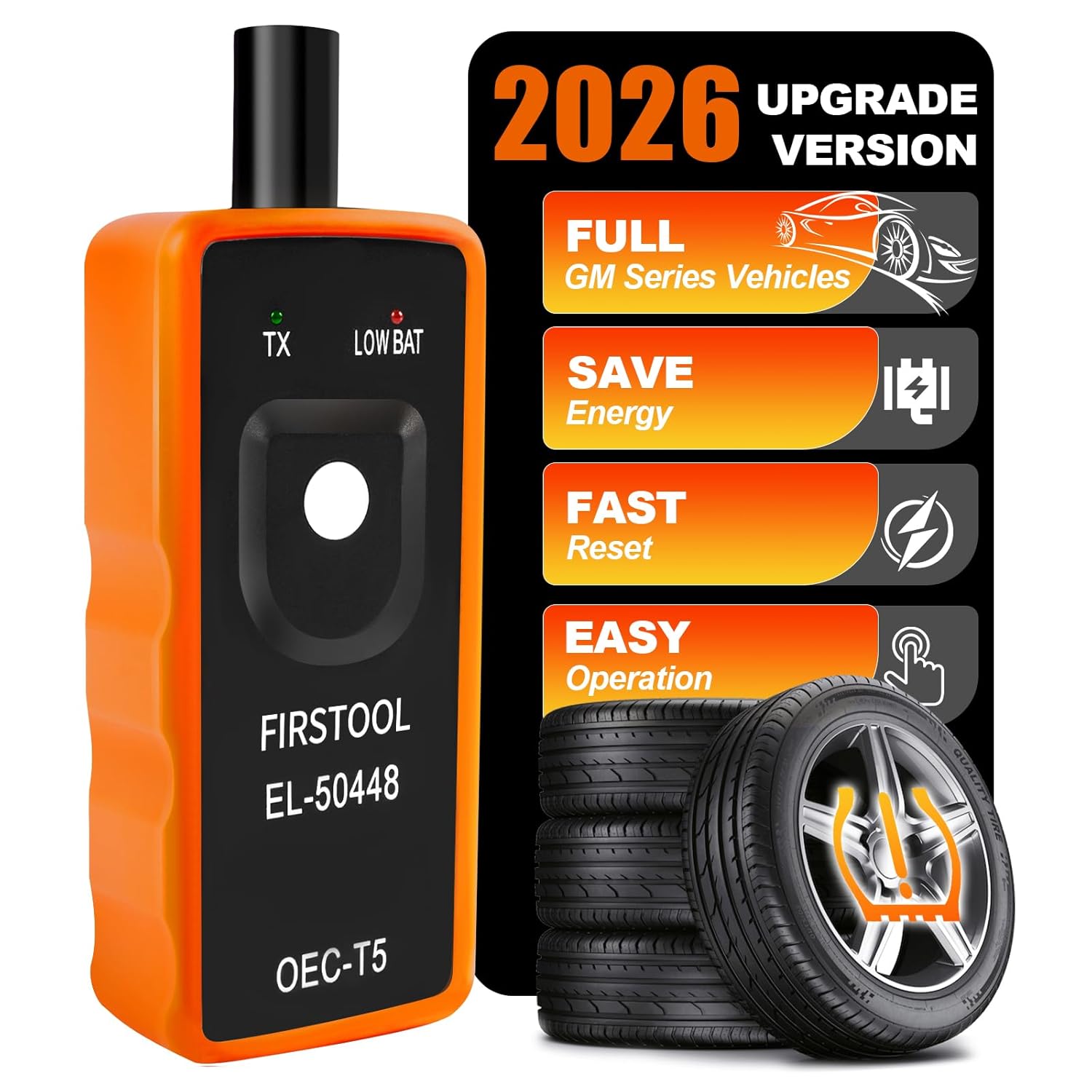
This TPMS relearn tool helps you quickly activate, match, and reset GM tire pressure sensors to keep the vehicle monitoring system working properly. It clears tire pressure alarms and dashboard warning lights after sensor replacement or tire rotation, and supports learning for common 315/433 MHz TPMS sensors. Designed for simple one-button operation, it can help you avoid unnecessary trips to repair shops.
Questions to Answer Before Buying
- What benefit do you need? Choose an all-terrain tire for regular gravel, dirt, trail, job-site, or mixed-surface use. A highway tire may be better for almost-exclusive pavement driving.
- Will you drive in winter? Confirm whether the exact tire carries the 3PMSF symbol. Use dedicated winter tires when severe snow and ice performance is a priority.
- Are you changing size? Larger tires may require clearance work, different wheels, suspension changes, speedometer correction, and a matching spare. A professional fitment check is essential.
An all-weather tire may be another option for drivers who need stronger snow capability but rarely leave pavement. It is not automatically equivalent to an off-road-focused all-terrain tire.
Frequently Asked Questions
Are all-terrain tires worth it on a Toyota Tacoma?
They are worth considering when you regularly drive on gravel, dirt, trails, job sites, or unmaintained roads. A highway or all-season tire normally offers better value, comfort, and efficiency when nearly all driving is on pavement.
Is there a downside to all-terrain tires?
Possible downsides include more road noise, extra weight, firmer ride quality, higher rolling resistance, reduced steering precision, and greater installed cost. The size, construction, tread pattern, and pressure determine how noticeable these tradeoffs become.
Do all-terrain tires reduce gas mileage?
They can. A heavier tire, larger overall diameter, aggressive tread, or low inflation increases the work required to move the truck. The actual change depends on the tire and driving conditions, so avoid assuming that every A/T tire causes the same result.
Are all all-terrain tires rated for severe snow?
No. Look for the Three-Peak Mountain Snowflake symbol on the exact tire. Even among qualified tires, snow and ice performance varies. Dedicated winter tires remain the stronger option for frequent ice or severe winter driving.
Can I install larger Tacoma tires without a lift?
Some modest size changes may fit certain trims, wheels, and alignments, while the same size may rub on another Tacoma. Check wheel offset, full-lock steering clearance, suspension compression, body mounts, fender liners, mud flaps, and the spare-tire location before installation.
Do I need an E-load tire for towing?
Not automatically. The tire must provide enough load capacity for the loaded vehicle at the approved pressure. An E-load tire may be heavier and stiffer than necessary. Calculate actual axle loads and follow the Tacoma, wheel, and tire specifications.
How often should Tacoma all-terrain tires be rotated?
Follow the model-year owner’s manual and tire warranty. General guidance is approximately every 5,000 to 8,000 miles when rotation is recommended, with earlier service if uneven wear develops.
Conclusion
All-terrain tires can give your Toyota Tacoma useful traction and durability on gravel, dirt, trails, and mixed-surface trips. The safest choice starts with the factory size, load index, speed rating, and cold-pressure specification. From there, select the least aggressive tire that meets your real off-road and winter needs.
Compare exact-size specifications rather than brand reputation or appearance alone. Confirm clearance, wheel compatibility, spare-tire fit, TPMS operation, warranty terms, and installed cost. Correct pressure, rotation, alignment, and regular inspections will have as much influence on long-term results as the model printed on the sidewall.
Sources
- National Highway Traffic Safety Administration TireWise — tire sizing, cold pressure, tread depth, rotation, inspections, labeling, and recalls.
- Toyota Tacoma Maintenance Data — examples of model-specific tire sizes, load indexes, pressures, and wheel specifications.
- BFGoodrich All-Terrain T/A KO3 — current product category, severe-snow rating, features, and U.S. warranty information.
- Yokohama GEOLANDAR A/T4 — current all-terrain model, 3PMSF status, intended use, and warranty information.
- Toyo Open Country A/T III — all-terrain classification, 3PMSF status, features, construction labels, and size-dependent warranty terms.
- Nitto Ridge Grappler — hybrid-terrain classification, tread design, stone ejectors, and road/off-road features.

