
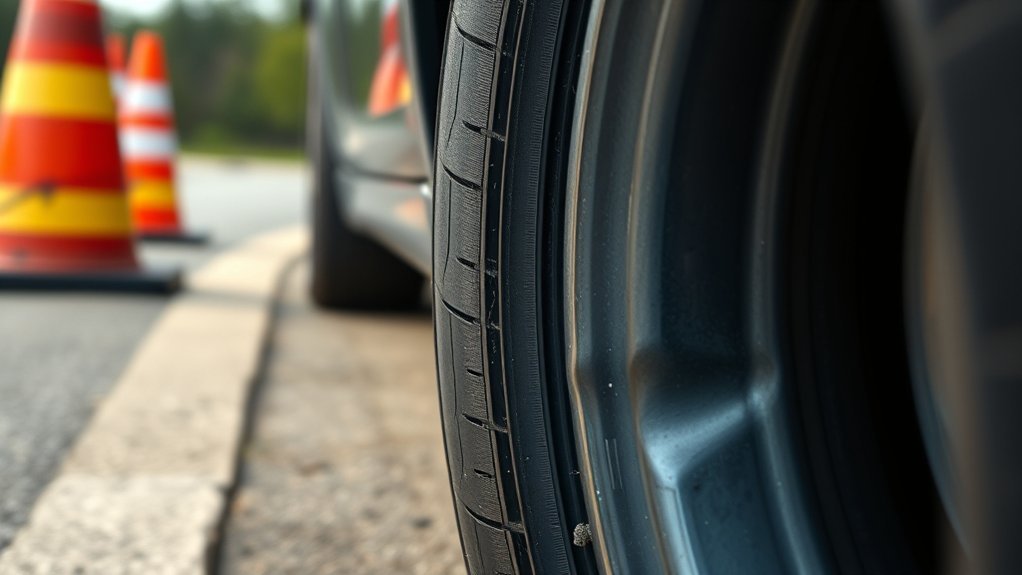
A bubble in your tire means the tire has internal damage, usually in the sidewall. Treat it as an urgent safety problem, not a cosmetic flaw. The tire may lose air or fail without much warning, especially at highway speed, during braking, while cornering, or after another impact.
Last updated: July 7, 2026 · Reviewed against current Michelin, NHTSA, Tire Industry Association, and U.S. Tire Manufacturers Association tire-safety guidance.
Quick Answer
A tire bubble usually means the sidewall cords or inner layers are damaged and air has pushed into a weakened area. Do not drive on it except to move out of immediate danger. Change to a safe spare only if you can do that away from traffic, or call roadside assistance and have the tire replaced by a qualified tire technician.
Key Takeaways
- A tire bubble is a warning sign of internal tire damage, most often from a pothole, curb strike, road debris, underinflation, overloading, or a defect.
- A bubbled tire is unsafe because the weakened area can turn into a sudden air loss or blowout.
- A sidewall bubble is not a repairable tire problem. Replacement is the safe fix.
- Do not drive normally, add air as a fix, plug the sidewall, or rely on sealant. Use a spare or tow the vehicle instead.
- Prevent bubbles by keeping tires properly inflated, avoiding hard impacts, checking sidewalls, respecting load limits, and replacing damaged tires promptly.
At a Glance
| Time Required | Stop driving as soon as it is safe. Tire shop inspection and replacement timing depends on tire availability, wheel damage, and shop workload. |
| Difficulty | Medium if changing to a spare in a safe, flat place; easy if calling roadside assistance or a tow truck. |
| Tools Needed | Spare tire, jack, lug wrench, flashlight, tire pressure gauge, wheel chock if available, and hazard lights or roadside warning triangles. |
| Cost | Inspection may be free at some shops; replacement cost depends on tire size, brand, vehicle type, speed rating, load rating, and warranty or road-hazard coverage. |
Warning: Do not plug, patch, seal, or keep driving normally on a tire with a sidewall bubble. The tire has structural damage, and the weakened area can fail suddenly.
What Does a Tire Bubble Mean?
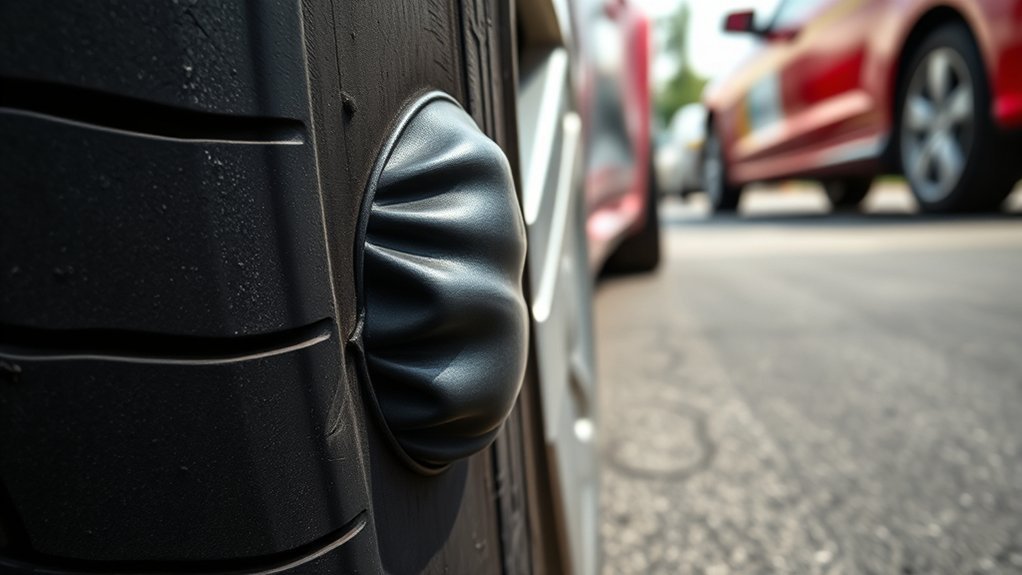
A bubble in a tire means the tire’s internal structure has been weakened. On most passenger tires, the bubble appears on the sidewall because air has moved into a damaged area between the tire’s inner layers. Michelin explains that a sidewall bulge or bubble generally points to damaged cords caused by a severe impact, and that the tire should be replaced.
This damage often happens after a hard hit with a pothole, curb, railroad crossing, speed bump, or road debris. Less commonly, a bubble can come from a manufacturing defect or recall-related issue. Either way, the tire can no longer support air pressure and vehicle load evenly, so it should be treated as unsafe until a qualified tire technician inspects the tire and replaces it.
Note: A sidewall indentation is not always the same as a bubble. Some normal tire construction joints can look slightly indented. A raised bulge, swelling, blister, or lump is the danger sign.
Why Tire Bubbles Are Dangerous
A tire bubble is dangerous because it marks a weak spot in the tire’s structure. The sidewall flexes constantly as you drive, turn, brake, and carry weight. Once the cords or inner liner are damaged, that area can keep stretching until the tire loses air quickly or blows out.
This is not a small maintenance issue. NHTSA TireWise currently reports that 511 people died in tire-related crashes in 2024, and NHTSA also warns that poor tire maintenance can lead to flats, blowouts, or tread separation. A bubbled tire raises that risk because its strongest internal layers are already compromised.
A tire bubble is the tire’s warning that its structure has already failed. The safest question is not “how long will it last?” but “how do I stop driving on it?”
Can You Drive on a Tire Bubble?
No, you should not drive normally on a tire with a bubble. If the vehicle is parked, do not start a trip on that tire. If you are already driving, slow down smoothly, avoid hard braking, turn on your hazard lights, and pull over as soon as you can do so safely.
The only reasonable exception is moving the vehicle a very short distance out of an active danger zone, such as out of a traffic lane. Once you are in a safe location, use the spare if you can change it safely or call roadside assistance. Do not drive at highway speed, do not drive to “test it,” and do not assume a small bubble is safe because the tire is still holding air.
If the bubble fails while the vehicle is moving, treat it like a tire blowout. Keep both hands on the wheel, avoid slamming the brakes, ease off the accelerator, correct the steering smoothly, and pull off the road only after the vehicle feels stable. NHTSA’s TireWise guidance gives the same control-first approach for blowouts.
Is a Tire Bubble Repairable?
No. A tire with a sidewall bubble is not safely repairable. A patch or plug can only address certain punctures in the tread area; it cannot rebuild broken sidewall cords or restore the tire’s load-carrying strength.
The Tire Industry Association says puncture repairs are limited to the center of the tread area, and that damage in the shoulder or sidewall is not repairable. The U.S. Tire Manufacturers Association also recommends considering repairs only when damage is limited to the tread area and the puncture is no greater than 1/4 inch, or 6 mm, in diameter.
If a shop offers to patch, plug, or seal a sidewall bubble, decline that repair and replace the tire instead. Sealant may help with some temporary tread punctures, but it does not fix a damaged sidewall structure.
[Products Worth Considering]

Milton S-921 pencil tire pressure gauge helps you maintain optimal tire pressure for passenger cars with accurate readings in PSI and kPa. It features a built-in deflator valve for convenient pressure adjustments, plus a single chuck head and nylon indicator bar for easy use on the go. Built from durable plated brass and designed for reliable performance, it’s a practical road trip and cold-weather maintenance tool.

The Dr.Roc spare tire tool kit helps you release, lower, or raise your spare tire with reliable extension tools and a lug nut wrench. It is made from rustproof automotive-grade steel and includes an organized carry case for convenient storage. Designed for compatibility with select GM models from the late 1990s through 2019, it uses upgraded extension components to install and remove spare tires with less hassle.

Orange Seal regular formula tubeless sealant quickly seals punctures and forms a durable bond inside your tire to help reduce flats. Made with natural latex, it adheres effectively to rubber and seals from the inside out, including the critical bead-to-rim interface for a reliable ride. It seals punctures up to 1/4 inch, slices up to 3/4 inch, and performs in temperatures as low as 11°F across MTB, road, cyclocross, gravel, and e-bike applications.
What to Do if You Spot a Tire Bubble
If you notice a bubble before driving, do not start the trip on that tire. If you notice it while driving, slow down smoothly, avoid sudden steering, avoid hard braking, turn on your hazard lights, and pull over somewhere safe.
| Action | Why It Matters | Best Next Step |
|---|---|---|
| Stop driving normally | Reduces heat, flex, and blowout risk | Pull over safely |
| Use the spare if safe | Gets the damaged tire off the vehicle | Follow your owner’s manual |
| Call roadside assistance | Avoids driving on a weakened sidewall | Tow to a tire shop |
| Replace the tire | A bubble cannot be safely repaired | Ask for a full inspection |
[Products Worth Considering]

Accurately measure tire tread depth with a calibrated gauge marked from 0 to 1 inch in 1/32 inch increments. The color-coded bar helps you quickly identify tread condition ranges, supporting safe driving for trucks, motorcycles, automobiles, and passenger vehicles.

This universal wheel alignment tool helps you accurately restore tire tilt angles after tire or suspension repairs using an adjustable camber gauge. It features a powerful magnetic base that firmly attaches to brake rotors for stationary, slip-free readings, improving consistency during measurement. Built from durable PC plastic, it resists wear and corrosion and is compact enough for car, truck, RV, and motorcycle alignment tasks.

The ETENWOLF T600 digital tire pressure gauge delivers precise, manually calibrated readings to ANSI B40.7 Grade 2A standards with ±0.5% PSI accuracy. Its 360° rotating nozzle and display hold make it easy to check pressures from any angle, while a bleed button helps dial tires to the perfect level. With a 0–250 PSI range and support for PSI, BAR, and KPA, it’s a convenient tool for maintaining tire performance across many vehicles and seasons.
1. Pull Over and Keep the Vehicle Stable
Choose a flat, visible location away from traffic. Turn on hazard lights, set the parking brake, and avoid crouching next to traffic. If you are on a highway shoulder or in a dangerous spot, it is usually safer to stay in the vehicle with your seat belt on and call for help.
2. Do Not Add Air as a “Fix”
Adding air may make the tire look firmer, but it does not repair the damaged cords or inner liner. If the bubble is caused by a weak area, more pressure can put extra stress on that weak spot.
3. Use a Spare or Tow the Vehicle
If your vehicle has a spare and you can change it safely, install the spare and drive only within the spare tire’s speed and distance limits. If you do not have a spare, or if the vehicle is in an unsafe place to work around, the safest option is to tow the vehicle to a tire shop.
4. Ask for More Than a Tire Swap
Because tire bubbles often come from impact damage, ask the technician to inspect the wheel, rim bead area, alignment, valve stem, and nearby suspension components. A bent wheel or alignment issue can damage the replacement tire if it is not corrected.
| Ask the Shop to Check | Reason |
|---|---|
| Wheel lip and bead seat | Impact damage can bend the rim or create a slow air leak. |
| Alignment and suspension parts | A pothole or curb hit can also bend or loosen nearby components. |
| Tire DOT code and purchase record | Documentation helps with warranty, road-hazard, or recall review. |
Pro Tip: Take a clear photo of the bubble, tire brand, tire size, tread area, wheel, and DOT tire identification number before the tire is removed. This can help with warranty, road-hazard, or recall questions.
What Not to Do With a Bubbled Tire
- Do not drive on it “just to see.” A bubble can fail without giving you a second warning.
- Do not patch or plug the sidewall. Sidewall structure cannot be restored with a puncture repair.
- Do not use tire sealant as a repair. Sealant cannot rebuild damaged cords or plies.
- Do not add extra air to smooth out the bubble. More pressure may put more stress on the damaged area.
- Do not move the tire to the rear axle and keep using it. The tire is structurally damaged no matter where it is mounted.
- Do not ignore vibration, thumping, pulling, or wobbling. These can point to tire, wheel, or suspension damage after an impact.
What Causes Tire Bubbles to Form?
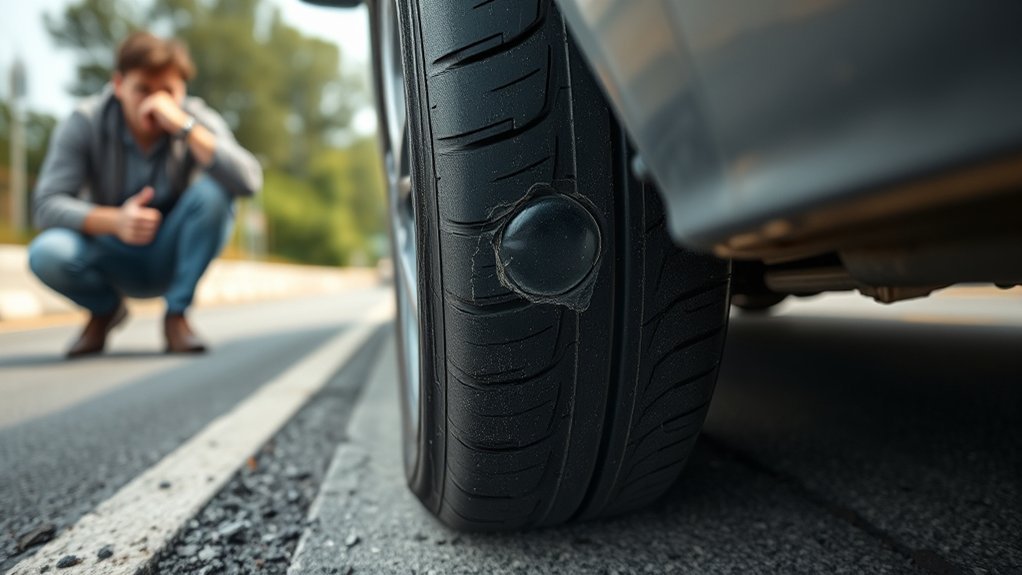
Tire bubbles usually form when impact or stress damages the tire’s inner layers. The air pressure inside the tire then pushes into the weakened area, creating a raised bulge.
Common Causes
- Pothole hits: A sharp impact can pinch the tire between the road and the wheel.
- Curb strikes: Scraping or hitting a curb can break sidewall cords.
- Road debris: Metal, rocks, or construction debris can damage the tire casing.
- Underinflation: Low pressure lets the sidewall flex too much, creating heat and stress.
- Overloading: Carrying more weight than the tire or vehicle is rated for increases strain.
- Driving on a flat: Even a short distance on a flat tire can destroy the sidewall internally.
- Manufacturing defect or recall issue: Less common, but possible, especially if the bubble appears on a newer tire with no clear impact.
The cause is not always obvious from the outside. That is why the damaged tire should be removed from service and inspected by a tire professional.
Tire Bubble vs. Sidewall Indentation
A tire bubble is a raised area that sticks outward from the sidewall or tread surface. It can look like a blister, lump, egg-shaped bulge, or swollen patch. A raised bubble is unsafe because it means the tire’s internal support has been weakened.
A sidewall indentation is different. Some tires have slight inward dimples where internal construction materials overlap. Those indentations usually do not stick outward and may appear evenly spaced around the tire. If you are unsure whether you are seeing a harmless indentation or a dangerous bulge, do not drive on the tire normally. Have it inspected.
How to Check Tires for Bubbles Safely
Regular tire checks help you catch sidewall damage before a trip. A quick inspection is especially important after hitting a pothole, curb, railroad crossing, speed bump, or road debris.
- Park on level ground. Set the parking brake and let the tires cool before checking pressure.
- Look at both sidewalls. Check the outside sidewall first, then turn the steering wheel to make the front tire sidewalls easier to see.
- Use a flashlight. Look for raised lumps, cuts, cracks, exposed cords, uneven swelling, or distorted rubber.
- Check tire pressure cold. Use the pressure listed on the Tire and Loading Information Label on the driver-side door area or in the owner’s manual, not the maximum pressure printed on the tire sidewall.
- Check tread condition. Look for uneven wear, exposed belts, cupping, or tread separation.
- Watch for symptoms. Vibration, thumping, pulling, or a new wobble after an impact can signal tire or wheel damage.
NHTSA recommends checking tire pressure at least once a month when tires are cold and checking all tires, including the spare. Tire Pressure Monitoring Systems are helpful, but they do not replace regular visual inspections and pressure checks. A TPMS light may warn you about low pressure, but it may not warn you about a visible sidewall bubble before the tire fails.
Should You Replace One Tire or More?
The bubbled tire must be replaced, but the number of tires you replace depends on your vehicle, tire condition, and drivetrain.
- One tire may be enough if the other tires are the same model or compatible type, have similar tread depth, and your vehicle manufacturer allows it.
- Two tires may be recommended if the opposite tire on the same axle is worn, aged, mismatched, or close to replacement.
- All four tires may be needed on some AWD or 4WD vehicles if tread depth differences exceed the vehicle manufacturer’s limit.
- Match the tire correctly. The replacement should match the required size, load index, speed rating, and service type for your vehicle.
Note: If only one tire is being replaced, ask the tire shop whether tread shaving, axle pairing, or matching the exact tire model is recommended for your vehicle.
Quick rule: Two-wheel-drive vehicles often tolerate one matching replacement better than AWD vehicles, but your owner’s manual controls the decision. AWD systems can be sensitive to tread-depth differences, so confirm the allowed variance before replacing only one tire.
[Products Worth Considering]

The SAFELIFE dial tire tread depth gauge measures tread depth in 1/32 inch increments with clear, easy-to-read 2-inch dial face. Color zones using a traffic light system help you quickly judge whether tread is low, marginal, or ample for safer driving. Built with a durable zinc cast body and a metal detect probe for precise, comfortable use across cars, motorcycles, trucks, and buses.

This ecocstm ratchet wrench is designed to make emergency and routine tire changes faster with a 360° rotating head and quick forward/reverse switching. The extended handle provides extra leverage to reduce effort and hand fatigue, while the adapter helps fit many scissor jacks on cars, SUVs, trucks, and vans. Built for reliable performance with durable construction, it’s a practical travel essential for on-the-road preparedness.

Get precise tire readings with the ETENWOLF T300 Plus digital gauge, calibrated to ANSI B40.7 Grade 2A for reliable accuracy. It measures across a wide 3–200 PSI range and includes thermal compensation for dependable performance from extreme cold to heat. The bright LED display, LED illumination, and replaceable AAA batteries make it easy to check pressures quickly, even in low light.
What if the Tire Is New?
A bubble on a newer tire can still come from impact damage, but it is worth checking warranty, road-hazard, and recall options before the tire is discarded.
- Take photos first. Photograph the bubble, tire size, brand, model, tread, wheel, and DOT tire identification number.
- Save your receipt. Road-hazard coverage, manufacturer warranty, or retailer coverage may require proof of purchase.
- Ask the shop to document the cause. A technician may be able to note whether the damage appears impact-related, defect-related, or unclear.
- Check for recalls. Use the NHTSA recall lookup to search for vehicle, tire, and equipment recalls.
- Do not keep using the tire while waiting. Warranty review does not make a bubbled tire safe to drive.
How to Prevent Tire Bubbles
You cannot prevent every pothole hit or road hazard, but good tire care reduces the chance of sidewall damage and helps you catch problems early.
- Check cold tire pressure monthly. Use the vehicle placard or owner’s manual pressure, not the maximum number molded into the tire sidewall.
- Slow down for potholes, speed bumps, and rough railroad crossings. A lower impact speed reduces the chance of pinching the sidewall against the wheel.
- Avoid curb strikes. Even a low-speed curb hit can damage sidewall cords.
- Respect load limits. Overloading the vehicle increases heat and strain in the tire casing.
- Replace tires with visible damage. Cuts, exposed cords, deep cracks, severe sidewall scuffs, and bubbles are replacement-level problems.
- Rotate and align when needed. Proper rotation, balance, and alignment help prevent uneven stress and irregular wear.
- Inspect after every hard impact. If you feel a thump, vibration, pull, or new wobble after hitting something, check the tire and wheel before continuing.
Tire Bubble FAQ
Is a tire bubble dangerous?
Yes. A tire bubble is dangerous because it means the tire’s internal structure has a weakened area. That weak spot can stretch, leak air, or fail suddenly while you drive.
Can you drive a short distance with a tire bubble?
You should not drive normally with a tire bubble. The only exception is moving slowly out of an immediate danger zone, such as an active traffic lane. After that, use a spare if it is safe or call roadside assistance.
Can a sidewall bubble be repaired?
No. A sidewall bubble cannot be safely repaired because plugs, patches, and sealants do not restore damaged cords or load-carrying strength. Replace the tire instead.
What causes a bubble in a tire?
Common causes include pothole hits, curb strikes, road debris, underinflation, overloading, driving on a flat tire, or a less common manufacturing or recall issue.
Is a sidewall indentation the same as a tire bubble?
No. A bubble sticks outward like a raised lump or blister. Some sidewall indentations are inward marks from normal construction. If you cannot tell the difference, have the tire inspected before driving normally.
What should you do if a tire bubble appears on a new tire?
Stop using the tire, take photos, save the receipt, record the DOT tire identification number, and ask the shop to document the cause. Then check warranty, road-hazard, and recall options.
Final Safety Takeaway
A tire bubble is a replacement-level safety problem. Do not treat it like a normal puncture, and do not rely on air, sealant, a plug, or a patch. Get the damaged tire off the vehicle, document the issue if warranty or recall coverage may apply, and ask the technician to inspect the wheel and suspension before you install the replacement tire.
Sources
- Michelin USA: Symptom — Bulge or Bubble — supports the explanation that a tire bulge or bubble points to damaged cords and requires replacement.
- NHTSA TireWise — supports tire-related crash data, tire maintenance risks, tire pressure checks, tread checks, and monthly inspection guidance.
- Tire Industry Association: Tire Repair — supports the rule that shoulder and sidewall damage is not repairable.
- U.S. Tire Manufacturers Association: Tire Repair Basics — supports tread-area-only repair limits and the 1/4-inch, or 6 mm, puncture limit.
- NHTSA Recalls — supports checking vehicles, tires, and equipment for safety recalls.
- AAA Club Alliance: How to Handle a Tire Explosion While Driving — supports safe emergency response principles for sudden tire failure.

