
Your Toyota 4Runner’s tire date code tells you when each tire was manufactured, even when the tread still looks deep. Reading it takes less than a minute, but the result should be combined with tread depth, damage, pressure loss, driving symptoms, and the tire or vehicle manufacturer’s service-life guidance. Check all four road tires and the spare.
Quick Answer
Find the DOT Tire Identification Number on the sidewall and read its final four digits. The first two show the manufacturing week, and the last two show the year. For example, 1319 means the tire was made in week 13 of 2019. Check both sidewalls because the full code may appear on only one side.
Key Takeaways
- The date code is the final four-number group in the DOT Tire Identification Number.
- Tire age matters, but no single mileage or age rule fits every tire and every 4Runner.
- Replace a tire immediately for serious damage, exposed cords, bulges, tread separation, or unsafe tread depth, regardless of age.
- Some manufacturers call for closer annual inspections after five years and replacement by ten years as a precaution.
- Check the spare, keep purchase records, register new tires, and review tire recalls.
Where to Find Your 4Runner’s Tire Date Code
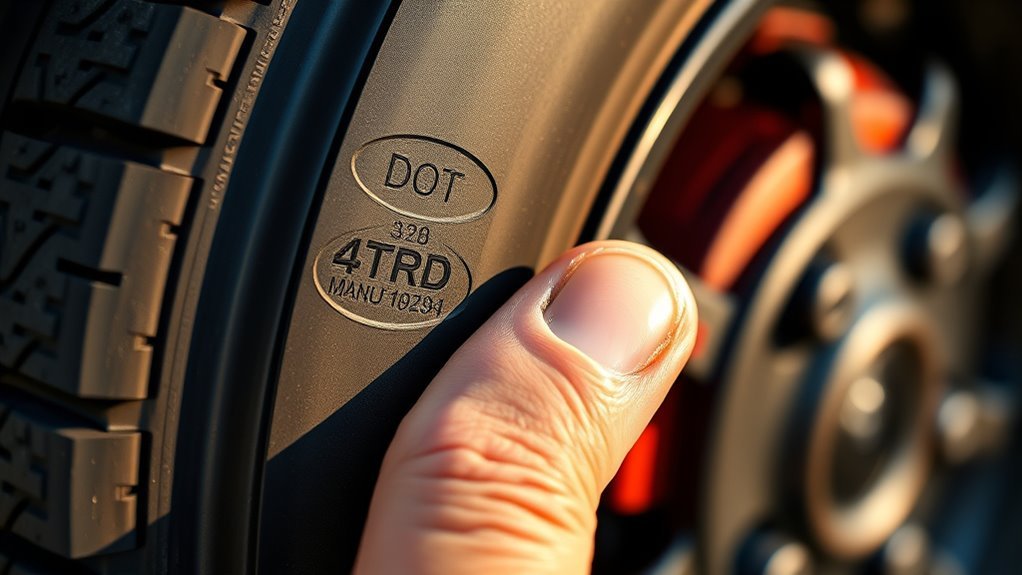
Look on the sidewall for a marking that begins with DOT. This is the Tire Identification Number, commonly shortened to TIN. Under federal rules, the final group is a four-digit date code that identifies the week and year of manufacture. The DOT symbol also certifies that the tire met applicable federal safety standards when it was manufactured. It does not guarantee that an old, damaged, or poorly maintained tire is safe today.
Inspect the outward-facing sidewall first. If you cannot see the complete TIN and four-digit date code, check the inward-facing sidewall. NHTSA advises checking both sides because the complete TIN may not appear on both sidewalls.
- Park on level ground, set the parking brake, and switch off the engine.
- Use a flashlight and clean dirt from the sidewall with a damp cloth.
- Find the letters “DOT,” then follow the code to its final four digits.
- Photograph the full TIN and repeat the check on all four tires.
- Check the spare tire, including a full-size spare that may rarely be used.
Warning: Never crawl beneath a vehicle supported only by a jack. If the date code faces inward and cannot be read safely, ask a tire shop to place the vehicle on a lift or inspect the tire during rotation.
What If Your DOT Code Is Missing or Faded?
First, confirm that you are viewing the complete TIN. A shorter or partial code may appear on one side while the full code, including the date, appears on the other. Turn the steering wheel for better access to the front tires, use bright side lighting, and inspect the spare separately.
If the date code is truly damaged, faded, or unreadable, purchase records may establish when the tire was bought, but a receipt does not always prove the manufacturing date. Tread depth, surface cracking, and tread pattern cannot reliably reveal a tire’s exact age. NHTSA notes that tire aging cannot be detected by appearance alone.
Ask a qualified tire professional to inspect the tire for cuts, bulges, exposed cords, irregular wear, persistent pressure loss, impact damage, and signs of separation. If the age remains unknown, use the tire’s condition, service history, and manufacturer guidance to make a conservative replacement decision. Replace it rather than guess when the tire shows damage, performs abnormally, or may be decades old.
Note: The full TIN helps with recall identification. Save a clear photo before dirt, curb abrasion, or normal wear makes the characters harder to read.
Why Tire Age Matters Even When Tread Looks Good
Tread depth is essential, but it is not the only safety factor. Rubber and other tire components change through use, storage, heat, sunlight, oxygen, ozone, inflation pressure, load, speed, and impact history. A low-mileage 4Runner or spare tire may retain deep tread while its materials continue to age.
Age also does not work like a precise expiration timer. The U.S. Tire Manufacturers Association explains that a tire’s serviceable life cannot be predicted from calendar age alone because operating and storage conditions vary widely. Use age as one part of a complete inspection, not as a substitute for checking wear and damage.
| Tire Age or Condition | Recommended Action |
|---|---|
| Any age with bulges, exposed cords, separation, deep cuts, unsafe tread, or repeated pressure loss | Stop using the tire and have it replaced or professionally evaluated immediately. |
| Under five years | Continue monthly pressure, tread, and damage checks. Follow the tire and vehicle manufacturer’s instructions. |
| Five to ten years | Increase attention to age. Some tire makers recommend a trained professional inspection at least annually after five years. |
| Ten years or older | Many manufacturers recommend replacement as a precaution, even when tread remains. Follow the earliest applicable manufacturer limit. |
A deep tread pattern cannot confirm that an older tire is structurally sound. Age, condition, maintenance, and driving behavior must be evaluated together.
How to Read 4-Digit Date Codes (2000 and Newer)
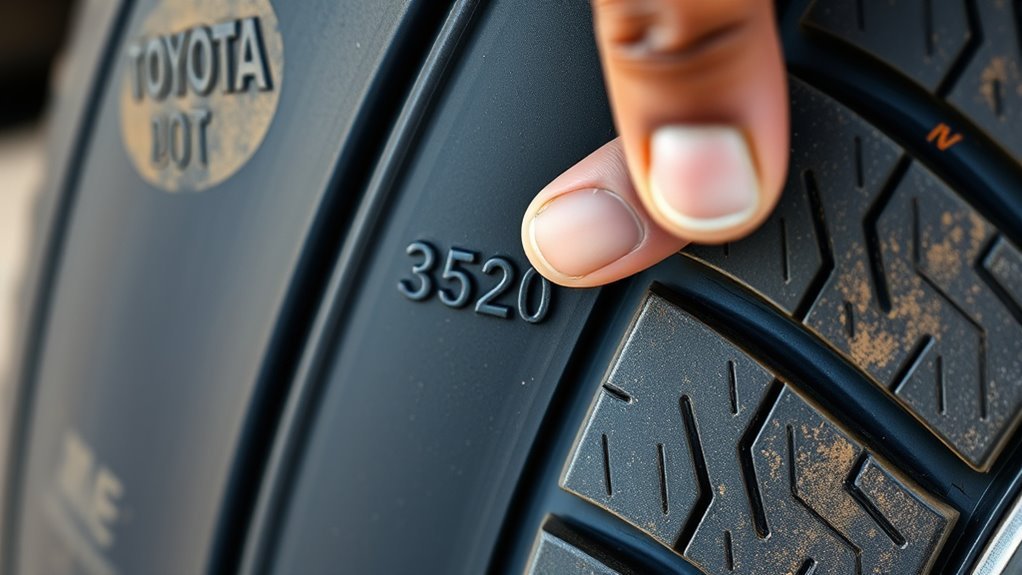
For tires made in 2000 or later, read the final four digits of the TIN. Do not count fixed character positions from the start of the entire DOT string because TIN formats and grouping can vary. The date is identified by being the last four-number group.
- First two digits: manufacturing week, normally 01 through 52 or 53.
- Last two digits: final two digits of the manufacturing year.
Examples:
- 1319: week 13 of 2019.
- 0324: week 3 of 2024.
- 5225: week 52 of 2025.
The current federal date-code format is defined in 49 CFR § 574.5. The first pair identifies the week, and the last pair identifies the year. A code that appears impossible, incomplete, or non-numeric may not be the date code, so inspect the rest of the sidewall before drawing a conclusion.
Pro Tip: Photograph each code and rename the image by tire position, such as “front-left 1319.” Update the label after rotations so your maintenance records remain clear.
How to Read 3-Digit Codes on Pre-2000 Tires
Tires made before 2000 used a three-digit date format. The first two digits identified the manufacturing week, while the final digit identified only the last digit of the year. That format creates decade ambiguity. A code such as 229 can mean week 22 of a year ending in 9, but the code alone does not distinguish 1979, 1989, or 1999.
Decoding Old Format
Read the first two digits as the week and the final digit as the year within an unknown decade. A separate triangle-like symbol was sometimes used on tires produced during the 1990s to distinguish that decade, but it was not part of the federal three-digit date itself and it did not identify the production week.
Any tire with a genuine three-digit date code was made before 2000. It is therefore far beyond the age at which major tire manufacturers commonly recommend continued service, even if the tread appears unused.
Decade Ambiguity Issues
The old format cannot always establish an exact year. Documentation, brand records, and the optional decade symbol may add context, but the distinction no longer changes the practical safety decision. A pre-2000 tire is at least more than a quarter-century old in 2026.
- Week is identifiable: the first two digits show the production week.
- Decade may remain uncertain: the last digit repeats every ten years.
- Age is already excessive: any authentic three-digit code confirms pre-2000 production.
Safety Replacement Guidelines
Remove a pre-2000 tire from road service. Do not rely on deep tread, low mileage, garage storage, or the absence of visible cracks. The same advice applies to an old full-size spare. Replace it with a tire that meets the size, load, speed, and fitment requirements for your model-year 4Runner.
Because Toyota 4Runner drivetrains and factory tire specifications vary by year and trim, use the driver-door Tire and Loading Information label and your owner’s manual when selecting replacements. Ask a qualified installer whether tread-depth matching is needed when replacing fewer than four tires.
How Old Is Too Old for 4Runner Tires?
No universal federal rule says every 4Runner tire must be replaced at exactly five, six, or seven years. NHTSA states that some vehicle and tire manufacturers recommend replacement between six and ten years regardless of treadwear. Your controlling guidance should come from the tire maker, Toyota’s instructions for your model year, and a trained inspection.
[Products Worth Considering]

Mount your spare tire off the floor and onto your wall using an e-track spare tire carrier that helps you stay organized in trailers, garages, and warehouses. The upgraded double-fittings design improves stability versus single-fittings and supports greater load bearing. Install by snapping into e-track anchor points and securing the tire with a lug-nut style bolt setup for quick, secure storage.

A concentrated tire and tube mounting compound designed to help simplify mounting rubber tires and tubes on passenger, semi truck, construction, and OTR applications. Its ultra-thick formula packs beads effectively and includes rust inhibitors to help protect against corrosion during use.

Monitor tire tread wear with a smart, color-coded depth gauge that shows clear condition ranges at a glance. The bar is range marked for fast, easy readings, helping you maintain safer traction and performance. Each gauge is portable with a pocket clip, and the set includes 20 units for daily use and sharing.
Age Thresholds
- At any age: replace for unsafe tread depth, exposed cords, bulges, separation, serious cuts, unrepairable punctures, or other disqualifying damage.
- After about five years: check the tire manufacturer’s policy. For example, Michelin recommends at least annual professional inspections after five years of service.
- By ten years: many manufacturers, including Michelin, recommend replacement as a precaution, even if tread remains.
A manufacturer’s maximum age is not a promise that every tire will remain safe until that date. Heat, underinflation, overloading, impacts, off-road use, towing, and storage conditions can require much earlier replacement.
Safety Risks
Age can contribute to changes in rubber and internal components, while poor maintenance can add heat and stress. Watch for cracking, bulges, exposed material, irregular wear, vibration, thumping, pulling, repeated air loss, or a sudden change in handling. Stop and seek professional help when a tire develops a serious symptom.
Inspect pressure, tread, and visible damage at least monthly and before long trips, towing, or heavy loads. Use the cold inflation pressure on the driver-door placard, not the maximum pressure molded on the tire sidewall.
When to Replace: Age Limits vs. Mileage
Replace based on the first limit you reach: unsafe condition, worn tread, damage, performance symptoms, or the applicable age recommendation. Mileage alone cannot settle the decision because two tires with the same mileage may have very different exposure, inflation history, loads, and impact damage.
- Check condition: look for cuts, bulges, cracks, exposed cords, irregular wear, and objects in the tread.
- Measure tread: replace at the legal or manufacturer limit and earlier when traction needs demand it. NHTSA identifies 2/32 inch as the minimum replacement point for U.S. road use.
- Check age: decode the final four digits of the TIN and compare the result with the tire and vehicle manufacturer’s guidance.
- Notice performance: investigate new vibration, noise, pulling, thumping, or pressure loss promptly.
- Include the spare: a rarely used spare can age without wearing down.
A tire that looks clean and has deep tread may still require replacement because of age or hidden damage. A newer tire may also require immediate replacement after a severe impact, sidewall injury, or separation.
[Products Worth Considering]

Steelman white tire marking crayons provide high-contrast, semi-permanent marks for repairing and inspecting tires and equipment. They write on wet or dry, smooth or coarse surfaces including rubber, metal, glass, and wood, making them ideal for puncture location and damage outlining. The lead- and zinc-free crayons resist weather and fading yet wipe away when you no longer need the marks.

The SAFELIFE dial tire tread depth gauge measures tread depth in 1/32 inch increments with clear, easy-to-read 2-inch dial face. Color zones using a traffic light system help you quickly judge whether tread is low, marginal, or ample for safer driving. Built with a durable zinc cast body and a metal detect probe for precise, comfortable use across cars, motorcycles, trucks, and buses.

Accurately measure tire tread depth with a calibrated gauge marked from 0 to 1 inch in 1/32 inch increments. The color-coded bar helps you quickly identify tread condition ranges, supporting safe driving for trucks, motorcycles, automobiles, and passenger vehicles.
Always Check Date Codes Before Buying New Tires

Read the date codes before installation so you know what you are receiving. “New” generally describes a tire that has not been sold or used, not one manufactured during the current month. NHTSA does not set a simple federal rule requiring a tire to be sold within one year of manufacture.
Do not reject a properly stored tire solely because it is more than a few months old. Instead, ask the retailer about storage, warranty start date, manufacturer service-life guidance, and return policy. Check that all tires are the correct size, load rating, speed rating, and type for your 4Runner.
For a full set, reasonably similar manufacturing dates make recordkeeping easier, but all four tires do not need the exact same production week. More important concerns include correct fitment, compatible construction, suitable tread pattern, proper installation, balanced wheels, and inflation to Toyota’s placard pressure.
Record the TINs and register the tires after purchase. NHTSA recommends registering tires and checking recalls. You can search current campaigns through the NHTSA recall database.
[Products Worth Considering]

Measure tire tread depth quickly and accurately with this LUMITECO dial gauge that reads in 1/32" increments up to 14/32". The color-coded green/yellow/red zones make it easy to judge tire wear and know when replacement is needed. A rugged, compact design with a protective pouch helps keep the gauge ready for use on cars, trucks, motorcycles, and more.

Replace or upgrade your zero-turn lawn mower tires with a universal fit flat-free tire and wheel assembly in a convenient 2-pack. Smooth tread front-caster style helps turning with reduced turf damage, while flat-free design eliminates the maintenance and downtime of air-filled flats. The included adapter kit supports 5/8-inch axles and hub lengths from 3.4 to 5 inches for compatibility across most ZTR mowers.

Replace worn wheelchair rear tires with a universal 24x1 no-flat polyurethane foam option designed to mount tightly on 24-inch rims without the tire falling off. Installation is made easier with included tools and multiple methods, including using a pry bar or softening the tire in hot water to reduce resistance. The package includes two tires plus tie ropes for convenient fitting and handling.
How to Document Tire Age for Resale Value
Good records help you manage safety and give a future buyer a clearer maintenance history. Keep evidence that connects each tire to its manufacture date, purchase, installation, rotations, inspections, repairs, and final removal.
- Photograph every TIN: capture the full code and a wider image showing the tire brand, model, and position.
- Save the invoice: record the retailer, installation date, mileage, tire size, and warranty information.
- Log maintenance: note rotations, balancing, alignment, pressure checks, puncture repairs, and professional inspections.
- Track position changes: update front, rear, left, right, and spare locations after every rotation.
- Save recall registration: keep confirmation that the tires were registered with the manufacturer or retailer.
Documentation does not prove that a tire is currently safe, but it reduces uncertainty and supports a more informed inspection. A buyer should still evaluate tread, pressure, damage, matching, and age.
Frequently Asked Questions
Should tires with a 3-digit date code be discarded?
Yes. A genuine three-digit date code identifies a tire made before 2000. That tire is now far beyond common manufacturer service-life recommendations and should be removed from road use, including when it is a spare.
How do you read a 3-digit DOT date code?
The first two digits show the manufacturing week, and the final digit shows the last digit of the year. The decade may be unclear. For example, 229 means week 22 of a year ending in 9.
Can the date code be on the inside sidewall?
Yes. The complete TIN and date code may appear on only one side. Check both sidewalls or ask a tire shop to read the inward-facing code safely.
Does a DOT mark mean the tire is still safe?
No. The DOT symbol indicates compliance with applicable federal standards when the tire was manufactured. Current safety also depends on age, tread, inflation, damage, load, maintenance, and service conditions.
Should a tire be rejected because it is more than one year old?
Not automatically. Storage conditions, the manufacturer’s policy, warranty terms, fitment, and remaining recommended service life matter more than an arbitrary one-year cutoff. Read the code before purchase and ask the retailer for those details.
How often should you check a 4Runner’s tire date codes?
Record the codes when you buy the vehicle or install tires, then review them during major inspections and before deciding whether to keep older tires. Pressure, tread, and visible damage deserve monthly checks.
Conclusion
Reading a 4Runner tire date code is simple: find the full DOT Tire Identification Number and decode its final four digits as week and year. The harder decision is knowing when to replace the tire. Combine age with tread, damage, pressure history, driving symptoms, professional inspections, and the earliest applicable manufacturer guidance. Check every road tire and the spare, then keep clear records so age never becomes a guess.
Sources
- NHTSA TireWise — tire aging, date-code location, replacement factors, monthly checks, tread limits, and spare-tire guidance.
- 49 CFR § 574.5 — federal TIN and four-digit manufacturing date-code requirements.
- U.S. Tire Manufacturers Association Tire Facts — service-life variables, TIN decoding, inspection, and storage guidance.
- Michelin: When to Replace Tires — annual inspection guidance after five years and precautionary replacement at ten years.
- NHTSA Recall Search — tire registration and recall-check resources.
- Toyota Owner’s Manuals — model-year-specific tire size, pressure, rotation, and vehicle guidance.