
Tire Tread Design Explained: Directional vs. Asymmetric for RAV4
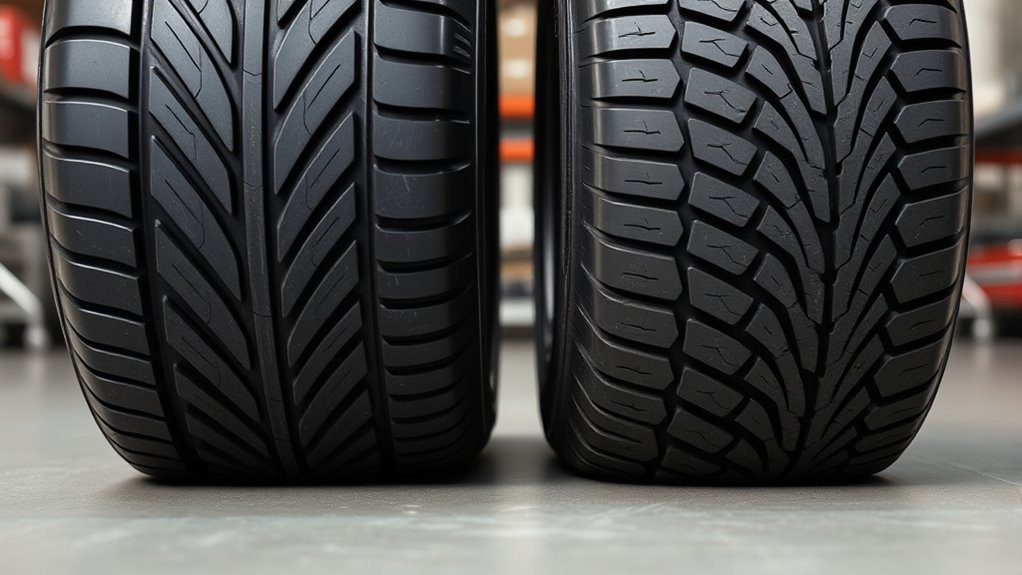
For most Toyota RAV4 owners, the better tire tread choice comes down to one question: do you need specialized wet-road confidence, or do you want a quieter, more balanced tire for mixed daily driving? Directional tread is strongest when water evacuation is the priority. Asymmetrical tread is usually the safer all-around pick for commuting, highway driving, light snow, and dry cornering.
Quick Answer
Choose directional tread for a RAV4 if you often drive in heavy rain, standing water, slush, or muddy conditions. Choose asymmetrical tread if you want the best everyday balance of wet grip, dry handling, comfort, road noise, rotation flexibility, and tread life.
Key Takeaways
- Directional tires use a one-way V-shaped or arrow-like pattern that helps push water away from the contact patch.
- Asymmetrical tires use different inner and outer tread zones to balance wet traction, dry cornering, comfort, and wear.
- Directional tires must follow the sidewall rotation arrow; asymmetrical tires must keep the “Outside” sidewall facing outward.
- Do not judge a tire by tread pattern alone. Tire compound, size, speed/load rating, UTQG rating, and winter markings matter too.
- For most RAV4 drivers, asymmetrical all-season or all-weather tires are the practical default; directional tires make more sense for wet, slushy, or loose-surface priorities.
Which Tread Should RAV4 Owners Choose? Quick Decision Guide

Choose directional tread if your RAV4 regularly sees heavy rain, standing water, slush, muddy roads, or gravel where a strong one-way channel pattern helps clear water and loose material. Directional tires are built to roll in one direction, so the sidewall will usually show a rotation arrow. If mounted backward, the tread cannot work as designed.
Choose asymmetrical tread if your RAV4 is mostly used for commuting, highway trips, school runs, errands, and mixed weather. Asymmetrical tires have an “Inside” and “Outside” sidewall. The inner tread area usually focuses on water evacuation, while the outer shoulder is built for cornering grip and stability. Tire makers such as Continental and Goodyear both emphasize that these markings must be followed during mounting.
| RAV4 Driving Need | Better Tread Choice | Why |
|---|---|---|
| Frequent heavy rain | Directional | One-way grooves help move water away from the tire’s contact patch. |
| Daily commuting | Asymmetrical | Usually quieter, more balanced, and easier to rotate than directional tires. |
| Dry cornering and highway stability | Asymmetrical | Larger outer shoulder blocks support lateral grip and steering feel. |
| Slush, mud, or loose gravel | Directional or all-terrain, depending on use | Directional channels can help clear soft material, but compound and tire category still matter. |
| Towing or loaded road trips | Asymmetrical with the correct load rating | Stability, load rating, pressure, and tire construction matter more than tread pattern alone. |
Note: Tread pattern is only one part of tire performance. A high-quality asymmetrical tire can outperform a cheap directional tire in the rain, and a winter-rated tire can outperform both in snow. Always match the tire to your RAV4’s size, load rating, climate, and driving conditions.
[Products Worth Considering]

The Continental Grand Prix 5000 is an allround road bike tire engineered for faster rolling, improved ride comfort, and enhanced puncture protection. It features a Vectran Breaker cut-protection layer, Lazer Grip micro-profile tread for confident cornering control, and Active Comfort Technology to damp vibration for smoother rides. BlackChili compound optimizes grip and speed for everyday performance and long-lasting confidence.

Measure tire tread depth quickly and accurately with this LUMITECO dial gauge that reads in 1/32" increments up to 14/32". The color-coded green/yellow/red zones make it easy to judge tire wear and know when replacement is needed. A rugged, compact design with a protective pouch helps keep the gauge ready for use on cars, trucks, motorcycles, and more.

Monitor tire tread wear with a smart, color-coded depth gauge that shows clear condition ranges at a glance. The bar is range marked for fast, easy readings, helping you maintain safer traction and performance. Each gauge is portable with a pocket clip, and the set includes 20 units for daily use and sharing.
How Directional Tread Works: RAV4 Benefits for Wet Grip and Hydroplaning
Directional tread uses a one-way pattern, often shaped like a V, arrow, or chevron. When it rolls in the correct direction, the grooves help move water from the center of the contact patch toward the sides of the tire. That can improve wet-road confidence and reduce the chance of hydroplaning when speed, water depth, tread depth, and tire condition are also under control.
- Water evacuation: Angled grooves help channel water outward as the tire rolls.
- Straight-line wet stability: Directional patterns are often designed to feel predictable in rain and slush.
- Loose-surface bite: Some directional tires can also help in mud, soft dirt, or slushy conditions, depending on tread depth and tire category.
The trade-off is that directional tires are less flexible during rotation. Because the tread must keep rolling the same way, a directional tire normally moves front-to-back on the same side of the vehicle unless it is dismounted and remounted on the wheel.
Warning: If a directional tire’s arrow points the wrong way when the RAV4 moves forward, have it corrected by a tire professional. Incorrect mounting can reduce the tire’s intended wet-road performance.
How Asymmetrical Tread Works: RAV4 Benefits for Cornering and All-Season Use
Asymmetrical tread divides the tire into functional zones. The inside section usually has more grooves and channels to help handle water. The outside shoulder usually uses larger, more stable tread blocks to support dry grip, steering response, and cornering stability. This makes asymmetrical tread a strong fit for RAV4 owners who want one tire to handle many daily situations well.
Improved Cornering Stability
When a RAV4 turns, weight shifts toward the outside tires. A tire with a stable outer shoulder can resist tread squirm and keep more consistent contact with the road. That is where asymmetrical tread has a real advantage: its outer blocks are designed to help with lateral grip and steering feel.
- Outer shoulder blocks support dry grip and steering precision.
- Inner grooves help move water away during wet driving.
- Varied tread blocks can help reduce repetitive tread noise compared with more aggressive patterns.
Year-Round Traction Balance
For many RAV4 drivers, the best tire is not the most specialized one. It is the tire that handles dry pavement, rain, mild winter weather, road noise, tread life, and fuel economy without a major weakness. That is why asymmetrical tread is common on touring, performance all-season, and all-weather tires.
| Asymmetrical Tread Feature | RAV4 Benefit |
|---|---|
| Inner channels | Wet-road water evacuation |
| Outer blocks | Cornering grip and steering stability |
| Varied tread pitch | Potentially quieter highway ride |
| Balanced contact patch | More even wear when rotated properly |
| All-season design options | Good daily-use versatility |
Pro Tip: If your RAV4 sees real winter driving, look beyond the tread pattern and check for the Three-Peak Mountain Snowflake symbol. That marking indicates the tire meets a snow-traction performance requirement; “M+S” alone is not the same thing.
Real-World Comparison: Wet Braking, Handling, Noise, and Fuel
Directional and asymmetrical tires can both be excellent, but they solve different problems. Directional tread is more specialized for one-way water evacuation. Asymmetrical tread is designed to balance more categories at once.
Wet Braking Performance
Wet braking depends on tread depth, rubber compound, tire age, inflation pressure, vehicle speed, road surface, and water depth. Directional tread can help by clearing water from under the tire, but it does not automatically make every directional tire stop shorter than every asymmetrical tire. A premium asymmetrical tire with a strong wet compound may outperform a budget directional tire.
For a RAV4 driven in heavy rain, a directional tire may feel more confident in straight-line water evacuation. For mixed wet and dry driving, an asymmetrical touring or all-weather tire is often the better daily compromise.
Handling and Cornering
Directional tires can feel predictable in wet straight-line driving, but asymmetrical tires usually have the advantage for balanced cornering. Their outer shoulders are built to handle lateral load, which helps during highway ramps, quick lane changes, and winding roads.
If your RAV4 is used mostly on pavement, asymmetrical tread gives you the more complete handling package. If your biggest concern is confidence through water, slush, or muddy patches, directional tread may be worth the rotation limitations.
Noise and Fuel Economy
Road noise and fuel economy are affected by tread pattern, tread depth, compound, tire weight, rolling resistance, and inflation pressure. Aggressive directional patterns may create more noticeable highway hum, while many asymmetrical touring tires are tuned for a quieter cabin. But there is no universal rule: the specific tire model matters more than the category label.
- Directional: Strong water-channeling design, but usually stricter rotation limits.
- Asymmetrical: Balanced wet/dry grip, often quieter, and usually more rotation-friendly.
- Symmetrical: Simple, quiet, and easy to rotate, but often less specialized for wet grip or cornering.
The best RAV4 tire is not the tread pattern with the most dramatic look. It is the tire that fits your climate, load needs, driving speed, road surfaces, and maintenance habits.
Mounting, Rotation, and Maintenance Tips for Each Tread Type
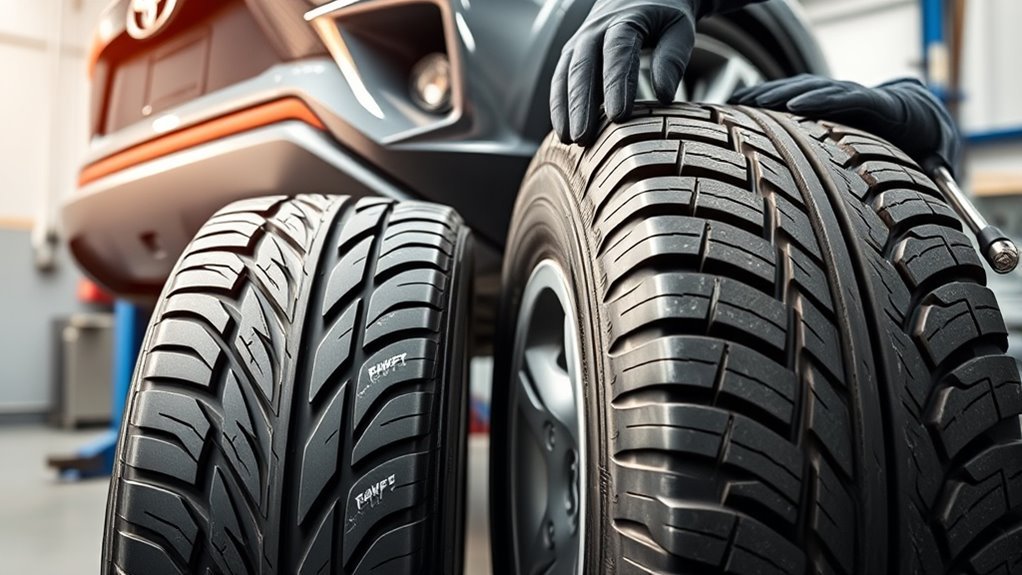
Correct mounting matters because directional and asymmetrical tires are not installed the same way. A directional tire must follow the sidewall arrow. An asymmetrical tire must keep the “Outside” marking facing outward. Some tires can be both directional and asymmetrical, which means both rules apply at the same time.
[Products Worth Considering]

The SAFELIFE dial tire tread depth gauge measures tread depth in 1/32 inch increments with clear, easy-to-read 2-inch dial face. Color zones using a traffic light system help you quickly judge whether tread is low, marginal, or ample for safer driving. Built with a durable zinc cast body and a metal detect probe for precise, comfortable use across cars, motorcycles, trucks, and buses.

Accurately measure tire tread depth with a calibrated gauge marked from 0 to 1 inch in 1/32 inch increments. The color-coded bar helps you quickly identify tread condition ranges, supporting safe driving for trucks, motorcycles, automobiles, and passenger vehicles.

Keep your tires properly inflated with this analog VONDIOR tire pressure gauge, designed for fast, easy readings without batteries. The swiveling, two-axis hose and large glow dial help you measure at any tire angle with instant visibility. Built with a protective rubber shield, it supports durable, low-maintenance use for cars and trucks.
Directional Tire Mounting and Rotation
- Look for a sidewall arrow or the word “Rotation.”
- Make sure the arrow points forward when the RAV4 moves forward.
- Rotate front-to-back on the same side unless a tire professional dismounts and remounts the tires.
- Check for uneven shoulder wear, cupping, vibration, or pulling after rotation.
Asymmetrical Tire Mounting and Rotation
- Look for “Outside,” “Inside,” or similar sidewall markings.
- Make sure “Outside” faces away from the vehicle after mounting.
- Once mounted correctly on the wheel, many asymmetrical tires can be rotated to different wheel positions, but always follow the tire maker and RAV4 manual guidance.
- If the tire is also directional, follow the rotation arrow as well as the “Outside” marking.
Maintenance Checklist for Both Tread Types
- Check tire pressure monthly and before long trips. Use the cold tire pressure listed on the driver-side door jamb label, not the maximum pressure printed on the tire sidewall.
- Inspect tread depth across the inner, center, and outer grooves. Replace tires when treadwear indicators show or when traction no longer feels safe.
- Watch for uneven wear. One-sided wear can point to alignment issues; cupping can point to worn suspension, imbalance, or rotation neglect.
- Rotate on schedule. Toyota’s RAV4 owner information says tire rotation helps equalize wear and extend tire life, and some models require tire pressure warning system initialization after rotation.
- Do not overload the vehicle. Tire performance depends on staying within the RAV4’s tire, axle, and vehicle load limits.
Warning: Do not mix tire sizes, constructions, or significantly different tread patterns on the same axle. U.S. federal inspection guidance also treats matching tire size designation and construction on the same axle as a safety requirement.
Best Pick by RAV4 Use Case: Commuting, All-Weather, Light Off-Road, Towing
Your best tread choice depends on how your RAV4 is actually used. A commuter RAV4 needs quiet comfort and even wear. A road-trip RAV4 needs stability and load confidence. A rainy-climate RAV4 needs wet grip. A trail-use RAV4 may need a more open all-terrain design rather than a regular highway tread.
Daily Commuting
For commuting, choose a quality asymmetrical or symmetrical touring tire. You will usually get lower road noise, predictable wear, and good comfort. Directional tread is not wrong for commuting, but it may be more specialized than most drivers need.
Rainy or Slushy Climates
If your RAV4 often drives through heavy rain, water-covered roads, or slush, directional tread can be a strong choice. Look for deep circumferential grooves, strong wet traction ratings, and good independent test results for the specific tire model.
All-Weather Driving
For one set of tires that handles dry roads, rain, and light winter conditions, an asymmetrical all-weather tire is often the best match. If winter roads are common, prioritize the Three-Peak Mountain Snowflake marking and winter-rated performance over tread pattern appearance.
Light Off-Road and Gravel
For light gravel roads, campground access, and occasional dirt, tread depth and tire category matter more than directional versus asymmetrical alone. A highway all-season tire will not behave like an all-terrain tire just because it has a bold pattern. If you regularly drive on loose surfaces, consider an all-terrain tire that fits your RAV4’s size and load requirements.
Towing and Loaded Trips
For towing or loaded family trips, focus on the correct tire size, load index, inflation pressure, condition, and even wear. Asymmetrical tread can help with stability, but it cannot compensate for underinflation, overloading, or worn tread.
Common Mistakes to Avoid
- Buying by tread appearance only: Aggressive-looking tread does not guarantee better wet grip, snow grip, or stopping distance.
- Ignoring sidewall markings: Directional arrows and “Outside” markings are not cosmetic; they are installation instructions.
- Mixing tread types casually: Different tread designs can create uneven grip and handling, especially in emergency braking or wet cornering.
- Skipping alignment checks: A good tread pattern will still wear poorly if the RAV4 has alignment or suspension issues.
- Using worn tires in rain: Even the best rain-focused tread loses water evacuation ability as tread depth drops.
Frequently Asked Questions
What is the difference between directional and asymmetrical tires?
Directional tires have a tread pattern designed to roll in one direction, usually marked by a rotation arrow on the sidewall. Asymmetrical tires have different inner and outer tread zones and are usually marked “Inside” and “Outside” so they are mounted facing the correct way.
Are directional tires better for a Toyota RAV4?
Directional tires can be better if your RAV4 often drives in heavy rain, slush, standing water, mud, or loose surfaces. They are not automatically better for every driver. For normal commuting and mixed weather, asymmetrical tires are often the better all-around choice.
What are the disadvantages of directional tires?
Directional tires have stricter mounting and rotation rules. They normally rotate front-to-back on the same side only unless they are dismounted and remounted. Some directional tread designs may also create more road noise than quieter touring-style tires.
Can you mix directional and asymmetrical tires?
It is best not to mix directional and asymmetrical tires on the same vehicle, especially on the same axle. Mixing tread types, sizes, ages, or constructions can reduce predictable handling and braking. For a RAV4, use four matching tires whenever possible.
Can asymmetrical tires also be directional?
Yes. Some tires are both asymmetrical and directional. In that case, the tire must be mounted with the “Outside” sidewall facing outward and the rotation arrow pointing in the correct forward-rolling direction.
Which tread type is best for snow on a RAV4?
For snow, tire category and compound matter more than directional versus asymmetrical alone. Look for a winter tire or all-weather tire with the Three-Peak Mountain Snowflake symbol if you regularly drive on snow or ice.
Conclusion
For a Toyota RAV4, directional tread is the better choice when wet-road water evacuation, slush control, or loose-surface traction is your top priority. Asymmetrical tread is the smarter default for most owners because it balances wet grip, dry handling, comfort, noise, tread life, and rotation flexibility.
Before buying, check the tire’s sidewall markings, load index, speed rating, winter symbols, warranty details, and independent wet/snow performance results. Then maintain the tires with correct pressure, regular rotation, alignment checks, and tread inspections. The tread pattern matters, but safe RAV4 performance comes from the full tire package.
Sources
- NHTSA TireWise — tire pressure, tread inspection, load limits, and consumer tire safety guidance.
- NHTSA Tire Safety Brochure — tire pressure, load limits, road hazard checks, and tire failure prevention.
- Continental: Mounting Directional and Asymmetrical Tires — sidewall markings, inside/outside orientation, and rotation guidance.
- Goodyear: Proper Mounting of Directional and Asymmetrical Tires — professional mounting guidance for incorrectly oriented tires.
- Bridgestone: Tire Tread Patterns — overview of symmetric, asymmetric, and directional tread pattern types.
- Toyota Owners Manuals and Warranties — official Toyota owner manual source for RAV4 tire pressure, tire rotation, TPMS, and maintenance guidance.
[Products Worth Considering]
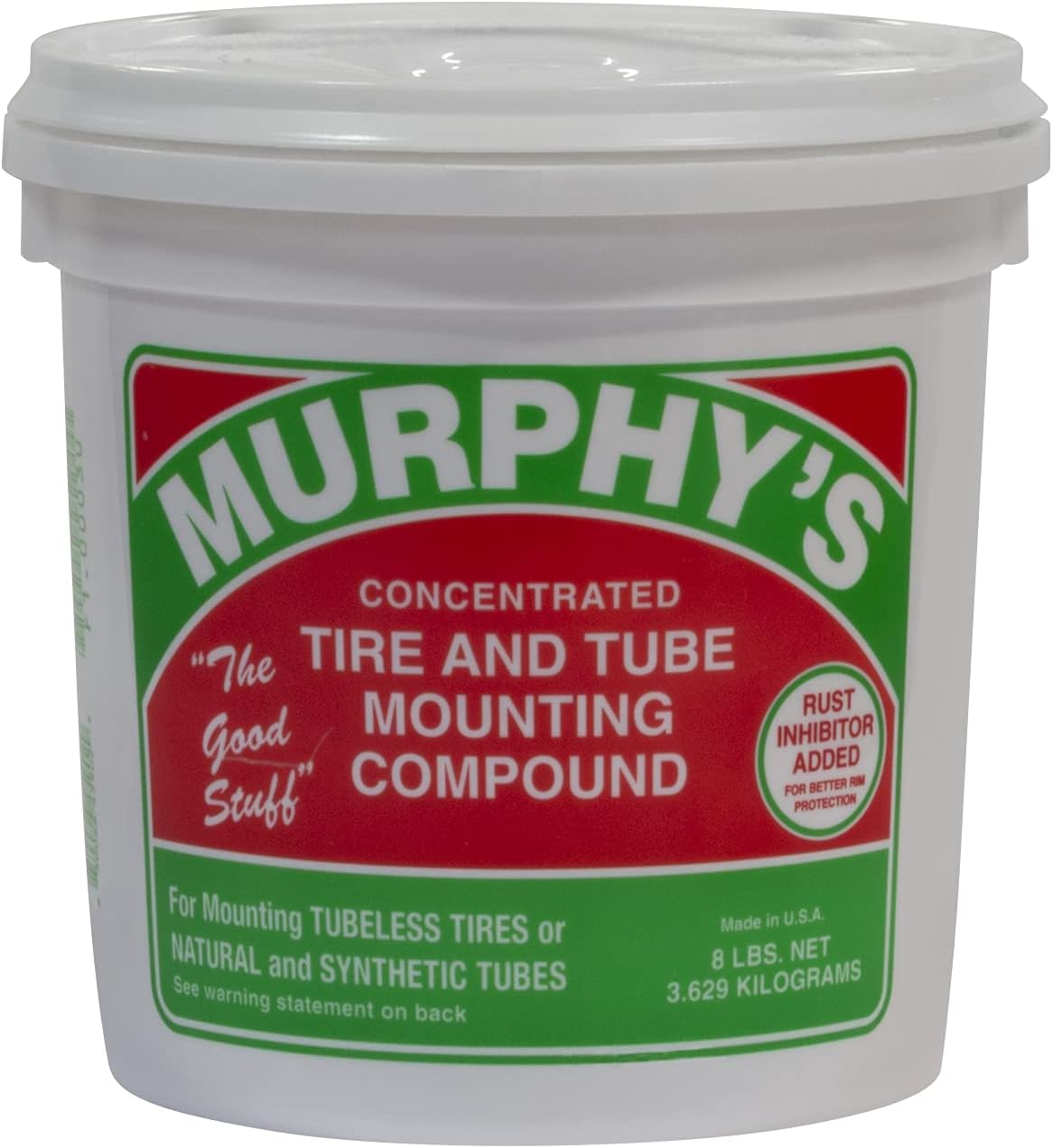
A concentrated tire and tube mounting compound designed to help simplify mounting rubber tires and tubes on passenger, semi truck, construction, and OTR applications. Its ultra-thick formula packs beads effectively and includes rust inhibitors to help protect against corrosion during use.

These universal tire valve stem caps help protect valve cores from dust, debris, and moisture while helping maintain stable tire pressure. The corrosion-resistant metal construction and sealed design provide reliable protection in road grime, mud, and winter conditions. Twist-on installation makes them quick to fit on cars, SUVs, trucks, and motorcycles.
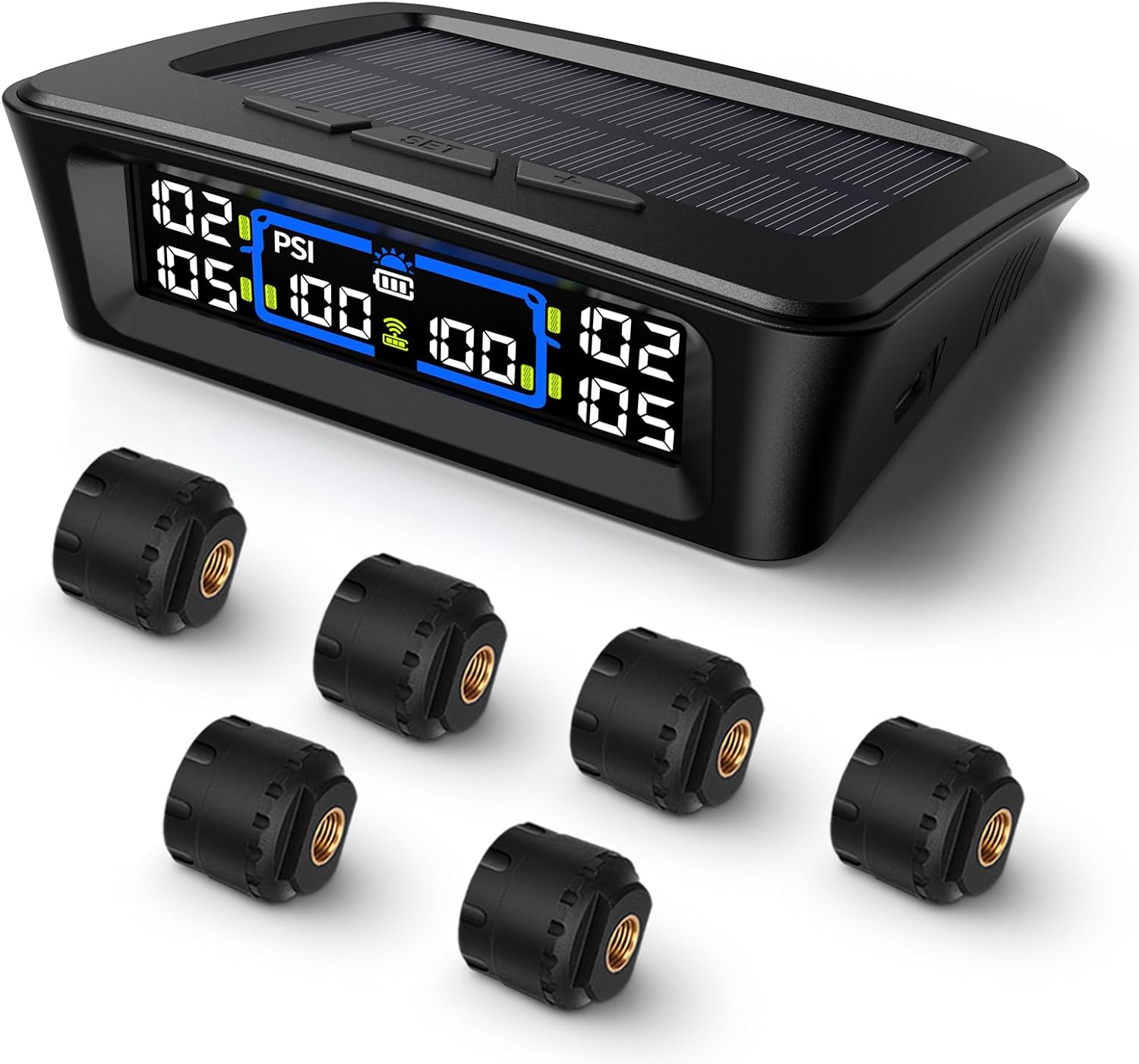
The Tymate TM12 RV TPMS delivers real-time tire pressure and temperature monitoring with a stable 433Hz display for safer long-distance driving. It supports simultaneous monitoring across vehicle and trailer zones, includes six alarm modes for pressure, temperature, leakage, battery, and signal loss, and features easy DIY installation with auto calibration. Power is supplied via USB-C charging or solar recharging, with a wide 0–144 PSI range and up to 50 ft signal coverage for RVs and towable trailers.

Related Articles

Why These 10 Wheel Locks Are Perfect for Your RAV4
Protecting your RAV4 starts before you lock the doors. Wheel theft is an avoidable cost and a hassle that interrupts your routine, and choosing…
Read More
10 Best 80000 Mile Tires for Rav4
You want tires that last, keep you safe, and save you money over the long run. Choosing 80,000 mile tires for your RAV4 matters…
Read More
10 Long Warranty Tires That Will Transform Your RAV4 Experience
You spend a lot of time behind the wheel of your RAV4, and the right tires change everything from ride comfort to fuel economy…
Read More
One Comment