
How Much Does a Monster Truck Tire Weigh? Exact Weight Guide
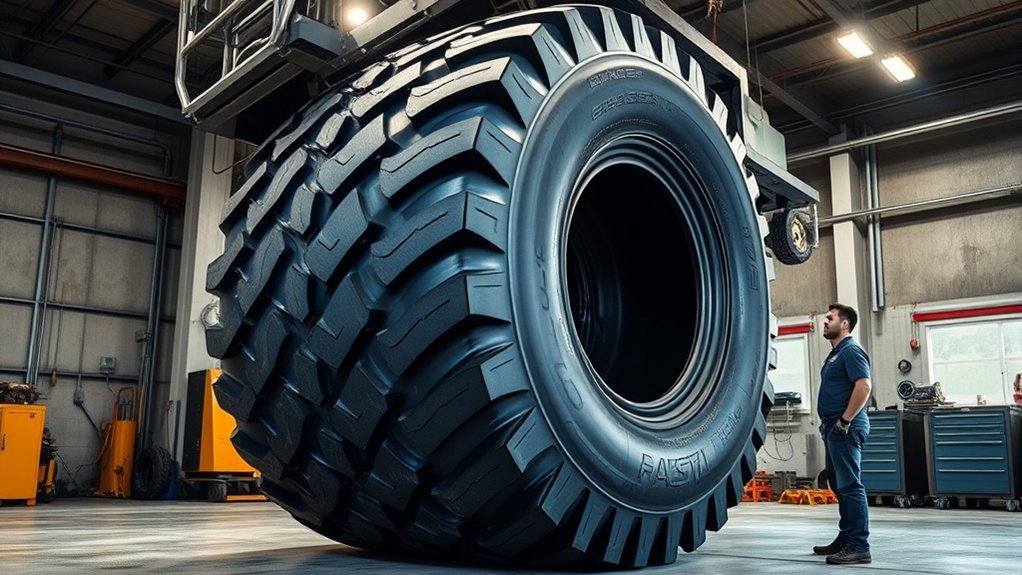
A monster truck tire has two different weight answers: the bare tire and the mounted tire-and-wheel assembly. For current Monster Jam trucks, Monster Jam lists each BKT tire-and-wheel assembly at 645 pounds. BKT describes the current tire itself as over 440 pounds, so avoid using older 800–900 pound claims unless the source explains the exact tire, wheel, and setup.
Last updated: July 7, 2026
Quick Answer
A current Monster Jam BKT tire weighs over 440 pounds by itself, and the full tire-and-wheel assembly weighs 645 pounds. Older or custom monster truck setups are sometimes described as 800–900 pounds, but that is not the current official Monster Jam tire-and-wheel figure.
Key Takeaways
- Current Monster Jam BKT tires are 66 inches tall and 43 inches wide.
- The current tire-and-wheel assembly weighs 645 pounds, according to Monster Jam.
- BKT describes the current Monster Jam tire itself as over 440 pounds.
- Current Monster Jam tires run at about 23 psi, or 1.6 bar.
- Older “800–900 pound” figures may refer to older, custom, or different tire-and-wheel setups.
How Much Does a Monster Truck Tire Weigh?
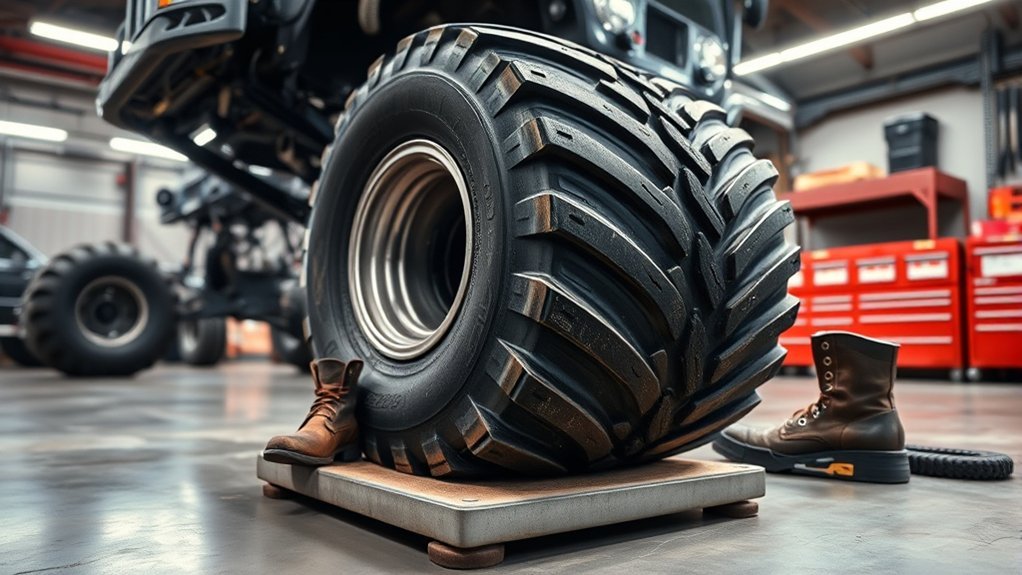
A modern Monster Jam tire has two useful weight numbers. Monster Jam lists the mounted tire-and-wheel assembly at 645 pounds. BKT describes the current Monster Jam tire itself as over 440 pounds, with a pressure of 1.6 bar, which is about 23 psi.
That distinction matters because many older articles and fan discussions use heavier numbers, often around 800 to 900 pounds. Those figures may describe older agricultural-style monster truck tires, different wheel assemblies, custom exhibition trucks, or outdated estimates. For a current Monster Jam truck using BKT tires, the safest answer is 645 pounds with the wheel.
Use 645 pounds when you mean the current Monster Jam BKT tire mounted on its wheel. Use “over 440 pounds” when you mean the current BKT tire by itself.
Monster Truck Tire Size, Pressure, and Weight
Current Monster Jam tires are large, but the official numbers are more specific than most estimates. Monster Jam lists its BKT tires as 66 inches in diameter, 43 inches wide, inflated to 23 psi, and weighing 645 pounds with the wheel. BKT also describes the current FL 354 tire as part of a fourth-generation Monster Jam design built from driver and Feld Entertainment feedback.
| Tire Type | Typical Size | Pressure | Weight |
| Current Monster Jam BKT tire | 66 in. tall x 43 in. wide | About 23 psi / 1.6 bar | 645 lb with wheel; over 440 lb tire-only |
| Older or custom monster truck setup | Often around 66 in.; special show trucks may differ | Varies by team and tire | Some older examples claim 800–900 lb, so verify the exact setup |
| Cat 797 mining truck tire | 59/80R63 mining tire | Depends on load, speed, and tire model | 11,795 lb for one Michelin XDR4 Extra Load 59/80R63 model |
Monster Jam trucks themselves are also massive. Monster Jam lists each truck at about 12,000 pounds, with a 10.5-foot height, 12.5-foot width, and 17-foot length. The tire-and-wheel assemblies are a major part of the truck’s unsprung and rotating mass.
For historical context, BIGFOOT #2 helped establish the familiar 66 x 43 x 25-inch monster truck tire format in the early 1980s. That size is still the number most fans recognize, but modern Monster Jam BKT tires are purpose-built competition tires rather than unmodified farm tires.
[Products Worth Considering]

Monster Jam 2025 Official 1:64 Scale Diecast Truck Series 40 Crazy Creatures Series El Toro Loco (Orange).

【High Quality】Monster truck tires made from INJORA M1 compound,the interior contains plastic rim,can be installed easily.

Compatibility: These RC Monster Truck Wheel Rim Tires Set compatible with 1/24 RC crawler SCX24, AX24, FCX24, 1/18 TRX4M, and other monster truck or mini RC car
What Makes Monster Truck Tires So Heavy?
Monster truck tires are heavy because they need a huge footprint, strong sidewalls, and enough rubber mass to survive violent landings. A current Monster Jam tire is almost as tall as many adults, and its width gives the truck the contact patch needed for dirt, ramps, crushed cars, and hard cornering.
The weight comes from several places:
- Large casing: A 66-inch tire uses far more material than a passenger-truck tire.
- Wide footprint: The 43-inch width spreads load and helps traction.
- Reinforced structure: The sidewalls and carcass must resist impact, cuts, and flex fatigue.
- Deep tread blocks: The tread has to bite into dirt while staying stable under high torque.
- Wheel assembly: The mounted wheel adds major weight, which is why tire-only and mounted weights differ.
Warning: A monster truck tire or tire-and-wheel assembly is too heavy to move, mount, or inflate casually. Handling one safely requires proper lifting equipment, trained people, and tire-service procedures.
Why Do Some Sources Say Monster Truck Tires Weigh 800 to 900 Pounds?
The 800–900 pound answer usually appears when a source does not separate the bare tire from the mounted tire-and-wheel assembly, or when it discusses an older or custom truck. For example, a non-current show truck, a Raminator-style setup, or a custom exhibition build may use a heavier tire-and-wheel package than the current Monster Jam BKT figure.
When you compare numbers, treat 645 pounds as the current Monster Jam BKT mounted assembly figure. Treat heavier numbers as setup-specific until the source names the tire model, wheel, and whether the tread has been custom cut.
How BKT Designs Monster Jam Tires
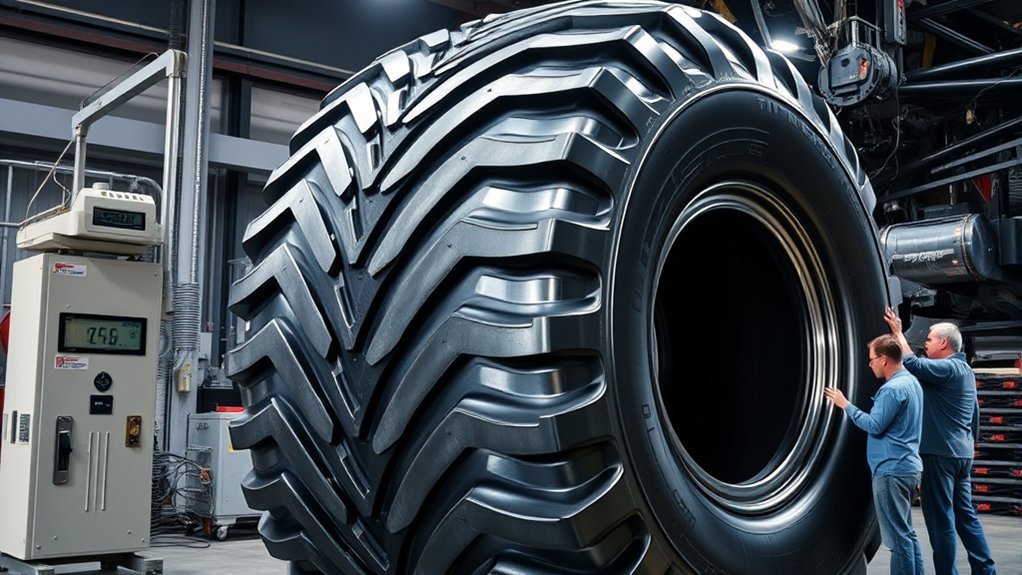
BKT is the official tire partner of Monster Jam and has supplied Monster Jam tires since 2014. Monster Jam also reports that BKT and Feld Motor Sports extended their partnership through 2031. The current FL 354 pattern is a competition-specific tire developed through years of feedback from Feld Entertainment and Monster Jam drivers.
The current tire is not simply heavy for the sake of being heavy. BKT has changed the design to improve how the truck lands, corners, and recovers from stunts. Reported changes include a width reduction of about 60 mm, a more rounded tire shape, deeper center tread for traction and durability, reduced shoulder tread depth to limit sinking while cornering, and added support-zone tread blocks to help traction when the truck lands at an angle.
Note: A monster truck tire’s weight is only one part of the setup. Tire pressure, tread cutting, wheel weight, suspension tuning, and track surface all change how the truck feels.
[Products Worth Considering]

What You Will Get: the package comes with 8 pieces of inflatable giant tire tubes, sufficient quantities can allow you to share with your family members and friends; Reminder: please don't inflate more than 95%, stay away from sharp objects and fire

⚡⚡【High-Quality Materials】The 1/10 monster truck tires and wheels are made of soft rubber, plastic and foam inserts. 1/10 monster truck tires and wheels is built-in sponge ring has strong shock absorption and excellent wear resistance, which effectively relieves the vibration of the car due to uneven road surface.And 1/10 rc monster tires due to the environmentally friendly and strong material, these 1/10 rc truck tires and wheels are more practical and durable.it make your rc truck car look more realistic and cool.

Pre-Mounted, Save time for installing, Ready for fun
Why Monster Truck Tire Weight Matters on Track
Tire weight matters because monster truck tires are both rotating mass and unsprung mass. The engine has to spin them, the brakes have to slow them, and the suspension has to control them when the truck lands.
- Acceleration: Heavier rotating assemblies need more torque to get moving.
- Braking: More rotating mass can increase the braking load.
- Landing control: The tire’s size and flex help absorb impact before the suspension finishes the job.
- Traction: A wide footprint helps the truck hook up on dirt and recover after awkward landings.
- Steering response: Heavy tires can feel slower to change direction, but they can also help the truck stay planted.
That is why the tire must balance strength, flex, and weight. Too weak, and it will not survive the show. Too heavy, and the truck becomes harder to launch, stop, and control.
How to Measure Monster Truck Tire Weight the Right Way
When comparing monster truck tire weights, always check exactly what is being measured. A tire-only number will be lower than a mounted tire-and-wheel number. A custom-cut tire may weigh less than an uncut agricultural tire. A special exhibition tire may be much larger than a current Monster Jam competition tire.
Use these questions before trusting a number:
- Is the number for the bare tire or the tire and wheel?
- Is it a current Monster Jam BKT tire or an older agricultural-style tire?
- Has the tread been custom cut?
- Is the tire used for competition, mud racing, display, or mining equipment?
- Is the source a manufacturer, official series page, retailer, or fan estimate?
Pro Tip: For current Monster Jam facts, use the official Monster Jam truck specs for mounted tire-and-wheel weight and BKT’s tire information for tire-only weight.
[Products Worth Considering]

SKILL-BUILDING PLAY: Develops hand-eye coordination, motor skills, and strategic thinking as kids launch vehicles up a ramp and through a ring of fire with the slam launcher

1.Check the size before buying.Note: With foam inserted,and the tires are NOT Pre Glued on Rims,you need glue them together before run them.

Frequently Asked Questions
How much does a monster truck tire weigh with the rim?
A current Monster Jam BKT tire-and-wheel assembly weighs 645 pounds. That number includes the tire mounted on the wheel, so it is the best answer when someone asks about the tire “with the rim.”
How much does a Monster Jam tire weigh without the wheel?
BKT describes the current Monster Jam tire itself as over 440 pounds. If you see a more exact tire-only number, verify that it comes from BKT, Monster Jam, a team, or a seller measuring the same tire model.
How big is a Monster Jam tire?
Monster Jam lists its BKT tires at 66 inches in diameter and 43 inches wide. The current tire pressure is about 23 psi, which matches BKT’s 1.6 bar figure.
Can one person lift a monster truck tire?
No. A current Monster Jam tire-and-wheel assembly weighs 645 pounds, so moving or mounting one safely requires lifting equipment and trained people. Do not try to handle one like a normal truck tire.
How much does one monster truck tire cost?
Monster Jam and BKT do not publish a simple retail price for current competition BKT tires on their public spec pages. The final cost can depend on the tire model, condition, custom cutting, wheel inclusion, freight, and whether the tire is sold by a team, manufacturer, or specialty seller.
Why do some websites say monster truck tires weigh 900 pounds?
The 900-pound number may come from older setups, different tire-and-wheel assemblies, agricultural flotation tires, custom show trucks, or repeated estimates that do not separate tire-only weight from mounted assembly weight. For current Monster Jam BKT tires, use over 440 pounds tire-only and 645 pounds with the wheel.
Is a Cat 797 tire heavier than a monster truck tire?
Yes. A Cat 797 mining truck uses 59/80R63-class mining tires, and one Michelin XDR4 Extra Load 59/80R63 model weighs 11,795 pounds. That is far heavier than a current 645-pound Monster Jam tire-and-wheel assembly.
Sources
- Monster Jam 101 — current Monster Jam truck size, tire size, tire pressure, and tire-and-wheel weight.
- BKT: Behind the Scenes of BKT Tires for Monster Jam — current BKT tire-only weight, pressure, and design background.
- Monster Jam: BKT and Feld Motor Sports Extend Partnership to 2031 — FL 354 development details and partnership information.
- Caterpillar 797F Mining Truck — Cat 797F mining truck context and 59/80R63 tire-size reference.
- Michelin XDR4 Extra Load 59/80R63 — mining tire size and weight reference for Cat 797-class applications.
- Bigfoot 4X4 History — background on the 66 x 43 x 25-inch monster truck tire format.
Conclusion
For current Monster Jam trucks, the best answer depends on what you are weighing. The BKT tire itself weighs over 440 pounds, while the full tire-and-wheel assembly weighs 645 pounds. The common 900-pound answer is not the current official Monster Jam figure. Tire size, pressure, tread design, wheel weight, and suspension setup all work together, which is why monster truck tire weight affects acceleration, braking, traction, and landing control.

Related Articles
What Is a Fat Tire? Complete Guide & Best Options
I’ll show you what makes fat tires different, which setups work best, and why the right choice could change your ride.
Read More
What Does W Mean on a Tire? Load, Speed & Rating Guide
Huh, what does W on a tire really mean, and why could choosing the wrong rating affect your safety and performance?
Read More
What Does Tire Flipping Work? Muscles, Benefits & Workout Guide
Strong tire flips hammer your entire body, but which muscles and benefits matter most?
Read More