
How Much Does a Car Tire Weigh? Exact Weight Guide
A car tire usually weighs less than most people expect, but the exact number changes fast once size, load rating, tread type, and construction are involved. A loose passenger-car tire may weigh around 20 to 30 pounds, while a light-truck all-terrain tire can weigh two or three times as much. If the tire is mounted on a wheel, the assembly is much heavier.
Quick Answer
A typical unmounted passenger car tire weighs about 20 to 30 pounds. Smaller compact-car tires can be closer to 15 to 22 pounds, larger performance or CUV tires can exceed 30 pounds, and many light-truck or off-road tires weigh about 45 to 80+ pounds each.
Key Takeaways
- Most unmounted passenger-car tires weigh about 20 to 30 pounds, but small compact tires may be lighter and large performance tires may be heavier.
- CUV and SUV passenger-rated tires often weigh about 25 to 45 pounds, while LT-rated truck and off-road tires commonly run about 45 to 80+ pounds.
- The wheel is not included in tire weight. A mounted tire and wheel assembly can easily add another 15 to 35+ pounds.
- Size, load range, sidewall strength, tread depth, run-flat construction, and tire category all affect weight.
- Tire weight matters, but fuel economy and braking are also strongly affected by rolling resistance, inflation pressure, tread compound, and road conditions.
Average Tire Weight by Type
Use these ranges as practical estimates for an unmounted tire. For the exact number, check the tire maker’s size-specific specs or weigh the tire on a scale.
| Tire type | Typical unmounted weight | Notes |
|---|---|---|
| Compact car tire | 15 to 22 lb | Small rim diameter, narrower tread, lower load rating |
| Common passenger car tire | 20 to 30 lb | Many sedan, hatchback, and touring sizes fall here |
| Large performance or CUV tire | 25 to 40+ lb | Wider tread, larger diameter, and XL load ratings add weight |
| SUV or light truck tire | 35 to 80+ lb | LT-rated, all-terrain, mud-terrain, and high-load tires are heavier |
| Motorcycle tire | 8 to 30 lb | Front tires are usually lighter than rear tires |
| ATV or UTV tire | 20 to 40+ lb | Large mud and utility tires can exceed this range |
| Specialty / extreme off-road tire | 80 lb to several hundred pounds | Agricultural, industrial, and monster truck tires are in a different class |
[Products Worth Considering]
![[2026NEW] 5000A Jump Starter with Air Compressor (150PSI)](https://m.media-amazon.com/images/I/71oG4PFNsmL._AC_SL1500_.jpg)
The 2026 Povasee 5000A jump starter is an all-in-one car power solution that jump-starts 12V vehicles and also inflates tires with a high-output air compressor. It supports multiple inflation presets with an LCD display, plus LED lighting and SOS signaling for safer roadside help. With secure protection systems, fast charging for phones, and 24-month standby, it’s built for reliable emergency performance in a wide temperature range.

ETENWOLF’s calibrated digital tire pressure gauges deliver accurate readings across a wide pressure range, from below 12 PSI to above 140 PSI. The built-in thermal compensation helps maintain performance in extreme cold and hot conditions, while the LED light improves visibility for quick checks. Includes replaceable AAA batteries for long-lasting use and convenience for everyday tire monitoring.

This calibrated digital tire pressure gauge delivers accurate readings within plus-minus 1 PSI for reliable tire maintenance. It features an illuminated nozzle and backlit LCD display to measure easily in dim areas, and offers four selectable units for versatile use. Automatic shutdown after 30 seconds helps conserve battery life for everyday convenience.
How Much Does a Car Tire Weigh?
A typical loose passenger-car tire weighs about 20 to 30 pounds. Smaller economy-car tires may weigh closer to 15 to 22 pounds, while larger 18-, 19-, 20-, or 22-inch performance and crossover tires can move into the low-to-mid 30-pound range.
For example, Continental’s published specifications show that weight changes by exact size even within the same tire model. A 225/45ZR17 size is listed at 22.5 pounds, while some larger 20-inch and SUV/crossover sizes in the same performance family are listed above 30 pounds.
The most important rule is this: tire weight is size-specific. Two tires with the same rim diameter can still weigh different amounts if one is wider, has a taller sidewall, has a higher load rating, uses run-flat construction, or has a deeper all-terrain tread.
Note: Tire weight means the tire only. If the tire is mounted on a wheel, add the wheel weight too. A mounted passenger-car tire and wheel assembly often weighs 40 to 60+ pounds, and a truck assembly can weigh much more.
What Makes Car Tires Heavier?
Tire weight comes from a mix of size, load capacity, materials, tread depth, and the job the tire is built to do. A quiet touring tire, a run-flat tire, an EV tire, and an off-road LT tire may all fit a vehicle, but their construction can be very different.
Tire Size, Width, and Load Range
Wider and taller tires usually weigh more because they need more rubber, reinforcement, and bead material. Load rating also matters. A tire built to carry a heavier vehicle or handle higher inflation pressure needs stronger internal construction.
This is why an LT-rated truck tire normally weighs more than a similar-looking passenger-rated SUV tire. Tire Rack explains that load capacity is related to tire size, construction, and inflation pressure. When the carcass, bead, and sidewall are strengthened for higher loads, weight usually rises too.
Material Composition Factors
A tire is not just rubber. It is a layered product made from natural rubber, synthetic rubber, carbon black, silica, oils, resins, steel, textile cords, bead wire, and other compounds. Continental’s tire material breakdown gives one example of a tire formula with rubber, fillers, reinforcing materials, plasticizers, vulcanization chemicals, and anti-aging agents.
Those materials are chosen for grip, heat resistance, strength, comfort, treadwear, and rolling resistance. Heavier construction is not automatically better or worse. It simply means the tire was built for a different balance of durability, load capacity, and performance.
Tread Depth and Design
Deeper tread usually adds weight because the tire contains more rubber. Aggressive all-terrain and mud-terrain patterns also use larger tread blocks, deeper voids, and stronger shoulders. That can improve off-road durability and traction, but it often adds mass and rolling resistance.
| Feature | Why it adds weight | Common example |
|---|---|---|
| Deep tread | More rubber in the tread blocks | All-terrain and mud-terrain tires |
| Wide section width | More casing, tread, and belt material | Performance tires and wide truck tires |
| Reinforced sidewall | Extra structure for load and impact resistance | LT, run-flat, and off-road tires |
| Higher load range | Stronger casing and bead package | E- and F-load light-truck tires |
Passenger Car Tire Weight Range
Most passenger car tires fall somewhere around 20 to 30 pounds, but the exact range is wider than a single average suggests. A compact-car tire can be under 20 pounds, while a larger ultra-high-performance or crossover tire can exceed 30 pounds.
A 17-inch tire is not always lighter than a 20-inch tire, but it often is when the tire width and load rating are similar. A 225/45ZR17 performance all-season tire may weigh around the low 20-pound range, while a wider 20-inch performance or crossover tire can land in the upper 20s or mid-30s.
Do not rely on rim diameter alone. A narrow 20-inch low-profile tire may weigh less than a tall, heavily reinforced 17-inch LT tire. Always compare the full size code, load index, load range, and tire model.
[Products Worth Considering]

The SAFELIFE dial tire tread depth gauge measures tread depth in 1/32 inch increments with clear, easy-to-read 2-inch dial face. Color zones using a traffic light system help you quickly judge whether tread is low, marginal, or ample for safer driving. Built with a durable zinc cast body and a metal detect probe for precise, comfortable use across cars, motorcycles, trucks, and buses.

This Rhino USA tire pressure gauge with inflator combines an analog dial, locking chuck, and bleed valve in one no-battery tool for inflating, checking, and bleeding in a single connection. It fits standard 1/4" NPT air compressor fittings and is built for reliable shop, roadside, and fleet use on cars, trucks, motorcycles, SUVs, RVs, and trailers. A lifetime replacement helps keep your tire maintenance routine covered.
SUV and Light Truck Tire Weight
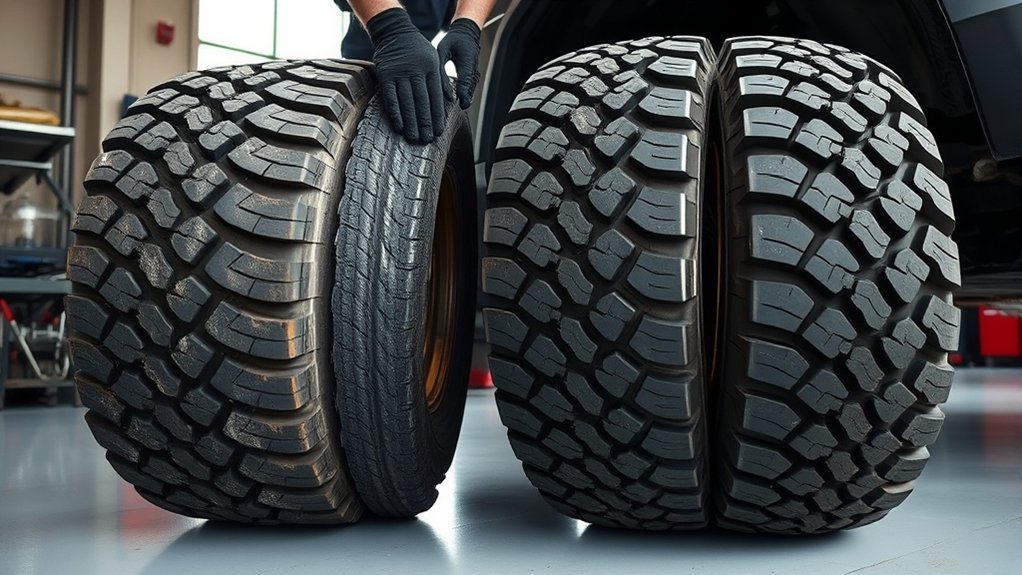
SUV and light truck tire weight depends heavily on whether the tire is passenger-rated, XL-rated, or LT-rated. Many crossover and SUV tires are basically passenger tires built in larger sizes, so they may weigh about 25 to 45 pounds. LT-rated all-terrain and mud-terrain tires are usually heavier because they are built for load, towing, rough roads, and off-road damage resistance.
As a real-world reference, Tire Rack’s BFGoodrich All-Terrain T/A KO3 specifications list many LT sizes in the 50- to 70-pound range, with larger flotation sizes reaching around 80 pounds. That is why truck tire weight should be checked by exact size instead of by vehicle category alone.
| Tire category | Typical weight | Best use |
|---|---|---|
| Passenger-rated CUV/SUV tire | 25 to 45 lb | Daily driving, comfort, highway use |
| LT highway tire | 40 to 65 lb | Towing, hauling, work trucks |
| LT all-terrain tire | 45 to 80+ lb | Mixed highway, gravel, dirt, snow, trails |
| Oversized mud-terrain or flotation tire | 60 to 100+ lb | Off-road builds and heavy-duty use |
[Products Worth Considering]

THE WORKHORSE THAT KEEPS SHOWING UP: You need a reliable all-terrain tire for the daily grind. The interlocked center tread delivers stability on the highway and traction on changing surfaces. Jagged sipes bite into wet pavement, gravel, and packed dirt. The Trail Blade A/T was built for the truck that clocks miles every single day.

FOUR DEEP GROOVES FOR ALL-WEATHER CONFIDENCE – Four deep grooves channel water and mud out of the contact patch fast, resisting hydroplaning on wet highways and slick trails. A chip-resistant compound stands up to gravel, debris, and rough job-site surfaces, ensuring tough, dependable traction in dry and wet conditions all year round.
Motorcycle, ATV, and Specialty Tire Weights
Motorcycle tires are much lighter than car tires in many cases. Small front motorcycle tires can weigh under 10 pounds, while large touring, cruiser, and rear sport-touring tires can move into the 20- to 30-pound range. Rear tires are usually heavier because they are wider and carry more driving load.
ATV and UTV tires commonly weigh about 20 to 40 pounds, but mud tires, utility tires, and larger UTV tires can exceed that. Their weight depends on ply rating, tread depth, sidewall protection, and overall diameter.
Specialty tires vary dramatically. Current Monster Jam BKT tire and wheel assemblies are listed at 66 inches tall, 43 inches wide, 23 psi, and 645 pounds with the wheel included. Agricultural, industrial, and earthmover tires can be far heavier than anything used on a passenger vehicle.
Tire Only vs. Tire and Wheel Assembly
Many people ask about tire weight because they are lifting a spare, shipping tires, changing wheels, or planning storage. In those cases, make sure you know whether the number includes the wheel.
- Tire only: the rubber tire without the rim or wheel.
- Wheel only: the metal rim, usually aluminum alloy or steel.
- Mounted assembly: tire plus wheel, and sometimes valve stem, TPMS sensor, and balancing weights.
A loose 25-pound passenger tire can become a 45- to 60-pound mounted assembly once it is installed on a wheel. A truck tire that weighs 60 pounds can become a much heavier assembly after the wheel is included.
How Tire Weight Affects Handling, Braking, and Fuel Economy
Tire weight affects the vehicle because tires are both unsprung mass and rotating mass. Unsprung mass is the weight the suspension has to control below the springs. Rotating mass is the weight the engine and brakes must speed up or slow down as the wheels turn.
Weight matters, but it is not the only factor. Tread compound, tire pressure, rolling resistance, load rating, wheel weight, and road surface can matter as much as the tire’s scale weight.
Handling and Ride Comfort
A lighter tire can help the suspension react more quickly to bumps and road changes. That may improve steering response and road feel. A heavier tire may feel more stable in some conditions, but it can also make the vehicle feel slower to respond, especially if the weight is paired with a heavy wheel.
Ride comfort is a tradeoff. A heavier tire with a taller sidewall may absorb rough pavement better than a lighter, low-profile performance tire. That does not mean the heavier tire is always better; it means the tire’s full design matters.
Braking and Acceleration
More rotating mass generally requires more energy to accelerate and more braking force to slow down. However, braking distance is not controlled by weight alone. Tread compound, road temperature, wet traction, tire pressure, brake condition, and ABS calibration all affect stopping performance.
If you are comparing two replacement tires in the same size, do not choose by weight alone. A tire that is a few pounds heavier may still stop better if it has a better tread compound and stronger wet traction performance.
Fuel Economy and Rolling Resistance
Tire weight can influence efficiency, but rolling resistance is the more direct tire-related fuel-economy factor. NHTSA’s tire fuel-efficiency work focuses on rolling resistance, wet traction, and treadwear, not weight alone. Underinflation also hurts efficiency: the U.S. Department of Energy reported that a test vehicle had about 2% to 3% lower fuel economy when all four tires were at 75% of recommended pressure and used 5% to 10% more fuel at 50% of recommended pressure.
Pro Tip: When fuel economy matters, compare the tire’s size, rolling-resistance claims, tread type, and load rating. A lighter tire is not automatically the most efficient tire if its tread design creates more rolling resistance.
How to Measure Tire Weight
At a Glance
| Time Required | 2 to 5 minutes per tire |
| Difficulty | Easy for a loose passenger tire; moderate for heavy mounted truck assemblies |
| Tools Needed | Digital scale, clean flat surface, gloves, and a helper for heavy assemblies |
| Cost | Free if you already own a suitable scale; otherwise the cost of a basic digital scale |
To measure tire weight accurately, weigh the tire on a clean, flat, stable surface. A bathroom scale can work for a rough passenger-tire estimate, but a digital shipping scale, platform scale, or shop scale is better for heavy tires.
- Clean the tire first. Remove mud, stones, water, and debris that could change the reading.
- Zero the scale. Make sure the display reads zero before placing the tire on it.
- Place the tire centered on the scale. Keep it stable and avoid leaning it against a wall.
- Record whether the wheel is included. Write “tire only” or “mounted tire and wheel assembly.”
- Repeat if needed. If the reading changes, weigh it again and use the most consistent number.
Warning: Mounted truck tires and large wheel assemblies can be heavy enough to cause back, foot, or hand injuries. Use gloves, lift with your legs, and get help instead of trying to catch or carry a heavy assembly alone.
Where to Find Tire Weight Specs
The most accurate place to find tire weight is the manufacturer’s or retailer’s size-specific specification table. Search the exact tire model plus the full size code, such as “225/45R17 tire weight” or “LT285/70R17 load range E tire weight.”
The tire sidewall helps you identify the size, load index, speed rating, DOT/TIN, and other required markings, but it usually does not print the tire’s actual weight. NHTSA’s TireWise information is useful for understanding tire safety ratings and sidewall-related tire information. Once you know the exact size and model, use the manufacturer’s specs or a trusted retailer specification table to confirm weight.
If you cannot find published specs, weighing the tire is the best option. For shipping, storage, or recycling, always note whether the number includes the wheel.
Frequently Asked Questions
What is the average weight of a car tire?
A typical unmounted passenger car tire weighs about 20 to 30 pounds. Small compact-car tires can be closer to 15 to 22 pounds, while larger performance, CUV, and SUV passenger tires can exceed 30 pounds.
How much does a 20-inch car tire weigh?
A 20-inch passenger or performance tire often weighs about 25 to 35 pounds, but a 20-inch SUV, EV, run-flat, or LT tire can weigh more. Always check the exact tire model and size because width and load rating matter as much as rim diameter.
How much does a 17-inch tire weigh?
A 17-inch passenger car tire commonly weighs about 20 to 25 pounds. A 17-inch LT all-terrain or truck tire can weigh 45 to 60+ pounds because it has a taller sidewall, stronger casing, deeper tread, and higher load capacity.
How heavy is a 40-inch tire?
Many 40-inch light-truck off-road tires weigh roughly 80 to 100+ pounds, depending on tread design, load range, and width. Industrial and specialty 40-inch tires can weigh much more, so the exact spec is essential.
Does tire weight include the rim?
No. Tire weight normally means the tire only. If the tire is mounted on a rim, you are weighing a tire and wheel assembly. The wheel can add 15 to 35+ pounds for many passenger vehicles and more for trucks.
Is a lighter tire always better?
No. A lighter tire can improve response, but the best tire still needs the correct load rating, traction, durability, treadwear, and inflation requirements for your vehicle. A slightly heavier tire may be the better choice for towing, off-road use, or winter traction.
Can I find tire weight on the sidewall?
Usually, no. The sidewall helps you identify tire size, load index, speed rating, DOT/TIN, and maximum load or pressure information, but actual tire weight is normally found in manufacturer or retailer specifications.
Conclusion
A car tire’s weight depends on more than rim diameter. Size, width, load rating, tread depth, materials, sidewall strength, and tire category all matter. For a quick estimate, expect many passenger-car tires to weigh about 20 to 30 pounds, SUV and CUV tires to range higher, and LT truck or off-road tires to weigh much more. For the exact number, use the tire’s full size and model to check published specs, or weigh the tire directly on a suitable scale.
Sources
- Continental ExtremeContact DWS06 Plus specifications — backs up size-specific passenger and CUV tire weight examples.
- Tire Rack BFGoodrich All-Terrain T/A KO3 specifications — backs up LT and off-road tire weight examples.
- Continental tire mixture guide — backs up tire material categories and composition discussion.
- NHTSA TireWise — backs up tire safety ratings and consumer tire information.
- U.S. Department of Energy tire pressure and fuel economy data — backs up the fuel-economy note about inflation pressure.
- Monster Jam 101 — backs up current Monster Jam tire and wheel assembly size and weight.

Related Articles

Are Premium Tires Worth the Extra Money?
Worth the extra money? Premium tires promise more grip, comfort, and longevity—but the real tradeoff may surprise you.
Read More
What Are OE Tires? Original Equipment Explained
Discover what OE tires really mean and why choosing the right replacement could change everything for your car’s ride, handling, and safety.
Read More
305 Tire Size Explained: How Big Is It?
I explain how big a 305 tire really is—and why the exact fit can surprise you.
Read More