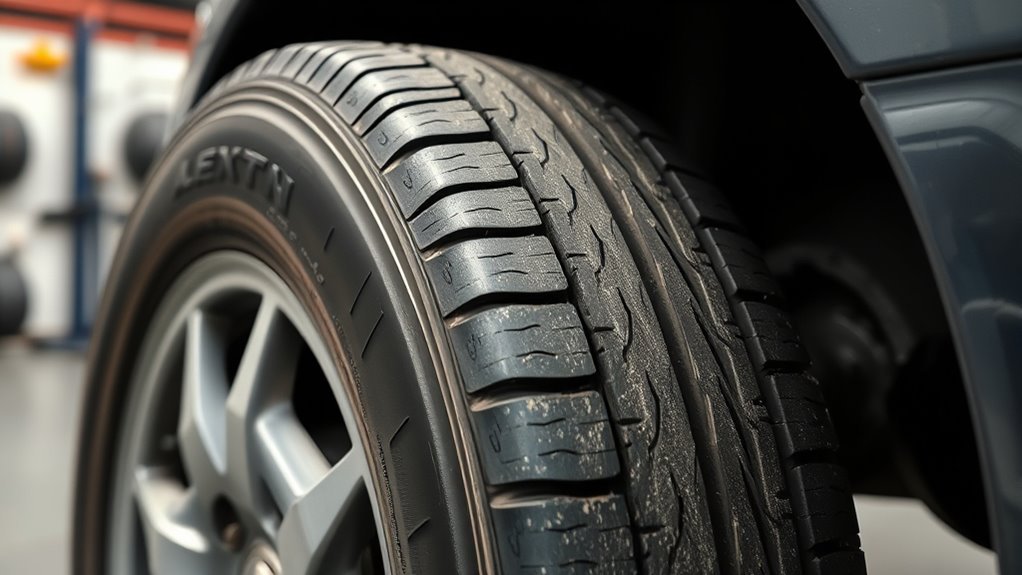
Inner-edge tire wear usually points to excessive negative camber, incorrect toe, or steering and suspension parts that are allowing the wheel alignment to move. Check tread depth across the full width of the tire, verify cold tire pressure, and inspect the steering and suspension before paying for an alignment. If cords or belts are exposed, the tire has a bulge or other structural damage, or the tread has reached its replacement limit, stop using the tire and have it replaced. Correcting the mechanical cause is essential because a new tire can develop the same wear if the alignment problem remains.
Last updated: August 18, 2026
Quick Answer
If the inside edge of one or more tires is wearing faster than the center and outside shoulder, start by checking for excessive negative camber, incorrect toe, or looseness or damage in steering and suspension components. A professional alignment can correct adjustable wheel angles, but worn ball joints, control-arm bushings, tie rods, wheel-bearing play, bent parts, or other mechanical faults should be repaired first. Incorrect inflation can accelerate wear, but overinflation more commonly produces center-tread wear rather than a classic one-sided inner-edge pattern.
| Wear Pattern | Likely Direction to Check | Next Step |
|---|---|---|
| Inner edge worn more than rest | Camber, toe, steering/suspension condition | Mechanical inspection and alignment measurement |
| Both shoulders worn | Low inflation, loading, fitment, driving conditions | Check cold PSI against vehicle placard |
| Center worn faster | Overinflation or application-related factors | Verify cold PSI and tire application |
| Feathered tread blocks | Toe or other alignment problem | Professional alignment inspection |
| Cupped or scalloped patches | Damping, balance, suspension or wheel issue | Inspect shocks/struts, balance and suspension |
Quick Home Checks to Spot Inner-Edge Wear
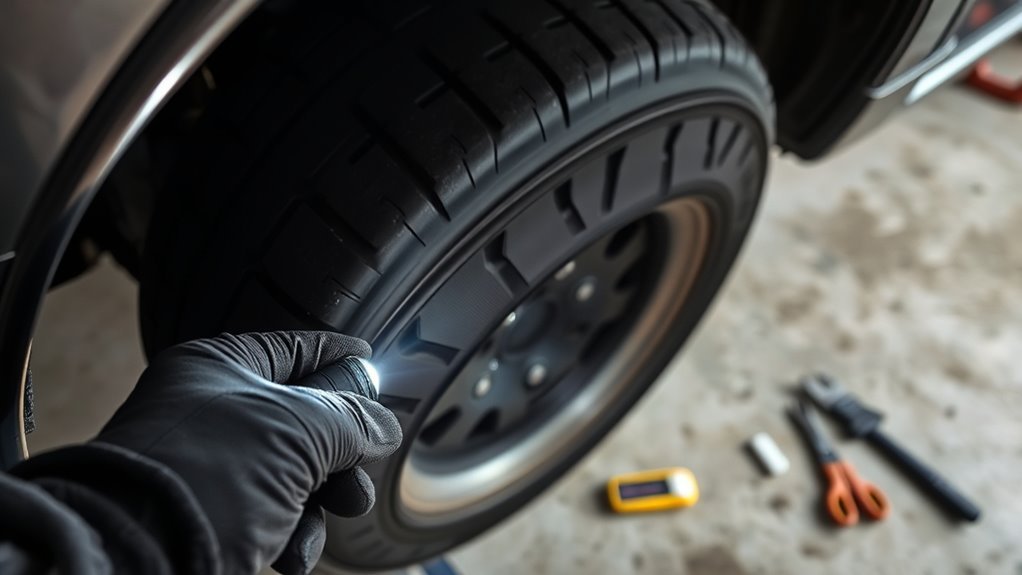
Inspect the tires at least monthly, including the tread that is difficult to see near the inside sidewall. Compare the inner, center, and outer grooves instead of judging the tire from the visible outside shoulder alone. A tread-depth gauge gives a more useful comparison than a visual check; see this guide on how to measure tire tread depth at several points across the tire.
Look for a smooth inner shoulder, exposed cords or steel belts, bulges, cuts, feathered tread blocks, or cupping. Check tire pressure when the tires are cold and compare it with the pressure on the vehicle’s tire-information placard or owner’s manual, not the maximum pressure molded on the tire sidewall. If you need a refresher, follow this guide to check tire pressure with a gauge.
Also note changes in how the vehicle drives. Pulling, an off-center steering wheel, looseness, or a recent pothole or curb impact can justify a professional steering, suspension, and alignment inspection. A home inspection can identify warning signs, but it cannot confirm the final camber and toe values as accurately as calibrated alignment equipment.
Identify Inner-Edge Wear and Safety Risks
Inner-edge wear means the tread near the vehicle side of the tire has less remaining depth than the center and outer portions. Measure several main grooves around the circumference because wear may not be identical at every point. Feathering, where tread blocks feel smoother in one direction and sharper in the other, can be an additional clue that toe is incorrect.
The safety decision depends on the tire’s actual condition. The National Highway Traffic Safety Administration says tires should be replaced when tread is worn to 2/32 inch and recommends checking tread and pressure at least monthly. If any part of the tire has exposed cords or belts, a bulge, significant cut, separation, or other structural damage, remove it from service and have it professionally inspected or replaced. Mild uneven wear does not automatically mean the tire must be discarded, but correcting the cause will not restore tread that has already worn away.
Wheel Alignment: How It Causes Inner-Edge Wear
Wheel alignment is one of the first systems to check when a tire is wearing heavily on one edge. Camber describes the inward or outward tilt of the wheel when viewed from the front. Excessive negative camber places more of the tire’s load toward the inner shoulder. Toe describes whether the fronts of the tires point slightly toward or away from each other. Incorrect toe makes the tread scrub across the road instead of rolling cleanly, so it can accelerate wear quickly.
The correct camber and toe values are vehicle-specific. Do not try to create a universal degree setting or force every vehicle toward zero camber or zero toe. The technician should measure the vehicle and compare the readings with the correct manufacturer specifications for its model, configuration, ride height, and wheel/tire setup.
Have the alignment checked when you see one-sided wear, persistent pulling, an off-center steering wheel, or abnormal tracking, and after a significant impact or relevant steering/suspension repair. An alignment should also be considered when replacing tires that were damaged by an unexplained uneven-wear pattern. Before adjustment, loose or damaged parts must be addressed so the alignment does not immediately move out of specification again.
Suspension Problems That Wear the Inner Edge
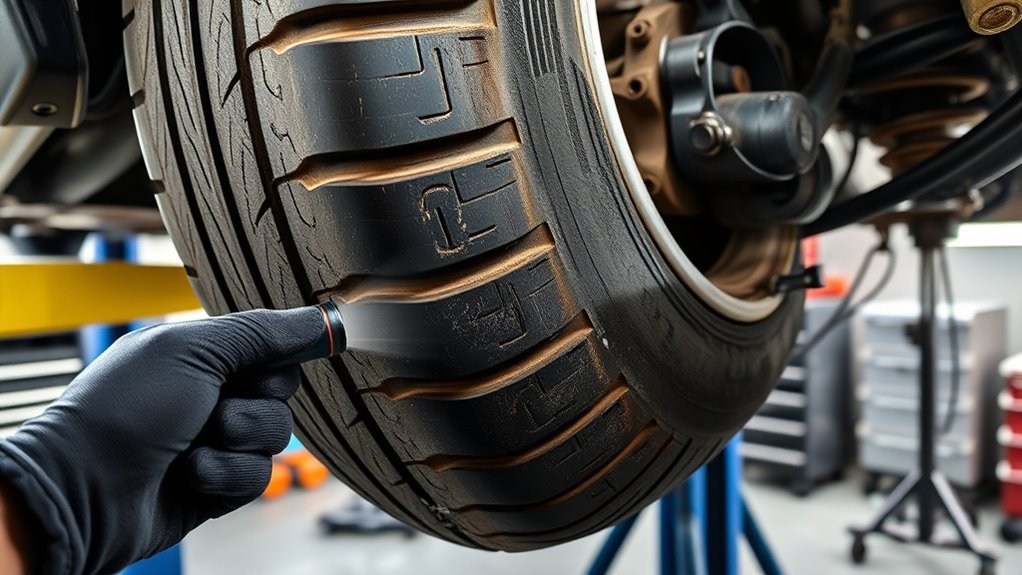
Suspension and steering components keep the wheel positioned while the vehicle accelerates, brakes, corners, and travels over bumps. Worn ball joints, control-arm bushings, tie rods, damaged arms, loose mounting points, or excessive wheel-hub/bearing play can allow the wheel angles to shift. That movement can create or worsen one-sided tire wear even if the previous alignment readings were acceptable.
Shocks and struts need slightly different treatment. Weak damping is more commonly associated with cupping or scalloped wear than with a smooth inner shoulder worn uniformly around the tire. However, damaged suspension assemblies, sagging components, or changes in ride height can also affect alignment geometry on some vehicles.
The best repair order is straightforward:
- Inspect steering, wheel bearings/hubs, suspension, wheels, and tires for looseness or damage.
- Repair worn, loose, bent, or damaged components.
- Measure and adjust alignment to the correct vehicle specifications.
- Recheck the worn tire and replace it if tread depth or structural condition makes it unsafe.
How Inflation and Loading Affect Tire Wear
Incorrect tire pressure matters, but the pattern matters too. According to Michelin’s tire terminology guidance, overinflation is associated with premature wear toward the center of the tread. Low pressure is more likely to load the shoulders. Therefore, a tire that is worn mainly along one inner edge should not be diagnosed as an overinflation problem without checking alignment and mechanical condition.
Use the cold inflation pressure specified by the vehicle manufacturer. Bridgestone recommends checking all tires monthly and before long trips or carrying extra load. The correct pressure is normally listed on the vehicle’s tire-information placard and in the owner’s manual.
Heavy loading can also influence tire behavior. Never exceed the vehicle’s payload, axle, or tire load limits. On some independent suspension designs, added load changes ride height and can alter wheel geometry enough to worsen an existing alignment problem. That effect depends on the vehicle, so loading should be treated as a possible contributor rather than a universal cause of negative camber.
| Condition | Typical Wear Clue | What to Do |
|---|---|---|
| Overinflation | More wear toward tread center | Set cold PSI to vehicle specification |
| Underinflation | More wear across both shoulders | Check for low pressure or leaks |
| One inner edge | Alignment or geometry concern | Inspect components and measure alignment |
| Heavy load | Vehicle-dependent | Stay within placard/manual load limits |
Driving Habits That Speed Up Inner-Edge Wear
Driving conditions can accelerate tire wear, but they should not distract from a clear one-sided pattern. Hard cornering, abrupt braking, rough roads, pothole impacts, and repeated curb strikes increase stress on the tires and suspension. A curb or pothole impact can also bend a wheel or suspension part or move alignment away from specification.
Aggressive cornering may increase shoulder wear, while braking can increase overall wear on heavily loaded tires. However, if one inner shoulder keeps disappearing while the rest of the tread remains much deeper, treat that as an alignment or mechanical warning rather than blaming driving style alone.
Avoid overloading the vehicle, use the recommended cold tire pressure, and inspect the tires after a significant impact. These habits help protect the tread, but they cannot compensate for incorrect camber, toe, or worn suspension components.
DIY vs Professional: When to Repair or Replace

Home checks are useful for finding the problem early. You can measure tread depth, check cold tire pressure, look for visible damage, record where the wear appears, and follow the vehicle manufacturer’s tire-rotation guidance. Correcting camber or toe, diagnosing loose steering components, and confirming whether suspension movement is within specification usually require professional equipment and experience.
[Products Worth Considering]

Steelman white tire marking crayons provide high-contrast, semi-permanent marks for repairing and inspecting tires and equipment. They write on wet or dry, smooth or coarse surfaces including rubber, metal, glass, and wood, making them ideal for puncture location and damage outlining. The lead- and zinc-free crayons resist weather and fading yet wipe away when you no longer need the marks.

Measure tire tread depth quickly and accurately with this LUMITECO dial gauge that reads in 1/32" increments up to 14/32". The color-coded green/yellow/red zones make it easy to judge tire wear and know when replacement is needed. A rugged, compact design with a protective pouch helps keep the gauge ready for use on cars, trucks, motorcycles, and more.

Monitor tire tread wear with a smart, color-coded depth gauge that shows clear condition ranges at a glance. The bar is range marked for fast, easy readings, helping you maintain safer traction and performance. Each gauge is portable with a pocket clip, and the set includes 20 units for daily use and sharing.
When To DIY
Use DIY inspection for tasks that do not require guessing at safety-critical alignment settings:
| Task | DIY Scope |
|---|---|
| Cold tire pressure | Check with an accurate gauge and compare with vehicle placard |
| Tread depth | Measure inner, center and outer grooves at several points |
| Visual inspection | Look for cords, bulges, cuts, cupping and obvious looseness or damage |
| Tire rotation | Follow the vehicle/tire maker’s permitted pattern and interval |
| Alignment diagnosis | Home observations can flag a problem; calibrated measurement is preferred for final diagnosis |
A basic home measurement may reveal that something is obviously wrong, but it should not be used as the final specification for a safety-critical alignment repair.
Signs You Need Pro
Arrange a professional tire, steering, suspension, and alignment inspection if inner-edge wear is pronounced or progressing quickly, the vehicle pulls or wanders, the steering wheel sits off-center, you hear new clunks or bearing-type noise, or the problem returns after a previous alignment.
If cords or belts are exposed, the tire has a bulge or structural damage, or the tread reaches the replacement threshold, stop treating the problem as a maintenance issue and replace the unsafe tire. An alignment can prevent further abnormal wear, but it cannot replace rubber that has already worn away.
Cost And Safety Tradeoffs
Checking pressure and tread depth yourself costs little and can identify problems early. Attempting to correct alignment or replace safety-critical steering and suspension parts without the correct tools or knowledge can be more expensive if the repair is wrong or the new tire develops the same wear.
For persistent inner-edge wear, pay for diagnosis of the underlying cause rather than repeatedly replacing tires. If a worn or loose component is found, repair it first and align the vehicle afterward. That sequence protects the replacement tire and gives the alignment a better chance of remaining within specification.
Maintenance Plan to Prevent Inner-Edge Wear (Rotation, Alignment, Inspection)
A useful maintenance plan focuses on inspection instead of an arbitrary alignment mileage:
- Check cold tire pressure monthly. Use the vehicle placard or owner’s manual specification.
- Inspect tread monthly. Measure the inner, center, and outer grooves so hidden inner wear is not missed.
- Rotate according to the vehicle manufacturer’s guidance. NHTSA notes that, where the manufacturer recommends rotation, 5,000 to 8,000 miles is a common interval, but some vehicles use different-size or directional setups that restrict rotation.
- Check alignment when symptoms appear. Uneven wear, pulling, an off-center steering wheel, impact damage, or relevant suspension work are stronger triggers than a universal mileage number.
- Inspect steering and suspension first if wear is severe. An alignment cannot remain correct if a joint, bushing, hub, arm, or other geometry-controlling component has excessive movement.
Keep records of tread measurements, pressure checks, rotations, repairs, and alignment results. If the inner shoulder begins losing tread faster again, those records can show when the pattern returned and whether it followed an impact, repair, tire replacement, or load change.
[Products Worth Considering]

The Ziopetru adjustable magnetic wheel alignment tool helps you check and restore camber and caster positioning after removing and reinstalling undercarriage components. With a clear leveling/bubble measurement system and an easy zeroing adjustment knob, it supports precise horizontal angle checking. The strong magnetic base mounts to metal surfaces for convenient use at home on cars, motorcycles, trucks, vans, and SUVs.

The SAFELIFE dial tire tread depth gauge measures tread depth in 1/32 inch increments with clear, easy-to-read 2-inch dial face. Color zones using a traffic light system help you quickly judge whether tread is low, marginal, or ample for safer driving. Built with a durable zinc cast body and a metal detect probe for precise, comfortable use across cars, motorcycles, trucks, and buses.

Accurately measure tire tread depth with a calibrated gauge marked from 0 to 1 inch in 1/32 inch increments. The color-coded bar helps you quickly identify tread condition ranges, supporting safe driving for trucks, motorcycles, automobiles, and passenger vehicles.
Pick Tires & Modifications That Reduce Inner-Edge Wear
Do not try to solve inner-edge wear by choosing a particular tread pattern, deeper tread, or stiffer sidewall. If camber or toe is incorrect, the new tire can develop the same one-sided wear regardless of brand.
After correcting the mechanical problem, choose a tire size, load index, speed rating, and construction approved for the vehicle. If you use non-stock wheels, lowering springs, coilovers, adjustable arms, or other suspension modifications, have the resulting wheel geometry measured. Lowering or changing suspension geometry can alter camber and toe, and some modified vehicles need appropriate adjustment hardware to bring the desired settings within a safe range.
Do not assume that more negative camber or a particular toe value is automatically wrong. Some vehicles are designed with measurable negative camber or toe from the factory. The goal for a normal road vehicle is to meet the correct specification for that vehicle and configuration while eliminating abnormal tire wear.
[Products Worth Considering]

This universal wheel alignment tool helps you accurately restore tire tilt angles after tire or suspension repairs using an adjustable camber gauge. It features a powerful magnetic base that firmly attaches to brake rotors for stationary, slip-free readings, improving consistency during measurement. Built from durable PC plastic, it resists wear and corrosion and is compact enough for car, truck, RV, and motorcycle alignment tasks.

The Topeak SmartGauge D2 delivers precise digital tire pressure readings for bikes, motorcycles, and sports equipment up to 250 psi (17 bar). Its rotating SmartHead works with both Presta and Schrader valves, so you can check pressure quickly without adapters. The LCD display makes it easy to read results in psi, bar, or kg/cm² with an included CR2032 battery for immediate use.

Replace worn tires quickly with this universal 4.80/4.00-8 tire and inner tube set designed for wheelbarrows and outdoor utility carts. The ribbed tread helps reduce turf damage while the natural rubber construction supports longer service life. Compatible with 15.5-inch outer diameter, 4-inch width, and 8-inch rim diameter wheels, it uses a straight TR-13 valve stem for easy installation. For best results, inflate with a manual pump and do not exceed 25 PSI.
Frequently Asked Questions
Why Are My Tires Wearing on the Inside Edge?
Inner-edge tire wear most often points to a wheel-alignment or geometry problem, especially excessive negative camber, incorrect toe, or worn or damaged steering and suspension components that let those angles change. Check tire pressure too, but a one-sided inner pattern is more characteristic of alignment than of simple overinflation.
What Causes Inner and Outer Tire Wear at the Same Time?
If both shoulders of the same tire are wearing faster than the center, low tire pressure is one of the first things to check. Loading, tire/wheel fitment, hard cornering, and other conditions can contribute, so compare cold pressure with the vehicle placard and inspect the full tread pattern before assuming it is an alignment problem.
Can a Bad Wheel Bearing Cause Inner Tire Wear?
A wheel bearing or hub with excessive play can contribute to irregular tire wear because the wheel is no longer held as rigidly as intended. However, alignment and suspension problems are more common explanations for a smooth inner-edge pattern. Bearing-related concerns often appear with other symptoms such as humming, grinding, looseness, vibration, or abnormal hub play.
Will an Alignment Fix Inner Tire Wear?
An alignment can stop additional abnormal wear if incorrect camber or toe is the cause and the steering and suspension are mechanically sound. It cannot restore tread that is already gone. If a component is worn or bent, repair that problem before the final alignment.
Is It Safe to Drive With Inner-Edge Tire Wear?
It depends on how much tread remains and whether the tire has structural damage. If cords or belts are visible, a bulge or separation is present, or the tread has reached its replacement limit, the tire should not remain in normal service. Even when tread remains, rapid inner-edge wear should be diagnosed promptly because the hidden inner shoulder can become unsafe before the visible part of the tire looks worn out.
How Do I Stop New Tires Wearing on the Inside?
Do not install new tires and assume the problem is solved. Inspect steering and suspension components, repair any looseness or damage, set alignment to the correct vehicle specifications, use the recommended cold tire pressure, and follow the manufacturer’s rotation guidance. Correcting the root cause before or when the new tires are installed helps prevent the same pattern from returning.
Conclusion
Inner-edge tire wear is primarily a diagnosis problem, not a tire-selection problem. Measure the tread across its full width, check cold pressure, inspect steering and suspension components for looseness or damage, and then measure camber and toe against the correct vehicle specifications. Repair worn components before the final alignment. Replace the tire when tread depth or structural condition makes it unsafe, and remember that correcting alignment prevents additional abnormal wear but cannot restore tread that has already disappeared.