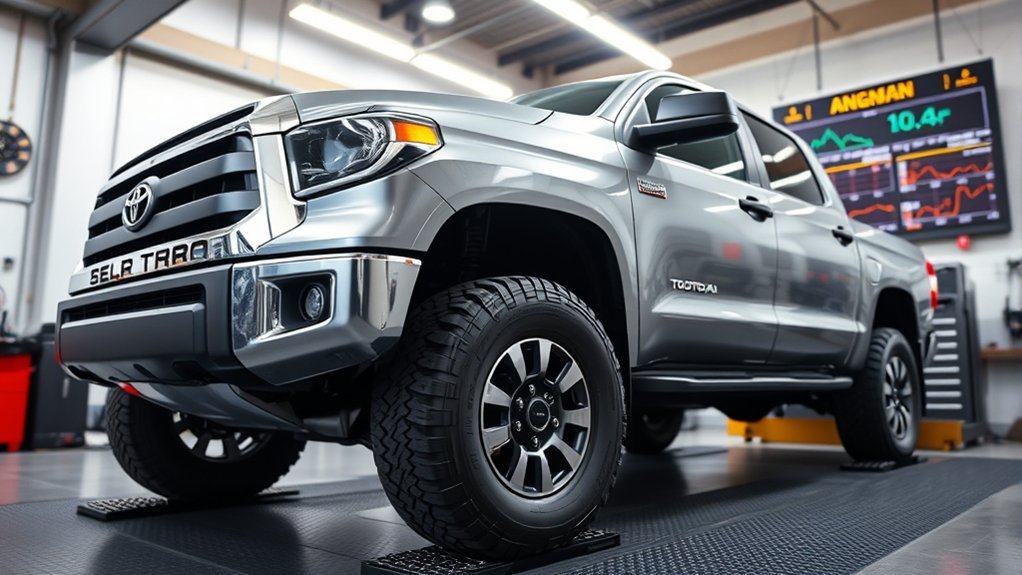
Uneven tire wear on a Toyota Tundra usually starts with one simple problem: the tires are not meeting the road evenly. Camber, caster, toe, tire pressure, tire rotation, worn suspension parts, load, and lift-kit geometry all work together. The safest goal is not to chase one universal number. It is to set your exact Tundra within Toyota’s factory alignment range while choosing tire-wear-friendly targets inside that range.
Quick Answer
For most daily driven Toyota Tundras, ask the shop to set camber close to zero, keep left and right caster even and positive within Toyota’s range, and set total toe slightly positive and centered in spec. Lifted trucks need model-specific service data and may need alignment-correction parts.
Key Takeaways
- Use Toyota alignment specs for your exact model year, trim, drivetrain, tire size, and ride height.
- For tire life, camber should usually sit close to zero and match side to side within the factory range.
- Caster should be positive and even so the truck tracks straight and the steering returns smoothly.
- Toe causes fast tire scrub when it is wrong, so ask the technician to center total toe within Toyota’s range.
- Lifted Tundras may need corrected upper control arms instead of forced alignment settings.
- Tire pressure, rotation, balance, tread depth, and suspension condition still matter after the alignment.
At a Glance
| Time Required | About 45 to 90 minutes for a normal professional alignment, longer if worn parts, seized adjusters, lift-kit issues, or steering calibration checks are needed |
| Difficulty | Professional service recommended because final camber, caster, and toe readings require an alignment rack and Toyota service data |
| Tools Needed | Alignment rack, Toyota service data, tire pressure gauge, tread depth gauge, torque tools, and suspension inspection tools |
| Cost | One professional alignment service, plus parts or labor if the truck needs upper control arms, ball joints, tie rods, bushings, tires, or other repairs before it can align correctly |
Warning: Do not copy a random camber, caster, or toe number from a forum and treat it as correct for every Tundra. Alignment specs vary by model year, tire size, drivetrain, suspension height, market, and vehicle condition. Use Toyota service data or the alignment rack database for your exact truck.
Common Alignment Problems Faced by Tundra Owners
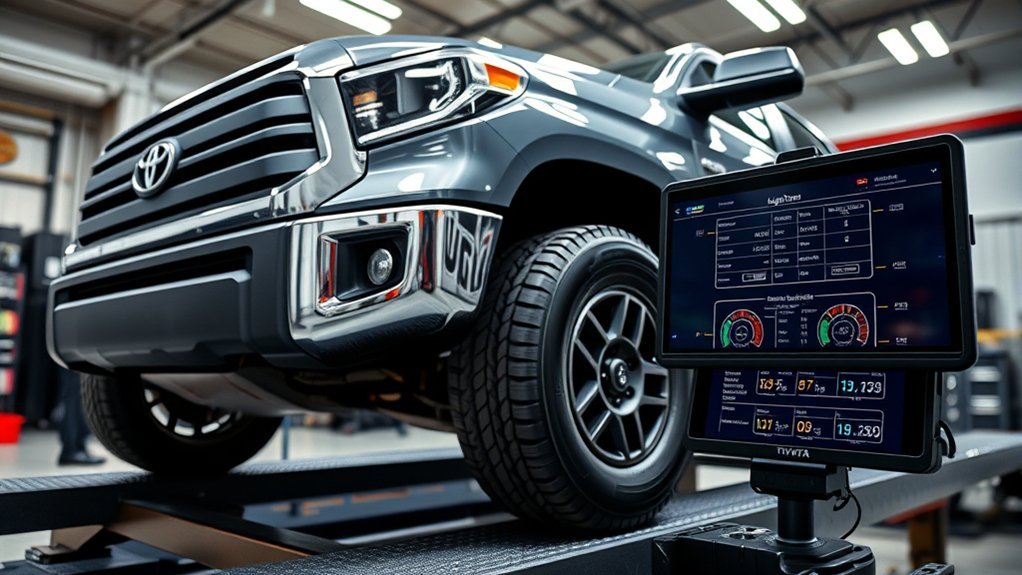
When a Toyota Tundra is out of alignment, the first signs often show up in the tires. You may see feathered tread blocks, worn outer shoulders, worn inner shoulders, cupping, or one front tire wearing faster than the other. The truck may also pull to one side, drift on a straight road, or need the steering wheel held off-center.
Toe problems can scrub tread quickly because the tires point slightly toward or away from each other while the truck moves forward. Camber problems usually show up as inside-edge or outside-edge wear. Caster problems usually affect tracking, steering return, and straight-line stability more than tread depth, but uneven side-to-side caster can still make the driver fight the wheel.
Lifted Tundras need extra attention because a suspension lift changes front-end geometry. If the shop cannot bring camber, caster, and toe back into the correct range, the truck may need alignment-correction parts instead of another basic adjustment.
Tire Wear Pattern Diagnosis
Use the wear pattern as a clue, not a final diagnosis. Tire pressure, balance, shocks, ball joints, tie rods, wheel bearings, and driving conditions can create similar symptoms.
| Wear pattern or symptom | Likely causes to check | What to ask the shop |
| Feathered tread blocks | Toe-in or toe-out error, worn tie rods, loose steering parts | Check total toe, individual toe, steering wheel center, and tie rod play. |
| Inner shoulder wear | Excessive negative camber, toe-out, worn suspension parts, lowered or altered geometry | Verify camber, toe, ball joints, control arm bushings, and tire pressure. |
| Outer shoulder wear | Positive camber, toe error, underinflation, hard cornering, worn parts | Check camber, toe, cold tire pressure, and front-end looseness. |
| Cupping or scalloping | Wheel imbalance, worn shocks or struts, loose suspension parts, irregular rotation history | Balance the tires and inspect shocks, struts, bushings, bearings, and joints before final alignment. |
| Center tread wear | Overinflation or tire/load mismatch | Confirm cold pressure against the door placard or owner’s manual. |
| Both shoulders worn | Underinflation, heavy loads, towing, aggressive cornering | Set cold pressure correctly and tell the shop how the truck is normally loaded. |
Toyota Tundra Alignment Basics: Camber, Caster, and Toe
A good alignment starts with three angles: camber, caster, and toe. These angles should be measured on a level alignment rack, with tires inflated correctly, the suspension checked for looseness, and the steering wheel centered. A qualified technician should also use the correct vehicle profile, not a generic full-size truck profile.
Camber
Camber is the inward or outward tilt of the tire when you view the truck from the front. Too much positive camber can load the outer shoulder. Too much negative camber can load the inner shoulder. For daily driving and tire life, most Tundras do best when camber sits close to zero and both sides match within the factory range.
Caster
Caster is the angle of the steering axis when you view the front suspension from the side. Positive caster helps the truck track straight and helps the steering wheel return after a turn. On a Tundra, a tire-wear-friendly setup usually keeps caster even side to side and as positive as the Toyota range allows without pushing camber out of range.
Toe
Toe describes whether the front edges of the tires point slightly inward or outward. It has a major effect on tire scrub. For a road-driven Tundra, the usual goal is slight positive toe-in within the Toyota range, with total toe centered and the steering wheel straight. Too much toe-in or toe-out can ruin tires faster than a small camber error.
Best Alignment Targets for Stock Tundras
For a stock Toyota Tundra, use the exact factory specifications for your model year and configuration. Toyota owner manuals are the right starting point for owner guidance, and Toyota’s Technical Information System is the official service-information source for exact repair data.
Note: The alignment rack may show a green range instead of one single number. Ask the technician to place the final numbers in the tire-wear-friendly part of that range, not just barely inside the limit.
| Alignment angle | Tire-wear-friendly target | Why it matters |
| Camber | Close to zero and even left to right within Toyota spec | Helps the tread sit flat on the road and reduces shoulder wear |
| Caster | Positive, even side to side, and not achieved at the expense of camber | Improves straight-line tracking and steering return |
| Toe | Slight positive toe-in within the factory range, with total toe centered | Reduces tire scrub and keeps the truck stable on the highway |
| Cross values | Keep side-to-side differences small unless the technician is correcting for road crown | Reduces pulling, drifting, and constant steering correction |
Best Alignment Approach for Lifted Tundras
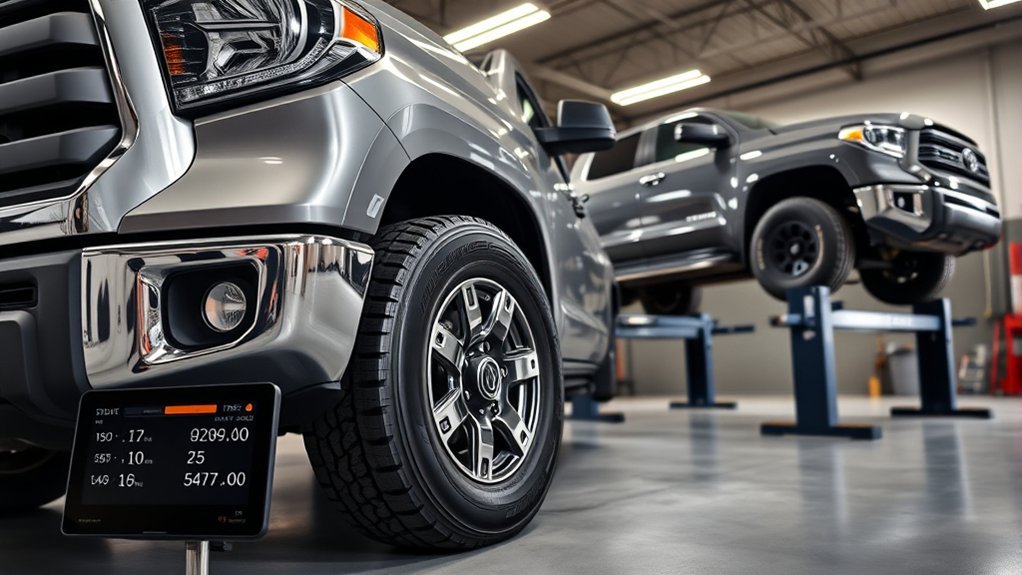
A lifted Tundra should still be aligned to safe, model-specific specs. The difference is that the suspension may no longer have enough factory adjustment to reach those specs cleanly. This is where adjustable or corrected upper control arms can help.
Do not add positive camber just because the truck is lifted. Positive camber may make the alignment screen look closer in one area, but it can also load the outside shoulder and hurt tire life. A better lifted-truck goal is to recover proper caster, keep camber close to zero, and set toe cleanly within the Toyota range.
| Lifted-truck issue | What to ask the shop |
| Not enough caster after a lift | Ask whether corrected upper control arms are needed to restore positive caster without pushing camber out of range. |
| Outer-edge tire wear | Check for excessive positive camber, toe error, underinflation, and worn front-end parts. |
| Inner-edge tire wear | Check for excessive negative camber, toe-out, loose components, and tire pressure errors. |
| Steering wheel off-center | Ask for the steering wheel to be centered while final toe is set, not corrected afterward by moving only one tie rod. |
| Driver-assistance or steering warnings after suspension work | Ask the shop to follow Toyota service information for any required steering angle or driver-assistance calibration checks. |
[Products Worth Considering]

The SAFELIFE dial tire tread depth gauge measures tread depth in 1/32 inch increments with clear, easy-to-read 2-inch dial face. Color zones using a traffic light system help you quickly judge whether tread is low, marginal, or ample for safer driving. Built with a durable zinc cast body and a metal detect probe for precise, comfortable use across cars, motorcycles, trucks, and buses.

Measure tire tread depth quickly and accurately with this LUMITECO dial gauge that reads in 1/32" increments up to 14/32". The color-coded green/yellow/red zones make it easy to judge tire wear and know when replacement is needed. A rugged, compact design with a protective pouch helps keep the gauge ready for use on cars, trucks, motorcycles, and more.

The Ziopetru adjustable magnetic wheel alignment tool helps you check and restore camber and caster positioning after removing and reinstalling undercarriage components. With a clear leveling/bubble measurement system and an easy zeroing adjustment knob, it supports precise horizontal angle checking. The strong magnetic base mounts to metal surfaces for convenient use at home on cars, motorcycles, trucks, vans, and SUVs.
How Mods Affect Your Alignment
Suspension changes can move a Tundra away from the geometry Toyota designed. Lift kits, leveling kits, aftermarket wheels, larger tires, heavy bumpers, winches, air bags, towing loads, and worn ball joints can all change how the tires sit on the road.
Suspension Impact on Alignment
A front lift changes the angle of the upper and lower control arms. That can reduce caster and make camber harder to set. If the truck feels nervous on the highway after a lift, the issue may be low caster, uneven caster, or toe that was only set barely inside the range.
A rear load or towing setup can also change ride height. On a truck used for heavy loads, tell the shop how the Tundra is normally driven. A truck that is aligned empty but used with constant weight may not behave the same once loaded.
Aftermarket Parts Considerations
Aftermarket upper control arms can help on lifted Tundras because they may provide more usable caster and camber adjustment. They are not a cosmetic upgrade. They should match your lift height, wheel offset, tire size, and intended use.
Before installing alignment-correction parts, inspect the basics. Loose tie rods, worn ball joints, tired bushings, damaged wheels, or uneven tire pressure can make a good alignment impossible. A quality shop will check these items before setting final numbers.
Pro Tip: Always ask for a before-and-after alignment printout. Keep it with your tire pressure and rotation records so you can compare settings if uneven wear returns later.
Before You Book an Alignment
Do a quick inspection before you pay for alignment work. This helps you avoid paying twice when the real issue is a loose part, damaged tire, or wrong pressure.
- Check cold tire pressure: Use the Tire and Loading Information Label on the driver’s door area or your owner’s manual, not the maximum pressure molded on the tire sidewall.
- Measure tread depth: Replace unsafe tires before alignment if the tread is at the legal minimum, severely uneven, or damaged.
- Inspect for visible damage: Look for bulges, exposed cords, cuts, separated tread, bent wheels, or vibration that needs immediate attention.
- Confirm the truck’s normal load: Tell the shop if the Tundra usually carries tools, a camper shell, towing weight, or heavy accessories.
- List recent changes: Mention lift kits, leveling kits, tire-size changes, wheel-offset changes, control arms, shocks, tie rods, or ball joints.
- Ask about seized adjusters: Rusted or seized cam bolts can prevent accurate adjustment on older or off-road-used trucks.
Warning: Do not keep driving on a tire with exposed cords, a sidewall bulge, tread separation, severe vibration, or rapid air loss. Have the tire and suspension inspected before chasing alignment numbers.
What to Ask For on the Alignment Rack
Many shops stop when the screen turns green. For a Tundra owner trying to reduce tire wear, that is not always enough. You want the final numbers to make sense together.
- Exact vehicle profile: Confirm the rack uses the correct Toyota Tundra year, drivetrain, suspension, and tire package.
- Camber: Ask for camber close to zero and even side to side within Toyota’s allowed range.
- Caster: Ask for positive caster that is balanced left to right without sacrificing camber.
- Toe: Ask for total toe centered in the Toyota range, with the steering wheel straight.
- Printout: Get the before and after readings for camber, caster, toe, and cross values.
- Suspension notes: Ask the technician to note any worn, seized, bent, or aftermarket parts that limited adjustment.
[Products Worth Considering]

Monitor tire tread wear with a smart, color-coded depth gauge that shows clear condition ranges at a glance. The bar is range marked for fast, easy readings, helping you maintain safer traction and performance. Each gauge is portable with a pocket clip, and the set includes 20 units for daily use and sharing.

Measure tyre tread depth precisely with a digital gauge that reads in both MM and inches, helping you monitor safe driving conditions. The large LCD screen is easy to operate, and the compact tool fits for cars, trucks, and motorcycles. It provides high accuracy with a 0-25.4mm range and includes a 1-year warranty for added peace of mind.

Steelman white tire marking crayons provide high-contrast, semi-permanent marks for repairing and inspecting tires and equipment. They write on wet or dry, smooth or coarse surfaces including rubber, metal, glass, and wood, making them ideal for puncture location and damage outlining. The lead- and zinc-free crayons resist weather and fading yet wipe away when you no longer need the marks.
How to Read Your Alignment Printout
The printout helps you see whether the truck was only pushed into the green or actually set up for stable tracking and tire life. Review these points before you leave the shop.
- Before readings: These show how far the truck was out before adjustment. They can explain the tire wear you saw.
- Final readings: These should land inside Toyota’s range and make sense side to side.
- Total toe: This is one of the most important numbers for tire scrub. Ask why if total toe sits near the edge of the range.
- Cross-camber and cross-caster: Large side-to-side differences can cause pulling, even when each individual value is technically in range.
- Steering wheel center: A straight printout does not help if the wheel is off-center on a level road.
- Unadjustable values: If a value could not be corrected, ask whether the cause is worn parts, seized adjusters, lift geometry, or damaged components.
Picking the Best Alignment Shop for Your Tundra
The best alignment shop for your Tundra is not always the closest one. Look for a shop that understands trucks, modified suspensions, and Toyota service data. This matters even more if your Tundra has a lift, aftermarket wheels, larger tires, or heavy accessories.
[Products Worth Considering]

These aluminum alloy tire valve stem caps with an O-ring seal help protect valve stems from corrosion while adding a clean, stylish look to your vehicle. The universal fit works across cars, trucks, motorcycles, bicycles, and more, making them an easy upgrade for everyday driving and off-road use. Installation is quick, and the included four-pack keeps all your tires dressed and protected.

Accurately measure tire tread depth with a calibrated gauge marked from 0 to 1 inch in 1/32 inch increments. The color-coded bar helps you quickly identify tread condition ranges, supporting safe driving for trucks, motorcycles, automobiles, and passenger vehicles.

This universal wheel alignment tool helps you accurately restore tire tilt angles after tire or suspension repairs using an adjustable camber gauge. It features a powerful magnetic base that firmly attaches to brake rotors for stationary, slip-free readings, improving consistency during measurement. Built from durable PC plastic, it resists wear and corrosion and is compact enough for car, truck, RV, and motorcycle alignment tasks.
Recommended Shop Criteria
Choose a shop that can explain the final alignment printout in plain language. The technician should be willing to inspect the front end before making adjustments, use the correct Toyota spec, center the steering wheel, and tell you if the truck needs parts before it can align correctly.
A shop familiar with lifted trucks should also understand upper control arm clearance, caster recovery, wheel offset, tire rub, and how ride height affects the alignment range.
Questions to Ask Before Booking
- Do you have alignment specs for my exact Toyota Tundra year and configuration?
- Can you align lifted Tundras with aftermarket upper control arms?
- Will you inspect tie rods, ball joints, control arm bushings, wheel bearings, tire pressure, and tire condition first?
- Will you provide a before-and-after printout?
- Can you target tire life and straight tracking instead of only getting the screen into the green?
- Will you tell me if seized adjusters, worn parts, or lift geometry prevent a proper alignment?
- Can you follow Toyota service information if steering-angle or driver-assistance calibration checks are required?
Aligning for Long-Term Tire Health
Alignment is only one part of tire life. Tire pressure, tread depth, rotation, wheel balance, driving style, load, and suspension condition also matter. The National Highway Traffic Safety Administration recommends checking tire pressure at least once a month when the tires are cold and using the pressure shown on the vehicle’s tire label or owner’s manual, not the maximum pressure on the tire sidewall.
NHTSA reported 511 motor vehicle traffic fatalities in tire-related crashes in 2024, which is why tire pressure, tread depth, rotation, balance, and alignment deserve regular attention.
Get the alignment checked after you install a lift kit, replace suspension or steering parts, hit a hard pothole or curb, change tire size, notice pulling, or see uneven tread wear. Also recheck alignment if the steering wheel no longer sits straight on a level road.
- Check tire pressure monthly: Include the spare if your Tundra has one.
- Measure tread depth: NHTSA says tires are not safe and should be replaced when tread is worn down to 2/32 inch.
- Rotate tires on schedule: Follow the Toyota owner’s manual and tire manufacturer guidance for your tire type.
- Balance tires when needed: Vibration can point to balance, tire, wheel, or suspension issues.
- Inspect suspension parts: An alignment will not hold if worn parts allow movement.
- Recheck after 500 to 1,000 miles: Look for new feathering, shoulder wear, pulling, or a steering wheel that has moved off-center.
Community Insights: Real User Experiences and Solutions
Owner experiences can be useful, but they should not replace Toyota specs. Use them to spot patterns and ask better questions. Do not copy another truck’s numbers unless that truck has the same generation, drivetrain, ride height, tire size, wheel offset, load, and suspension setup.
When owners compare alignment printouts, the same practical lessons often stand out. A truck can be “in the green” and still pull if cross-caster or cross-camber is uneven. A lifted truck can wear tires if caster recovery is poor. A toe setting near the edge of the range can still scrub tread if the truck is loaded, lifted, or driven mostly on highways.
For lifted trucks, the best results usually come from matching the parts to the lift height and asking the shop to set the truck carefully, not forcing factory arms beyond their useful adjustment range. The right parts, correct pressure, steady rotations, and a clear printout will do more for tire life than chasing a random number from another Tundra.
Frequently Asked Questions
What is the best wheel alignment setting for a Toyota Tundra?
The best setting is the Toyota factory specification for your exact Tundra, with tire-wear-friendly targets inside that range. For most daily driving, ask for camber close to zero, caster positive and even, and toe slightly positive with total toe centered in spec.
Will 1 degree of camber cause tire wear?
It can, especially if toe is also wrong or the camber is uneven from side to side. Excessive positive camber can wear the outer shoulder, while excessive negative camber can wear the inner shoulder. Toe error often makes that wear happen faster.
Do lifted Tundras need different alignment settings?
A lifted Tundra still needs to land within safe Toyota-based alignment limits, but the parts may need more adjustment range. Many lifted trucks need corrected upper control arms to regain caster and keep camber near zero without forcing bad toe settings.
Should I get an alignment after installing new tires?
Yes, get an alignment check if the old tires showed uneven wear, the truck pulls, the steering wheel is off-center, or suspension parts were changed. New tires can wear quickly if the old alignment problem remains.
How often should I align my Toyota Tundra?
Check alignment when you see uneven tire wear, install new tires, change suspension parts, lift or level the truck, hit a hard pothole or curb, or notice pulling or an off-center steering wheel. You can also ask for an alignment check during tire service.
Can tire pressure look like an alignment problem?
Yes. Underinflation can wear tire shoulders, overinflation can wear the center, and mismatched pressure can make the truck pull. Check cold tire pressure before judging the alignment.
What should I look for on the alignment printout?
Check the before and after readings for camber, caster, toe, and cross values. Final numbers should be inside Toyota’s range, close enough side to side for stable tracking, and paired with a centered steering wheel.
Conclusion
The best Toyota Tundra alignment for tire wear is not a single camber or toe number that fits every truck. Use the correct Toyota specification for your exact model, then ask the shop to target even camber, stable caster, centered toe, and a straight steering wheel within that range.
If your Tundra is lifted, do not force the alignment with stock parts that have run out of adjustment. Corrected upper control arms, good tire pressure habits, regular rotations, and before-and-after alignment printouts will do more for tire life than chasing a random number from another truck.
Sources
- NHTSA TireWise — tire pressure, tread depth, tire rotation, balance, alignment, TPMS, and tire safety guidance.
- Toyota Manuals and Warranties — official Toyota owner manual lookup for model-specific owner guidance.
- Toyota Technical Information System — Toyota service information and repair manual access for exact service specifications.
- Toyota Tire Center — Toyota tire safety, inflation, damage, traction, and factory-trained service information.