
How to Rotate Tires on a Toyota Camry
Your Toyota Camry’s front tires usually wear faster because they handle steering, braking, and most drive force. A simple tire rotation helps spread that wear across all four tires, which can improve handling, ride comfort, and tire life. Use the correct pattern for your drivetrain, work on a flat surface, and tighten the lug nuts to Toyota’s torque spec for your model year.
Quick Answer
For most front-wheel-drive Toyota Camry models, move the front tires straight back and cross the rear tires to the front. Rotate the tires about every 5,000 to 7,500 miles, or follow the schedule in your owner’s manual. Use jack stands, check tire pressure, and tighten each lug nut to the correct torque spec.
Key Takeaways
- Rotate Camry tires on a regular schedule to help prevent uneven tread wear.
- Use the front-wheel-drive pattern unless your owner’s manual gives a different pattern.
- Lift the car only on a flat surface and support it with jack stands before removing wheels.
- Check tire pressure, tread depth, and visible damage during each rotation.
- Tighten lug nuts in a star pattern and use a torque wrench for the final tightening.
How Tire Rotation Works on a Toyota Camry

Tire rotation means moving each tire to a new position on your Camry. This helps each tire share the work more evenly, since front and rear tires wear in different ways.
Most Toyota Camry models use front-wheel drive, so the front tires tend to wear faster. In that case, move the front tires straight to the rear and cross the rear tires to the front. If your Camry has all-wheel drive, check your owner’s manual because the rotation pattern may differ.
During each rotation, check tire pressure and tread depth. Look for cracks, bulges, punctures, or wear on one edge. These signs can point to low pressure, alignment trouble, or suspension problems.
What You’ll Need Before Rotating Camry Tires
Set aside about 30 to 45 minutes if you have the right tools and a safe place to work. Park on a flat, hard surface, shift into Park, and set the parking brake before you start.
- Vehicle jack rated for your Camry
- Jack stands rated for the vehicle’s weight
- Lug wrench or breaker bar
- Torque wrench
- Wheel chocks
- Tire pressure gauge
- Owner’s manual for jack points and torque specs
Warning: Never work under a car supported only by a jack, because the vehicle can fall without warning.
[Products Worth Considering]

The Trivd Frol 1/2" air impact wrench delivers high performance torque up to 1500 ft-lbs with a twin hammer impact mechanism for strong, balanced blows. It features an ergonomic grip, compact lightweight design, and quick-stop control with 3 forward speeds up to 8000 RPM plus a reverse speed. Built for demanding automotive repair and tire shop work, the rear exhaust helps keep debris away from the surface.

Monitor tire tread wear with a smart, color-coded depth gauge that shows clear condition ranges at a glance. The bar is range marked for fast, easy readings, helping you maintain safer traction and performance. Each gauge is portable with a pocket clip, and the set includes 20 units for daily use and sharing.

This 1/2-inch drive breaker bar delivers powerful leverage for loosening and tightening stubborn lug nuts and automotive fasteners. The 180-degree flex head helps you reach tight spaces at the angle you need, making tire and brake jobs easier. A spring-loaded ball detent design holds 1/2-inch sockets securely while the chrome-moly head provides durable strength for everyday use.
Step-by-Step Guide to Rotating Tires on a Camry
Follow these steps in order to rotate your Camry’s tires safely. Stop and call a professional if a wheel will not come loose, a jack point looks damaged, or you don’t feel sure about any step.
- Park safely. Park on a level surface, set the parking brake, and place wheel chocks around the wheels that stay on the ground first.
- Loosen the lug nuts. Break each lug nut loose while the tires still touch the ground. Do not remove the nuts yet.
- Lift the vehicle. Use the jack points listed in your owner’s manual, then place the Camry securely on jack stands.
- Remove the wheels. Take off the lug nuts and wheels, then keep the nuts in a safe spot.
- Move the tires into position. For front-wheel drive, move the front tires straight back and cross the rear tires to the front.
- Reinstall the wheels. Hand-thread each lug nut first so you don’t cross-thread it.
- Lower the vehicle. Lower the Camry until the tires touch the ground enough to keep the wheels from spinning.
- Tighten the lug nuts. Use a star pattern and finish with a torque wrench set to the spec in your owner’s manual.
- Check pressure and tread. Set tire pressure to the door-jamb placard and inspect the tread before driving.
Pro tip: Mark each tire’s old position with chalk before removal so you can track wear patterns over time.
[Products Worth Considering]

Measure tire tread depth quickly and accurately with this LUMITECO dial gauge that reads in 1/32" increments up to 14/32". The color-coded green/yellow/red zones make it easy to judge tire wear and know when replacement is needed. A rugged, compact design with a protective pouch helps keep the gauge ready for use on cars, trucks, motorcycles, and more.

Upgrade your wheels with MIKKUPPA M12x1.5 mag seat lug nuts built for secure, corrosion-resistant performance. These closed-end chrome lug nuts are a direct replacement for select Toyota models, including Camry, Corolla, RAV4, Sienna, Avalon, Highlander, Matrix, Venza, and Prius. Triple-chromium plating and cold-forged, heat-treated steel help deliver strength for daily driving and replacement needs.

The VEHLIVE SU-50448 II TPMS relearn tool provides a fast activation reset to restore accurate tire pressure monitoring after sensor replacement or tire rotation. It supports 315 MHz and 433 MHz GM series sensors and helps clear dashboard pressure warnings. With simple two-button operation and horn-confirmed relearning order, you can reprogram sensors conveniently at home.
Tire Rotation Patterns
Use the right tire rotation pattern for your drivetrain and tire type. The wrong pattern can reduce traction or cause uneven wear.
- Front-wheel drive (FWD): Move front tires straight to the rear and cross rear tires to the front.
- Rear-wheel drive (RWD): Move rear tires straight to the front and cross front tires to the rear.
- All-wheel drive (AWD) or four-wheel drive (4WD): Use a crisscross pattern unless your manual says otherwise.
- Directional tires: Move tires front to rear on the same side only.
Directional tires have tread designed to roll one way. Check the sidewall for an arrow or rotation marking before you move them.
Tools Required for Rotation
At minimum, you need a jack, jack stands, wheel chocks, and a lug wrench. A torque wrench matters because it lets you tighten lug nuts to the correct force, not just by feel.
Remove wheel covers only if they block access to the lug nuts. After the rotation, tighten lug nuts in a star pattern and recheck them after a short drive if your owner’s manual recommends it.
Tire Rotation Patterns for Front-Wheel, Rear-Wheel, and All-Wheel Drive Vehicles
Different drivetrains place different loads on tires. Your Camry most likely uses front-wheel drive, but the same tire care rules apply to many passenger vehicles.
- Front-wheel drive: Front tires move straight back, and rear tires cross to the front.
- Rear-wheel drive: Rear tires move straight forward, and front tires cross to the rear.
- All-wheel drive or four-wheel drive: Tires usually move in a crisscross pattern to balance wear.
If your tires have staggered sizes, directional tread, or different front and rear fitments, don’t use a standard pattern. Follow the tire maker’s guidance or ask a tire shop before rotating them.
[Products Worth Considering]

The Dr.Roc spare tire tool kit helps you release, lower, or raise your spare tire with reliable extension tools and a lug nut wrench. It is made from rustproof automotive-grade steel and includes an organized carry case for convenient storage. Designed for compatibility with select GM models from the late 1990s through 2019, it uses upgraded extension components to install and remove spare tires with less hassle.

Accurately measure tire tread depth with a calibrated gauge marked from 0 to 1 inch in 1/32 inch increments. The color-coded bar helps you quickly identify tread condition ranges, supporting safe driving for trucks, motorcycles, automobiles, and passenger vehicles.

This spare tire tool kit is designed for the 2004 to 2018 Ford F-150 to help you loosen and tighten wheel lug nuts and manage the spare tire and provided jack functions from underneath the vehicle. It includes the lug nut wrench and extension pieces plus a convenient storage carrying case for organized transport. The jack itself is not included.
Ideal Intervals for Tire Rotation: When to Schedule?
Many drivers rotate Camry tires every 5,000 to 7,500 miles. Your best interval comes from your owner’s manual, tire warranty, and driving conditions.
Rotate sooner if you drive often on rough roads, carry heavy loads, or notice uneven tread wear. You can also pair tire rotation with oil changes so you don’t miss the service.
Recommended Rotation Frequency
Regular tire rotation helps keep tread wear balanced. Balanced wear can improve ride comfort, reduce vibration, and help the tires last longer.
- Maximize tread life: Give each tire a chance to work in more than one position.
- Improve ride comfort: Reduce vibration from uneven wear patterns.
- Support safe handling: Keep traction more consistent across all four tires.
If your Camry pulls to one side or the steering wheel shakes after a rotation, have the tires balanced and the alignment checked.
Why Toyota’s Tire Rotation Guidelines Matter
Toyota’s schedule helps protect tire life, ride quality, and warranty coverage. Tire makers may also require regular rotations to keep a treadwear warranty valid.
| Rotation Interval | Tire Warranty Impact | Performance Benefit |
|---|---|---|
| 5,000 miles | Supports warranty records | Helps even out wear |
| 6,000 miles | Supports warranty records | May reduce vibration |
| 7,500 miles | Supports warranty records | Helps extend tire life |
Keep receipts or maintenance notes after each rotation. These records can help if you need a tire warranty claim later.
How Driving Conditions Affect Tire Rotation Timing
Your driving habits can change how fast the tread wears. Check your tires more often if your normal routes put extra stress on them.
- Rough roads: Gravel, potholes, and broken pavement can speed up wear.
- City driving: Frequent braking and tight turns can wear front tires faster.
- Heavy loads: Extra weight can increase heat and tread wear.
- Aggressive driving: Hard cornering and fast stops can shorten tire life.
Common Mistakes to Avoid When Rotating Tires
Small mistakes during tire rotation can create safety problems. Avoid these common errors before you drive away.
- Using only a jack instead of jack stands
- Tightening lug nuts by feel instead of using a torque wrench
- Rotating directional tires in the wrong direction
- Ignoring uneven tread wear, sidewall damage, or low pressure
- Skipping the owner’s manual for jack points and torque specs
Uneven tread can also point to worn suspension parts or poor alignment. Fix the cause, not just the tire position.
Consequences of Skipping Tire Rotation
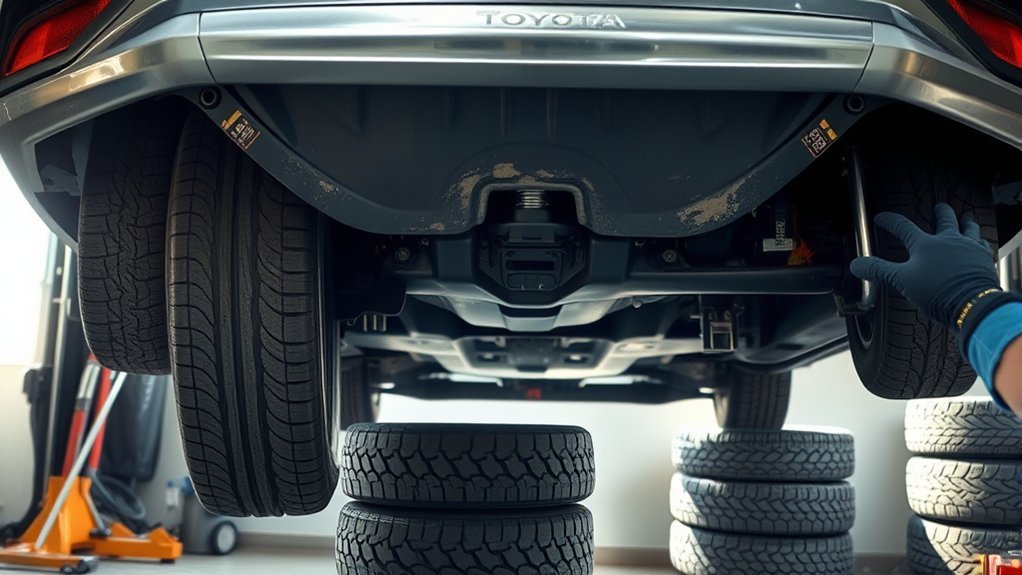
If you skip tire rotation, one pair of tires may wear much faster than the other. That can reduce grip, increase road noise, and make the ride feel rough.
Uneven tire wear can also cause vibration and steering issues. In severe cases, you may need new tires sooner than expected. Regular rotation costs less than replacing tires early.
Note: Tire rotation does not fix alignment, balance, or suspension problems that already caused uneven wear.
Easy Tips for Keeping Your Tires Healthy
Healthy tires help your Camry brake, steer, and ride the way it should. Add these checks to your normal maintenance routine.
Good tire care starts with pressure checks, tread checks, and regular rotation.
- Check tire pressure at least once a month and before long trips.
- Use the tire pressure listed on the driver’s door placard, not the sidewall maximum.
- Inspect tread depth with a tread gauge or the penny test.
- Look for cuts, nails, bulges, cracks, and exposed cords.
- Schedule alignment service if you see strong wear on one edge.
Rotate your tires about every 5,000 to 7,500 miles, or follow your manual if it gives a different interval. This simple habit helps you spot tire problems before they become costly.
Frequently Asked Questions
How Often Should You Rotate Tires on a Camry?
You should rotate your Camry’s tires about every 5,000 to 7,500 miles, unless your owner’s manual gives a different interval. Regular rotation helps reduce uneven wear and keeps handling more consistent.
What Does Toyota Recommend for Tire Rotation?
Toyota recommends following the maintenance schedule for your exact Camry model year. Many Camry owners pair tire rotation with routine oil service, but your owner’s manual gives the final guidance.
Can You Rotate Camry Tires at Home?
You can rotate Camry tires at home if you have the right tools, a flat work area, and safe jack stands. If you don’t have a torque wrench or you’re unsure about the jack points, use a tire shop instead.
Do You Need an Alignment After Rotating Tires?
You don’t need an alignment after every tire rotation. Get one if the car pulls to one side, the steering wheel sits off-center, or the tread wears unevenly.
What If Your Camry Has Directional Tires?
Directional tires must stay on the same side of the car and move only front to rear. Check the sidewall arrow before rotating them.
Conclusion
Regular tire rotation helps your Toyota Camry ride smoother, handle better, and get more life from each tire. Use the correct pattern for your drivetrain, follow your owner’s manual, and tighten the lug nuts with a torque wrench. Check pressure and tread each time so you can catch problems early. A few minutes of tire care now can help you avoid bigger repair costs later.
References
- Toyota Warranty and Owner’s Manuals — Toyota Motor Sales, U.S.A.
- Tires — National Highway Traffic Safety Administration
- Consumer Tire Education — Tire Industry Association