
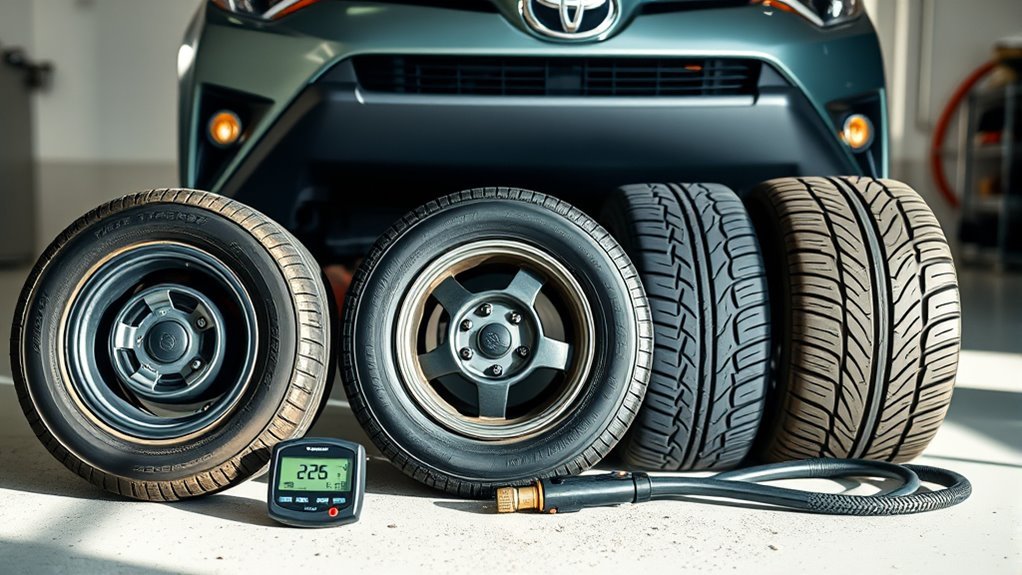
Proper tire pressure helps your Toyota RAV4 wear its tires evenly because it keeps the tread sitting on the road the way Toyota and the tire manufacturer intended. Too little air usually overloads the tire shoulders. Too much air can concentrate wear near the center. The safest target is not a guess or the number on the tire sidewall; it is the cold tire pressure listed on your RAV4’s driver-side Tire and Loading Information Label or in the owner’s manual.
Quick Answer
Proper tire pressure prevents uneven RAV4 tire wear by keeping the tread flat against the road. Under-inflation can wear the outer edges and build heat, while over-inflation can wear the center faster. Check pressure monthly when tires are cold and use the PSI on your door-jamb label.
Key Takeaways
- Use the PSI listed on your RAV4’s Tire and Loading Information Label, not the maximum PSI printed on the tire sidewall.
- Check pressure at least once a month when the tires are cold, meaning the vehicle has not been driven for at least three hours.
- Low tire pressure can cause shoulder wear, heat buildup, poor handling, and lower fuel economy.
- High tire pressure can reduce the contact patch and may increase center tread wear.
- TPMS is helpful, but it is not a replacement for manual tire-pressure checks with a gauge.
At a Glance
| Time Required | 5–10 minutes |
| Difficulty | Easy |
| Tools Needed | Accurate tire pressure gauge, air compressor or inflator, valve caps |
| Cost | Usually free if you already have a gauge; about $10–$25 for a basic digital gauge |
How Does Proper Tire Pressure Prevent Uneven Tire Wear?
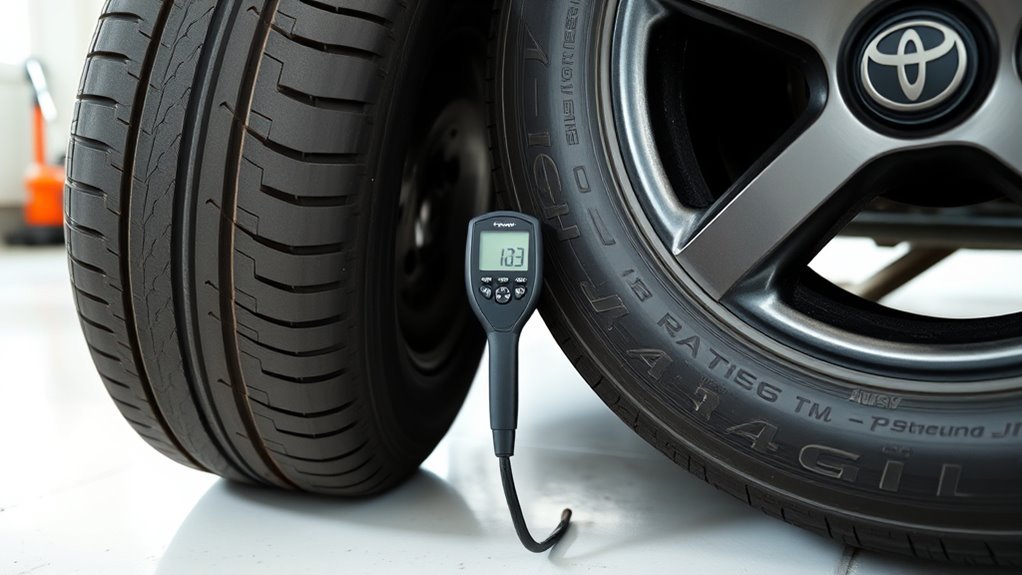
Maintaining the correct cold tire pressure helps the tire carry weight evenly across the tread. When pressure is right, the tread blocks contact the road more evenly, which reduces the chance of fast wear on one part of the tire.
When a tire is under-inflated, the sidewalls flex more and the outer shoulders often carry too much load. That can create extra heat, faster edge wear, softer steering response, and a higher risk of tire damage. When a tire is over-inflated, the center of the tread may carry too much load, which can reduce grip and wear the middle of the tire faster.
Warning: Do not use the maximum PSI printed on the tire sidewall as your RAV4’s recommended tire pressure. That sidewall number is a tire limit, not Toyota’s cold inflation setting for your vehicle.
| Pressure Condition | Common Wear Pattern | What It Can Mean |
|---|---|---|
| Too low | Both outer shoulders wear faster | The tire is flexing too much and running hotter than it should. |
| Too high | Center tread wears faster | The tread contact patch may be too concentrated in the middle. |
| Correct cold PSI | More even tread wear | The tire is carrying the vehicle load as designed. |
According to NHTSA tire-safety guidance, proper tire pressure affects tire safety, durability, and fuel consumption.
Find the Correct RAV4 Tire Pressure Before Inflating
The correct RAV4 tire pressure depends on the model year, trim, tire size, and original equipment setup. For example, some 2020 RAV4 Hybrid trims use 36 PSI when cold, but other RAV4 trims and tire sizes may use a different pressure. That is why the best source is always your own vehicle’s Tire and Loading Information Label.
Look for the label on the driver-side door edge or doorjamb. You can also check the tire inflation section of the Toyota RAV4 owner’s manual. The number you want is the cold tire inflation pressure, usually shown in PSI and kPa.
Note: If your RAV4 has replacement tires, a different wheel size, heavy cargo, or non-original tire sizing, ask a qualified tire shop or Toyota service center to confirm the correct pressure.
[Products Worth Considering]

Monitor tire tread wear with a smart, color-coded depth gauge that shows clear condition ranges at a glance. The bar is range marked for fast, easy readings, helping you maintain safer traction and performance. Each gauge is portable with a pocket clip, and the set includes 20 units for daily use and sharing.
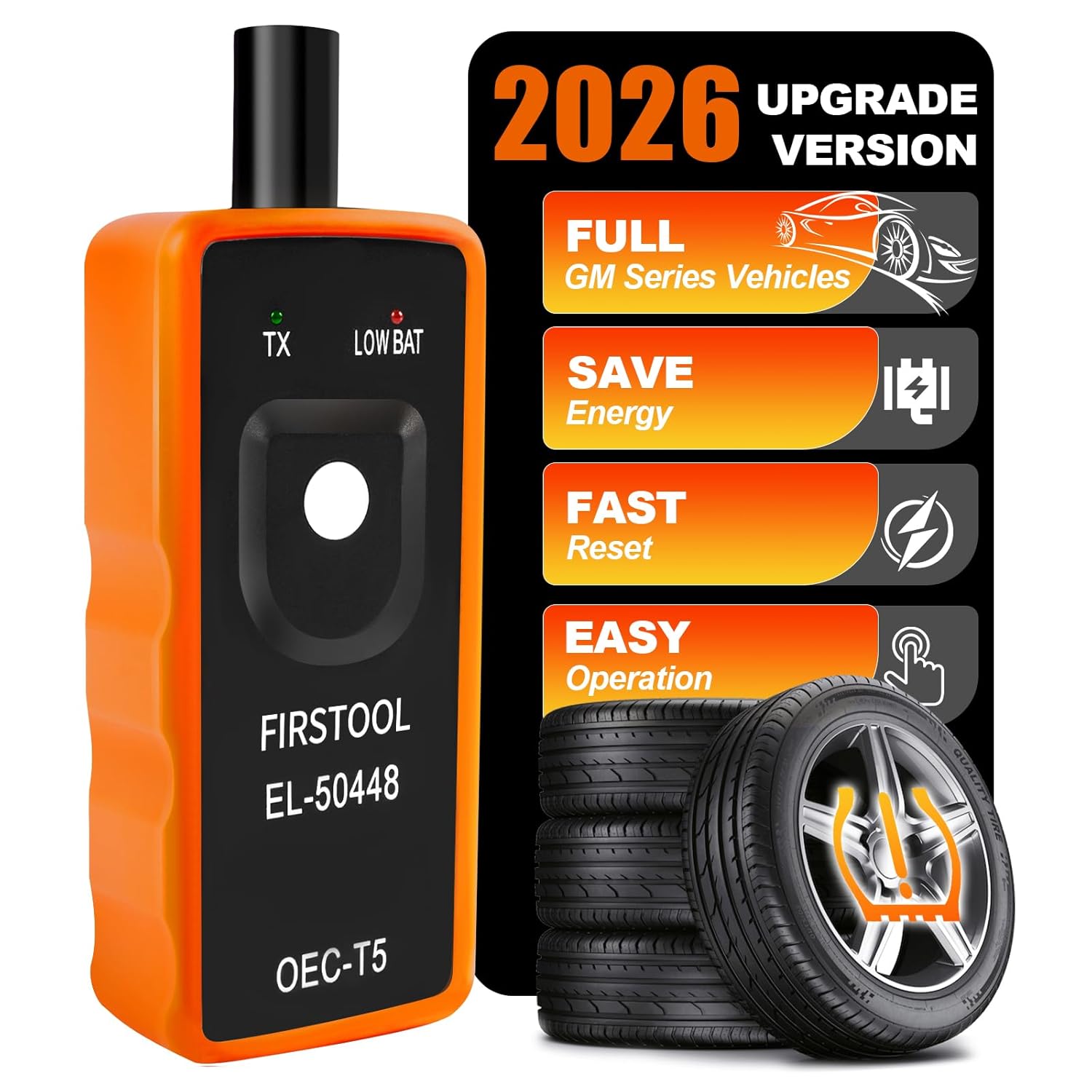
This TPMS relearn tool helps you quickly activate, match, and reset GM tire pressure sensors to keep the vehicle monitoring system working properly. It clears tire pressure alarms and dashboard warning lights after sensor replacement or tire rotation, and supports learning for common 315/433 MHz TPMS sensors. Designed for simple one-button operation, it can help you avoid unnecessary trips to repair shops.

Steelman white tire marking crayons provide high-contrast, semi-permanent marks for repairing and inspecting tires and equipment. They write on wet or dry, smooth or coarse surfaces including rubber, metal, glass, and wood, making them ideal for puncture location and damage outlining. The lead- and zinc-free crayons resist weather and fading yet wipe away when you no longer need the marks.
What Are the Effects of Low Tire Pressure on Handling and Safety?
When tire pressure drops below the recommended cold PSI, your RAV4 can feel less stable and less precise. Under-inflated tires increase flex in the sidewall, which can make steering feel slower and can reduce your confidence during lane changes, cornering, and emergency braking.
Low pressure also increases rolling resistance. FuelEconomy.gov states that under-inflated tires can lower gas mileage by about 0.2% for every 1 PSI drop in the average pressure of all tires. Proper inflation is a simple maintenance habit that protects tire life, safety, and fuel economy at the same time.
Do not wait until the tire looks flat. Modern radial tires can be several PSI low and still look normal from the outside. Use a gauge instead of judging by appearance.
How Do Seasonal Changes Affect Tire Pressure?
Seasonal temperature changes can move tire pressure up or down even when the tire is not leaking. A useful rule of thumb is that tire pressure changes by about 1 PSI for every 10°F change in temperature. Pressure usually drops in cold weather and rises in hot weather.
- Cold weather: Air contracts, so a tire that was correct in mild weather may read low after a cold night.
- Hot weather: Air expands, so pressure may read higher after the vehicle sits in the sun or after highway driving.
- Season changes: Check pressure more often during fall and winter temperature swings, especially if the TPMS light comes on in the morning.
Pro Tip: Set your RAV4’s tire pressure in the morning before driving, when the tires are cold. If you must add air after driving, recheck and adjust the pressure again once the tires have cooled.
How to Keep Your Tire Pressure in Check
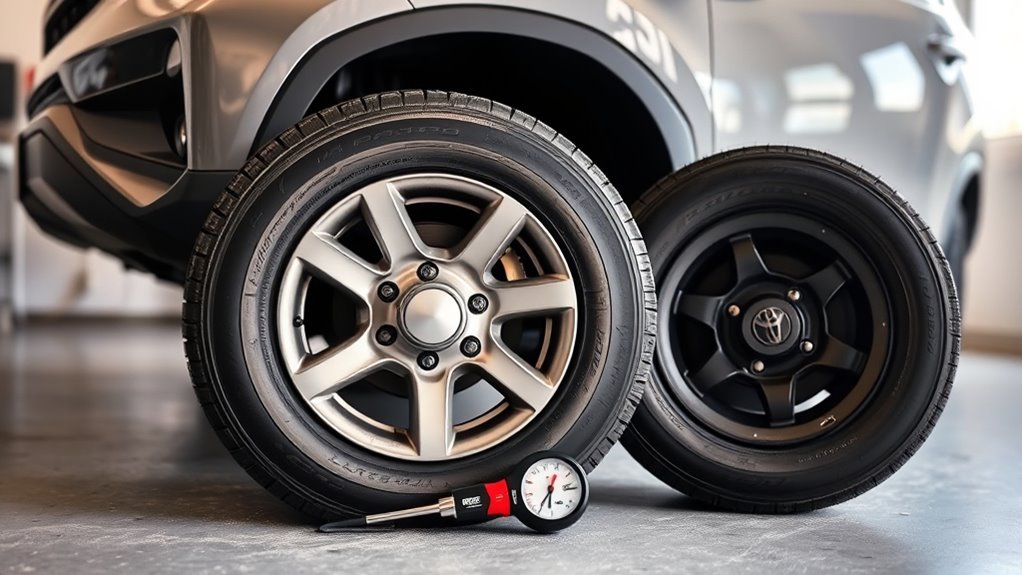
Checking tire pressure is simple, but the timing matters. NHTSA recommends checking all tires, including the spare if equipped, at least once a month when they are cold. Cold means the vehicle has not been driven for at least three hours.
- Find the correct PSI. Read the Tire and Loading Information Label on the driver-side doorjamb or check your owner’s manual.
- Use a reliable gauge. Remove the valve cap and press the gauge firmly onto the valve stem.
- Compare the reading. If the reading is below the placard PSI, add air. If it is above the placard PSI when cold, release a small amount of air.
- Recheck the pressure. Measure again after adding or releasing air so you do not overshoot the target.
- Repeat for every tire. Check all four tires, and check the spare if your RAV4 has one.
- Reinstall valve caps. Valve caps help keep dirt and moisture out of the valve stem.
| Action | Frequency |
|---|---|
| Check tire pressure | At least once a month |
| Check when tires are cold | Before driving or 3+ hours after driving |
| Inspect tires for damage | Monthly and before long trips |
| Monitor TPMS alerts | Whenever the warning light appears |
| Rotate tires | Follow your Toyota maintenance schedule |
[Products Worth Considering]

Keep your tires properly inflated with this analog VONDIOR tire pressure gauge, designed for fast, easy readings without batteries. The swiveling, two-axis hose and large glow dial help you measure at any tire angle with instant visibility. Built with a protective rubber shield, it supports durable, low-maintenance use for cars and trucks.

The Topeak SmartGauge D2 delivers precise digital tire pressure readings for bikes, motorcycles, and sports equipment up to 250 psi (17 bar). Its rotating SmartHead works with both Presta and Schrader valves, so you can check pressure quickly without adapters. The LCD display makes it easy to read results in psi, bar, or kg/cm² with an included CR2032 battery for immediate use.

The TYAMATE TM8 solar-powered wireless TPMS delivers real-time tire pressure and temperature monitoring with six alarm modes for safer driving. A vibrant color LCD display shows readings clearly while windshield mounting keeps it hands-free and easy to read. With a wide 0–87 PSI range, strong 433.92 MHz signal transmission, and quick sensor pairing, it’s ideal for RV, sedan, SUV, MPV, and truck use.
What If the TPMS Light Comes On?
Your RAV4’s Tire Pressure Monitoring System is a backup warning system, not a replacement for a tire gauge. Federal TPMS requirements are designed around warning drivers about significant under-inflation, and NHTSA notes that TPMS is not a substitute for regular tire maintenance.
- Solid TPMS light: Pull over when safe, inspect the tires, and check pressure with a gauge as soon as possible.
- Light on during a cold morning, then off later: Pressure may be near the warning threshold. Check and adjust cold PSI instead of ignoring it.
- Flashing TPMS light, then solid: This can indicate a TPMS malfunction. Have the system inspected by a qualified technician.
- Light stays on after inflation: Recheck all tires cold. If pressure is correct and the light remains, inspect for a slow leak, damaged sensor, or reset procedure in the owner’s manual.
[Products Worth Considering]

Measure tire tread depth quickly and accurately with this LUMITECO dial gauge that reads in 1/32" increments up to 14/32". The color-coded green/yellow/red zones make it easy to judge tire wear and know when replacement is needed. A rugged, compact design with a protective pouch helps keep the gauge ready for use on cars, trucks, motorcycles, and more.

Upgrade your Toyota tire setup with these corrosion-resistant, leak-proof valve stem caps designed to help protect the valve core from water, snow, and road grime. The caps feature a snug rubber seal and durable copper alloy construction to resist rust and oxidation while maintaining stable tire pressure. Ideal for replacing worn original caps and keeping your wheels looking clean and stylish.

This tire inflator with pressure gauge delivers long-lasting performance with a durable rubber-protected gauge and sturdy build. The longer hose and 360 swivel air chuck help you seal the valve securely and keep your hands free while measuring, inflating, or deflating. It’s battery-free for reliable use and provides ±2 PSI accuracy in the mid-range for most typical tires, with universal compatibility for 1/4 NPT compressor outputs.
Debunking Common Tire Pressure Myths for RAV4 Owners
Several tire-pressure myths can lead to uneven wear or unsafe driving. These are the ones RAV4 owners should avoid:
- Myth: The tire sidewall tells me the correct PSI. The sidewall shows the tire’s maximum cold inflation limit, not your RAV4’s recommended pressure.
- Myth: More pressure is always better. Over-inflation can reduce the contact patch and may wear the center tread faster.
- Myth: TPMS means I do not need a gauge. TPMS alerts you only when pressure is significantly low or when the system detects a problem. Monthly manual checks are still needed.
- Myth: One PSI never matters. One PSI is usually not an emergency, but repeated small losses add up, especially when temperatures drop.
- Myth: Tire pressure is the only cause of uneven wear. Alignment, balance, rotation habits, worn suspension parts, and driving style can also affect tread wear.
When Uneven Wear Is Not Just a Pressure Problem
Correct PSI is important, but it cannot fix every wear pattern. If your RAV4’s tires show feathering, cupping, one-sided wear, vibration, or pulling, pressure may not be the main issue.
- One-sided shoulder wear: Often points to alignment problems.
- Cupping or scalloped wear: May point to balance, suspension, or shock/strut issues.
- Rapid wear on one tire: Could indicate a damaged tire, wheel, alignment issue, or uneven load.
- Vibration at highway speed: May need wheel balancing or tire inspection.
NHTSA notes that rotation, balance, and alignment help maximize tire life. If the wear pattern looks unusual, have the tires inspected instead of only adding air.
Frequently Asked Questions
Why is my tire pressure light on but my tires look fine on my Toyota RAV4?
Your tires can be low even if they look normal. A solid TPMS light usually means at least one tire is significantly under-inflated. Check all tires with a gauge when cold. If the light flashes for 60–90 seconds and then stays on, the TPMS may have a malfunction and should be inspected.
Is 37 PSI too high for a RAV4?
It depends on your RAV4’s cold placard pressure. If your door-jamb label says 36 PSI and the tire reads 37 PSI cold, it is slightly high but not usually urgent; adjust it back to the placard number when convenient. If your placard says 33 PSI, then 37 PSI cold is too high and should be corrected.
Should I check RAV4 tire pressure hot or cold?
Check it cold whenever possible. Cold means the vehicle has been parked for at least three hours. Tire pressure rises as the tires warm up during driving, so a hot reading can make a low tire look closer to normal than it really is.
How often should I check my RAV4 tire pressure?
Check pressure at least once a month, before long trips, and during major temperature changes. Also check it any time the TPMS light comes on, after hitting a pothole, or if the vehicle starts pulling, vibrating, or feeling unstable.
Can tire pressure alone fix uneven tire wear?
Not always. Correct pressure can prevent pressure-related edge or center wear, but uneven wear can also come from poor alignment, missed rotations, wheel imbalance, worn suspension parts, or tire damage. If wear continues after correcting PSI, have the tires inspected.
Conclusion
Proper tire pressure is one of the easiest ways to prevent uneven tire wear on your RAV4. Use the cold PSI listed on your driver-side door-jamb label or owner’s manual, check it monthly with a gauge, and do not rely only on TPMS. When pressure is right, your tires are more likely to wear evenly, handle predictably, last longer, and support better fuel economy.
Sources
- Toyota RAV4 Owner’s Manual — Tire inflation pressure — backs using Toyota’s tire-inflation guidance for model-specific pressure.
- NHTSA TireWise Tire Safety — backs cold monthly tire-pressure checks, TPMS limitations, tread checks, rotation, alignment, and tire-safety guidance.
- FuelEconomy.gov — Keeping Your Vehicle in Shape — backs the 0.2% fuel-economy loss per 1 PSI average tire-pressure drop.
- eCFR 49 CFR 571.138 — Tire Pressure Monitoring Systems — backs the role of TPMS in warning about significant under-inflation.
- Tire Rack — Temperature Change and Tire Air Pressure — backs the rule of thumb that tire pressure changes about 1 PSI per 10°F temperature change.


1 thought on “How Tire Pressure Affects Tire Wear on a RAV4”