

Your front tires can wear up to twice as fast as your rear tires — and if you ignore it, you’ll be buying a new set years earlier than you should. The fix is simple, cheap, and takes under an hour at home. This guide covers exactly how to rotate your Toyota RAV4 tires, which pattern to follow, and how often to do it.
Quick Answer
Rotate your RAV4’s tires every 5,000–7,500 miles for FWD models, or every 3,000–5,000 miles for AWD. Use a front-to-back pattern for directional tires. For non-directional tires, cross the rears to the front for more even wear. Always tighten lug nuts in a star pattern after rotation.
Why Tire Rotation Matters for Your RAV4
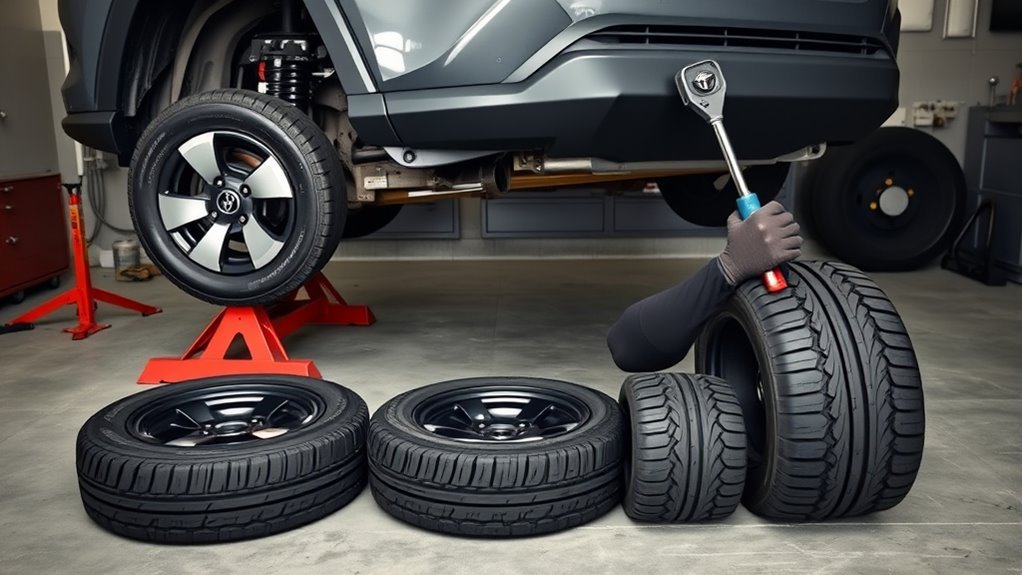
Front tires wear faster than rear tires on most vehicles. On a RAV4, they handle steering forces, carry more weight during braking, and — on FWD models — also deliver engine power. Skipping rotations lets that imbalance build up until one set is worn out while the other still has plenty of tread left.
According to Toyota’s scheduled maintenance guidelines, you should rotate your RAV4’s tires every 5,000–7,500 miles on FWD models. AWD models need more frequent attention — every 3,000–5,000 miles — because all four wheels receive and react to engine power at different rates. Always check your owner’s manual for the exact interval recommended for your trim.
Regular rotations improve traction, reduce the risk of oversteer in bad weather, and — according to tire industry estimates — can extend tire life by up to 20%. That’s a meaningful saving when a quality set of tires costs several hundred dollars.
How to Rotate Your RAV4 Tires Step by Step
You’ll need a car jack, lug nut wrench, and jack stands before you start. Don’t skip the jack stands — a car resting on the jack alone is a serious safety risk.
| Step | Action | Safety tip |
|---|---|---|
| 1. Gather tools | Car jack, lug nut wrench, jack stands | Make sure parking brake is on |
| 2. Loosen lug nuts | Slightly loosen all lug nuts | Do this before lifting |
| 3. Lift vehicle | Use the jack to lift your RAV4 | Place jack stands for safety |
| 4. Rotate tires | Move tires per your rotation pattern | Follow the owner’s manual |
After repositioning, tighten the lug nuts in a star pattern to distribute pressure evenly. For RAV4 models, the correct torque spec is approximately 76 ft-lbs — use a torque wrench if you have one. Finally, check tire pressure after rotation, since air pressure often shifts when tires are removed and remounted.
[Products Worth Considering]

The Trivd Frol 1/2" air impact wrench delivers high performance torque up to 1500 ft-lbs with a twin hammer impact mechanism for strong, balanced blows. It features an ergonomic grip, compact lightweight design, and quick-stop control with 3 forward speeds up to 8000 RPM plus a reverse speed. Built for demanding automotive repair and tire shop work, the rear exhaust helps keep debris away from the surface.

Measure tire tread depth quickly and accurately with this LUMITECO dial gauge that reads in 1/32" increments up to 14/32". The color-coded green/yellow/red zones make it easy to judge tire wear and know when replacement is needed. A rugged, compact design with a protective pouch helps keep the gauge ready for use on cars, trucks, motorcycles, and more.

Accurately measure tire tread depth with a calibrated gauge marked from 0 to 1 inch in 1/32 inch increments. The color-coded bar helps you quickly identify tread condition ranges, supporting safe driving for trucks, motorcycles, automobiles, and passenger vehicles.
Which Rotation Pattern Should You Use?
The right pattern depends on whether your tires are directional or non-directional. Check the sidewall: a directional tire has an arrow showing which way it’s meant to roll.
If your RAV4 has directional tires, your only option is a straight front-to-back swap. Move the front tires directly to the rear on the same side. Move the rear tires directly to the front on the same side. Never cross them — doing so reverses the intended rolling direction and reduces wet-weather grip.
If your RAV4 has non-directional tires, you have more flexibility. A cross rotation — where the rear tires move to the opposite front position — gives more even tread wear than a straight front-to-back swap. For AWD models, Toyota’s owner’s manual recommends a straight front-to-back pattern as the default, but many owners and independent shops use the cross pattern on non-directional tires without issue.
Aim for rotations every 5,000–7,500 miles on FWD models and every 3,000–5,000 miles on AWD models. Set a reminder in your calendar so it doesn’t slip between oil changes.
[Products Worth Considering]

Upgrade your wheels with MIKKUPPA M12x1.5 mag seat lug nuts built for secure, corrosion-resistant performance. These closed-end chrome lug nuts are a direct replacement for select Toyota models, including Camry, Corolla, RAV4, Sienna, Avalon, Highlander, Matrix, Venza, and Prius. Triple-chromium plating and cold-forged, heat-treated steel help deliver strength for daily driving and replacement needs.

Monitor tire tread wear with a smart, color-coded depth gauge that shows clear condition ranges at a glance. The bar is range marked for fast, easy readings, helping you maintain safer traction and performance. Each gauge is portable with a pocket clip, and the set includes 20 units for daily use and sharing.

The SAFELIFE dial tire tread depth gauge measures tread depth in 1/32 inch increments with clear, easy-to-read 2-inch dial face. Color zones using a traffic light system help you quickly judge whether tread is low, marginal, or ample for safer driving. Built with a durable zinc cast body and a metal detect probe for precise, comfortable use across cars, motorcycles, trucks, and buses.
Common Tire Rotation Mistakes to Avoid

A few easy mistakes can undermine an otherwise good rotation. Watch out for these:
- Crossing directional tires. If your tires have a directional arrow on the sidewall, they must stay on the same side of the vehicle. Crossing them reverses the tread pattern and reduces performance on wet roads.
- Skipping alignment checks. Rotation and alignment work together. If your RAV4 AWD pulls to one side or the steering wheel sits off-center, a rotation alone won’t fix uneven wear — you need an alignment too.
- Under-torquing or over-torquing lug nuts. Hand-tightening isn’t enough, and an impact wrench cranked too high warps the brake rotor. Torque to approximately 76 ft-lbs in a star pattern.
- Skipping the tread depth check. Before you rotate, inspect each tire. If tread depth falls below 2/32 of an inch, rotation won’t save the tire — it needs replacing. A tread depth gauge costs just a few dollars at any auto parts store.
Galaxy Toyota’s Tire Care Services
If you’d rather have a professional handle the job, Galaxy Toyota’s tire care team offers quick-turnaround rotation appointments near Long Branch. Their technicians can also advise on the right rotation pattern for your specific RAV4 trim and tire type.
Galaxy Toyota runs regular service specials, so it’s worth checking their current offers before you book. Pairing a rotation with an oil change keeps both jobs on the same schedule and cuts down on trips to the shop.
[Products Worth Considering]

This universal magnetic jack pad is designed to protect pinch welds when lifting vehicles, helping prevent seam damage or warping. Crafted from solid aluminum with a nylon pad insert, it provides reinforced structural support and a secure fit for most single-vehicle pinch welds. Slotted for strong magnet holding, it supports safe jacking for cars, SUVs, trucks, and more.

Upgrade your wheels with MIKKUPPA closed-end lug nuts designed for reliable fit and corrosion resistance. The one-piece, cold-forged and heat-treated steel construction helps resist rust and stripping, while the integrated finish delivers a durable black appearance. Built to OEM standards with a conical 60-degree seat, these nuts provide a secure solution for compatible Ford, Honda, Jeep, and Chevrolet models.

These M14x1.5 closed-end chrome lug nuts are a one-piece replacement designed for secure fitment on compatible GM, Ford, and select Chrysler/Dodge models. Featuring a 60-degree conical seat and anti-rust chrome plating, they help resist corrosion and maintain a bright look for everyday driving. Built for long-term durability, they include OEM-style part references and are backed by 12 months of support.
Frequently Asked Questions
What is the tire rotation pattern for a Toyota RAV4?
The standard pattern for a RAV4 is front-to-back on the same side. If your tires are non-directional, a cross rotation — where the rear tires move to the opposite front position — can produce more even tread wear. Check your owner’s manual and your tire sidewall before deciding.
How do I rotate my tires at home?
You’ll need a car jack, jack stands, a lug nut wrench, and ideally a torque wrench. Loosen the lug nuts before lifting, place jack stands for safety, move each tire to its new position, then tighten lug nuts to spec (approximately 76 ft-lbs) in a star pattern. Check tire pressure when you’re done.
Rotating your tires on schedule is one of the cheapest ways to protect a set of tires that cost several hundred dollars. Stick to the intervals in your owner’s manual, use the right pattern for your tire type, and do a quick tread-depth check each time. If you’re ever unsure about wear patterns or alignment, Galaxy Toyota’s tire team can give you a professional assessment before a small issue turns into an expensive replacement.

1 thought on “Toyota RAV4 Tire Rotation: DIY Steps & Pattern”