
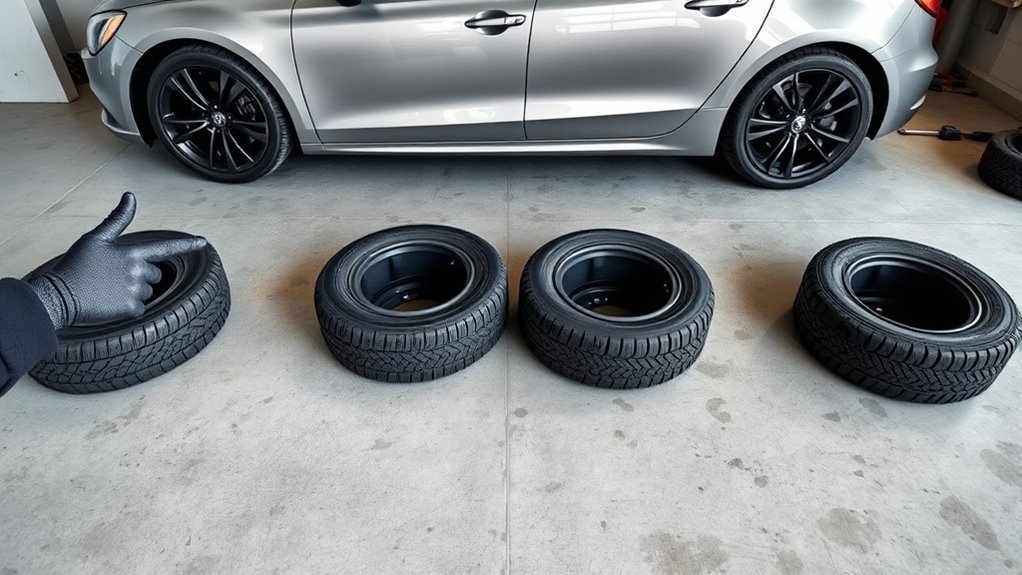
You should rotate tires every 5,000–8,000 miles and pick the pattern that matches your drive type and tire design. Use a forward cross for FWD, a rearward cross for RWD/4WD, an X-pattern for AWD with non‑directional tires, and front‑to‑back for directional setups. Check tread depth, pressure, TPMS, and balance during each service, and account for staggered or spare tire requirements. Follow manufacturer guidance for the best wear and handling. Keep reading for specific step‑by‑step placements and tips.
Quick Answer
- Interval: Rotate your tires every 5,000 to 8,000 miles (often done with oil changes).
- FWD Pattern: Forward Cross (front tires move straight back, rear tires cross to the front).
- RWD/4WD Pattern: Rearward Cross (rear tires move straight forward, front tires cross to the rear).
- AWD Pattern: X-Pattern (all four tires cross diagonally).
- Maintenance: Check tire pressure, verify TPMS sensors, and inspect tread depth (replace at 2/32″).
Tire Rotation Patterns : Quick Guide (Which Pattern for FWD, RWD, AWD, Directional Tires)

Choosing the right rotation pattern for your drive type and tire construction maximizes tread life. For a front-wheel-drive (FWD) vehicle, use the Forward Cross pattern. The front tires move straight back, while the rear tires cross to the front. This balances tire performance and minimizes uneven wear. If you have a rear-wheel-drive (RWD) or four-wheel-drive (4WD), use the Rearward Cross pattern. The rear tires move straight forward, and the front tires cross to the opposite rear positions. For all-wheel-drive (AWD) with non-directional tires, the X-Pattern moves each tire diagonally to equalize wear. If your tires are directional, use the Front-to-Back pattern. Each tire stays on its original side while swapping between axles to protect the tread design and high-speed tracking.
Four Rotation Patterns and When to Use Each (Forward Cross, Rearward Cross, X, Front‑to‑Back)
For front‑wheel‑drive vehicles, you will typically use the Forward Cross. This sends the front tires straight back while swapping the rear pair side‑to‑side to correct front tread wear. For rear‑wheel‑drive and many 4WD trucks, the Rearward Cross moves the rear tires straight forward and crosses the fronts to equalize load‑related wear. Use the X‑pattern for balanced diagonal transfers on symmetric tires, or the Front‑to‑Back pattern when preserving directional tread orientation.
Forward Cross Use Cases
The Forward Cross rotation works best for a front‑wheel‑drive car that shows heavier front wear. You move the front tires straight back and cross the rear tires to the front. This brings less‑worn rubber to the steering axle and reduces front‑end stress from stop‑and‑go city driving. Use this pattern when tire wear concentrates at the front due to torque steer, heavy braking, or frequent commuting. It restores even tread depth to the steering axle, which improves handling and extends the tire’s service life. The Forward Cross is practical and predictable for standard daily driving conditions.
Rearward Cross Benefits
The rearward cross rotation suits rear‑wheel‑drive and 4WD vehicles. It is especially useful when the rear tires handle most of the drive torque and acceleration loads. You move the rear tires straight forward while swapping the front tires to the opposite rear positions. This balances contact-patch duty and reduces localized wear. This redistribution manages acceleration stress so rear tires don’t wear out prematurely, which is helpful if you tow, climb hills, or carry heavy loads. Following this schedule every 5,000–8,000 miles supports tire longevity and provides steadier traction and predictable handling.
X And Front‑To‑Back
If your vehicle or tire type requires a different approach, you may use the X pattern. This diagonally swaps all tires to promote uniform tread wear on standard setups. However, use the front‑to‑back pattern if your tires are directional. This keeps each tire on its designated side to preserve the tread design and high‑speed stability. Apply a quick tread wear analysis after each rotation to verify the pattern is working effectively.
- Diagonally cross tires to balance wear.
- Preserve directional tread orientation when required.
- Equalize stress across both axles.
- Extend the usable tread life of the set.
- Confirm results with tread wear analysis.
Always choose your pattern based on drive type, tire design, and manufacturer guidance.
How to Choose a Tire Rotation Pattern (Drive Type, Directional, Staggered, Spare)
When choosing a rotation pattern, look at your drive type, tire construction, and whether you carry a full-size spare. Each factor dictates how your tires can move. For FWD vehicles, use the Forward Cross to manage tire wear. For RWD and 4WD, prefer the Rearward Cross. Track your rotation frequency according to the manufacturer’s recommendations.
If your tires are directional, keep their rotation Front-to-Rear to preserve traction, as flipping sides will compromise performance. Staggered setups (where front and rear tires are different sizes) restrict movement. Standard cross patterns often are not possible here, so consult the vehicle manual and accept the limited options. Uniform-size, non-directional tires give you more flexibility, allowing the X-Pattern or Rearward Cross to promote even wear.
If you carry a full-size spare, incorporate it to extend the set’s service life. The Forward Cross suits FWD, while the Rearward Cross suits RWD/4WD. Matching the pattern to these constraints helps maximize tread life and driving confidence.
Five‑Tire Rotation: Rotating With a Full‑Size Spare (Step‑by‑Step Positions)

A five-tire rotation uses your full-size spare to equalize tread wear across all tires. You systematically swap positions so every tire shares road time, which prevents uneven wear and preserves handling. For front-wheel-drive, use the forward cross. For rear- or four-wheel-drive, use the rearward cross. By cycling the spare into service, spare tire maintenance becomes a routine habit.
Cycle your full-size spare into regular rotation—use forward cross for FWD, rearward cross for RWD/4WD to equalize tread.
- Visualize rear tires moving forward as fronts cross sides on FWD.
- Picture the spare fitting into the right-rear (FWD) or left-front (RWD/4WD) slot.
- Imagine the driven-axle tires shifting straight back on RWD/4WD.
- See each tire accrue equal mileage, distributing tread wear evenly.
- Check mount points and air pressure while swapping to ensure the spare is ready for use.
Perform this rotation at regular intervals to prolong tire life and sustain balanced traction.
[Products Worth Considering]

The Dr.Roc spare tire tool kit helps you release, lower, or raise your spare tire with reliable extension tools and a lug nut wrench. It is made from rustproof automotive-grade steel and includes an organized carry case for convenient storage. Designed for compatibility with select GM models from the late 1990s through 2019, it uses upgraded extension components to install and remove spare tires with less hassle.

Monitor tire tread wear with a smart, color-coded depth gauge that shows clear condition ranges at a glance. The bar is range marked for fast, easy readings, helping you maintain safer traction and performance. Each gauge is portable with a pocket clip, and the set includes 20 units for daily use and sharing.

This spare tire tool kit is designed for the 2004 to 2018 Ford F-150 to help you loosen and tighten wheel lug nuts and manage the spare tire and provided jack functions from underneath the vehicle. It includes the lug nut wrench and extension pieces plus a convenient storage carrying case for organized transport. The jack itself is not included.
When to Rotate and What to Check (Intervals, TPMS, Tread Depth, Balancing)
Set a consistent service rhythm and use an inspection checklist to catch wear before it becomes a safety issue. Rotate every 5,000–8,000 miles, which is often easiest to remember if done alongside oil changes. Check your tread depth; you should replace tires at 2/32″ minimum and watch the tread wear indicators for uneven patterns that signal alignment or balance problems. Monitor pressure frequently, as correct inflation prevents premature wear and poor handling. If your vehicle has a TPMS system, reprogram or verify the sensors after the rotation so the dashboard readings stay accurate. Finally, balance the tires during rotation to eliminate vibrations.
| Interval | Inspection | Action |
|---|---|---|
| 5k–8k miles | Pressure | Inflate to spec |
| Every visit | Tread depth | Replace at 2/32″ |
| After rotation | TPMS | Reprogram/verify |
| As needed | Balance | Correct vibration |
| Ongoing | Visual | Look for uneven wear |
[Products Worth Considering]

Measure tire tread depth quickly and accurately with this LUMITECO dial gauge that reads in 1/32" increments up to 14/32". The color-coded green/yellow/red zones make it easy to judge tire wear and know when replacement is needed. A rugged, compact design with a protective pouch helps keep the gauge ready for use on cars, trucks, motorcycles, and more.

The SAFELIFE dial tire tread depth gauge measures tread depth in 1/32 inch increments with clear, easy-to-read 2-inch dial face. Color zones using a traffic light system help you quickly judge whether tread is low, marginal, or ample for safer driving. Built with a durable zinc cast body and a metal detect probe for precise, comfortable use across cars, motorcycles, trucks, and buses.

The VEHLIVE SU-50448 II TPMS relearn tool provides a fast activation reset to restore accurate tire pressure monitoring after sensor replacement or tire rotation. It supports 315 MHz and 433 MHz GM series sensors and helps clear dashboard pressure warnings. With simple two-button operation and horn-confirmed relearning order, you can reprogram sensors conveniently at home.
DIY vs. Shop: How Rotations Are Done and When to Get Professional Service
You can perform rotations yourself if you have basic tools, know your vehicle’s specific pattern, and stick to the 5,000–8,000 mile interval. Opt for professional service when the patterns are complex, a full-size spare needs integration, or you want technicians to inspect the tread, pressures, and alignment. Scheduling rotations during routine oil changes makes professional service convenient and ensures expert checks.
[Products Worth Considering]

This ecocstm ratchet wrench is designed to make emergency and routine tire changes faster with a 360° rotating head and quick forward/reverse switching. The extended handle provides extra leverage to reduce effort and hand fatigue, while the adapter helps fit many scissor jacks on cars, SUVs, trucks, and vans. Built for reliable performance with durable construction, it’s a practical travel essential for on-the-road preparedness.

Accurately measure tire tread depth with a calibrated gauge marked from 0 to 1 inch in 1/32 inch increments. The color-coded bar helps you quickly identify tread condition ranges, supporting safe driving for trucks, motorcycles, automobiles, and passenger vehicles.

ETENWOLF T300 is a calibrated digital tire pressure gauge designed for reliable readings across low and high pressure ranges. It includes thermal compensation for stable performance in extreme cold or heat, an LED light for visibility, and an auto shut-off to help preserve battery life. Ideal for pickups, RVs, and heavy-duty vehicles, it delivers accurate PSI measurements with sturdy durability.
When To DIY
If you have the right jack, jack stands, lug wrench, and your vehicle’s rotation pattern, you can safely rotate tires at home and save on labor costs. You should DIY when you know the correct pattern, have basic tools, and prefer handling your own maintenance.
- Use a clean workspace, solid jack points, and reliable jack stands.
- Apply the correct lug torque with a calibrated torque wrench.
- Understand the forward or rearward cross patterns.
- Be aware of the limits of staggered or directional tires.
- Perform a quick visual inspection and pressure check.
Average Cost of Professional Tire Rotation
The average cost for a professional tire rotation ranges from $20 to $70, depending on your vehicle and the shop. Many tire retailers offer free rotations if you originally purchased your tires from them. Dealerships and specialty shops may charge more, but you can often save money by bundling a rotation with an oil change or wheel balancing service.
When To Professional
While DIY rotation makes sense for some, it is equally important to know when to bring your vehicle to a shop. Choose professional service when your tires are specialized, vehicle configurations are unusual, or you want a thorough safety check. Shops follow manufacturer-specific patterns, perform visual inspections, check air pressure and tread depth, and offer rebalancing or alignment checks. These professional advantages reduce risk and extend tire life. Document any wear patterns, ask the technician to confirm the rotation pattern, and prioritize safety and long-term performance.
Frequently Asked Questions
What Is the 7 7 Rule for Tires?
The 7 7 Rule says you rotate tires every 7,000 miles or at least every 7 months to optimize tire longevity and balance rotation frequency with maintenance. This helps prolong tread life and preserve handling performance.
Final Thoughts
Rotate your tires regularly to extend their life, improve handling, and maintain safety. Choose a pattern based on your drive type: Forward Cross for FWD, Rearward Cross for RWD, X for AWD, or front‑to‑back for directional setups. Include a full‑size spare in a five‑tire rotation if available. At each service, check the TPMS, tread depth, and tire balance. You don’t need a specialized mechanic to do it at home; simply follow the manufacturer specs, torque the lug nuts correctly, and stick to a consistent schedule.


1 thought on “Tire Rotation Patterns: Best Guide for Every Drivetrain”