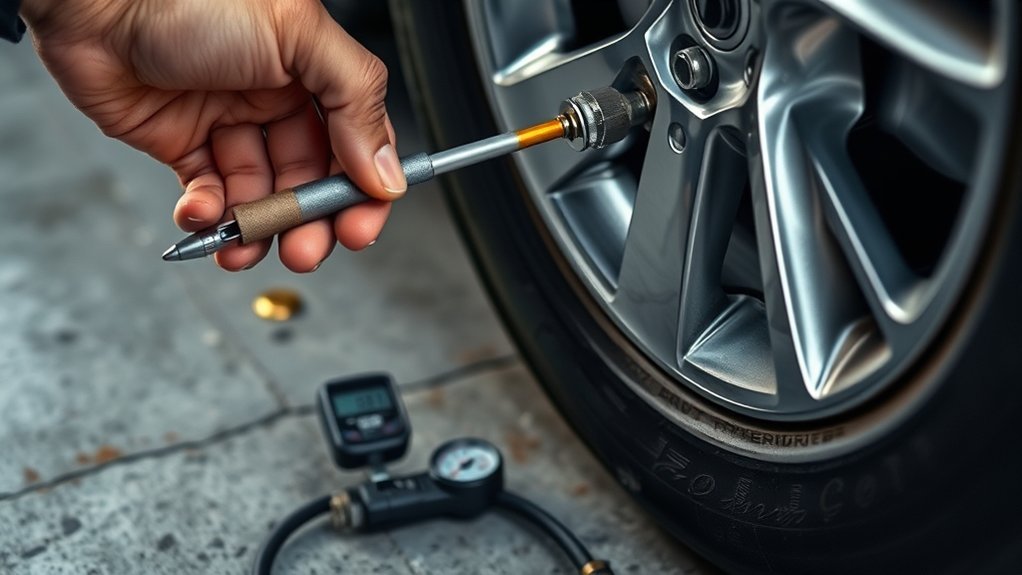
A tire gauge looks simple, but it does an important job every time you press it onto a valve stem. It seals against the tire valve, lets air pressure push on a small measuring part inside the tool, and turns that force into a PSI reading you can compare with your vehicle’s recommended tire pressure.
Quick Answer
A tire gauge works by making an airtight seal on the valve stem so tire pressure can push against a sensing element. Pencil and dial gauges turn that movement into a scale or needle reading. Digital gauges use an electronic sensor and display the pressure as PSI, kPa, or bar.
Key Takeaways
- A tire gauge measures air pressure by sealing to the valve stem and reading the force of the compressed air inside the tire.
- Mechanical gauges use moving parts such as a Bourdon tube, diaphragm, piston, or sliding rod; digital gauges use electronic pressure sensors.
- For the most useful reading, check tires when they are cold and compare the result with the driver’s door-jamb label or owner’s manual.
- Do not use the maximum pressure printed on the tire sidewall as your normal setting unless your vehicle manufacturer specifically says to.
- A tire pressure monitoring system can help, but it does not replace monthly checks with a reliable tire gauge.
At a Glance
| Time Required | About 5 minutes for four tires, plus the spare if accessible |
| Difficulty | Easy |
| Tools Needed | Tire pressure gauge, valve caps, and an air compressor if pressure is low |
| Cost | Usually low cost for a basic gauge; higher for digital, inflator, or smart models |
How Tire Gauges Measure Pressure
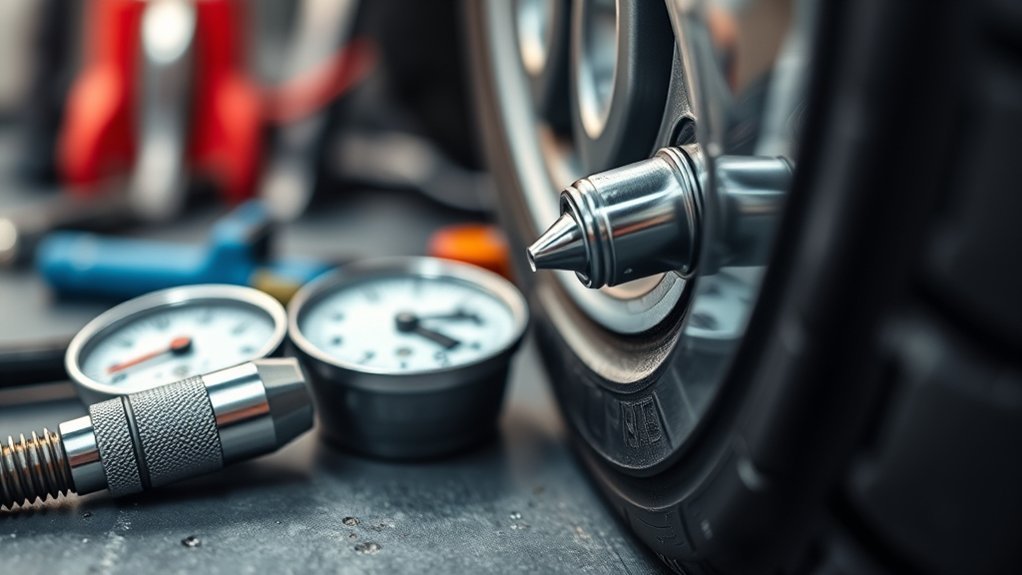
A tire gauge measures pressure by connecting to the tire valve and creating a short sealed path between the tire and the gauge. Once the seal is tight, the air inside the tire pushes against a sensing element inside the tool. The gauge then converts that movement or electrical signal into a number.
Most passenger vehicles in the United States show tire pressure in PSI, or pounds per square inch. Many gauges also show kPa or bar. These are just different units for the same idea: how much force the compressed air is applying inside the tire.
Inside the gauge, the process usually works like this:
- The gauge seals to the valve stem. A rubber gasket or chuck presses against the valve so air does not leak out during the reading.
- The valve core opens. Pressing the gauge straight onto the stem briefly opens the valve and lets tire air reach the gauge.
- Air pressure moves a sensor or mechanical part. That part may be a sliding rod, piston, diaphragm, Bourdon tube, or electronic pressure sensor.
- The gauge displays the reading. A pencil gauge pushes out a scale, a dial gauge moves a needle, and a digital gauge shows the number on a screen.
This is why a firm, straight press matters. If the gauge sits crooked on the valve stem, air leaks around the seal and the reading can come out low or inconsistent. A good seal is also why routine checks are easier when you use a gauge that fits comfortably in your hand.
NHTSA reports 511 tire-related crash fatalities in 2024, so tire pressure is not just a fuel-economy detail. It is part of basic vehicle safety.
Types of Tire Gauges Explained
Tire pressure gauges come in several designs. They all measure pressure, but they differ in how easy they are to read, how much abuse they tolerate, and how much detail they show.
[Products Worth Considering]

AstroAI’s tire pressure gauge with inflator helps you check and adjust car tire pressure accurately for safer, smoother driving. It offers 3-in-1 operation to inflate, deflate, or measure pressure, with an easy-to-read 2.5-inch glow dial and a heavy-duty air chuck for convenient use. Universal compatibility supports Schrader-valve tires and quick-connect 1/4" NPT air compressors for quick maintenance.

Keep your tires properly inflated with this analog VONDIOR tire pressure gauge, designed for fast, easy readings without batteries. The swiveling, two-axis hose and large glow dial help you measure at any tire angle with instant visibility. Built with a protective rubber shield, it supports durable, low-maintenance use for cars and trucks.

Milton S-921 pencil tire pressure gauge helps you maintain optimal tire pressure for passenger cars with accurate readings in PSI and kPa. It features a built-in deflator valve for convenient pressure adjustments, plus a single chuck head and nylon indicator bar for easy use on the go. Built from durable plated brass and designed for reliable performance, it’s a practical road trip and cold-weather maintenance tool.
Pencil Tire Gauges
A pencil gauge, sometimes called a stick gauge or pen gauge, uses air pressure to push out a small sliding scale. It is compact, cheap, and easy to keep in a glove box. The tradeoff is that the scale can be harder to read, especially in low light, and cheap models may not be ideal for small pressure differences.
Dial Tire Gauges
A dial gauge uses internal mechanical movement to turn a needle across a round face. Many dial models are easy to read and may include a bleed valve, which lets you release air slowly if the tire is overinflated. Choose one with a clear scale in the pressure range your vehicle uses most often.
Digital Tire Gauges
A digital gauge uses an electronic pressure sensor and a screen. It is often the easiest type to read, especially at night, and many models switch between PSI, kPa, and bar. The main weakness is the battery. A weak battery, damaged sensor, or dirty chuck can still give a bad reading.
Inflator Gauges
An inflator gauge combines an air hose, trigger, and pressure gauge. You see these on portable compressors and shop air systems. They are convenient because you can add air and check pressure in one setup, but you still need to pause and let the reading settle before trusting it.
Smart Tire Gauges
Smart gauges may connect to an app, save readings, or send alerts. They can help if you track multiple vehicles or want reminders, but they are not automatically more accurate than a well-made basic gauge. The sensor quality and calibration still matter.
Choosing the right gauge can enhance your tire maintenance routine, especially when paired with quality all-season tires for your climate and driving needs.
How to Use a Tire Gauge Correctly
Using a tire gauge correctly is the difference between a useful reading and a number you should not trust. For best results, check tire pressure when the tires are cold. The National Highway Traffic Safety Administration recommends checking all tires, including the spare, at least once a month when the tires are cold.
- Find the recommended PSI. Look for the Tire and Loading Information Label on the driver’s door edge or doorjamb, or check your owner’s manual.
- Check tires cold. A cold tire is one that has not been driven for at least three hours. If you drove recently, recheck later when the tires cool.
- Remove the valve cap. Put it in your pocket or another safe spot so it does not roll away.
- Press the gauge straight onto the valve stem. Push firmly until the air leak stops and the gauge gives a stable reading.
- Read the pressure right away. Digital models show a number. Pencil gauges push out a scale. Dial gauges move a needle.
- Compare the reading with the recommended pressure. If the tire is low, add air. If it is high, release a little air and check again.
- Repeat for every tire. Front and rear tires may have different recommended pressures on some vehicles.
- Replace the valve cap. The cap helps keep dirt and moisture away from the valve core.
Warning: Do not use the maximum PSI printed on the tire sidewall as your everyday inflation target. Use the vehicle manufacturer’s recommended cold tire pressure on the door-jamb label or in the owner’s manual.
If a tire is low, add the missing air with a compressor, then check again with the same gauge. Keeping tires properly inflated can improve fuel economy and help tires last longer. FuelEconomy.gov reports that proper inflation improves gas mileage by 0.6% on average, and underinflation can reduce mileage by about 0.2% for every 1 PSI drop in the average pressure of all tires.
Choosing the best gauge can help you stay informed about tire performance characteristics without guessing.
[Products Worth Considering]

Inflate Presta and Schrader bike and car tires with one compressor attachment, including tubeless setups. The digital gauge lets you monitor 2–200 PSI readings in 0.1 PSI increments with ±2 PSI accuracy, while the adjustable lever and built-in bleed button help you dial in precise pressure. Quick-connect coupler, hose, and a complete Presta service kit with spare cores and caps make it ready for fast maintenance.

This tire inflator with pressure gauge delivers long-lasting performance with a durable rubber-protected gauge and sturdy build. The longer hose and 360 swivel air chuck help you seal the valve securely and keep your hands free while measuring, inflating, or deflating. It’s battery-free for reliable use and provides ±2 PSI accuracy in the mid-range for most typical tires, with universal compatibility for 1/4 NPT compressor outputs.

Check tire pressure quickly and accurately with the Accutire MS-4021B digital gauge, featuring a large backlit LCD for easy visibility. The angled head and rubber-coated handle make it comfortable to grip, while unit switching lets you read psi, bar, kPa, or kg/cm2. An automatic shutoff helps preserve battery life, and it measures 5–150 PSI in small increments for confident tire maintenance.
Cold vs. Warm Tire Pressure
Tire pressure rises as tires warm up from driving, sunlight, or hot pavement. That is why the door-jamb number is a cold tire pressure recommendation. If you measure pressure after driving, the reading may be higher than it would be first thing in the morning.
If you must add air while the tires are warm because one is visibly low or unsafe, inflate it to the recommended cold pressure as a temporary step. Then recheck and adjust when the tire is cold. This is safer than driving on a seriously underinflated tire.
Pro Tip: Use the same personal tire gauge for your monthly checks. A consistent gauge makes it easier to notice real pressure changes instead of chasing small differences between tools.
How Accurate Tire Gauges Are
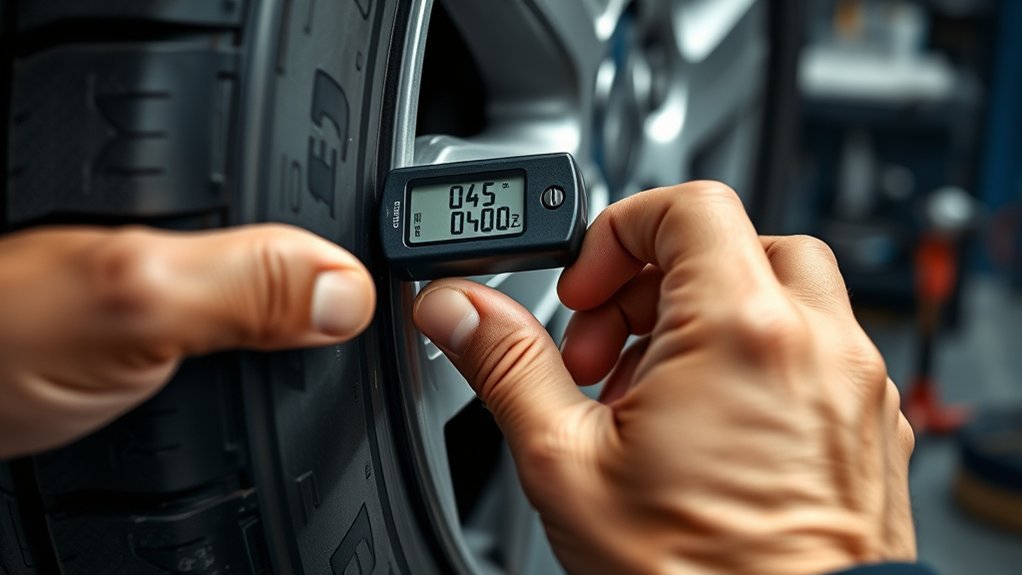
A tire gauge does not need laboratory-level precision for normal car maintenance, but it should be consistent and close enough to catch meaningful underinflation or overinflation. The accuracy depends on the gauge’s design, stated tolerance, pressure range, age, storage, and condition.
Mechanical gauges can drift if they are dropped, bent, clogged, or worn. Digital gauges can be affected by weak batteries, sensor problems, or moisture. Inflator gauges can be inaccurate if the compressor hose pulses or if the gauge is not allowed to settle before you read it.
The ASME B40.100 pressure gauge standard covers pressure gauges and gauge attachments, including elastic element gauges, diaphragm-related components, and digital pressure-indicating gauges. For a consumer tire gauge, the practical move is simple: buy a gauge with a clear stated accuracy, keep it clean, and compare it with a trusted shop gauge if readings suddenly seem wrong.
Do not assume a gas-station gauge is always better than your own. Public gauges can be dropped, exposed to weather, or damaged by repeated use. A clean gauge kept in your vehicle can give more consistent results for monthly checks.
Additionally, consider the importance of choosing the right tires, because tire type, load rating, and condition also affect how your vehicle feels on the road.
Common Tire Gauge Mistakes
Most bad readings come from small handling errors, not from the basic idea of the gauge. Watch for these common problems:
- Pressing at an angle: This causes a leak and often gives a low reading.
- Reading after a long drive: Warm tires can show higher pressure than a true cold reading.
- Using the tire sidewall number: That is usually a maximum pressure, not your vehicle’s normal setting.
- Checking only one tire: Each tire can lose pressure at a different rate.
- Ignoring the spare: A spare tire can be low when you need it most.
- Using a weak digital gauge battery: Low power can make readings inconsistent or hard to trust.
- Leaving valve caps off: Dirt and moisture can reach the valve core and contribute to slow leaks.
TPMS and Tire Gauges
A tire pressure monitoring system, or TPMS, can warn you when a tire becomes significantly underinflated. It is a helpful safety feature, but it is not a replacement for a tire gauge.
NHTSA says passenger cars, light trucks, and vans from model year 2008 or newer are required to have TPMS. The warning light tells you when the system detects a problem, but it may not alert you to small pressure differences, gradual seasonal pressure changes, or a tire that is only slightly low.
Note: If your TPMS light flashes for about 60 to 90 seconds and then stays on, the system may have a malfunction. Check your tire pressure with a gauge and have the TPMS inspected.
Calibrate and Maintain Your Tire Gauge
Regular care keeps your tire gauge trustworthy. You do not need a complex routine, but you should protect the gauge from dirt, impact, moisture, and extreme heat.
- Store it safely. Keep it in a glove box, console, or small case instead of loose in a toolbox.
- Keep the chuck clean. Grit or oil on the sealing surface can cause leaks and bad readings.
- Check the zero point. A dial gauge needle should return to zero when it is not connected to a tire.
- Replace digital batteries. If the screen fades or readings jump around, install a fresh battery.
- Compare readings. If your gauge suddenly disagrees with a trusted shop gauge by several PSI, recalibrate it if possible or replace it.
- Replace damaged gauges. A gauge that has been run over, dropped hard, cracked, or soaked may not be worth trusting.
For analog tire gauges, inspect needle movement and response before every use. For digital gauges, watch for slow startup, dim displays, or readings that change without a reason. Understanding tire performance characteristics can also help you spot when pressure, tread, load, or alignment may be affecting your drive.
[Products Worth Considering]

The Milton S-693 straight foot dual head air chuck is designed for accurate tire pressure checks and quick, secure valve-core engagement with lock-on threads on both ends. With a 1/4" FNPT connection and a maximum 150 PSI rating, it’s built for use on inner duals and common vehicle tires, including trucks and RVs.

AstroAI’s digital tire pressure gauge inflates and measures with high accuracy, reading within 1% and supporting four pressure units from 3 to 250 PSI. The heavy-duty brass air chuck locks securely on valve stems, while the 19.7-inch stainless braided hose and 360° rotatable dial improve comfort and control for faster single-hand operation. Battery-saver behavior and an integrated flashlight add convenience and safety for everyday roadside and garage use.

The JACO FlowPro Tire Inflator measures, inflates, and airs down tires up to 100 PSI with battery-free operation and ±2% accuracy after calibration. It features a glowing pressure dial for night visibility, a heavy-duty steel build with a hybrid hose, and a precision push-to-inflate thumb trigger. The patented Lightning Air Chuck locks on for a secure seal, and the kit includes quick-connect hardware for easy inline use with your air compressor.
Troubleshooting Bad Tire Gauge Readings
If your reading does not make sense, do not keep adding or releasing air blindly. Use a quick check instead.
- You hear constant hissing: Remove the gauge and press it on again straight. A hiss usually means the seal is not tight.
- The reading changes every time: Check the valve stem for dirt, try a slower press, and compare with another gauge.
- The tire keeps losing air: Look for a nail, damaged valve stem, cracked rubber, bent wheel, or loose valve core.
- The TPMS light stays on after inflation: Drive a short distance if your manual says the system needs to reset, or check the owner’s manual for the reset procedure.
- The gauge reads zero on a full tire: The gauge may not be opening the valve core, or the gauge may be damaged.
Frequently Asked Questions
How do you use a tire gauge correctly?
Check the tire when it is cold, remove the valve cap, and press the gauge straight onto the valve stem until the air leak stops. Read the PSI, compare it with the driver’s door-jamb label or owner’s manual, then add or release air as needed. Check all tires monthly, including the spare if your vehicle has one.
What PSI should RAV4 tires be?
A Toyota RAV4 often uses a pressure in the low-to-mid 30 PSI range, but the correct number depends on model year, trim, tire size, and load. Use the Tire and Loading Information Label on the driver’s doorjamb or the official Toyota owner’s manual for your exact vehicle.
What PSI should Kia Telluride tires be?
A Kia Telluride commonly falls around the mid-30 PSI range, but you should not rely on a general number. Check the driver’s door-jamb label or your Kia owner’s manual for the correct cold tire pressure for your specific model year, trim, tire size, and load condition.
What should Subaru Outback tire pressure be?
A Subaru Outback usually uses a cold tire pressure in the low-to-mid 30 PSI range, but front and rear pressures may differ by model year and tire size. Use the driver’s door-jamb label or Subaru owner resources for the exact pressure instead of guessing from a broad range.
Is a digital tire gauge more accurate than a pencil gauge?
A digital tire gauge is often easier to read, but it is not automatically more accurate. Accuracy depends on the gauge’s stated tolerance, sensor quality, battery condition, pressure range, and care. A clean, consistent pencil or dial gauge can still work well for routine checks.
Why does my tire gauge hiss when I use it?
A quick puff of air is normal when the gauge first presses the valve core. A steady hiss usually means the gauge is not sealed straight against the valve stem. Remove it, line it up squarely, and press firmly again until the leak stops and the reading is stable.
Can I rely on TPMS instead of a tire gauge?
No. TPMS is helpful, but it usually warns only when pressure is significantly low or when the system detects a fault. A tire gauge lets you check each tire before it reaches a warning point, which is why monthly manual checks still matter.
Conclusion
A tire gauge gives you a direct way to check whether your tires match the pressure your vehicle manufacturer recommends. The tool works by sealing to the valve stem, sensing the force of the air inside the tire, and turning that force into a readable PSI number.
For the best results, check tires cold, press the gauge straight, compare the reading with the door-jamb label, and repeat monthly. Keep your gauge clean, replace weak batteries, and do not rely only on TPMS. A few minutes with a reliable gauge can help improve safety, tire life, fuel economy, and confidence every time you drive.
Sources
- NHTSA TireWise — tire pressure, cold tire checks, door-jamb label guidance, TPMS limits, and tire-safety context.
- FuelEconomy.gov: Keeping Your Vehicle in Shape — fuel economy effect of proper tire inflation and underinflation.
- ASME B40.100 Pressure Gauges and Gauge Attachments — pressure gauge terminology, gauge types, test procedures, and recommendations.
- Toyota Owners Manuals and Warranties — official manual source for Toyota model-specific tire pressure information.
- Kia Owners Manuals — official manual source for Kia model-specific tire pressure information.
- Subaru Vehicle Resources — official owner resource source for Subaru model-specific information.