
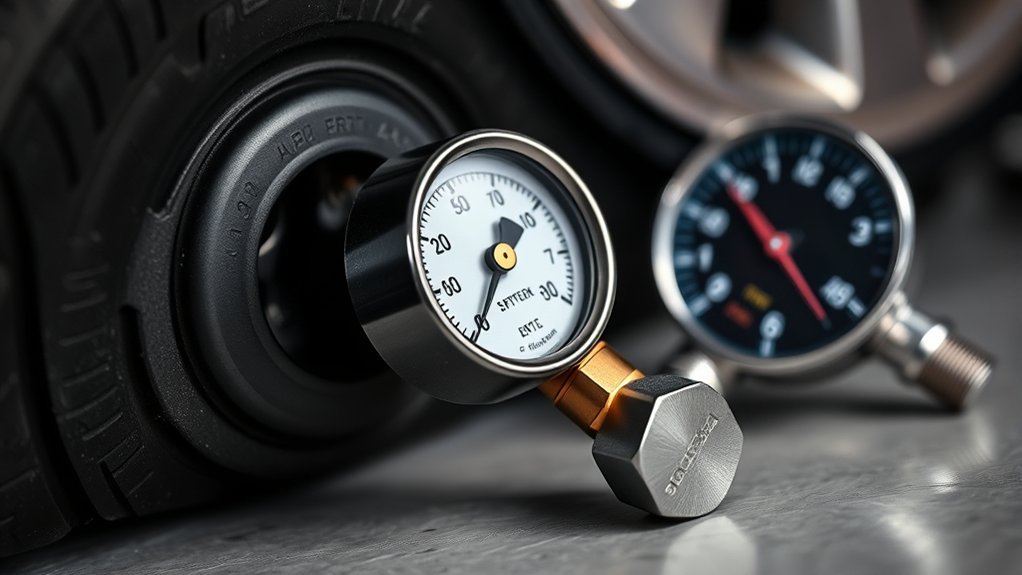
A tire pressure gauge works by sealing against the tire valve stem, sensing the air pressure inside the tire, and showing that pressure as PSI, bar, or kPa. The reading you see is gauge pressure, which means pressure above the surrounding atmosphere. Once you understand that basic idea, it becomes much easier to choose the right gauge, use it correctly, and avoid false readings.
Quick Answer
A tire pressure gauge measures PSI by sealing to the valve stem and letting tire air act on a sensing part. Analog gauges use mechanical movement, while digital gauges use an electronic pressure sensor. For the most accurate result, check cold tires and compare the reading with the vehicle placard, not the tire sidewall maximum.
Key Takeaways
- Tire gauges read gauge pressure, which is pressure above local atmospheric pressure.
- Dial gauges usually use a Bourdon tube or diaphragm, while pencil gauges use a sliding piston and marked rod.
- Digital gauges use an electronic pressure sensor and display the result on a screen.
- A good digital gauge is often easier to read, but either digital or analog can be accurate if it is well made and maintained.
- Check tires cold, seat the gauge squarely on the valve stem, and use the pressure listed on your vehicle’s door label or owner’s manual.
At a Glance
| Time Required | About 5 minutes for all four tires |
| Difficulty | Easy |
| Tools Needed | Tire pressure gauge, valve cap, and air source if pressure is low |
| Cost | Usually low; varies by gauge type, build quality, and features |
How Tire Gauges Measure Pressure
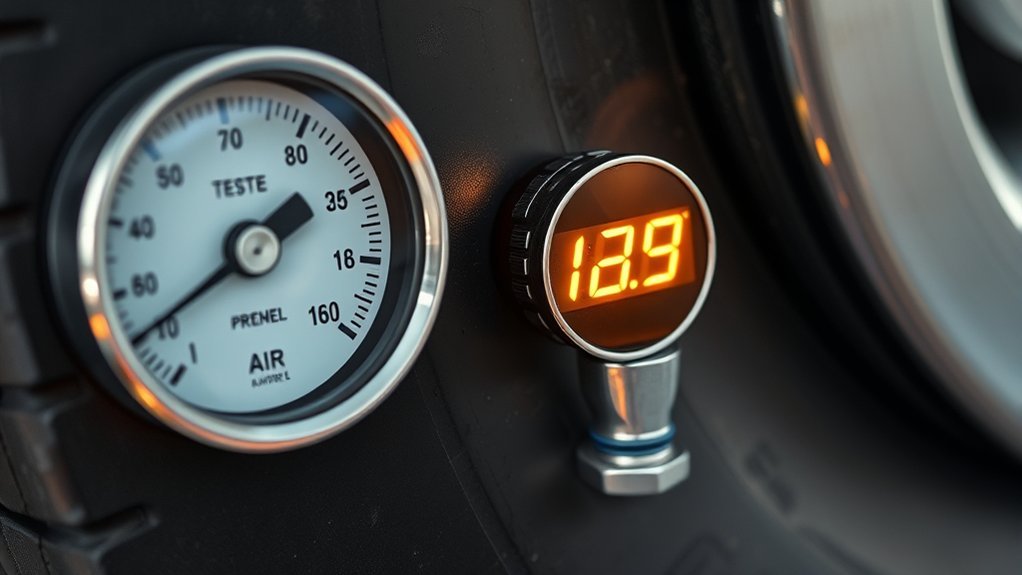
Tire gauges measure the force of compressed air inside the tire. When you press the gauge straight onto the valve stem, the gauge briefly opens the valve and creates a seal. That lets tire pressure act on the gauge’s sensing part.
The reading is usually shown in PSI, or pounds per square inch. Many gauges also show bar or kPa. In everyday tire care, you compare that number with the cold tire pressure listed by the vehicle maker.
A tire gauge reads gauge pressure, also called PSIG. That means it reads pressure above the surrounding air, not total absolute pressure. Physics texts describe tire pressure readings this way because a tire gauge reads zero at atmospheric pressure and positive when pressure is higher than atmospheric pressure. LibreTexts/OpenStax explains gauge pressure and absolute pressure in more detail.
Your tire gauge does not tell you “how much air is in the tire” by volume. It tells you the air pressure that helps the tire carry load, hold shape, manage heat, and keep proper road contact.
Before You Check: Find the Right PSI
Before you use any gauge, find the correct pressure for your vehicle. The right number is usually on the Tire and Loading Information Label on the driver’s door edge or doorjamb. You can also check the owner’s manual. NHTSA says the vehicle maker’s recommended cold tire pressure is the proper PSI or kPa for normal checking.
Warning: Do not use the maximum pressure printed on the tire sidewall as your normal target. That number is the tire’s maximum inflation limit, not the vehicle’s recommended everyday cold pressure.
If the front and rear tires have different recommended pressures, follow the label for each axle. If your vehicle uses a temporary spare, full-size spare, trailer tire, or non-original tire size, check the owner’s manual or a qualified tire professional before inflating.
Analog vs. Digital Tire Gauges
Analog and digital tire gauges do the same job, but they show the result in different ways. Analog gauges use mechanical movement. Digital gauges use an electronic sensor and a screen.
| Gauge Type | How It Works | Best For | Tradeoff |
|---|---|---|---|
| Dial analog | Uses a Bourdon tube, diaphragm, or similar mechanical element to move a needle. | Garage use, repeated checks, and readers who like a large dial. | Harder to read in low light unless it has a large face or glow markings. |
| Pencil analog | Uses tire pressure to push a sliding rod out of the gauge body. | Glove box storage and quick roadside checks. | Small markings can be harder to read accurately. |
| Digital | Uses an electronic pressure sensor and shows the value on a screen. | Fast reading, low-light use, and switching between PSI, bar, or kPa. | Needs a working battery. |
Digital gauges are often easier to read because the screen gives you a direct number. Analog gauges are simple, battery-free, and durable. Accuracy depends more on gauge quality, condition, range, and calibration than on the label “digital” or “analog” alone.
[Products Worth Considering]

Measure tire tread depth quickly and accurately with this LUMITECO dial gauge that reads in 1/32" increments up to 14/32". The color-coded green/yellow/red zones make it easy to judge tire wear and know when replacement is needed. A rugged, compact design with a protective pouch helps keep the gauge ready for use on cars, trucks, motorcycles, and more.
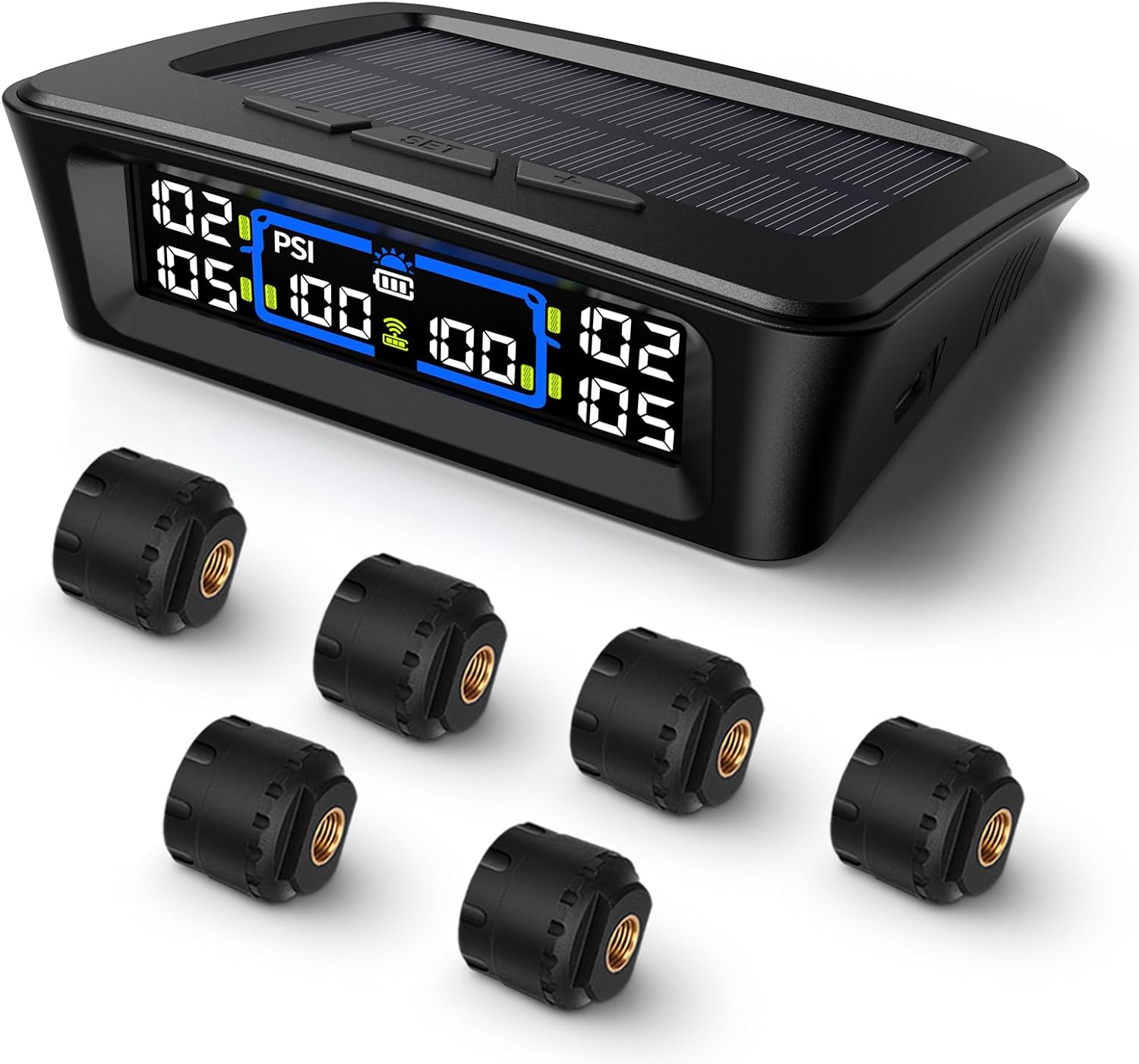
The Tymate TM12 RV TPMS delivers real-time tire pressure and temperature monitoring with a stable 433Hz display for safer long-distance driving. It supports simultaneous monitoring across vehicle and trailer zones, includes six alarm modes for pressure, temperature, leakage, battery, and signal loss, and features easy DIY installation with auto calibration. Power is supplied via USB-C charging or solar recharging, with a wide 0–144 PSI range and up to 50 ft signal coverage for RVs and towable trailers.

Milton S-921 pencil tire pressure gauge helps you maintain optimal tire pressure for passenger cars with accurate readings in PSI and kPa. It features a built-in deflator valve for convenient pressure adjustments, plus a single chuck head and nylon indicator bar for easy use on the go. Built from durable plated brass and designed for reliable performance, it’s a practical road trip and cold-weather maintenance tool.
How Analog Tire Gauges Work
An analog tire gauge turns air pressure into mechanical movement. When tire air enters the gauge, it pushes against an internal part. That movement then moves a needle, rod, or scale so you can read the pressure.
Bourdon Tube Mechanics
A Bourdon tube gauge uses a curved, hollow metal tube. One end receives pressure from the valve stem, while the other end is closed and connected to a linkage. As pressure rises, the tube tries to straighten. That small movement moves the pointer across the dial.
Bourdon gauges are common in many pressure-measuring tools. WIKA describes Bourdon tube gauges as mechanical instruments used for gauge-pressure measurement and notes that they work without supply voltage.
| Part | Function | Result |
|---|---|---|
| Inlet | Connects to the valve stem | Tire pressure enters the gauge |
| Curved tube | Flexes as pressure rises | Mechanical movement begins |
| Pointer | Converts movement into a dial reading | You read PSI, bar, or kPa |
Pencil Gauge Operation
A pencil gauge uses a simple piston-and-spring design. When you press it onto the valve, air pressure pushes the internal piston and extends a marked rod. You read the pressure at the point where the rod stops.
Pencil gauges are compact and easy to keep in a glove box. Their main weakness is readability. The markings are small, and a slight angle or quick glance can cause a reading error. Keep the gauge clean and dry, and follow the maker’s instructions if the sliding rod sticks.
Bourdon Tube vs. Pencil Gauges
Bourdon tube gauges and pencil gauges both measure tire pressure, but they suit different habits. A Bourdon-style dial gauge gives you a larger face and often feels steadier for repeated checks. A pencil gauge is lighter and simpler to carry.
| Feature | Bourdon / Dial Gauge | Pencil Gauge |
|---|---|---|
| Reading style | Needle on a dial | Sliding marked rod |
| Portability | Good, but bulkier | Excellent |
| Low-light use | Depends on dial size and markings | Usually harder |
| Best use | Home garage checks | Quick backup gauge |
How Digital Tire Gauges Work
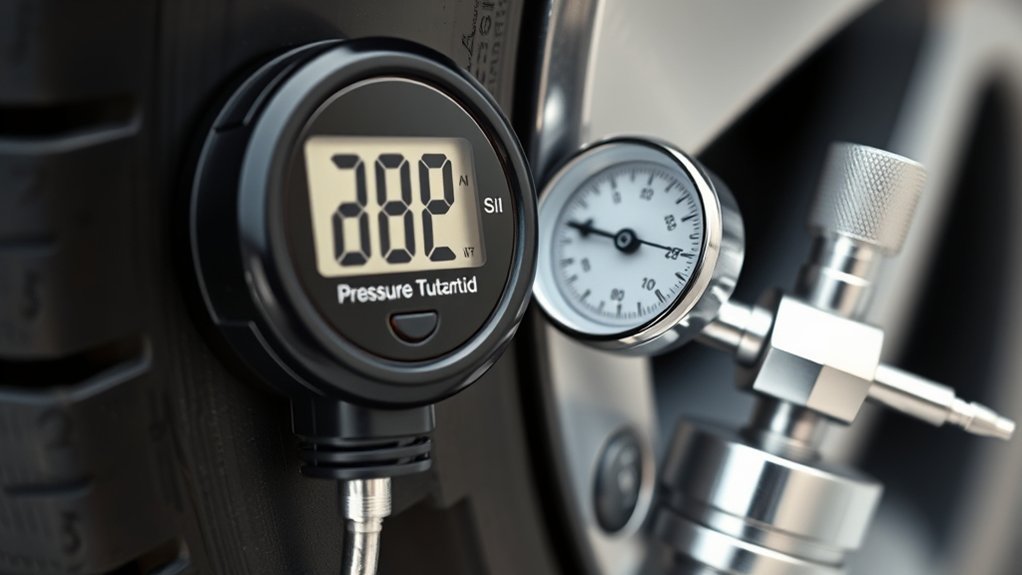
A digital tire gauge uses an electronic pressure sensor instead of a mechanical pointer. When you press the gauge onto the valve stem, the sensor detects pressure and sends an electrical signal to a small processor. The gauge then shows the result on a digital display.
Digital Sensor Function
The sensor inside a digital tire gauge responds to pressure changes. The electronics convert that response into a number you can read. Better digital gauges may include a backlit display, auto shut-off, pressure hold, or unit switching between PSI, bar, and kPa.
Battery condition matters. If the display fades, resets, or gives inconsistent readings, replace the battery and compare the gauge with a reliable reference gauge before trusting it again.
Display and Readout
The main advantage of a digital gauge is readability. You do not need to judge a needle position or line up a small rod. You press the gauge firmly, wait for the reading to stabilize, and record the number.
Digital gauges are especially helpful at night or in a dim garage. A backlit screen can reduce misreads, and a pressure-hold feature can let you move the gauge away from the valve before reading it.
Which Tire Gauge Is More Accurate?
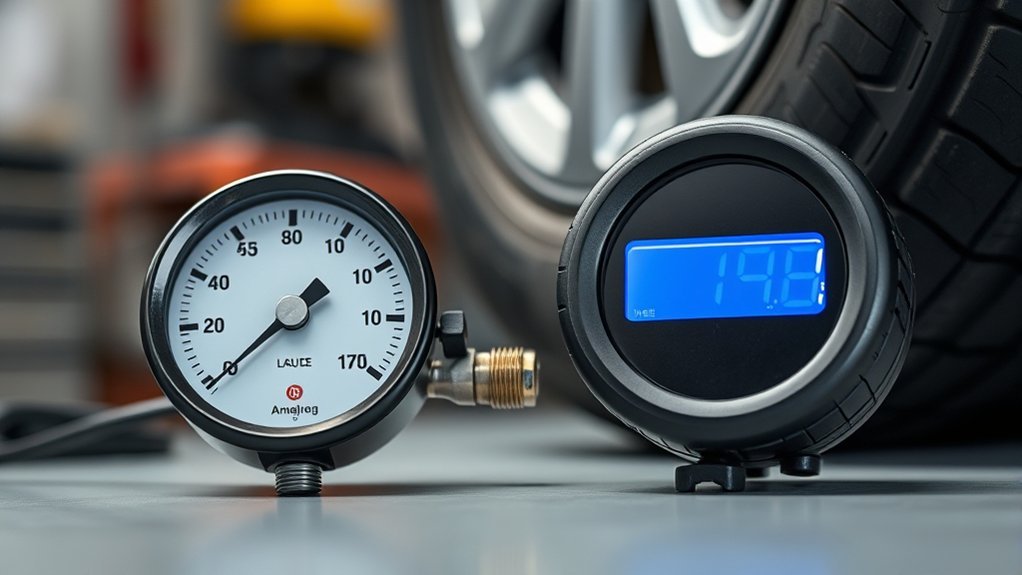
No gauge type is automatically accurate forever. A high-quality digital gauge can be very easy to read and consistent, but a well-built dial gauge can also be dependable. A cheap or damaged gauge of either type can be wrong.
For real-world use, judge a gauge by these factors:
- Range: Choose a gauge that comfortably covers your tire pressure. A normal passenger car gauge may not be enough for high-pressure truck, RV, or trailer tires.
- Readability: Choose markings or a screen you can read without guessing.
- Repeatability: The gauge should give nearly the same result when you check the same cold tire twice in a row.
- Condition: Dirt, moisture, weak batteries, bent parts, or a damaged chuck can cause bad readings.
- Reference check: Compare your gauge with a trusted shop gauge or another known-good gauge if readings seem unusual.
If you want the easiest reading, choose digital. If you want a battery-free tool, choose analog. If you want a backup for the glove box, keep a pencil gauge, but check it against a better reference now and then.
[Products Worth Considering]
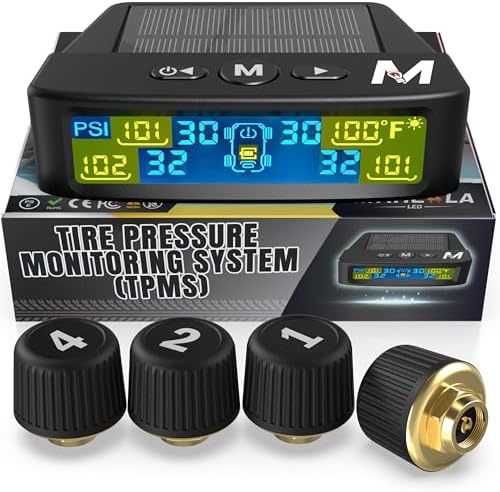
Marcala’s TPMS set of four sensors helps you monitor tire pressure and temperature in real time while driving, with updates every second. The bright color LCD uses auto-dimming for easy viewing, powered by dual solar and USB charging, and offers six alarm modes. Built for trailers, RVs, campers, trucks, and towing setups, the sensors support monitoring 1-4 wheels up to 98 PSI with IP67 waterproof protection.

The TYAMATE TM8 solar-powered wireless TPMS delivers real-time tire pressure and temperature monitoring with six alarm modes for safer driving. A vibrant color LCD display shows readings clearly while windshield mounting keeps it hands-free and easy to read. With a wide 0–87 PSI range, strong 433.92 MHz signal transmission, and quick sensor pairing, it’s ideal for RV, sedan, SUV, MPV, and truck use.
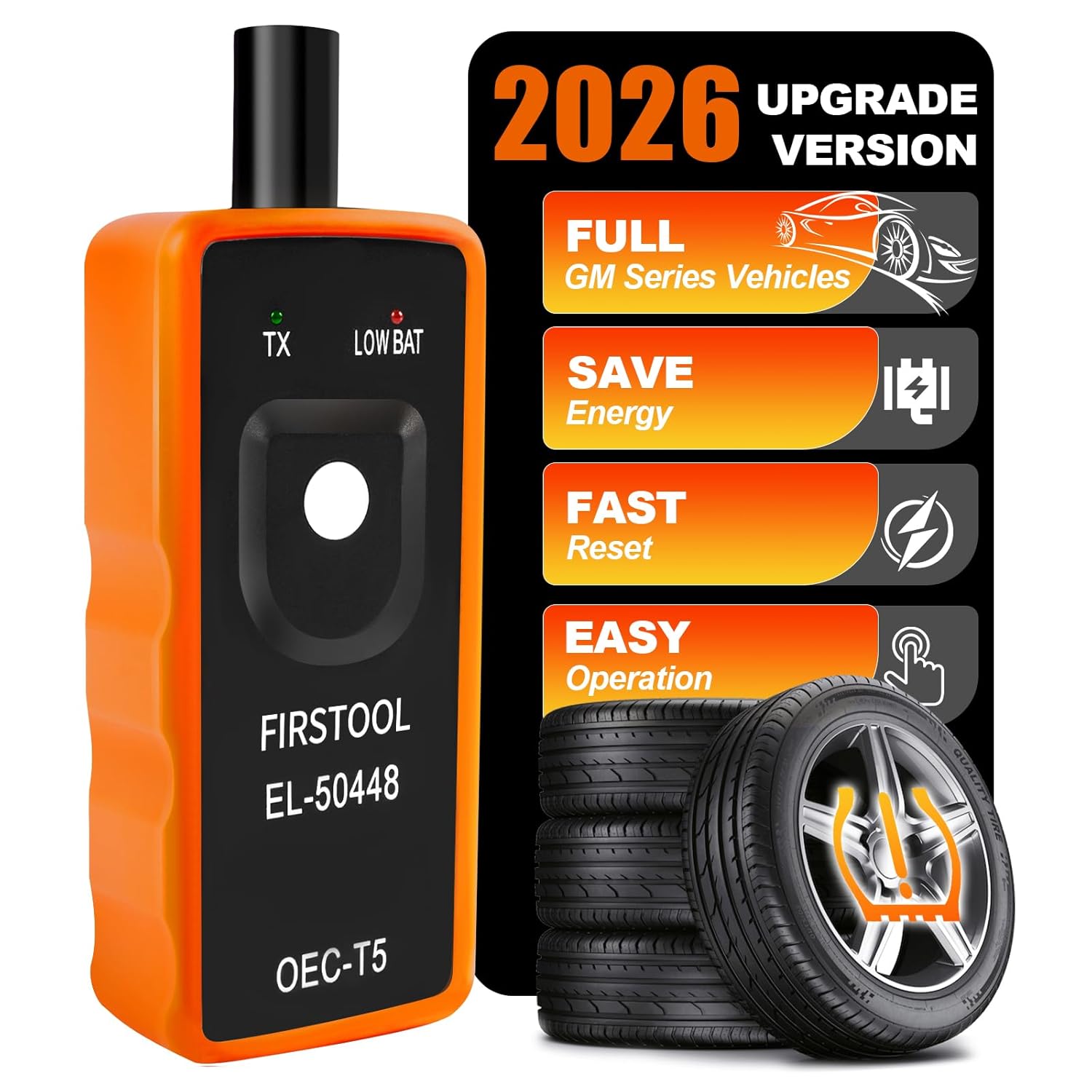
This TPMS relearn tool helps you quickly activate, match, and reset GM tire pressure sensors to keep the vehicle monitoring system working properly. It clears tire pressure alarms and dashboard warning lights after sensor replacement or tire rotation, and supports learning for common 315/433 MHz TPMS sensors. Designed for simple one-button operation, it can help you avoid unnecessary trips to repair shops.
How to Use a Tire Pressure Gauge Correctly
The basic process is simple, but technique matters. A poor seal can leak air and give a false low reading.
- Check tires cold. NHTSA recommends checking tire pressure when the tires are cold, meaning the vehicle has not been driven for at least three hours.
- Find the recommended PSI. Use the driver’s door label, owner’s manual, or vehicle maker’s online manual. Toyota also points drivers to the door jamb sticker and owner’s manual for the correct pressure specification.
- Remove the valve cap. Put it in your pocket so it does not roll away.
- Press the gauge straight onto the valve stem. Use firm, even pressure. If you hear a long hiss, reseat the gauge and try again.
- Read the number. On a dial gauge, look straight at the needle. On a pencil gauge, read the marked rod. On a digital gauge, wait for the screen to stabilize.
- Compare with the placard pressure. Add air if the tire is low. Release small amounts of air if it is high.
- Recheck after adjusting. Confirm the pressure before replacing the valve cap.
- Repeat for all tires. Check the spare too, if your vehicle has one.
Pro Tip: Check pressure before a long trip, before carrying a heavy load, and whenever outdoor temperature changes sharply. Tire pressure can change by about 1 PSI for every 10°F change in ambient temperature, according to Bridgestone tire inflation guidance.
How Elevation Affects Tire Pressure Readings
Elevation can affect a gauge reading because the gauge compares tire pressure with local atmospheric pressure. As you climb to higher altitude, atmospheric pressure drops. If tire temperature and air amount stayed the same, the gauge pressure could read slightly higher because the outside reference pressure is lower.
Elevation and PSI
At sea level, standard atmospheric pressure is about 14.7 psia. At 9,000 feet, it is about 10.5 psia in a standard atmosphere table. At 10,000 feet, it is about 10.1 psia. Engineering ToolBox provides an altitude and atmospheric pressure table with these values.
For everyday drivers, this does not mean you should chase pressure numbers every time you go up or down a mountain. Temperature changes, recent driving, tire load, and placard pressure matter more for routine maintenance.
Temperature vs. Altitude
Temperature often causes the more noticeable tire-pressure change. Cold air lowers tire pressure, while warm air raises it. That is why “cold tire pressure” means before driving and before the tire heats up from road use.
If you drive to a higher elevation and the tires are warm, the gauge may show a higher number for more than one reason. The tire warmed up during driving, and the surrounding atmospheric pressure may also be lower. Wait for a cold reading when practical before making final adjustments.
Adjusting for Altitude
Use the vehicle maker’s recommended cold pressure where the vehicle is parked and used. If you live at high altitude, check your tires cold at that location and follow the door label. If you are only passing through mountain roads, do not bleed warm tires just because the reading rose after driving.
Note: A small altitude-related change is normal. A large sudden drop usually points to a leak, valve problem, puncture, or measurement error rather than elevation alone.
Why Tire Gauges Give Bad Readings
A tire gauge can give a bad reading when the tool, tire valve, or technique is off. The most common problem is a poor seal at the valve stem. If air hisses out while you check, the gauge is not seated correctly.
- Poor seal: The gauge is angled or not pressed firmly enough onto the valve.
- Warm tires: Driving heats the tire and raises pressure, so the reading will not match the cold placard number.
- Dirty valve stem: Dirt, corrosion, or moisture can interfere with the seal.
- Gauge damage: Dropping a dial gauge or crushing a pencil gauge can affect movement.
- Weak battery: A digital gauge with low power may display inconsistent numbers.
- Wrong range: A gauge used near the top of its scale may be harder to read accurately.
If one tire reads far lower than the others, recheck it. If the second reading confirms the drop, inspect for a nail, valve leak, sidewall damage, or wheel issue. Do not ignore a tire that keeps losing pressure.
TPMS vs. Tire Pressure Gauge
A Tire Pressure Monitoring System, or TPMS, is helpful, but it does not replace a handheld gauge. NHTSA says TPMS warns you when tire pressure is significantly underinflated, and it still recommends monthly pressure checks with an accurate gauge.
TPMS may not warn you when every tire is slightly low, and some systems do not display exact tire pressure. Use TPMS as a warning system, not as your only maintenance method.
If the TPMS light turns on, check all tires as soon as you safely can. If the light flashes and then stays on, your vehicle may have a TPMS malfunction. Check your owner’s manual and schedule service if needed.
How to Choose Between Tire Gauges
Choose a tire gauge based on how and where you will use it. A simple glove-box backup has different needs than a garage gauge you use every week.
- Choose a digital gauge if you want a clear screen, backlight, unit switching, and fast readings.
- Choose a dial gauge if you want a battery-free tool with a larger display than a pencil gauge.
- Choose a pencil gauge if you want a small, inexpensive backup that stores easily.
- Choose a higher-pressure gauge if you service truck, RV, trailer, or commercial tires that require more PSI than passenger tires.
- Choose a bleeder-style gauge if you often need to lower pressure precisely after adding too much air.
The best gauge is the one you can read clearly, use confidently, and check against a reliable reference when something seems off.
[Products Worth Considering]

Get precise tire readings with the ETENWOLF T300 Plus digital gauge, calibrated to ANSI B40.7 Grade 2A for reliable accuracy. It measures across a wide 3–200 PSI range and includes thermal compensation for dependable performance from extreme cold to heat. The bright LED display, LED illumination, and replaceable AAA batteries make it easy to check pressures quickly, even in low light.

AstroAI’s heavy-duty digital tire pressure gauge delivers quick, accurate readings with 0.1 increments and a secure valve-stem seal. It features a green backlit LCD and built-in flashlight for easy use in low light, plus an ergonomic non-slip stainless-steel design. The wide 0–230 PSI range works across common vehicle tires, with unit selection and an auto shut-off to save battery.

AstroAI’s digital tire pressure gauge with inflator helps you quickly check, inflate, and deflate tires with an easy lock-on chuck and integrated bleed valve. It delivers calibrated accuracy within 1% for a clear PSI readout from 3 to 250 PSI, supporting dependable tire maintenance. Designed for many vehicle types, it connects to common compressor outputs and standard Schrader valves.
When to Replace or Verify Your Tire Gauge
Replace or verify your gauge if it gives inconsistent readings, leaks at the chuck, sticks, shows a cracked display, has a bent rod, or no longer matches another trusted gauge. A gauge that has been dropped hard may also need checking.
For a quick home test, check the same cold tire three times in a row. The readings should be very close. If they jump around, the gauge, valve stem, or your technique needs attention.
Frequently Asked Questions
Is 40 PSI too high for a tire that calls for 35 PSI?
Usually, yes. If the vehicle placard calls for 35 PSI cold, a cold reading of 40 PSI is above the recommended pressure. Recheck with a reliable gauge, then bleed air down to the placard pressure. Do not judge pressure by the tire sidewall maximum.
How do I know if my tire gauge is accurate?
Compare it with a trusted shop gauge or another known-good gauge on the same cold tire. If your gauge is consistently off by more than a small amount, replace it or have it checked. Also replace weak digital-gauge batteries before judging accuracy.
What PSI should RAV4 tires be?
Many Toyota RAV4 models use a cold tire pressure around the mid-30 PSI range, but you should not guess. Check the driver’s door label, owner’s manual, or Toyota’s online manual for your exact model year, tire size, and trim.
What PSI should Kia Telluride tires be?
Many Kia Telluride trims use a cold pressure around 35 PSI, but the correct number depends on the model year, tire size, and load information. Use the driver’s door placard or owner’s manual for the exact pressure.
Is a digital tire gauge better than an analog gauge?
A digital tire gauge is often easier to read, especially in low light. An analog gauge is simpler and does not need batteries. Either type can work well if it is made well, kept clean, and checked against a reliable reference.
Can I trust my TPMS instead of checking with a gauge?
No. TPMS is a warning system, not a replacement for routine pressure checks. Use a gauge at least monthly and before long trips, and check pressure right away if the TPMS light turns on.
Conclusion
A tire pressure gauge works by turning tire air pressure into a readable number. Dial and pencil gauges do it mechanically, while digital gauges use an electronic sensor and screen. The most important step is not choosing the fanciest gauge. It is using a reliable gauge correctly on cold tires and matching the reading to your vehicle’s recommended pressure.
Check all tires monthly, keep the gauge clean, and do not rely on the tire sidewall maximum or TPMS alone. With a simple routine, you can improve tire wear, handling, fuel use, and safety without guessing.
Sources
- NHTSA TireWise — cold tire pressure checks, tire placard guidance, TPMS limitations, and tire safety basics.
- Toyota: How To Check Tire Pressure — door-jamb sticker, owner’s manual guidance, and effects of underinflation.
- WIKA: Bourdon Tube Pressure Gauge — Bourdon tube gauge operation and mechanical gauge-pressure measurement.
- LibreTexts/OpenStax: Gauge Pressure and Absolute Pressure — gauge pressure definition and tire-gauge pressure explanation.
- Engineering ToolBox: Atmospheric Pressure vs. Elevation — atmospheric pressure values by altitude.
- Bridgestone: Proper Tire Inflation — temperature effects on tire pressure and tire-pressure checking guidance.

