
Quick Answer
Current U.S. estimates for replacing one direct TPMS sensor vary widely: RepairPal lists $240–$299, while Kelley Blue Book lists $314–$368. RepairPal breaks its estimate into $164–$187 for parts and $77–$112 for labor. A separate relearn, if billed separately, averages $49–$71. Taxes, fees, location, vehicle, and sensor choice can change the bill.
Last checked: October 5, 2026. Dates and figures were verified against official and established industry sources.
Key Takeaways
- A solid TPMS warning light usually means you should check tire pressure first; a light that flashes for 60–90 seconds and then stays on can indicate a system malfunction.
- Direct TPMS uses pressure sensors in the wheels. Indirect TPMS estimates pressure from wheel-speed and other vehicle data, so there is no wheel-mounted pressure sensor to replace.
- A sensor quote may include a service kit, diagnostics, mounting work, programming, relearning, balancing, shop supplies, taxes, or other local fees.
- Programming a blank universal sensor and relearning a sensor ID to the vehicle are different jobs, so ask which services your quote includes.
- Direct TPMS sensors commonly reach battery end-of-life after roughly five to ten years, although actual life varies by sensor and use.
[Products Worth Considering]

The VEHLIVE SU-50448 II TPMS relearn tool provides a fast activation reset to restore accurate tire pressure monitoring after sensor replacement or tire rotation. It supports 315 MHz and 433 MHz GM series sensors and helps clear dashboard pressure warnings. With simple two-button operation and horn-confirmed relearning order, you can reprogram sensors conveniently at home.

This TPMS relearn tool helps you quickly activate, match, and reset GM tire pressure sensors to keep the vehicle monitoring system working properly. It clears tire pressure alarms and dashboard warning lights after sensor replacement or tire rotation, and supports learning for common 315/433 MHz TPMS sensors. Designed for simple one-button operation, it can help you avoid unnecessary trips to repair shops.

The AICEL TPMS relearn tool helps you quickly reset or relearn tire pressure sensors after replacement, tire rotation, or resolving tire pressure alarms. It provides an activation reset function so your vehicle’s TPMS can operate optimally, saving time and money on frequent visits to an auto shop. Designed for easy use on most vehicles, it works by placing the tool near the valve stem and using the learn button.
Tire Sensor Cost Breakdown
For a standalone one-sensor replacement, current published estimates are not identical. RepairPal’s September 3, 2026 estimate is $240–$299, while Kelley Blue Book currently shows $314–$368.
RepairPal separates its estimate into $164–$187 for parts and $77–$112 for labor. It also says the range excludes taxes and fees and does not account for your location. That is why an itemized local quote matters more than a national average.
| Cost item | Published estimate | What it means |
|---|---|---|
| RepairPal total | $240–$299 | Average TPMS sensor replacement estimate; taxes, fees, and location differences excluded |
| RepairPal parts | $164–$187 | Parts portion of its replacement estimate |
| RepairPal labor | $77–$112 | Labor portion of its replacement estimate |
| Kelley Blue Book total | $314–$368 | Its current average replacement range |
| Separate relearn | $49–$71 | RepairPal average when a relearn is priced as its own service |
Treat national estimates as a benchmark, not a guaranteed shop price. Your vehicle, sensor, location, and included services can move the total.
What Drives Tire Sensor Costs?
The biggest cost drivers are the type of TPMS, the sensor itself, your vehicle, and the service required after installation. The first distinction matters because direct and indirect systems are fundamentally different.
According to NHTSA’s TireWise guidance, direct TPMS uses sensors located in the tires, while indirect TPMS relies on wheel-speed and other vehicle data. That means an indirect system does not have a wheel-mounted pressure sensor that you replace as a normal TPMS sensor job.
On a direct system, OEM and aftermarket options can differ in price and setup. A compatible aftermarket sensor may reduce the parts cost, but compatibility still has to match the vehicle. Universal sensors may also need programming before the vehicle can use them.
Vehicle design changes the labor too. A technician generally has to remove the wheel, separate the tire from the wheel enough to access the sensor, install the replacement, restore the tire, set pressure, and complete any required setup.
Sensor age can also change the decision. HELLA says TPMS sensors usually need replacement after about five to ten years when the internal battery is used up, though the actual life depends on the sensor and operating conditions.
Hidden Fees to Watch For
The sensor may be only one line on the invoice. Extra charges can be legitimate, but you should know what each one covers before you approve the work.
A common add-on is valve and sealing hardware. Schrader’s TPMS service-kit guidance lists parts such as valve stems, valve cores, caps, grommets, nuts, and screws depending on the sensor design, and recommends replacing the appropriate service-pack components when the tire is removed.
- Diagnostic fee: covers testing the warning light, checking sensor communication, or identifying which sensor has failed.
- Service kit or valve hardware: may cover seals, valve cores, stems, caps, nuts, or related one-time-use parts.
- Mounting or balancing: may be included in the sensor labor or billed separately, depending on the shop and the work performed.
- Programming or relearning: can appear as a separate line if the sensor or vehicle requires extra setup.
- Shop supplies, disposal, and taxes: may appear on some invoices and are shop- or location-specific.
Ask whether the quoted total is out-the-door or whether taxes and fees will be added later. Also ask whether the shop is replacing only the failed sensor or adding valve hardware, balancing, diagnostics, or relearn work.
Programming and Relearning Costs
Programming and relearning are not the same service. Programming prepares a blank programmable sensor for a specific vehicle, while relearning tells the vehicle which sensor ID or wheel position it should recognize.
Schrader explains the programming-versus-relearning difference: a blank universal sensor must first receive the correct vehicle protocol, and a new sensor ID then has to be recognized by the vehicle when the application requires it.
If a shop bills a relearn separately, RepairPal’s September 3, 2026 estimate is $49–$71, excluding taxes, fees, and location differences. Some shops may include this step with sensor replacement, so ask before comparing quotes.
| Task | Typical Impact | Your Move |
|---|---|---|
| Sensor programming | May be needed for a blank universal sensor | Ask whether programming is included |
| Vehicle relearn | Registers the sensor with the vehicle | Confirm whether it is included or separate |
| Sensor compatibility | Wrong applications may not communicate correctly | Verify the exact part number for your vehicle |
| Diagnostics | Finds communication or system faults | Ask whether the fee applies toward the repair |
Warning: Do not assume a TPMS light automatically means the sensor is dead. A steady light can mean low tire pressure. NHTSA says a TPMS malfunction on 2008-and-newer vehicles may appear as a light that flashes for 60–90 seconds and then remains illuminated.
[Products Worth Considering]

Replace worn or missing TPMS sensors with a pre-programmed 4-pack designed for compatible GM vehicles. These 315MHz sensors provide real-time tire pressure monitoring and alert you if pressure is too high, too low, or if a rapid air leak occurs. Most installations are ready with minimal relearn effort after mounting, helping improve safety and driving confidence.
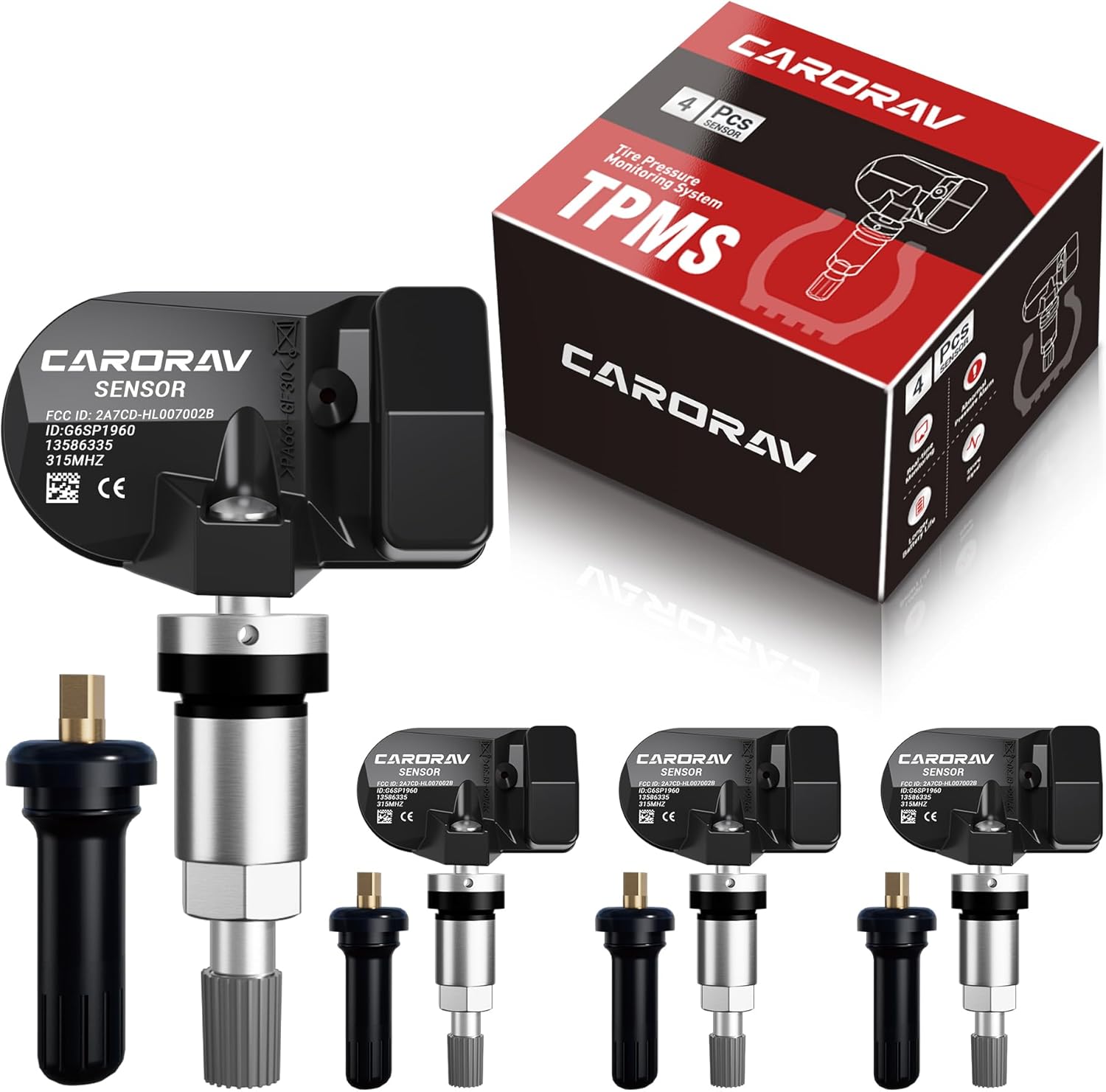
Replace worn or missing TPMS sensors with CARORAV pre-programmed GM-compatible sensors for a smoother installation experience. These 315MHz replacement sensors help monitor tire pressure in real time with long battery life, and they are designed to withstand harsh temperatures. Manual or OBDII relearn may be required to reset the system for proper recognition.

Masoll Gen 2 external TPMS sensors are a DIY replacement set of 4 for select GM vehicles made after 2006, helping you shut off the TPMS warning light quickly. Simply screw the sensors onto the tire valves and sync to your car ECU using the included EL-50448 relearn tool. Dual-frequency 315/433 MHz design provides OEM-level performance with accurate readings and replaceable batteries for about two years.
Repair vs. Replacement
A failed electronic sensor usually means replacement, but a leak or damaged valve component does not always require a new sensor body. The correct repair depends on whether the electronic sensor still communicates and whether the problem is limited to serviceable valve hardware.
If the sealed sensor battery has reached the end of its life or the electronics have failed, replacing the sensor is usually the practical fix. If the sensor still works but the valve stem, grommet, core, nut, or cap is damaged or corroded, the shop may be able to service those parts instead.
Do not replace all four sensors automatically just because one fails. However, if all four are original and similar in age, ask the shop to test the remaining sensors and quote both one-sensor and multi-sensor options. That lets you compare the cost of one repair now with the possibility of repeated tire-removal labor later.
Treat the sensor and its valve hardware as separate questions: the electronics may need replacement even when some sealing components are serviceable.
How to Get a Fair Quote
A fair quote tells you exactly what part is being installed and which services are included. Compare at least three estimates when possible, but compare the same scope of work rather than just the bottom-line number.
Ask the shop for the sensor brand and part number, whether it is OEM or aftermarket, whether valve hardware is included, and whether programming or relearning is part of the price. If the warning light has not been diagnosed yet, ask whether diagnostic time is included or billed separately.
| Quote Item | What to Check | Why It Matters |
|---|---|---|
| Parts | Brand, part number, OEM or aftermarket | Confirms compatibility and what you are paying for |
| Labor | Tire removal, installation, and balancing | Shows whether wheel service is bundled or separate |
| Extras | Diagnostics, valve kit, programming, relearn, taxes, fees | Prevents surprise charges at checkout |
If one sensor failed sooner than expected, also ask whether the sensor or earlier installation is still under warranty. A written, itemized estimate makes it much easier to compare shops fairly.
Frequently Asked Questions
How Long Do Tire Sensors Usually Last?
Direct TPMS sensors often last about five to ten years before the internal battery is exhausted. The exact life varies by sensor design, driving conditions, and use. Because the battery is commonly sealed into the sensor assembly, a dead battery often means replacing the complete sensor.
Can I Drive With a Broken Tire Sensor?
You may still be able to drive, but a failed sensor means you cannot rely on TPMS to warn you about pressure loss in that wheel. Check tire pressure manually and arrange diagnosis soon. If a tire is visibly damaged, rapidly losing air, or unsafe to drive on, treat the tire problem as the priority.
Are Aftermarket Tire Sensors Reliable?
Aftermarket TPMS sensors can be a reasonable option when they are built for your vehicle and programmed correctly. Compatibility matters more than simply choosing the cheapest sensor. Ask for the brand and exact part number, and confirm that the shop can program and relearn that sensor for your year, make, and model.
Do All Vehicles Use the Same Sensor Type?
No. Some vehicles use direct TPMS with a pressure sensor in each wheel, while others use indirect TPMS and infer pressure from wheel-speed or other vehicle data. Direct replacement sensors can also differ by vehicle application, so match the sensor to the exact year, make, and model before installation.
Will a Dead Sensor Turn on the Warning Light?
A dead direct TPMS sensor can trigger a system-malfunction warning. On 2008-and-newer vehicles, NHTSA says a malfunction may appear as the TPMS light flashing for 60–90 seconds and then staying illuminated. A solid light can also indicate low tire pressure, so check pressure before assuming the sensor has failed.
Does a New TPMS Sensor Need to Be Relearned?
Many direct TPMS applications require the vehicle to recognize the new sensor ID after replacement, but the exact procedure depends on the vehicle and sensor. A blank universal sensor may also need programming first. Ask the shop whether programming, relearning, or both are required and included in the quoted price.
Conclusion
A tire sensor replacement cost should make sense line by line: sensor, wheel labor, valve hardware, diagnostics, and any programming or relearn. Confirm the fault first, then compare itemized quotes with the same parts and services so the cheapest-looking estimate does not become the most expensive at checkout.
Sources
- RepairPal TPMS Sensor Replacement Cost Estimate: 2026 replacement, parts, and labor estimates.
- Kelley Blue Book TPMS Sensor Replacement Cost: current average replacement range.
- RepairPal TPMS Relearn Cost Estimate: 2026 relearn estimate.
- NHTSA TireWise: direct and indirect TPMS basics, warning-light behavior, and tire-pressure safety guidance.
- Schrader TPMS Service Kits: service-kit components and replacement guidance.
- Schrader Programming vs. Relearning: distinction between sensor programming and vehicle relearning.
- HELLA TPMS Sensors: typical sensor replacement interval and battery-life guidance.
[Products Worth Considering]

The UYYE TPMS relearn tool helps activate and relearn tire pressure monitor sensors quickly, typically in minutes. It supports TPMS learn mode resetting using a simple three-step process: enter learn mode, position the tool near the valve stem, and press the learn button. Designed for specific GM models, it streamlines sensor programming and reduces trips to dealers or tire shops.

The Tymate TM2 RV tire pressure monitoring system keeps you informed with a color LCD display, automatic backlight, and solar charging for dependable operation. It supports up to 10 tire positions with four pre-paired sensors, while offering multiple alarm modes for fast leak detection, pressure extremes, temperature alerts, and low-signal warnings. Built-in monitoring uses accurate readings and reliable 433.92MHz communication to help protect your RV, trailer, truck, or SUV.

Replace worn or malfunctioning GM TPMS sensors with this 433MHz pre-programmed sensor set designed for compatibility with many Chevrolet, Buick, GMC, and Cadillac models. It includes guidance for proper OBDII relearning/pairing after installation and supports reliable long-term operation with a high-performance CR2032 battery. Quality tested for durability and performance to help restore accurate tire pressure monitoring.
