Choosing desert tires for a Toyota Hilux is not just about picking the most aggressive tread you can find. In soft sand, the best setup combines the right tire type, correct load rating, strong sidewalls, sensible tire size, and safe off-road tire pressure. Use your Hilux’s tire placard and owner’s manual as the starting point, then adjust for sand only when you leave the road.
Quick Answer
For most Toyota Hilux desert driving, choose a quality all-terrain tire with reinforced sidewalls, the correct load index, and a size approved for your model. For soft sand, many drivers start around 18 PSI, then lower gradually if needed. Reinflate to road pressure before driving on pavement.
Key Takeaways
- For mixed desert use, a strong all-terrain tire is usually the best balance of sand flotation, rocky-track durability, road comfort, and tread life.
- Mud-terrain tires can work well on rocky desert tracks, but very aggressive tread may dig in soft sand if pressure and throttle are wrong.
- Use low tire pressure only off-road. Airing down helps flotation, but highway driving on underinflated tires can overheat and damage them.
- Common modern Hilux tire sizes include 265/65R17 and 265/60R18, but your exact size must match your market, trim, load rating, and tire placard.
- Carry a tire pressure gauge, deflator, air compressor, shovel, and recovery boards before entering dunes or remote desert tracks.
At a Glance
| Time Required | 15–30 minutes to check tire condition and pressure before a desert trip; 5–10 minutes to air down; 10–20 minutes to reinflate after leaving sand. |
| Difficulty | Beginner to intermediate. Tire pressure adjustment is simple, but dune driving and recovery require practice. |
| Tools Needed | Accurate tire pressure gauge, tire deflator, portable air compressor, tread-depth gauge, spare valve caps, shovel, recovery boards, and a full-size spare. |
| Cost | Low for gauges and deflators, moderate for compressors and recovery gear, and high for a full tire set. Tire prices vary by size, load rating, brand, and market. |
Why Tire Selection Is Critical for Desert Driving

Desert driving creates two different tire challenges at the same time. Soft sand needs flotation, so the tire spreads the Hilux’s weight over a larger contact patch instead of digging down. Rocky tracks, gravel, and dry wadis need sidewall strength, puncture resistance, and enough tread depth to grip loose surfaces.
That is why the “best” desert tire is not always the most aggressive mud tire. A deep, open tread can help on rocks, gravel, and mixed terrain, but soft dunes usually reward smooth throttle, sensible momentum, and lower off-road pressure. BFGoodrich off-road guidance also emphasizes deflating tires a bit for sand, snow, and mud, then using steady momentum instead of wheelspin.
Heat is another major factor. Desert air, hot sand, vehicle load, speed, and underinflation all add stress to the tire casing. USTMA tire safety guidance warns that improper inflation can cause excessive heat build-up and internal tire damage, so low pressure should be treated as an off-road tool, not a highway setting.
Warning: Never drive at highway speed on aired-down desert pressures. Reinflate to the cold pressure shown on your Hilux tire placard or owner’s manual before returning to pavement.
Key Features of Toyota Hilux Off-Road Tires for the Desert
When you are choosing Toyota Hilux off-road tires for the desert, focus on the complete tire specification, not only the tread pattern. The tire must fit the wheel, carry the vehicle load, handle heat, resist cuts, and still behave safely on the road.
[Products Worth Considering]

Monitor tire tread wear with a smart, color-coded depth gauge that shows clear condition ranges at a glance. The bar is range marked for fast, easy readings, helping you maintain safer traction and performance. Each gauge is portable with a pocket clip, and the set includes 20 units for daily use and sharing.

This ALL-TOP auto-stop tire deflator valve kit lets you air down off-road tires quickly without watching pressure, automatically stopping when your preset PSI is reached. Each valve is individually calibrated for reliable performance with an acceptable +/- 2 PSI tolerance. The adjustable deflator range covers 10 to 30 PSI and includes four valves plus valve caps and a zipper pouch for easy setup on trucks, SUVs, RVs, UTVs, and powersports.
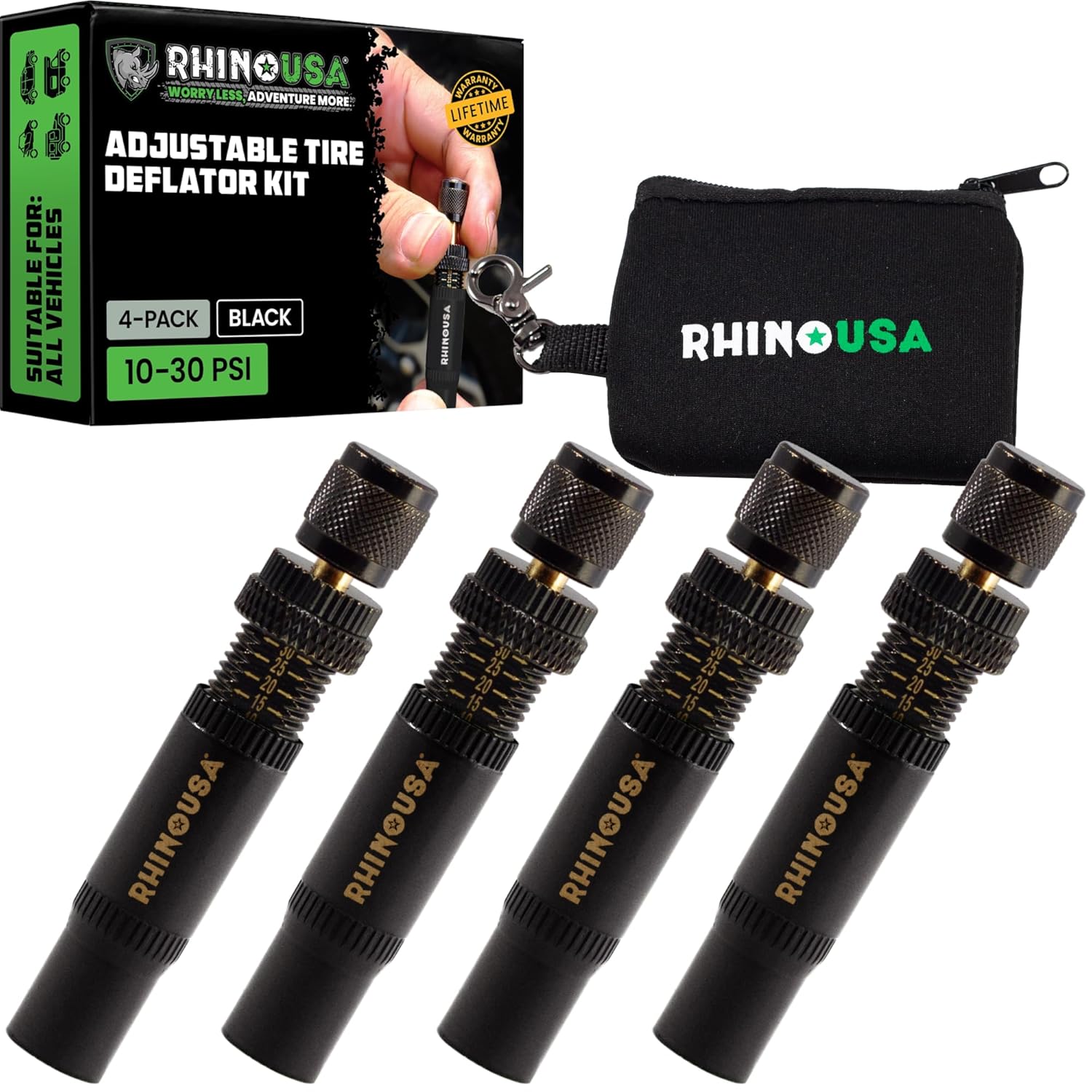
Use the Rhino USA adjustable tire deflators to air down all four tires at once by screwing one deflator onto each valve stem, letting you step away while the tires reach your preset pressure. Each deflator independently adjusts across a 10–30 PSI range with laser-etched indicators for quick setup and verification, making it ideal for beach, sand, and rocky off-road trails.
Tread Design Efficiency
For desert driving, look for tread that matches your main terrain:
- Soft dunes and beach-style sand: moderate all-terrain tread usually works well because flotation and low pressure matter more than extreme lugs.
- Rocky desert tracks: deeper tread blocks, open shoulders, and cut-resistant construction help protect against stones and sharp edges.
- Mixed road and desert use: all-terrain tires give the best balance of sand performance, highway manners, wet braking, and tread life.
- Severe off-road use: mud-terrain tires add bite and sidewall toughness, but they can be noisier, heavier, and less efficient on-road.
Durability Against Abrasion
Desert tires should resist cuts, chips, and sidewall damage. Prioritize these features:
- Reinforced sidewalls: helpful when driving near rocks, dry riverbeds, construction tracks, and thorny scrub.
- Correct load index: the tire must meet or exceed the Hilux’s required load rating, especially when carrying camping gear, tools, water, or towing equipment.
- Light truck construction where suitable: many LT-rated tires have stronger construction, but they can ride firmer and may need pressure matched carefully to load.
- Heat management: use correct pressure, avoid overloading, and reduce speed on rough tracks to limit casing temperature.
Note: The maximum pressure printed on a tire sidewall is not your normal driving pressure. For road use, start with the Hilux placard or owner’s manual, then ask a tire professional if you change tire size, load range, or wheel diameter.
Optimal Air Pressure
For soft sand, many Hilux drivers start around 18 PSI, then adjust slowly. If the vehicle still digs, lower the pressure in small steps. If the tire feels unstable, the sidewall folds heavily, or the bead is at risk of unseating, stop and add air.
A practical off-road range for many standard-wheel Hilux setups is roughly 15–20 PSI in soft sand, but the correct number depends on tire size, wheel type, vehicle weight, load, driving speed, and terrain. Heavy loads may need more pressure than an unloaded vehicle. Beadlock wheels can safely run lower pressures than standard wheels, but most daily-driven Hilux vehicles do not have beadlocks.
Pro Tip: Start at 18 PSI on soft sand, drive a short test section, then lower by 2 PSI at a time only if the Hilux is still sinking. Avoid sharp steering, sudden braking, and high-speed cornering when aired down.
Recommended Tire Types for Toyota Hilux in Desert Conditions
The best tire type depends on how your Hilux is used. A work truck that spends most of its time on highways with occasional desert weekends needs a different tire from a heavily loaded overlanding Hilux that crosses rocky tracks every month.
| Tire Type | Best For | Trade-Offs |
| All-Terrain (A/T) | Most Hilux owners, mixed road/desert driving, soft sand, gravel, and light rocky tracks. | Less aggressive than mud-terrain tires in deep ruts or very rough tracks. |
| Mud-Terrain (M/T) | Rocky desert, sharp gravel, severe off-road tracks, and drivers who prioritize durability. | Can be heavier, louder, less fuel-efficient, and may dig in soft sand if driven with too much wheelspin. |
| Highway-Terrain (H/T) | Mostly road use with very light hard-packed sand or graded tracks. | Weaker off-road grip and sidewall protection than A/T or M/T tires. |
| Hybrid Rugged-Terrain (R/T) | Drivers who want more sidewall and shoulder bite than A/T without going full M/T. | Ride, noise, and wet-road performance vary widely by model. |
Good all-terrain examples include the BFGoodrich All-Terrain T/A KO2, which BFGoodrich describes as built for off-road use on mud, sand, snow, and rocks. For more aggressive off-road traction, the Toyo Open Country M/T is a mud-terrain tire with aggressive tread and off-road-focused construction. The Goodyear Wrangler DuraTrac is another rugged off-road option often considered for trucks and 4×4 use.
Treat these as examples, not universal answers. Always confirm the correct size, load rating, speed rating, and local availability for your specific Hilux.
[Products Worth Considering]

Measure tire tread depth quickly and accurately with this LUMITECO dial gauge that reads in 1/32" increments up to 14/32". The color-coded green/yellow/red zones make it easy to judge tire wear and know when replacement is needed. A rugged, compact design with a protective pouch helps keep the gauge ready for use on cars, trucks, motorcycles, and more.

The SAFELIFE dial tire tread depth gauge measures tread depth in 1/32 inch increments with clear, easy-to-read 2-inch dial face. Color zones using a traffic light system help you quickly judge whether tread is low, marginal, or ample for safer driving. Built with a durable zinc cast body and a metal detect probe for precise, comfortable use across cars, motorcycles, trucks, and buses.

Accurately measure tire tread depth with a calibrated gauge marked from 0 to 1 inch in 1/32 inch increments. The color-coded bar helps you quickly identify tread condition ranges, supporting safe driving for trucks, motorcycles, automobiles, and passenger vehicles.
Understanding Tire Sizes for Your Hilux
Tire size affects ground clearance, gearing, speedometer accuracy, braking, steering feel, fuel use, and clearance inside the wheel wells. Before changing size, check the tire placard on your Hilux, the owner’s manual, and local vehicle modification rules.
Common Tire Sizes
Many modern Toyota Hilux 4×4 trims use sizes such as 265/65R17 and 265/60R18. Toyota Australia’s May 2026 HiLux specification sheet lists those sizes across several 4×4 grades, but exact fitment varies by country, model year, trim, body style, drivetrain, and wheel package.
Here is how to read a size such as 265/65R17:
- 265: tire width in millimeters.
- 65: sidewall height as a percentage of tire width.
- R: radial construction.
- 17: wheel diameter in inches.
Selecting Appropriate Dimensions
Wider or taller tires may improve flotation and ground clearance, but they are not automatically better. If you move beyond factory sizing, check:
- Wheel-well clearance: no rubbing at full steering lock or suspension compression.
- Wheel offset: poor offset can stress bearings and change steering geometry.
- Spare tire match: your spare should be compatible with the fitted tires.
- Load index: never fit a tire with a lower load rating than required.
- Speedometer and gearing: larger rolling diameter can affect readings and acceleration.
- Legal approval: some regions restrict tire diameter, track width, and lift changes.
Note: A tire size that fits one Hilux may rub on another because suspension, trim, wheel offset, accessories, and load all change clearance.
Maintaining Proper Tire Pressure in the Desert
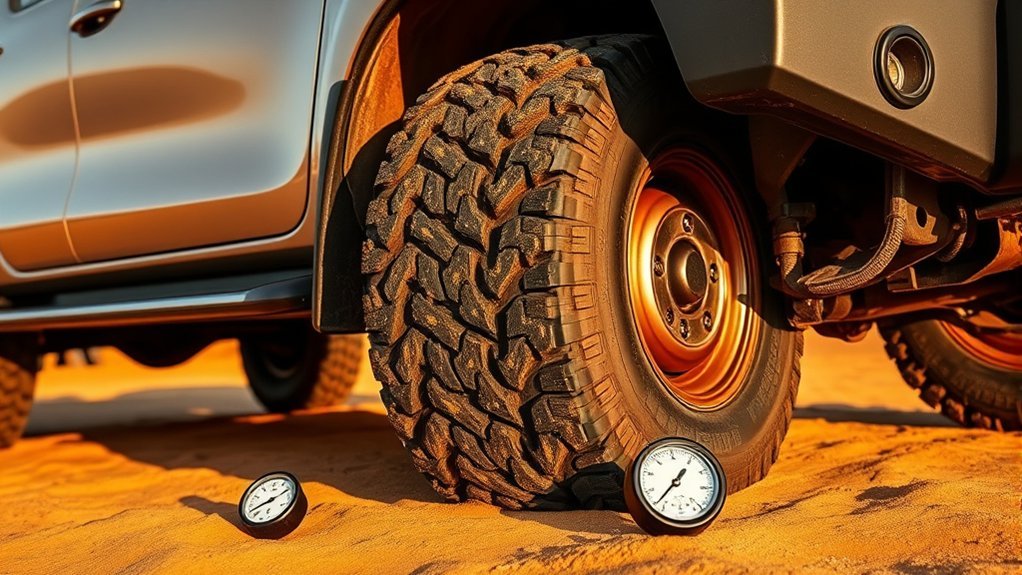
Tire pressure is the easiest desert-driving adjustment you can make. On sand, lowering pressure increases the tire footprint and helps the Hilux float instead of dig. On pavement, however, pressure must return to the manufacturer’s recommended cold setting so the tire can carry load safely and control heat.
| Terrain | Starting Pressure | Important Caution |
| Highway / paved road | Use the Hilux tire placard or owner’s manual cold pressure. | Do not use sand pressure on pavement. |
| Gravel / hard desert track | Slightly below road pressure if needed for comfort and traction. | Keep enough pressure to protect sidewalls from rock impact. |
| Soft sand | Start around 18 PSI, then lower gradually if required. | Avoid sharp turns and high speed to reduce bead-unseating risk. |
| Very soft dunes | Often 15–18 PSI on standard wheels, depending on load and tire. | Stop lowering pressure if the tire becomes unstable or the rim is poorly protected. |
How to Air Down for Sand
- Park on level ground before entering soft sand.
- Check all four tires with an accurate gauge.
- Set an initial target, such as 18 PSI for soft sand.
- Deflate each tire evenly and replace valve caps.
- Drive a short distance using smooth throttle and steady momentum.
- If the Hilux still digs, lower pressure in small steps.
- When leaving the sand, reinflate before driving fast or far on pavement.
Airing down is for flotation and traction off-road. Correct road pressure is for load support, heat control, braking, and tire life.
Essential Tire Maintenance Tips for Desert Driving
Desert driving is hard on tires even when nothing dramatic happens. Sand hides rocks, heat builds quickly, and low pressure flexes sidewalls more than normal road driving. Use this checklist before and after each trip.
Before the Trip
- Check tire pressure when the tires are cold.
- Inspect tread and sidewalls for cuts, cracking, bulges, nails, thorns, and exposed cords.
- Confirm your spare tire is inflated and usable.
- Pack a compressor, tire gauge, deflator, puncture repair kit, jack base plate, shovel, and recovery boards.
- Check that your tire load rating suits passengers, cargo, water, tools, roof racks, and towing load.
After the Trip
- Reinflate to road pressure before sustained pavement driving.
- Remove stones from tread grooves.
- Look for sidewall scuffs, cuts, and bead damage.
- Wash away sand, salt, and grit if you drove near coastal dunes.
- Rotate tires according to your Hilux manual. If no interval is specified, a general tire-industry interval is about 5,000–8,000 miles, or roughly 8,000–13,000 km.
Signs Your Tires Need Replacing?
Replace your Toyota Hilux tires before they become a desert liability. Soft sand may feel forgiving, but a damaged tire can fail suddenly when you air back up, carry load, or drive home at highway speed.
- Low tread depth: replace at the legal minimum of 1.6 mm / 2/32 inch, and consider replacing earlier for severe off-road use if wet grip, braking, or sand performance has declined.
- Sidewall damage: cracks, cuts, exposed cords, bulges, blisters, or deep scrapes are serious warning signs.
- Uneven wear: cupping, feathering, or one-sided wear may point to alignment, suspension, balance, or pressure problems.
- Repeated punctures: multiple repairs or damage near the sidewall can make a tire unsuitable for remote desert trips.
- Age and heat exposure: tires that look “fine” can harden or crack over time, especially in hot climates.
Warning: Do not ignore bulges, exposed cords, deep cuts, or bead damage. Have the tire inspected by a qualified tire professional before using it again off-road.
Best Places to Get and Install Your Desert Tires
The best place to buy desert tires for a Toyota Hilux is a shop that understands 4×4 fitment, not just tire size. Look for a retailer or installer that can check load index, speed rating, wheel offset, tire age, alignment, balancing, spare compatibility, and local modification rules.
In the UAE and similar desert markets, local retailers such as PitStopArabia and specialist 4×4 tire shops often carry popular all-terrain and mud-terrain options from brands such as BFGoodrich, Goodyear, Toyo, Michelin, Yokohama, Falken, and Cooper. Availability changes, so confirm the exact size and manufacturing date before paying.
Before installation, ask the shop to confirm:
- The tire size matches your Hilux placard or approved upgrade path.
- The load index is equal to or higher than the required rating.
- The tire does not rub at full steering lock or suspension compression.
- The wheel nuts are torqued correctly.
- The spare tire remains compatible.
- The tires are balanced and the alignment is checked after installation.
[Products Worth Considering]

Vigorder rubber cement glue delivers superior adhesion and cures quickly within about 30 seconds for seamless rubber bonding. Once cured, it helps provide a strong, durable, waterproof seal that holds up to vehicle weight, pressure, and heat. Suitable for cars, motorcycles, trucks, bicycles, and off-road tires, it’s designed for emergency patch and maintenance repairs.

The JACO FlowPro Tire Inflator measures, inflates, and airs down tires up to 100 PSI with battery-free operation and ±2% accuracy after calibration. It features a glowing pressure dial for night visibility, a heavy-duty steel build with a hybrid hose, and a precision push-to-inflate thumb trigger. The patented Lightning Air Chuck locks on for a secure seal, and the kit includes quick-connect hardware for easy inline use with your air compressor.

The 22800 wheel stud installer makes replacing wheel studs quick and secure, saving time and effort during tire service. It uses a ratchet or impact wrench to pull new studs firmly into place, helping when existing studs are too long. Compatible with most automotive wheels and light-duty truck wheel studs, it’s designed for easy, tool-assisted installation.
Final Checklist for Desert Tire Performance
Before every desert trip, run through this simple checklist:
- Choose the right tire type: all-terrain for most mixed use, mud-terrain for harsher rocky tracks, and highway-terrain only for light off-road use.
- Match the Hilux specification: check size, load index, speed rating, and cold pressure against the vehicle placard or owner’s manual.
- Air down only when needed: start around 18 PSI for soft sand and adjust slowly.
- Drive smoothly: steady momentum works better than wheelspin in sand.
- Carry recovery gear: compressor, gauge, deflator, shovel, boards, and a proper spare are basic desert equipment.
- Reinflate immediately afterward: return to road pressure before highway driving.
Frequently Asked Questions
What tires are best for desert driving?
For most desert drivers, a strong all-terrain tire is the best choice because it balances soft-sand flotation, rocky-track durability, road comfort, and tread life. Choose a mud-terrain tire only if your driving includes frequent sharp rocks, deep ruts, or severe off-road tracks.
How much air should be in a Hilux tyre for sand driving?
A common starting point for soft sand is around 18 PSI, with many standard-wheel setups working in the 15–20 PSI range off-road. The safe number depends on tire size, load, wheel type, and terrain. Reinflate to the placard pressure before road driving.
What is the best tyre for a Toyota Hilux?
There is no single best tire for every Hilux. For daily driving plus desert weekends, choose a quality all-terrain tire in the correct size and load index. For tougher rocky desert use, consider a more aggressive all-terrain, rugged-terrain, or mud-terrain option.
Are mud-terrain tires better than all-terrain tires in the desert?
Not always. Mud-terrain tires can be stronger and more aggressive on rocky tracks, but all-terrain tires are often better for mixed road and sand use. On soft dunes, pressure, flotation, and smooth driving usually matter more than the most aggressive tread.
Can I fit wider tires to my Hilux for sand?
Sometimes, but do not assume wider tires will fit safely. Check wheel-well clearance, offset, suspension travel, spare compatibility, speedometer accuracy, load index, and local rules. A qualified 4×4 tire shop can confirm whether a wider size is suitable.
How fast can I drive with aired-down tires?
Keep speeds low when aired down. Low pressure increases sidewall flex and heat, and it can raise the risk of bead unseating during sharp turns or sudden impacts. Reinflate before fast gravel, long road sections, or highway driving.
Conclusion
The right Toyota Hilux desert tire is the one that matches your terrain, vehicle load, tire placard, and driving style. For most owners, a reinforced all-terrain tire in the correct size is the safest all-round choice. Air down carefully for soft sand, drive smoothly, avoid wheelspin, and always reinflate before returning to the road. With the right tires and pressure habits, your Hilux will feel more stable, capable, and predictable across desert terrain.
Sources
- Toyota Australia HiLux Specification Sheet — backs up current Hilux wheel, tire, GVM, and towing specification references.
- U.S. Tire Manufacturers Association Tire Care & Safety Guide — backs up inflation, loading, rotation, inspection, and replacement safety guidance.
- BFGoodrich Off-Road Driving Tips — backs up sand-driving guidance on airing down and maintaining steady momentum.
- BFGoodrich All-Terrain T/A KO2 — backs up the KO2 all-terrain tire example.
- Toyo Open Country M/T — backs up the mud-terrain tire example and off-road traction features.
- eCFR 49 CFR 570.9 Tires — backs up the 2/32 inch tread-depth safety minimum reference.