Disclosure: As an Amazon Associate, we earn from qualifying purchases. If you click a link on this page and make a purchase, we may receive a small commission at no extra cost to you.
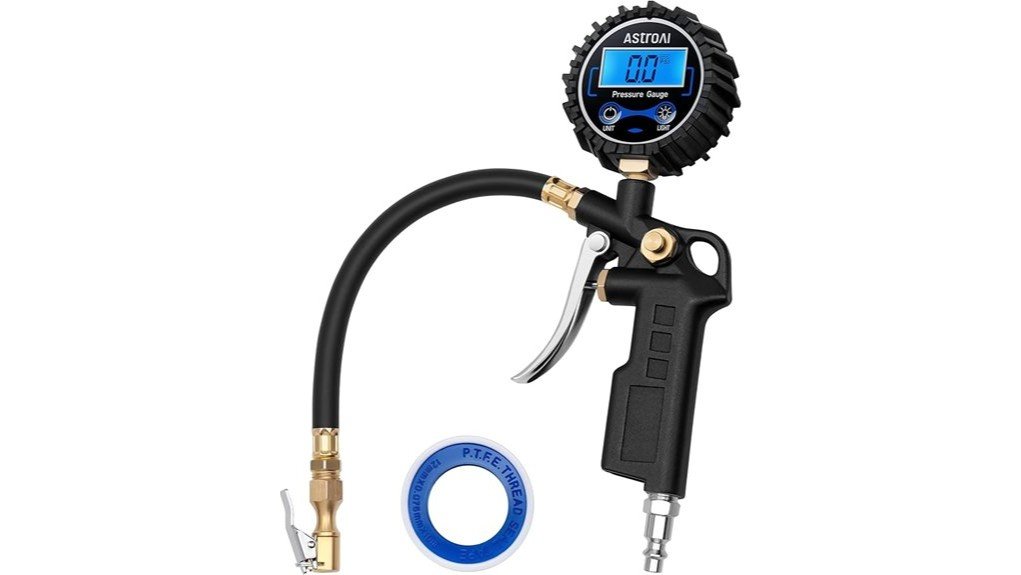
Checking tire pressure should be simple, but using one tool to inflate, another to measure, and a third to release excess air can slow the job down. The AstroAI 250PSI-M Digital Tire Pressure Gauge with Inflator combines those tasks in one compressor-powered tool. Its wide pressure range, backlit screen, locking chuck, and bleed valve suit home garages and mixed vehicle fleets. The main tradeoffs are that you still need an air compressor, it connects directly only to Schrader valves, and the manual says to keep it away from rain and water.
Quick Verdict
Rating: 8.5/10
Best For: Home garages, DIY vehicle maintenance, and drivers who already own an air compressor.
Bottom Line: This 3-in-1 tool makes it easier to check, add, and bleed air without switching accessories. It offers strong everyday convenience, but it is not a portable compressor or a weatherproof professional calibration instrument.
| Specification | Detail |
|---|---|
| Brand | AstroAI |
| Model | 250PSI-M |
| Product type | 3-in-1 digital tire inflator gauge |
| Functions | Checks pressure, inflates through a connected compressor, and bleeds excess air |
| Pressure range | 3 to 250 PSI digital measurement range |
| Claimed accuracy | ±1% manufacturer specification |
| Display resolution | 0.1 PSI |
| Measurement units | PSI, kPa, bar, and kg/cm² |
| Display | Backlit LCD |
| Power | 2 AAA batteries, included |
| Tire valve compatibility | Standard Schrader valves |
| Compressor connection | NPT compressor connector, listed for 1/4-inch and 1/2-inch NPT outputs |
| Chuck and hose | Straight locking chuck, interchangeable chuck fittings, and rubber hose |
| Weight | About 10.6 ounces |
| Auto-off | Approximately 20 to 60 seconds after use |
| Warranty | 3-year limited warranty stated in the manual |
| Package note | The manual illustrates valve caps, a valve-core tool, and thread-seal tape; confirm current seller contents before ordering |
Key Takeaways
- The AstroAI 250PSI-M combines a digital gauge, compressor trigger, and bleed valve in one handheld tool.
- Its 3 to 250 PSI range and four display units cover passenger vehicles, motorcycles, trailers, RVs, and many higher-pressure applications.
- The backlit LCD reads in 0.1 PSI increments, while AstroAI rates overall accuracy at ±1%.
- The tool works directly with Schrader valves and requires a separate air compressor for inflation.
- The manual lists replaceable AAA batteries, short-delay auto-off, dry-use precautions, and a 3-year limited warranty.
What Is the AstroAI 250PSI-M?
The AstroAI 250PSI-M is a compressor accessory that places a digital pressure gauge, inflation trigger, rubber hose, tire chuck, and air-bleed control in one assembly. You can use it as a stand-alone pressure checker, or connect it to a compatible compressor when you need to add air.
Its main advantage is workflow. Instead of adding air, disconnecting the hose, checking with a separate gauge, and repeating the process, you can perform each step with the same tool. The design is most useful for routine garage maintenance, seasonal pressure adjustments, and households that maintain several vehicles.
Who Should Buy It?
Best For
- Home mechanics who already have an air compressor
- Drivers maintaining cars, trucks, motorcycles, trailers, or RVs with Schrader valves
- Buyers who want one tool for checking, inflating, and bleeding pressure
Skip If
- You need a self-powered portable tire inflator
- Your bicycle uses only Presta valves and you do not want to use an adapter
- You need a weatherproof or independently certified professional shop gauge
Before You Buy: This product does not contain an air pump or motor. You need a separate compressor with a compatible fitting to inflate a tire, and you should confirm your coupler size before ordering.
[Products Worth Considering]

AstroAI’s digital tire pressure gauge inflates and measures with high accuracy, reading within 1% and supporting four pressure units from 3 to 250 PSI. The heavy-duty brass air chuck locks securely on valve stems, while the 19.7-inch stainless braided hose and 360° rotatable dial improve comfort and control for faster single-hand operation. Battery-saver behavior and an integrated flashlight add convenience and safety for everyday roadside and garage use.

This all-in-one air compressor accessory kit combines a digital tire pressure gauge with an inflator and blow gun in a single easy-to-use unit. The heavy duty, corrosion-resistant construction helps you quickly set and read tire PSI up to 200, and the vent valve releases excess air without removing the chuck. It connects to any 1/4 inch NPT air compressor output and includes multiple nozzles, adaptors, and stem caps for versatile inflating and blowing tasks.

AstroAI’s digital tire pressure gauge with inflator helps you quickly check, inflate, and deflate tires with an easy lock-on chuck and integrated bleed valve. It delivers calibrated accuracy within 1% for a clear PSI readout from 3 to 250 PSI, supporting dependable tire maintenance. Designed for many vehicle types, it connects to common compressor outputs and standard Schrader valves.
Accuracy and Display Quality
AstroAI specifies ±1% accuracy across the gauge’s operating range and a display resolution of 0.1 PSI. The backlit LCD can show PSI, kPa, bar, or kg/cm², which is useful when you work with vehicles or manuals that use different pressure units.
The 0.1 PSI display does not mean the tool is guaranteed accurate to one tenth of a PSI. Resolution describes the smallest change shown on screen, while the ±1% figure describes the manufacturer’s accuracy claim. For routine vehicle maintenance, the gauge gives you a much clearer target than estimating pressure from an analog scale with wide markings.
Small differences between two gauges can occur. If the AstroAI reading differs sharply from another trusted gauge, check the seal at the chuck, reset the display to zero, replace weak batteries, and compare both tools on the same cold tire.
Valve and Compressor Compatibility
The gauge connects directly to standard Schrader valves. That covers most cars, light trucks, SUVs, motorcycles, ATVs, trailers, RVs, lawn equipment, and many bicycles. A Presta bicycle valve needs a suitable adapter, and that adapter should be treated as a separate compatibility item rather than assumed to be included.
On the compressor side, the product is listed for NPT air systems, including 1/4-inch and 1/2-inch outputs. Compressor fittings vary, so compare the gauge connector with your hose, coupler, and shop setup before purchase. A secure fit matters because leaks at the compressor connection or tire chuck can slow inflation and distort readings.
Build Quality and Included Accessories
The tool uses a pistol-grip body, rubber hose, backlit digital gauge, metal air fittings, and interchangeable chuck hardware. AstroAI’s listing describes brass and stainless-steel components in the air path, while the current retail material field also references ABS, aluminum, and copper alloy. The safest buying takeaway is that this is a mixed-material consumer tool with metal pressure fittings, not a solid-metal industrial gauge.
The manual illustrates four valve caps, a valve-core tool, thread-seal tape, and interchangeable chuck pieces. Package bundles can change between sellers or production runs, so check the current product images and included-items list if those accessories matter to you.
Locking Chuck, Bleed Valve, and Auto-Off
The straight locking chuck helps hold the hose on a Schrader valve while you operate the trigger. If the chuck leaks, the manual recommends pressing it firmly onto the valve and rotating it clockwise until the seal improves. That extra step may be needed on short, recessed, or awkwardly angled valve stems.
The trigger adds air when the gauge is connected to a compressor. The bleed valve releases pressure in small steps when a tire is overfilled. During active inflation or bleeding, the displayed number can move because air is flowing. Release the trigger or bleed button, then let the display settle before judging the tire’s actual pressure.
Two replaceable AAA batteries power the display. The gauge shuts down automatically after a short period of inactivity, listed in the manual as roughly 20 to 60 seconds, and it can also be turned off manually.
How It Performs in Real Use
For Routine Car and SUV Checks
The all-in-one layout is most useful when several tires need small corrections. You can connect the chuck, read the pressure, add a short burst of air, release the trigger, and confirm the final number without reaching for another gauge. The bleed valve also makes it easier to correct an overfill.
For Trucks, RVs, and Trailers
The 250 PSI upper range gives the display room for higher-pressure applications. Your compressor, hose, fittings, tire valve, and tire itself must still be rated for the pressure involved. The gauge’s maximum range is not permission to exceed the vehicle or tire manufacturer’s specifications.
For Motorcycles, ATVs, and Lawn Equipment
These vehicles often use Schrader valves but may have less space around the stem. The straight chuck can work well when access is clear, though tight brake rotors, small wheels, or recessed stems may require careful chuck positioning. Check for a solid seal before trusting the displayed number.
For Bicycles
The tool works directly on Schrader-equipped bicycle tires. It is less convenient for Presta-only bikes unless you add the correct adapter. The 250 PSI range is broad, but you should always follow the pressure range printed for the bicycle tire and rim rather than choosing pressure based on the gauge’s capacity.
How to Use It Correctly
- Find the correct pressure. Use the vehicle placard or owner’s manual, not the maximum pressure molded on the tire sidewall.
- Check cold tires when practical. A cold reading gives you the clearest comparison with the vehicle manufacturer’s recommendation.
- Connect the compressor. Attach the quick-connect fitting and confirm that the hose and coupler do not leak.
- Select the unit and zero the gauge. Turn the display on, choose PSI or another unit, and use the reset control if the screen does not return to zero.
- Attach the chuck firmly. Press or twist the chuck onto the Schrader valve until the seal is stable.
- Add or release air in short steps. Use the trigger to inflate and the bleed button to reduce pressure.
- Read with airflow stopped. Release the control and allow the number to settle before making the next adjustment.
Pro Tip: Check all tires before driving, record the first reading, and make small adjustments. This reduces the chance of chasing a number that changes as the tire warms or while air is still flowing.
Compatibility and Safety
Use the AstroAI gauge only for its intended tire-inflation tasks and keep it within the pressure limits of every connected component. Inspect the hose, chuck, compressor fitting, and valve stem before use. Stop if the body is damaged, the hose is cracked, the display behaves erratically, or a connection cannot hold a seal.
The manual says not to expose the gauge to rain or water and to keep it away from fire, corrosive liquids, magnetic materials, and children. Remove the batteries if the tool will sit unused for a long period. Store it in a dry toolbox where the display and chuck will not be crushed.
For vehicle tires, use the recommended cold pressure on the driver’s door placard or in the owner’s manual. The number on the tire sidewall is generally a maximum rating, not the normal pressure target for your vehicle.
Pros and Cons
Pros
- Checks, inflates, and bleeds pressure with one tool
- Wide 3 to 250 PSI digital range
- Backlit 0.1 PSI display with four measurement units
- Locking chuck and bleed valve simplify fine adjustments
- Replaceable AAA batteries and a stated 3-year limited warranty
Cons
- Requires a separate air compressor for inflation
- Direct valve compatibility is limited to Schrader valves
- The chuck may need firm pressure or rotation to stop leaks, and the tool should be kept dry
Is It Worth the Price?
The AstroAI 250PSI-M fits the value-focused part of the consumer inflator-gauge market. You get a digital gauge, locking chuck, inflation trigger, and bleed control in one device, so it can replace several basic compressor accessories in a home garage.
It offers the most value when you already own a compressor and maintain several Schrader-valve tires. It is less attractive when you need roadside portability, Presta compatibility without adapters, waterproof construction, or documented third-party calibration for professional work.
[Products Worth Considering]

AstroAI’s calibrated digital tire pressure gauge delivers precise readings across a 0–150 PSI range, with high clarity from a backlit LCD. Built for everyday road use, it features one-button operation, an anti-slip ergonomic grip, and support for multiple pressure units plus auto shutoff. Powered by AAA batteries, it’s an all-weather essential for checking tire health and TPMS warnings.

Get quick, reliable tire readings with a backlit digital gauge that seals easily to valve stems for accurate 0.1 increments. Switch units on demand and check pressure on cars, trucks, motorcycles, and bicycles using the included Presta-to-Schrader adapter. The gauge powers with AAA batteries and automatically shuts off to help save battery life.

The ETENWOLF T500 digital tire pressure gauge with inflator delivers accurate readings across a wide 0–250 PSI range, calibrated to ANSI B40.7 Grade 2A. An all-in-one tool combines gauge, air chuck, hose, inflating and controlled bleed for checking, inflating, and deflating tires on many vehicle types. It’s built for reliable use in extreme temperatures and features an illuminated backlit display with replaceable AAA batteries for convenient operation.
How It Compares to Alternatives
The AstroAI 100 PSI mechanical inflator gauge is worth comparing if you prefer a battery-free analog display and do not need the 250 PSI range. The JACO FlowPro Digital Tire Inflator Gauge offers a 200 PSI digital alternative, while Milton sells digital inflator gauges in the 250 PSI class for buyers comparing hose length, chuck design, and shop-oriented construction.
The AstroAI 250PSI-M makes the most sense when you want a compact, wide-range digital setup at a value-focused price. Before choosing, compare the connector type, warranty terms, replacement parts, and the amount of working space around your vehicle’s valve stems.
[Products Worth Considering]

Inflate Presta and Schrader bike and car tires with one compressor attachment, including tubeless setups. The digital gauge lets you monitor 2–200 PSI readings in 0.1 PSI increments with ±2 PSI accuracy, while the adjustable lever and built-in bleed button help you dial in precise pressure. Quick-connect coupler, hose, and a complete Presta service kit with spare cores and caps make it ready for fast maintenance.

AstroAI’s tire pressure gauge with inflator helps you check and adjust car tire pressure accurately for safer, smoother driving. It offers 3-in-1 operation to inflate, deflate, or measure pressure, with an easy-to-read 2.5-inch glow dial and a heavy-duty air chuck for convenient use. Universal compatibility supports Schrader-valve tires and quick-connect 1/4" NPT air compressors for quick maintenance.

Stay on top of tire pressure with a factory-calibrated digital gauge accurate to ±1 PSI and readable in 0.1 increments. It features a bright backlit LCD plus a illuminated nozzle for easy readings in low light, with auto-off power saving for longer battery life. Switch quickly between PSI, Bar, Kgf/cm², and KPA using a single button, and cover most everyday vehicles with a 0–150 PSI range.
Frequently Asked Questions
Can the AstroAI 250PSI-M inflate a tire by itself?
No. It is an inflator gauge and air-control tool, not a powered compressor. You must connect it to a compatible air compressor before the trigger can add air.
How accurate is the digital pressure reading?
AstroAI rates the gauge at ±1% accuracy with 0.1 PSI display resolution. That is a manufacturer specification, so compare it with a trusted gauge if you need to investigate an unusual reading.
Why does the number change while I am inflating?
Airflow through the hose can make the displayed pressure move while the trigger is pressed. Release the trigger, wait for the reading to settle, and then decide whether the tire needs more air.
Does it work on bicycle tires?
It works directly with bicycle tires that use Schrader valves. A Presta valve requires a suitable adapter, and you should verify that the adapter and compressor setup match the tire’s pressure requirements.
How do I replace the battery?
Remove the rear battery-compartment cover and replace both AAA batteries, matching the marked polarity. Refit the cover and confirm that the display returns to zero before use.
Can I use it in rain or wet roadside conditions?
The manual says not to expose the product to rain or water. Keep it dry, wipe moisture from the valve area when safe, and use a different method if conditions could soak the display or battery compartment.
What should I do if the chuck leaks?
Press the chuck firmly onto the valve stem and adjust its angle. The manual also recommends rotating the chuck clockwise to improve the seal, then checking every compressor and hose connection if the leak continues.
What warranty does AstroAI provide?
The reviewed manual states a 3-year limited warranty for defects in materials and workmanship for the original purchaser. Confirm the current warranty and seller terms at checkout because regional policies and bundles can differ.
The Bottom Line
The AstroAI 250PSI-M is a strong choice for home-garage users who want one digital tool to check, inflate, and bleed Schrader-valve tires. Its main strengths are the wide range, clear display, and efficient controls, while the need for a separate compressor and dry-use limitation make it less suitable for a glove-box emergency kit or wet outdoor work.