Disclosure: As an Amazon Associate, we earn from qualifying purchases. If you click a link on this page and make a purchase, we may receive a small commission at no extra cost to you.
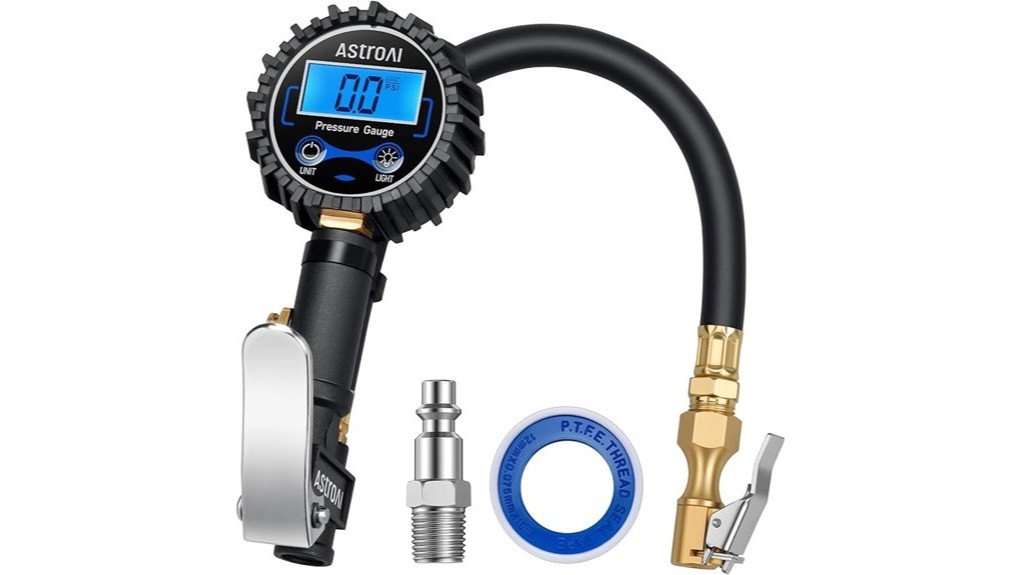
Checking tire pressure should be simple, but separate gauges, leaky chucks, and repeated compressor stops can slow the job down. The AstroAI Digital Tire Pressure Gauge with Inflator combines the gauge, inflation trigger, hose, locking chuck, and bleed valve in one hand-held tool. Its broad pressure range and backlit display suit routine garage work, but it is not a standalone air compressor and it does not stop inflation automatically at a preset PSI. This review explains its accuracy, compressor requirements, setup, strengths, and limitations so you can decide whether it fits your tire-care routine.
Quick Verdict
Rating: 8.4/10, recommended with caveats
Best For: Home garages, DIY vehicle maintenance, and drivers who already own a compatible air compressor
Bottom Line: The AstroAI inflator gauge makes pressure checks, filling, and controlled air release faster because all three functions sit in one tool. Its main tradeoff is that you still need a compatible compressor and must release the trigger to confirm the settled pressure.
| Specification | Detail |
|---|---|
| Brand | AstroAI |
| Model | ATG250, 250 PSI digital inflator gauge |
| Product type | 3-in-1 pressure gauge, inflator, and deflator |
| Pressure range | 3 to 250 PSI |
| Display resolution | 0.1 PSI |
| Rated accuracy | ±1% |
| Measurement units | PSI, kPa, bar, and kg/cm² |
| Display | Backlit digital LCD |
| Materials | Brass and stainless steel components |
| Hose | 18-inch rubber hose |
| Air connection | 1/4-inch NPT compressor output and quick-connect fitting |
| Valve compatibility | Standard Schrader valves; other valve types need a suitable adapter |
| Power | 2 AAA batteries, included |
| Automatic power-off | After 20 seconds of inactivity |
| Dimensions | 8.26 x 3.15 x 3.34 inches |
| Listed weight | 1.3 pounds |
| Included accessories | Interchangeable air chucks, valve caps, valve-core tool, NPT fitting, thread-seal tape, batteries, and manual |
| Warranty | 3-year limited warranty for the original purchaser |
Key Takeaways
- The AstroAI ATG250 combines pressure measurement, inflation control, and air bleeding in one hand-held tool.
- It displays four pressure units and shows changes in 0.1 PSI increments across a listed 3 to 250 PSI range.
- The tool requires a compatible 1/4-inch NPT air compressor connection, so it cannot inflate a tire by itself.
- The 20-second automatic shutoff powers down the display only. It is not a preset pressure stop for inflation.
- Its straight locking chuck works with Schrader valves, while Presta and other valve types require an adapter.
What Is the AstroAI Digital Tire Pressure Gauge with Inflator?
The AstroAI ATG250 is an air-compressor attachment for checking and adjusting tire pressure. You connect the tool to your compressor, secure the chuck to a Schrader valve, squeeze the trigger to add air, and press the bleed button to release excess pressure.
The main selling point is workflow. Instead of filling a tire, removing the air hose, and checking it with a separate gauge, you can manage the full process from one handle. The backlit screen also makes the reading easier to see in a dim garage or beside a vehicle at night.
This tool is designed for cars, SUVs, trucks, motorcycles, RVs, and bicycles that use Schrader valves. Its 250 PSI ceiling gives it more range than most passenger tires need, but the number does not mean every compressor, hose, chuck, or tire should be used at that pressure.
Who Should Buy It?
Best For
- Drivers who already own a compressor with a compatible 1/4-inch NPT connection
- DIY users who check and top off several vehicle tires in one session
- Home garages that need one tool for measuring, adding, and bleeding air
Skip If
- You need a self-powered roadside inflator that works without an air compressor
- You want preset PSI selection with automatic inflation stop
- Your equipment uses a different fitting or valve and you do not want to add adapters
Before You Buy: This is an inflator gauge, not an air compressor. The automatic shutoff turns off the digital display after inactivity, but it does not stop airflow when your tire reaches a target pressure.
[Products Worth Considering]

AstroAI’s calibrated digital tire pressure gauge delivers precise readings across a 0–150 PSI range, with high clarity from a backlit LCD. Built for everyday road use, it features one-button operation, an anti-slip ergonomic grip, and support for multiple pressure units plus auto shutoff. Powered by AAA batteries, it’s an all-weather essential for checking tire health and TPMS warnings.

AstroAI’s digital tire pressure gauge inflates and measures with high accuracy, reading within 1% and supporting four pressure units from 3 to 250 PSI. The heavy-duty brass air chuck locks securely on valve stems, while the 19.7-inch stainless braided hose and 360° rotatable dial improve comfort and control for faster single-hand operation. Battery-saver behavior and an integrated flashlight add convenience and safety for everyday roadside and garage use.

Inflate Presta and Schrader bike and car tires with one compressor attachment, including tubeless setups. The digital gauge lets you monitor 2–200 PSI readings in 0.1 PSI increments with ±2 PSI accuracy, while the adjustable lever and built-in bleed button help you dial in precise pressure. Quick-connect coupler, hose, and a complete Presta service kit with spare cores and caps make it ready for fast maintenance.
Design and Build Quality
The AstroAI uses brass and stainless steel in its air-contact components, which gives the tool a sturdier feel than an all-plastic gauge. A rubber hose separates the gauge body from the chuck, helping you reach valves without holding the full tool directly against the wheel.
The straight locking chuck grips a standard Schrader valve while you work. AstroAI also includes interchangeable chuck parts and small service accessories, including valve caps, a valve-core tool, thread-seal tape, and an NPT fitting. Those extras can help during setup, but you should confirm the current package contents on the listing because bundles can change.
Backlit Display and Controls
The digital LCD shows PSI, kPa, bar, or kg/cm². A 0.1 PSI display resolution makes small pressure changes visible, but resolution and accuracy are not the same thing. The tool is rated to ±1% accuracy, so you should judge it by repeatable readings rather than assuming every tenth of a PSI is exact.
The handle includes an inflation trigger and a separate bleed/reset button. This layout lets you add air, stop, read the settled pressure, and release small amounts without disconnecting the chuck.
How the AstroAI Tire Inflator Works
Start by attaching the correct NPT connector to the gauge and linking it to your air compressor. Secure the air chuck to the tire valve, make sure the connection is sealed, and reset the display if needed. Squeeze the trigger to add air, then release the trigger before you evaluate the final pressure.
The displayed number can move while air is flowing because the gauge is reading an active air stream. For a more useful reading, stop inflation and wait for the number to settle. If you overshoot, press the bleed valve briefly, release it, and check again.
Pro Tip: If air leaks around the locking chuck, press it firmly onto the valve and rotate it slightly until the seal improves. Stop airflow before making your final pressure decision.
Accuracy and Pressure Control
The listed pressure range is 3 to 250 PSI, with four selectable units and a 0.1 PSI display resolution. That range covers routine passenger-car pressures and many higher-pressure applications, provided every connected component is rated for the job.
For normal tire care, repeatability matters as much as the headline range. Take two readings after the airflow stops. If they remain close, the tool is giving you a stable reference. If the AstroAI differs sharply from another trusted gauge, inspect the valve seal, check the batteries, reset the display, and compare again before adding more air.
The bleed valve is useful for fine correction because you can release air in short taps. It still requires attention. This model does not let you enter a target pressure and walk away while the tool stops automatically.
How It Performs in Real Use
Monthly Tire Checks
For a household with several vehicles, the combined trigger, gauge, and bleed valve can reduce tool swapping. You can move from tire to tire, compare each reading with the vehicle placard, add air where needed, and correct small overfills from the same handle.
Before a Long Trip
The backlit display and locking chuck make a pre-trip check easier in a garage or driveway. Check the tires when they are cold, including the spare when accessible, and use the pressure listed by the vehicle manufacturer rather than the maximum number molded into the tire sidewall.
Motorcycles and Bicycles
The hose and straight chuck can work well on accessible Schrader valves. Tight wheel clearances may make a straight chuck harder to position, and bicycles with Presta valves need a suitable adapter. Check fit before relying on the tool for every wheel you own.
Roadside Use
The gauge itself is compact enough to carry, but it cannot create compressed air. It only becomes a useful roadside inflator when you also have a compatible compressor and power source. A self-contained 12-volt or cordless inflator is more practical for drivers who want one emergency device.
How to Use It Correctly
- Find the correct pressure: Use the driver-side door placard or your owner’s manual. Do not use the tire sidewall maximum as the normal target.
- Check cold tires: Measure before driving or after the vehicle has been parked for several hours.
- Confirm the fittings: Make sure the compressor, NPT connector, hose, and chuck are secure and rated for the intended pressure.
- Seal the chuck: Push the chuck fully onto the Schrader valve and lock it in place. Reposition it if you hear air leaking.
- Add air in short stages: Squeeze the trigger, release it, and let the reading settle before adding more.
- Bleed carefully: Tap the bleed valve briefly and recheck after each adjustment.
- Store it dry: Disconnect the tool, wipe away dirt or moisture, and protect the hose and display from impacts.
Compatibility and Safety
The AstroAI connects to a 1/4-inch NPT compressor output or compatible quick-connect fitting. It is built around Schrader valves, the standard type found on most cars and many motorcycles, trucks, RVs, and bicycles. A different valve type requires the correct adapter, and an incompatible air fitting should never be forced into place.
Before using the upper part of the gauge’s pressure range, check the ratings for your compressor, regulator, hose, couplers, chuck, valve, and the item being inflated. Wear eye protection when working with pressurized air, keep the hose away from hot or moving parts, and stop if a fitting, hose, or valve appears damaged.
The gauge helps you set pressure, but it cannot diagnose a puncture, damaged tire, bent wheel, leaking valve stem, or failing compressor. A tire that loses pressure repeatedly needs inspection by a qualified tire professional.
Why Proper Tire Pressure Matters
Correct tire pressure supports predictable handling, tire durability, and fuel use. Underinflation creates extra flex and heat, while overinflation can reduce the tire’s contact area and make the ride harsher.
You should check tire pressure at least monthly and before long trips. Tire pressure monitoring systems are useful warnings, but they do not replace regular checks with a gauge because the dashboard light may not appear until pressure has dropped significantly.
Pros and Cons
Pros
- Combines inflation, pressure measurement, and air bleeding in one tool
- Broad 3 to 250 PSI range with four measurement units
- Backlit 0.1 PSI display is easy to read during small adjustments
- Brass and stainless steel components support regular garage use
- Includes batteries and several setup and valve-service accessories
Cons
- Requires a separate air compressor with compatible fittings
- Does not provide preset pressure selection or automatic airflow stop
- Straight chuck and Schrader-only setup may need adapters for some wheels and valves
Is It Worth the Price?
The AstroAI offers strong value for the price when you already own a compressor and want to replace a separate chuck, gauge, and deflator with one tool. Its useful pressure range, readable display, included accessories, and three-year limited warranty make it a practical choice for routine home maintenance.
It provides less value when your real need is portable roadside inflation. In that case, buying this gauge plus a separate compressor adds cost, storage, and setup. You would likely get more from a self-contained inflator with a power cord or rechargeable battery.
[Products Worth Considering]

AstroAI’s digital tire pressure gauge with inflator helps you quickly check, inflate, and deflate tires with an easy lock-on chuck and integrated bleed valve. It delivers calibrated accuracy within 1% for a clear PSI readout from 3 to 250 PSI, supporting dependable tire maintenance. Designed for many vehicle types, it connects to common compressor outputs and standard Schrader valves.

Get precise tire readings with the ETENWOLF T300 Plus digital gauge, calibrated to ANSI B40.7 Grade 2A for reliable accuracy. It measures across a wide 3–200 PSI range and includes thermal compensation for dependable performance from extreme cold to heat. The bright LED display, LED illumination, and replaceable AAA batteries make it easy to check pressures quickly, even in low light.

AstroAI’s tire pressure gauge with inflator helps you check and adjust car tire pressure accurately for safer, smoother driving. It offers 3-in-1 operation to inflate, deflate, or measure pressure, with an easy-to-read 2.5-inch glow dial and a heavy-duty air chuck for convenient use. Universal compatibility supports Schrader-valve tires and quick-connect 1/4" NPT air compressors for quick maintenance.
How It Compares to Alternatives
The JACO FlowPro Digital is a comparable compressor-mounted inflator gauge with a lower 200 PSI ceiling and a focus on workshop-style control. The AZUNO 200 PSI digital inflator is another similar option, often paired with a lock-on chuck and carrying case. Compare hose reach, chuck angle, fitting type, display size, and warranty rather than choosing only by maximum PSI.
An analog 100 PSI inflator gauge may be better when you want a battery-free tool for passenger vehicles. The AstroAI ATG250 makes more sense when you prefer a backlit digital reading, four units, and a wider pressure range.
[Products Worth Considering]

The AstroAI 2 pack air chucks provide a heavy-duty, closed-flow locking design that helps keep air flowing during inflation while securely attaching to the valve stem. Built with 250 PSI rated brass components and compatible with Schrader valves, they feature 1/4" female NPT threads for a wide fit with common inflators. The straight tip and locking clip make filling tires and monitoring pressure more convenient.

Stay on top of tire pressure with a factory-calibrated digital gauge accurate to ±1 PSI and readable in 0.1 increments. It features a bright backlit LCD plus a illuminated nozzle for easy readings in low light, with auto-off power saving for longer battery life. Switch quickly between PSI, Bar, Kgf/cm², and KPA using a single button, and cover most everyday vehicles with a 0–150 PSI range.

This all-in-one digital tire pressure gauge with inflator helps you quickly and accurately set tire pressure for safer, smoother rides. It features an LED backlit display with measurements in PSI, KPA, Bar, and Kg/cm², along with a straight locking chuck, hose, and bleed valve for easy adjustments. Calibrated accuracy within 1% and automatic shutoff after inactivity help reduce guesswork and conserve battery life.
Frequently Asked Questions
Does the AstroAI inflator gauge work without an air compressor?
No. It measures pressure and controls compressed air, but it does not contain a motor or pump. You need a compatible compressor with a 1/4-inch NPT output or suitable quick-connect setup.
Does it stop automatically at the selected PSI?
No. The 20-second automatic shutoff only powers down the display after inactivity. You must release the inflation trigger, check the settled reading, and stop adding air yourself.
What pressure units does the AstroAI gauge display?
It displays PSI, kPa, bar, and kg/cm². The listed range is 3 to 250 PSI, and the screen shows pressure changes in 0.1 PSI increments.
Can I use it on bicycle tires?
You can use it directly on bicycle tires with Schrader valves. A Presta valve needs a compatible adapter, and you should confirm that the tire, tube, rim, and compressor setup can handle the intended pressure.
Why does the pressure reading change while I inflate?
Airflow can make the displayed pressure move while the trigger is pressed. Release the trigger, allow the reading to settle, and then decide whether to add or bleed more air.
What should I do if the chuck leaks?
Push the chuck firmly onto the valve and rotate it slightly to improve the seal. Also inspect the valve, chuck washer, hose connection, and thread seal before continuing.
What warranty does AstroAI provide?
The manual states a three-year limited warranty for the original purchaser. It covers defects in materials and workmanship, while misuse, alteration, accidents, and abnormal handling are excluded.
The Bottom Line
The AstroAI ATG250 is a good fit when you already own an air compressor and want faster, more controlled tire-pressure adjustments from one tool. Its backlit display, broad range, bleed valve, and included accessories are useful strengths, while the need for a separate compressor and the lack of preset auto-stop are the main reasons to skip it.