
Will a Donut Spare Fit Your Car? How to Check
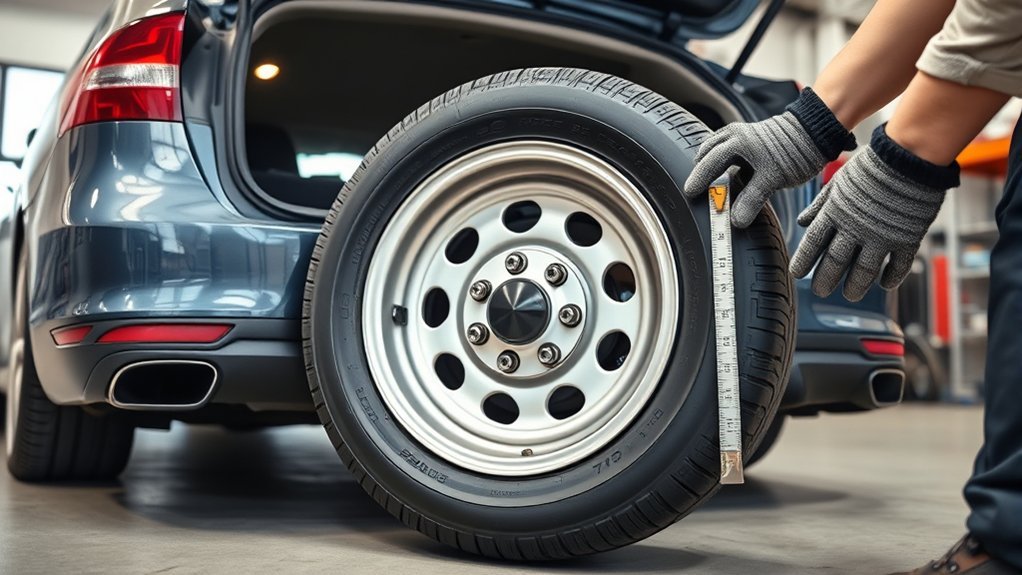
A donut spare can fit your car, but bolt pattern alone is not enough to prove compatibility. The safest choice is the temporary spare approved for your exact vehicle or application. You also need the correct tire and wheel dimensions, hub fit, lug-seat type, brake clearance, load capacity, inflation pressure, and any vehicle-specific AWD or axle-placement instructions.
Quick Answer
A donut spare fits only when it is approved for your vehicle or matches every required fitment specification and clears the brakes and suspension. Check your owner’s manual, spare-tire label, wheel fitment data, inflation pressure, and vehicle-specific restrictions. Never assume a spare fits simply because the lug holes line up.
Key Takeaways
- Start with your owner’s manual or OEM application information. A temporary spare designed for your vehicle is safer than choosing a donor wheel by dimensions alone.
- Verify the bolt pattern, center bore, wheel diameter, offset, lug-seat type, tire diameter, load capacity, and brake clearance.
- Use the cold inflation pressure and temporary-use limits specified for that spare. Many compact spares are limited to 50 mph, but the exact limit is vehicle-specific.
- AWD, stability-control, ABS, TPMS, staggered-wheel, and performance-brake vehicles can have additional restrictions.
- Inspect the spare’s age, pressure, tire condition, and wheel condition before depending on it in an emergency.
At a Glance
| Time Required | About 10–20 minutes for basic specification and test-fit checks |
| Difficulty | Easy to moderate; use a tire shop if specifications or clearances are uncertain |
| Tools Needed | Owner’s manual, tire-pressure gauge, ruler or caliper, factory wheel tools, and torque wrench |
| Cost | Usually $0 if you already have the tools; a tire shop may charge for fitment inspection |
Warning: Do not drive on a donor donut just because the lug holes line up. A wheel can bolt on yet still have the wrong center bore, offset, lug-seat design, load capacity, brake clearance, or rolling diameter. Do not use spacers, adapters, machining, or other fitment workarounds unless your vehicle manufacturer specifically approves them.
Check the Owner’s Manual First
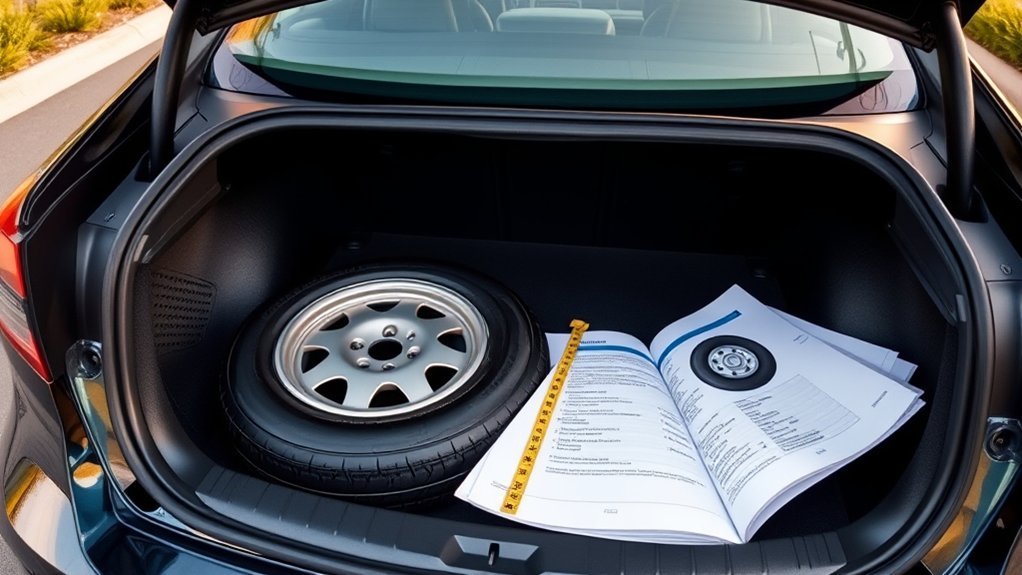
Your owner’s manual should be the first place you check. It can identify the type of spare your vehicle uses, the correct temporary-use pressure, speed restrictions, axle-placement instructions, and warnings for systems such as AWD, ABS, traction control, or TPMS.
If your vehicle originally came with a compact spare, use the specified spare size or OEM replacement application whenever possible. Do not assume a temporary spare from another vehicle is safe simply because both cars share a manufacturer or bolt pattern.
The manual may also tell you where the spare belongs if the flat occurs on a particular axle. This matters because manufacturer instructions vary. Some vehicles allow the temporary spare in a particular position, while others require you to move a full-size wheel to the flat position and install the compact spare elsewhere.
If the manual does not approve the spare you found, or you cannot verify the spare’s application, have a tire shop or dealer confirm it before driving.
Pro Tip: Test-fit an approved spare at home before you need it on the roadside. You can confirm brake clearance, lug fit, pressure, and tool access without discovering a problem during an emergency.
[Products Worth Considering]

The Trivd Frol 1/2" air impact wrench delivers high performance torque up to 1500 ft-lbs with a twin hammer impact mechanism for strong, balanced blows. It features an ergonomic grip, compact lightweight design, and quick-stop control with 3 forward speeds up to 8000 RPM plus a reverse speed. Built for demanding automotive repair and tire shop work, the rear exhaust helps keep debris away from the surface.

The 22800 wheel stud installer makes replacing wheel studs quick and secure, saving time and effort during tire service. It uses a ratchet or impact wrench to pull new studs firmly into place, helping when existing studs are too long. Compatible with most automotive wheels and light-duty truck wheel studs, it’s designed for easy, tool-assisted installation.

This 1/2-inch drive breaker bar delivers powerful leverage for loosening and tightening stubborn lug nuts and automotive fasteners. The 180-degree flex head helps you reach tight spaces at the angle you need, making tire and brake jobs easier. A spring-loaded ball detent design holds 1/2-inch sockets securely while the chrome-moly head provides durable strength for everyday use.
Check Your Bolt Pattern
Verify the bolt pattern before attempting to mount a donut spare. The pattern identifies both the number of wheel studs and the diameter of the circle formed by them. A common format such as 5×114.3 means five lugs on a 114.3 mm bolt circle.
The spare’s bolt pattern must match the vehicle specification exactly. A wheel that appears close enough can fail to seat correctly, place abnormal loads on the studs, or prevent proper clamping.
If the bolt pattern does not match exactly, stop. Never force a temporary spare onto the studs.
Also verify the lug-hole design and the lug-nut or lug-bolt seat. Conical, spherical, and flat-seat hardware are not automatically interchangeable. Hand-start each fastener before tightening. If the threads bind or the wheel does not sit flat against the hub, remove it and recheck the application.
When installing an approved spare, tighten the fasteners in the sequence and to the torque specification listed by the vehicle manufacturer.
Match the Donut Spare Tire Size
Read the temporary spare size molded into the sidewall and compare it with the spare specification in your vehicle information. Temporary tires often use a size beginning with a “T,” although labeling varies.
Do not compare only the rim diameter. The tire’s overall rolling diameter also depends on its section width and sidewall profile. The approved compact spare may be much narrower than the normal road tire while still being designed to work temporarily with the vehicle.
There is no universal percentage of diameter difference that makes every donor donut safe. ABS, stability-control systems, AWD systems, differentials, and transmission strategies vary by vehicle. Use the manufacturer-approved spare specification rather than applying a generic “close enough” rule.
Check the spare’s load information and temporary-use markings as well. A compact spare is engineered for emergency service, not normal driving or long-term substitution for a road tire.
Compare Wheel Diameter and Offset
The spare wheel must have enough diameter and the correct inner profile to clear the brake caliper. A wheel with the right bolt pattern can still fail to clear a larger brake package used on a different trim.
Wheel offset is also important because it controls where the wheel sits relative to the hub, suspension, and body. Too much or too little offset can create contact or poor fastener engagement even when the tire looks similar in size.
Do not expect the tire-pressure label on the door jamb to provide bolt pattern, center-bore, or offset measurements. Use your vehicle’s owner information, OEM parts catalog, service data, or a qualified tire/wheel professional for those specifications.
If the spare came from another vehicle and you cannot verify its wheel dimensions and application, do not rely on a visual comparison.
Check Brake and Suspension Clearance
A compatible spare must clear the brake caliper, dust shield, strut, control arm, tie rod, brake hose, wheel weights, and surrounding bodywork. Test-fit the wheel before an emergency whenever possible.
Perform any wheel removal only on firm, level ground with the vehicle secured according to the owner’s manual. Use the specified jacking points, apply the parking brake when instructed, and never put any part of your body under a vehicle supported only by a jack.
Measure Caliper Gap
Brake clearance is determined by more than the wheel’s advertised diameter. The shape of the inner wheel barrel and spokes also matters, especially on vehicles with large front calipers.
| Check | What to Verify |
|---|---|
| Caliper clearance | The wheel barrel and spokes do not touch the caliper |
| Wheel barrel | The inner profile clears the complete brake assembly |
| Hardware | No valve stem, clip, wheel weight, or shield contacts the wheel |
If clearance is extremely close or difficult to judge, stop and have a tire shop confirm the fit. Do not grind a caliper or modify the spare wheel to create clearance.
Inspect Suspension Travel
With an approved spare securely mounted, look for clearance between the tire/wheel and nearby suspension components. On a steerable axle, check the visible clearance as the steering moves through its normal range while the vehicle is safely supported and operated according to the manufacturer’s service procedure.
You do not need to force suspension movement or improvise by jacking suspension arms to prove that a questionable donor spare fits. If static fitment is uncertain, professional inspection is the safer option.
Also remember that some vehicles use different wheel or tire sizes from front to rear. Never assume that a spare approved for one axle can be used on another unless the owner’s manual permits it.
Test Wheel Rotation
Before lowering the vehicle completely, rotate the mounted wheel by hand when the manufacturer’s jacking procedure allows it. The wheel should turn without scraping, binding, or contacting the brake caliper, shield, suspension, or other hardware.
| Check Point | What to Observe | Action if It Fails |
|---|---|---|
| Brake clearance | No scraping or contact | Remove the spare |
| Steering clearance | No visible rub through steering range | Confirm application and offset |
| Rotation feel | Smooth rotation without binding | Stop and inspect |
Once the vehicle is back on the ground, confirm that the wheel is fully seated and torque the fasteners to the vehicle manufacturer’s specification. If you hear rubbing, feel abnormal vibration, or see a warning that the manual does not describe as normal with the spare installed, stop driving and have the fit checked.
Verify Hub Bore and Lug Nut Fit
Check the spare wheel’s center bore and fastening system against the approved vehicle specification. If the center opening is too small, the wheel will not seat. If the wheel requires an adapter, spacer, machining, improvised hub ring, or different hardware merely to make a donor donut fit, treat that as a sign that you need the correct spare instead.
Inspect the lug holes and mounting face for cracks, elongation, heavy corrosion, bends, or other damage. Match the required conical, spherical, or flat-seat fastener design exactly.
Hand-start every lug nut or wheel bolt. It should thread smoothly for the normal engagement distance without cross-threading or bottoming out prematurely.
A temporary spare should sit flush against the mounting surface and use the fastening arrangement specified for the vehicle. If anything binds or looks wrong, do not drive on it.
Check the Spare Tire Speed Limit
Temporary spares have operating restrictions that normal road tires do not. Read both the spare’s markings and your owner’s manual before driving.
Many vehicle manufacturers limit compact spares to 50 mph (80 km/h), but that number is not a universal substitute for the instructions on your specific vehicle and spare.
Read the Sidewall
The spare’s sidewall can identify its size, construction, temporary-use status, load information, inflation markings, and speed warning. Look for wording such as “Temporary Use Only” and any maximum-speed instruction.
- Confirm the complete tire-size designation.
- Look for temporary-use wording and speed restrictions.
- Inspect the DOT Tire Identification Number and date code.
- Check the tire for cracking, cuts, bulges, exposed material, or other damage.
- Confirm the specified cold inflation pressure before use.
Do not assume that the pressure used in your four normal road tires is correct for the compact spare. Temporary spares commonly require a much higher cold pressure.
Respect Speed Limits
Even when the donut fits correctly, it cannot automatically be driven like a normal tire. Follow the lowest applicable limit in the owner’s manual or on the temporary spare.
A compact spare can change grip, braking feel, cornering response, ground clearance, and the behavior of electronic vehicle systems. Avoid hard acceleration, sudden braking, high-speed cornering, and unnecessary lane changes.
Use the spare to reach a safe repair location rather than treating it as a normal replacement tire.
Avoid Long Distances
There is no single mileage limit that applies to every donut spare. Some manuals specify a maximum distance while others simply instruct the driver to replace the temporary spare with a normal tire as soon as possible.
- Follow any distance limit in the owner’s manual or spare-tire instructions.
- Take a direct route to a tire shop or repair location.
- Keep the spare at its specified cold pressure.
- Reduce speed further if road, weather, traffic, or vehicle behavior requires it.
If the car feels unstable, the spare loses pressure, or you hear rubbing or other unusual noises, stop in a safe location rather than trying to complete the trip.
Check the Spare Tire’s Age and Condition
A spare can match every dimension and still be unsafe to use if the tire or wheel has deteriorated. Because spare tires may sit unused for years, include them in regular tire inspections.
Check the DOT Tire Identification Number for the manufacturing date. The last four digits identify the week and year of manufacture. Tire manufacturers set their own service-life recommendations, so follow the tire maker’s and vehicle maker’s replacement guidance rather than judging the spare only by tread depth.
Inspect the tread and sidewalls for cracks, cuts, bulges, deformation, exposed cords, weathering, or contamination. Inspect the steel wheel for heavy rust, bent mounting surfaces, damaged lug holes, or cracks.
Check pressure when the tire is cold. A compact spare that has spent years in the trunk can be seriously underinflated even if it has never touched the road.
Note: Tire-age policies differ. For example, some tire manufacturers specify a maximum service age for spare tires even when tread remains. Follow the manufacturer of the tire installed on your spare wheel.
[Products Worth Considering]

ZEHXI’s 60 pack screw-in tire plug kit uses high-grade rubber plugs with sealing threads to help repair minor punctures quickly without removing the tire. The set includes two plug sizes, so you can match different puncture openings and keep repairs organized in a transparent case. A handy screwdriver is included for fast installation, helping drivers get more mileage from existing tires while being ready for flat-tire emergencies.

Secure a full-size spare on your trailer with this powder-coated steel spare tire mount bracket. It fits most 4-, 5-, and 6-lug wheel bolt patterns and mounts to trailer tongues up to 4 in wide and 5 in tall. Built for reliable carry with a max 150 lb load rating and includes zinc-plated hardware for straightforward installation.

The SAFELIFE dial tire tread depth gauge measures tread depth in 1/32 inch increments with clear, easy-to-read 2-inch dial face. Color zones using a traffic light system help you quickly judge whether tread is low, marginal, or ample for safer driving. Built with a durable zinc cast body and a metal detect probe for precise, comfortable use across cars, motorcycles, trucks, and buses.
Check AWD, Axle, and Electronic-System Rules
AWD and four-wheel-drive vehicles deserve extra attention because differences in rolling circumference can affect drivetrain operation. Do not apply a generic rule about how much diameter difference is acceptable; use the vehicle manufacturer’s instructions.
There is also no universal rule saying a donut always belongs on the front or always belongs on the rear. Manufacturer procedures vary by model and drivetrain. If the manual says to move a normal wheel from one axle to the other before installing the compact spare, follow that procedure.
A temporary spare can also trigger or change the behavior of systems such as TPMS, ABS, traction control, stability control, cruise control, or AWD. A warning light may be expected on some vehicles but signal a real problem on others.
If your vehicle has staggered tire sizes, performance brakes, an electronic differential, or an AWD system and the manual does not clearly approve the spare you have, confirm fitment with the manufacturer or a qualified tire professional.
Know When a Donut Spare Won’t Fit
A donut spare is not suitable if it has the wrong bolt pattern, will not seat fully on the hub, uses incompatible lug hardware, interferes with the brakes or suspension, or is not approved for your vehicle’s temporary-spare application.
It may also be unsuitable when:
- The wheel cannot clear a larger brake package.
- The vehicle requires a specific front or rear placement that the spare cannot satisfy.
- The overall tire diameter conflicts with the vehicle manufacturer’s requirements.
- The spare’s load capability is inadequate.
- The tire is damaged, badly aged, or cannot hold its specified pressure.
- The wheel is bent, cracked, heavily corroded, or has damaged lug holes.
- The vehicle manufacturer prohibits that type of temporary spare.
Vehicles with staggered wheels, AWD, large performance brakes, or unusual hub dimensions can require a very specific spare even when another compact wheel appears nearly identical.
When any critical specification is uncertain, use the correct replacement spare or arrange roadside assistance instead of experimenting at the roadside.
Read the Door Sticker for Tire and Spare Information
Check the driver-side door jamb or B-pillar for the Tire and Loading Information label. On vehicles that list a spare, it can provide the approved spare-tire size and recommended cold inflation pressure.
The label is valuable, but it is not a complete wheel-fitment sheet. Do not expect it to tell you the bolt pattern, center bore, wheel offset, caliper clearance, or lug-seat design.
Locate the Door Sticker
Open the driver’s door and find the tire-information label. Record the listed road-tire sizes and cold pressures and, when shown, the spare-tire size and pressure.
Use the owner’s manual or OEM service/parts information for specifications that do not appear on the label.
- Record the listed front and rear tire sizes.
- Record the recommended cold pressures.
- Check whether a separate spare size and pressure are listed.
- Use OEM information for wheel dimensions and temporary-spare operating restrictions.
Match Spare Specs
Compare the label and owner information with the spare you plan to use. Treat each source as part of the fitment check rather than assuming the door sticker contains every required dimension.
| Specification | Where to Check | What to Verify |
|---|---|---|
| Spare tire size | Door label if listed; owner information | Use the approved designation |
| Cold pressure | Door label/manual/spare instructions | Inflate to the specified spare pressure |
| Bolt pattern, bore, offset | OEM service or parts information | Match the approved wheel application |
| Brake clearance | Approved application and test fit | No contact or binding |
If the information conflicts, do not assume the spare is close enough. Resolve the discrepancy before driving.
Safe Donut Spare Test-Fit Checklist
If you already have a spare and want to verify it before an emergency, use this simple sequence:
- Confirm that the spare is approved for your year, model, trim, drivetrain, and brake package.
- Read the spare size, temporary-use markings, pressure specification, and date code.
- Inspect the tire and wheel for damage or heavy corrosion.
- Park on a firm, level surface and follow the vehicle’s wheel-changing procedure.
- Verify the bolt pattern, hub fit, and lug-seat compatibility.
- Mount the spare without forcing it and confirm that the wheel seats flush.
- Check visible brake and suspension clearance and rotate the wheel by hand when safe to do so.
- Torque the fasteners to the vehicle manufacturer’s specification.
- Confirm any AWD, axle-position, TPMS, or electronic-system instructions before driving.
Warning: Never crawl under a vehicle supported only by its emergency jack. If a fitment check requires measurements or access that cannot be performed safely from outside the vehicle, have a shop inspect it.
What to Do If It Doesn’t Fit
If the donut spare does not fit, stop. Do not force it onto the hub, substitute different lug hardware at random, grind the wheel or brake caliper, enlarge the center bore, or add an unapproved spacer or adapter.
Recheck the approved spare size, wheel application, bolt pattern, center bore, offset, lug-seat design, and brake clearance.
- Use the vehicle’s approved compact spare or replacement assembly.
- Install a compatible full-size spare if the manufacturer permits one.
- Use the vehicle’s supplied tire-repair/inflator system when applicable and when the damage is suitable for it.
- Call roadside assistance or arrange towing if no safe spare is available.
If the original tire has a simple tread puncture, professional repair may be possible. Industry repair guidance for passenger and light-truck tires generally limits repair to the tread repair area and punctures no larger than 1/4 inch (6 mm). The tire should be removed from the wheel and inspected internally, and an approved repair uses both a patch and a stem or equivalent combination repair. Shoulder, sidewall, and other non-repairable damage requires tire replacement.
When you are unsure, a qualified tire shop can confirm fitment and determine whether the original tire can be safely repaired.
Frequently Asked Questions
Can I Drive on a Donut Spare in Snow?
Avoid it when possible. A compact spare normally provides less grip and can change the vehicle’s handling, while some vehicles prohibit tire chains on the temporary spare. If you must use it during winter conditions, follow the owner’s manual, keep the trip as short as possible, reduce speed substantially, and arrange towing if traction is unsafe.
How Long Can I Use a Donut Spare Tire?
There is no universal 50-mile or 70-mile rule for every compact spare. Follow the distance limit in your owner’s manual or spare-tire instructions. In all cases, treat a donut as an emergency tire and replace it with the normal road tire as soon as practical.
Do Donut Spares Affect ABS or Traction Control?
They can. Some vehicles may change the operation of ABS, traction control, stability control, AWD, TPMS, cruise control, or other systems while a compact spare is installed. The exact behavior depends on the vehicle, so check the owner’s manual instead of assuming a warning light is harmless.
Should I Inflate a Donut Spare to Full Pressure?
Inflate it to the specified cold pressure for that exact temporary spare. Compact spares often require much more pressure than the normal road tires, commonly around 60 psi on many applications, but the correct value is the one specified by your vehicle or spare-tire instructions.
Can I Repair a Flat Tire Instead of Using a Donut Spare?
Sometimes. A professional repair may be possible when the puncture is confined to the repairable tread area and is no larger than 1/4 inch (6 mm). The tire should be removed for internal inspection and repaired with an approved patch-and-stem method. Shoulder or sidewall damage generally is not repairable under passenger-tire industry procedures.
Can I Use a Donut Spare From Another Car?
Only if its application is verified for your vehicle or every required specification and manufacturer restriction can be confirmed. Matching bolt pattern alone is not enough. Center bore, offset, wheel profile, brake clearance, lug-seat type, rolling diameter, load capacity, and drivetrain requirements also matter.
Does a Donut Spare Have to Be the Same Diameter as My Normal Tire?
Not necessarily. An approved compact spare can be narrower and use a different wheel and tire size than the normal road tire. What matters is that the temporary spare is designed for your vehicle and stays within the manufacturer’s drivetrain, clearance, and electronic-system requirements.
Conclusion
Before driving on a donut spare, verify that it is approved for your vehicle or fully matches the required application. Check the owner’s manual, spare-tire size and pressure, bolt pattern, hub fit, wheel dimensions, lug hardware, brake clearance, tire condition, and any AWD or axle-position instructions.
A spare that merely bolts onto the hub is not automatically safe. If anything about the application, clearance, pressure, or vehicle-specific restrictions is uncertain, use the proper replacement spare or call roadside assistance instead of forcing the fit.
Sources
- National Highway Traffic Safety Administration — TireWise — tire-size, pressure, tire-label, spare-maintenance, and tire-age guidance.
- National Highway Traffic Safety Administration — FMVSS 110 vehicle placard test procedure — tire and spare size/cold-pressure labeling information.
- U.S. Tire Manufacturers Association — Puncture Repair Procedures for Passenger and Light Truck Tires — professional puncture-repair limits and methods.
- Bridgestone — Passenger and Light Truck Tire Maintenance and Safety Manual — temporary-spare application, inspection, inflation, and service-life guidance.
- Michelin — Driving on a Spare Tire — temporary-spare speed, distance, and short-term-use guidance.
[Products Worth Considering]

This ecocstm ratchet wrench is designed to make emergency and routine tire changes faster with a 360° rotating head and quick forward/reverse switching. The extended handle provides extra leverage to reduce effort and hand fatigue, while the adapter helps fit many scissor jacks on cars, SUVs, trucks, and vans. Built for reliable performance with durable construction, it’s a practical travel essential for on-the-road preparedness.

The Big Rig Defense Tire Thumper is a truck tire pressure checker that lets you quickly check multiple tires by giving them a firm whack. Listen for a reassuring thump and feel the stick bounce when a tire is fully inflated, helping you get back on the road safely. It features a comfortable, glove-friendly handle and a secure wrist strap for confident use on busy routes.
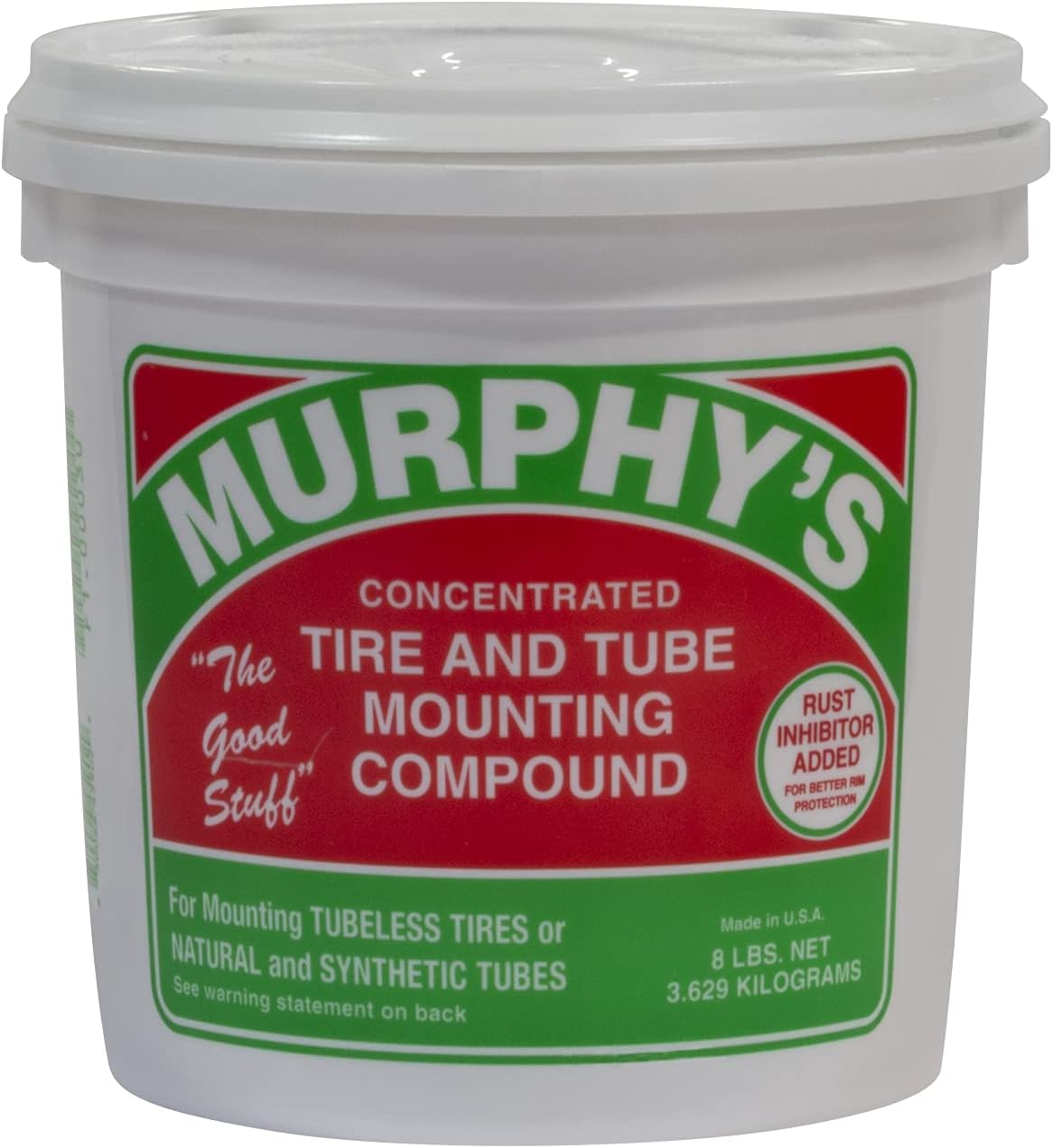
A concentrated tire and tube mounting compound designed to help simplify mounting rubber tires and tubes on passenger, semi truck, construction, and OTR applications. Its ultra-thick formula packs beads effectively and includes rust inhibitors to help protect against corrosion during use.

Related Articles

What Is Hydroplaning? Causes and How to Prevent It
Glide into the surprising causes of hydroplaning and the simple ways to stop it before your tires lose grip.
Read More
Can You Drive on a Tire With a Bulge? Safety Risks
Can you drive on a tire with a bulge, or is a sudden blowout lurking around the corner?
Read More
Is Tire Siping Worth It? Benefits and Drawbacks
Better grip in wet and wintry driving might tempt you—but is tire siping actually worth the tradeoffs?
Read More