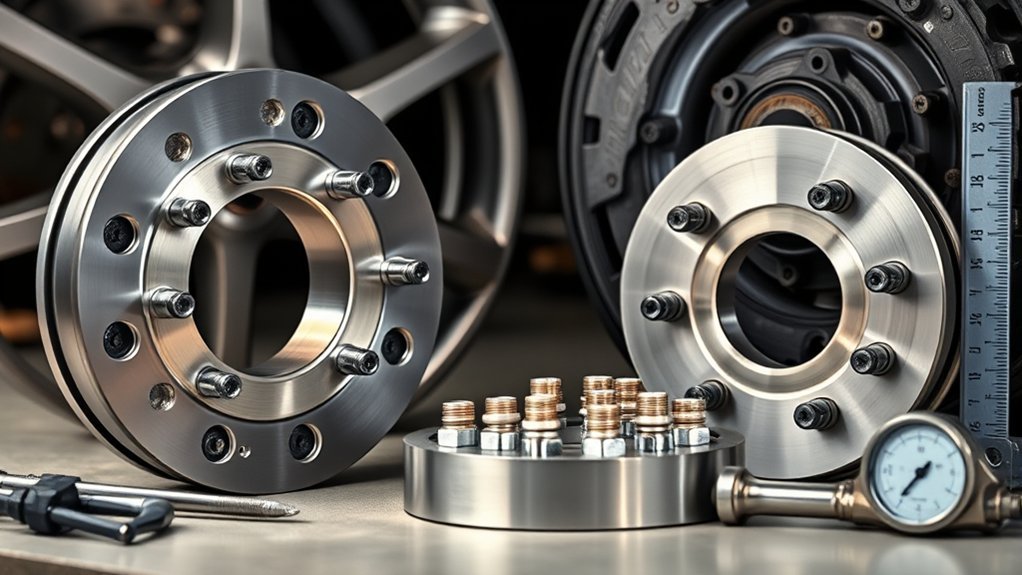
Wheel spacers and wheel adapters both move your wheels outward, but they do different jobs. A spacer keeps the vehicle’s existing bolt pattern, while an adapter can provide a different wheel-side bolt pattern. The right choice depends on your wheel, hub, offset, center bore, hardware, and measured clearance—not on a universal “safe” thickness.
Quick Answer
Use a wheel spacer when you need to move a compatible wheel outward while keeping the same bolt pattern. Use a wheel adapter when the wheel and hub use different bolt patterns. Neither is automatically safer; correct application, centering, hardware, clearance, thread engagement, and torque determine whether the setup is suitable.
Key Takeaways
- Wheel spacers move a wheel outward without changing its bolt pattern; wheel adapters can move it outward and change the wheel-side bolt pattern.
- There is no universal safest spacer thickness. Current manufacturer systems span a wide range of widths, and the correct size depends on the exact vehicle, wheel, tire, and hardware combination.
- A spacer reduces the wheel’s effective installed offset by approximately the spacer thickness. A 15 mm spacer on an ET45 wheel places the wheel approximately where an ET30 wheel of the same width would sit.
- Check bolt pattern, center bore, fastener thread and seat, thread engagement, original-stud clearance, brake clearance, fender clearance, and full steering movement before driving.
- Use a calibrated torque wrench and follow the vehicle, wheel, and spacer or adapter manufacturer’s instructions, including any required post-installation torque checks.
What Is a Wheel Spacer?
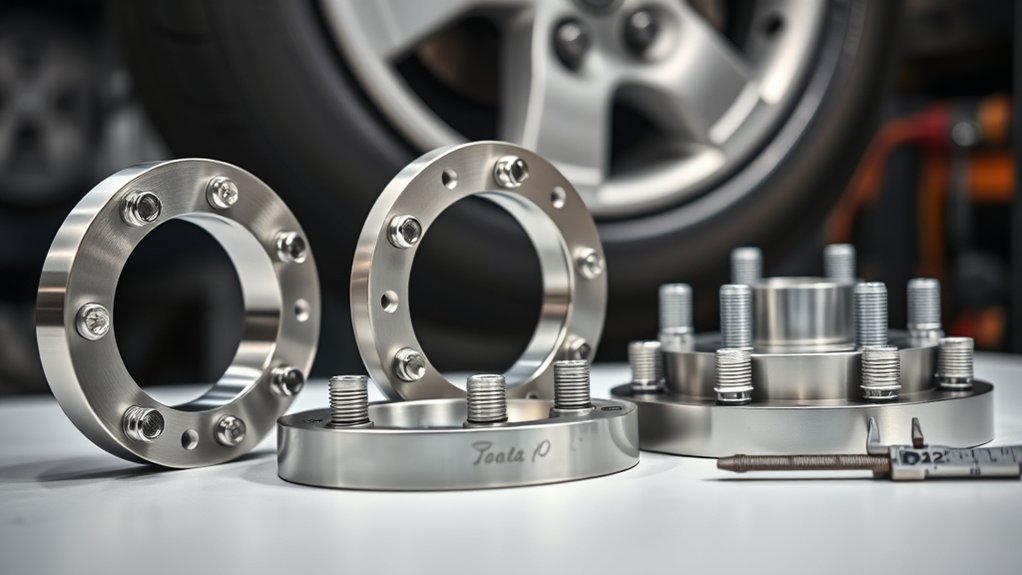
A wheel spacer is a machined component that fits between the hub and wheel and moves the complete wheel-and-tire assembly outward. It increases track width when installed on both sides of an axle and changes the wheel’s installed position without changing the wheel’s own stamped offset.
Spacers are commonly used to fine-tune wheel position, provide additional inner clearance in a verified fitment, or create a different stance. However, a spacer should not be treated as a universal way to make an incompatible wheel fit.
There are several attachment systems. Current Eibach Pro-Spacer products, for example, include both slip-on and bolt-on designs, while H&R TRAK+ lists multiple spacer systems for different vehicle and hardware configurations.
Slip-On Wheel Spacers
A slip-on spacer sits between the hub and wheel while the wheel still uses studs or bolts connected to the original hub. Depending on spacer thickness and vehicle design, you may need longer wheel bolts or longer replacement studs to maintain the required thread engagement.
Bolt-On Wheel Spacers
A bolt-on spacer attaches to the hub first and then provides a second set of studs or threaded holes for the wheel. This design creates two fastening interfaces, so both must match the intended application and be tightened exactly as the manufacturer specifies.
With some bolt-on designs, the original studs can extend beyond the outer face of the spacer. The back of the wheel must have enough recess or pocket depth to clear those studs. If it does not, the wheel may fail to sit flat against the spacer.
A spacer is only one part of the wheel attachment system. Flat mounting surfaces, correct centering, compatible fasteners, adequate thread engagement, proper clearance, and correct torque all matter.
What Is a Wheel Adapter?
A wheel adapter also moves the wheel outward, but its main distinguishing feature is that it can provide a different wheel-side bolt pattern. This can let you use a wheel that does not share the vehicle hub’s original lug pattern.
For example, an application-specific adapter may have one bolt pattern on the vehicle side and a different pattern on the wheel side. Not every bolt-pattern conversion is practical, however. The adapter must have enough material and thickness for its fasteners, both patterns must be correctly engineered, and the wheel still has to clear the body, brakes, suspension, and original hardware.
Current H&R TRAK+ wheel adapters are listed in application-dependent widths from 15 to 50 mm, showing why “adapters start at one inch” is not a reliable general rule.
Do not confuse a bolt-pattern adapter with a hub adapter. H&R also lists hub adapters that retain the same bolt pattern while accommodating a different center-bore arrangement. The exact part must match the function you actually need.
What’s the Difference Between Wheel Spacers and Adapters?
The easiest way to compare wheel spacers vs. adapters is to look at what happens to the wheel interface.
| Feature | Wheel Spacer | Wheel Adapter |
|---|---|---|
| Main purpose | Moves the wheel outward | Changes wheel compatibility and usually moves the wheel outward |
| Bolt pattern | Usually remains the same | Can change from the hub pattern to a different wheel pattern |
| Attachment | Slip-on or bolt-on, depending on design | Normally bolts to the hub and provides a second wheel-side interface |
| Critical measurements | Thickness, bolt pattern, center bore, hub lip, hardware, clearance | Vehicle-side pattern, wheel-side pattern, both center dimensions, thickness, hardware, clearance |
| Is one inherently safer? | No | No |
[Products Worth Considering]

These M14x1.5 closed-end chrome lug nuts are a one-piece replacement designed for secure fitment on compatible GM, Ford, and select Chrysler/Dodge models. Featuring a 60-degree conical seat and anti-rust chrome plating, they help resist corrosion and maintain a bright look for everyday driving. Built for long-term durability, they include OEM-style part references and are backed by 12 months of support.

Upgrade your wheels with MIKKUPPA closed-end lug nuts designed for reliable fit and corrosion resistance. The one-piece, cold-forged and heat-treated steel construction helps resist rust and stripping, while the integrated finish delivers a durable black appearance. Built to OEM standards with a conical 60-degree seat, these nuts provide a secure solution for compatible Ford, Honda, Jeep, and Chevrolet models.

This car D-wheel lock nut key provides an anti-theft solution for D-shaped wheel lock bolts, helping keep your wheels secure. It features a flower-shaped internal pattern that resists micro-adjustment theft while allowing removal and mounting of compatible locking nuts. Made for reliable performance under high torque, it’s easy to use with standard socket wrench turning for quick tire maintenance and emergency repairs.
Hub-Centric Fitment and Fastener Details
A hub-centric spacer or adapter is designed around the vehicle’s hub-centering dimensions so the assembly can be positioned concentrically. Manufacturers such as H&R use hub-centric designs in many application-specific systems.
Hub-centric construction does not replace the need for correct wheel fasteners. You still need to confirm all of the following:
- Bolt pattern or PCD: The hole count and pitch-circle diameter must match the intended hub or wheel interface.
- Center bore: The spacer must fit the hub correctly, and its wheel-side centering feature must be compatible with the wheel.
- Thread diameter and pitch: Examples include M12x1.5 and M14x1.5; use only the specification required for your vehicle and hardware.
- Fastener seat: Conical, ball/spherical, mag, and other seats are not interchangeable.
- Thread engagement: The fastener must engage far enough to create the required clamping force.
- Stud or bolt length: Slip-on spacers can require longer hardware, while bolt-on systems may have their own studs or threaded holes.
The Wheel & Tire Council aftermarket wheel-installation guideline hosted by NHTSA says every stud or bolt must have adequate thread engagement and recommends engagement at least equal to the fastener diameter unless the applicable manufacturer specifies otherwise. Eibach publishes its own minimum-turn requirements for specific Pro-Spacer hardware, so the instructions supplied with your exact system take priority.
Warning: Never assume that a spacer fitting over the studs means the complete wheel assembly is compatible. Stop if the spacer does not sit completely flat, the wheel cannot sit flat against the spacer, the fastener seat or thread is wrong, the studs are too short, or any part contacts the brakes, suspension, ABS components, body, or original hardware.
Are Wheel Spacers and Adapters Safe?
Wheel spacers and adapters are not automatically safe or unsafe simply because of their thickness or type. Their suitability depends on whether the part was designed for the application and whether the full wheel attachment system is installed correctly.
Eibach’s Pro-Spacer installation instructions require installers to verify hub fit, bolt pattern, hardware dimensions, wheel and fender clearance, brake-related clearance, free wheel rotation, and final torque. Eibach also recommends professional installation for that system and warns against combining two or more spacer rings.
A separate Wheel & Tire Council installation guide hosted by NHTSA warns that spacers and adapters should not be used simply to force an otherwise unsuitable wheel fitment. That distinction matters: a properly engineered application-specific system is different from using a generic spacer as a workaround for the wrong wheel.
Do Not Stack Wheel Spacers
Do not stack two spacers to create the thickness you want. Eibach specifically states that combining two or more spacer rings is not safe. Use one properly designed spacer or adapter of the required specification.
Material Quality Matters, but Alloy Numbers Are Not Enough
Many reputable spacers and adapters use high-strength aluminum alloys, but you should not judge safety only by marketing terms such as “T6,” “aircraft aluminum,” or a particular alloy number. T6 is a temper designation, not a complete material specification by itself.
Look instead for a reputable manufacturer, verified vehicle application, accurate machining, appropriate hardware, clear load/application information, corrosion protection where appropriate, and detailed installation instructions.
How Do Spacers Affect Wheel Offset and Track Width?
Spacer thickness changes where the wheel sits even though the number stamped on the wheel does not change.
A useful fitment calculation is:
Approximate effective offset = wheel offset − spacer thickness
For example, if you have an ET45 wheel and add a 15 mm spacer, the wheel sits approximately where an ET30 wheel of the same width would sit:
45 mm − 15 mm = 30 mm effective installed offset
If you install the same 15 mm spacer on both sides of an axle, the total track width increases by approximately 30 mm.
Note: Offset math tells you where the wheel moves; it does not prove that the setup fits. Wheel width, tire width and shape, brake package, suspension travel, steering angle, fender shape, and alignment can all change the available clearance.
Moving the wheel centerline outward can also change steering geometry and the loads acting through wheel-end components. The amount depends on the original suspension geometry, wheel specifications, tire, vehicle load, and final offset, which is another reason to avoid choosing thickness by appearance alone.
How Do You Choose the Right Size and Fitment?
There is no universal “safe” spacer size such as 3–10 mm or a universal “flush” range such as 12–20 mm. Current manufacturer catalogs include far wider ranges because different vehicles require different systems. H&R, for example, lists spacer designs from 3 mm up to 65 mm depending on the system and application.
Choose thickness from measurements and verified fitment data instead:
- Confirm the wheel specifications. Record wheel width, diameter, offset, bolt pattern, center bore, and fastener-seat type.
- Confirm the vehicle hub specifications. Verify bolt pattern, hub diameter, thread diameter, thread pitch, and original stud or bolt arrangement.
- Measure the outside gap. With the vehicle at normal ride height, use a straightedge at the fender and measure how far the wheel or tire can move outward without protruding or contacting the body.
- Check inner clearance. Confirm clearance around brakes, suspension components, wheel weights, brake hoses, ABS components, and other nearby hardware.
- Calculate the new effective offset. Subtract spacer or adapter thickness from the current wheel offset.
- Verify the hardware system. Make sure you will have the required thread engagement and correct fastener seat after the spacer is installed.
- Check original-stud clearance. On applicable bolt-on systems, confirm that protruding factory studs fit into recesses in the back of the wheel.
- Test the assembly before driving. The spacer and wheel must sit flat and concentric, and the wheel must rotate freely.
Pro Tip: Choose the thinnest application-approved spacer that achieves the clearance or wheel position you actually need. Leaving extra fender clearance is more useful than chasing a perfectly flush appearance that rubs when the suspension compresses.
[Products Worth Considering]

The 22800 wheel stud installer makes replacing wheel studs quick and secure, saving time and effort during tire service. It uses a ratchet or impact wrench to pull new studs firmly into place, helping when existing studs are too long. Compatible with most automotive wheels and light-duty truck wheel studs, it’s designed for easy, tool-assisted installation.

Upgrade your wheels with MIKKUPPA M12x1.5 mag seat lug nuts built for secure, corrosion-resistant performance. These closed-end chrome lug nuts are a direct replacement for select Toyota models, including Camry, Corolla, RAV4, Sienna, Avalon, Highlander, Matrix, Venza, and Prius. Triple-chromium plating and cold-forged, heat-treated steel help deliver strength for daily driving and replacement needs.

Replace or upgrade your zero-turn lawn mower tires with a universal fit flat-free tire and wheel assembly in a convenient 2-pack. Smooth tread front-caster style helps turning with reduced turf damage, while flat-free design eliminates the maintenance and downtime of air-filled flats. The included adapter kit supports 5/8-inch axles and hub lengths from 3.4 to 5 inches for compatibility across most ZTR mowers.
Installation and Post-Installation Checks
Wheel attachment is safety-critical, so follow the instructions supplied by the vehicle, wheel, and spacer or adapter manufacturer. If those instructions conflict, do not guess—confirm the correct procedure for the exact application.
[Products Worth Considering]

Replace worn wheelchair rear tires with a universal 24x1 no-flat polyurethane foam option designed to mount tightly on 24-inch rims without the tire falling off. Installation is made easier with included tools and multiple methods, including using a pry bar or softening the tire in hot water to reduce resistance. The package includes two tires plus tie ropes for convenient fitting and handling.

Measure tire tread depth quickly and accurately with this LUMITECO dial gauge that reads in 1/32" increments up to 14/32". The color-coded green/yellow/red zones make it easy to judge tire wear and know when replacement is needed. A rugged, compact design with a protective pouch helps keep the gauge ready for use on cars, trucks, motorcycles, and more.

Monitor tire tread wear with a smart, color-coded depth gauge that shows clear condition ranges at a glance. The bar is range marked for fast, easy readings, helping you maintain safer traction and performance. Each gauge is portable with a pocket clip, and the set includes 20 units for daily use and sharing.
Before Installation
- Inspect studs, wheel bolts, nuts, threads, and mounting surfaces for damage.
- Clean rust, scale, and dirt from the hub and mating surfaces so the spacer can sit completely flat.
- Verify the spacer or adapter part number and application.
- Confirm bolt pattern, center bore, hardware, fastener seat, and thread engagement.
- Never stack spacer rings.
During Installation
- Support the vehicle safely before removing a wheel.
- Make sure the spacer or adapter sits flush against the hub with no rocking or interference.
- Make sure the wheel then sits flush against the spacer or adapter.
- Start fasteners by hand so you do not cross-thread them.
- Tighten fasteners gradually in the correct crisscross or star pattern.
- Use a calibrated torque wrench for final tightening.
- Follow the applicable torque specification rather than guessing from stud diameter alone.
Before Driving
Rotate the wheel and check for contact with the brake system, ABS components, suspension, wheel weights, or other hardware. Turn the steering from lock to lock on the front axle and verify tire-to-body and tire-to-suspension clearance.
Clearance also has to remain adequate when the vehicle is carrying weight and the suspension compresses. A setup that clears while hanging on a lift can still rub on the road.
Recheck Torque
Follow the spacer or adapter manufacturer’s exact re-torque schedule. Schedules differ. Eibach’s System 6 instructions call for checks at approximately 25 miles and 500 miles, while the Wheel & Tire Council aftermarket wheel guideline calls for a fastener torque check within the first 100 miles or two to three days.
That is more accurate than treating “50–100 miles” as a universal rule.
Check Alignment and Driving Behavior
Eibach advises checking wheel alignment after spacer installation and adjusting it if necessary. An alignment is especially sensible when the vehicle already has suspension modifications, altered ride height, unusual tire wear, or a noticeable steering change.
After installation, stop driving and inspect the setup if you notice new vibration, steering shake, clicking, rubbing, looseness, unusual tire wear, or a wheel that does not appear centered.
When Should You Not Use a Wheel Spacer or Adapter?
A spacer or adapter is the wrong fix when the underlying wheel is incompatible in a way the component was not specifically designed to address.
Do not proceed if:
- The bolt pattern or center bore is wrong for the specified interface.
- The wheel cannot sit completely flat.
- You cannot obtain the required thread engagement.
- The original studs interfere with the wheel on a bolt-on design.
- The tire contacts the body or suspension at full steering lock or during suspension movement.
- The wheel or spacer contacts a brake caliper, brake hose, ABS component, or other hardware.
- The studs, bolts, lug nuts, wheel, hub, or bearing are already damaged.
- You are trying to cure vibration without first identifying its actual cause.
- You would need to stack multiple spacers.
- The modification is prohibited for road use where you live.
Sometimes the better solution is a wheel with the correct bolt pattern, center bore, width, and offset instead of adding another interface between the wheel and hub.
Are Wheel Spacers and Adapters Legal?
There is no single rule that covers every U.S. state or every country. Local equipment laws and inspection standards can impose their own restrictions, so check the rules where the vehicle is registered and driven.
For example, 67 Pa. Code § 175.65 states that spacers or similar devices thicker than 1/4 inch may not be installed to increase wheel track on vehicles covered by that Pennsylvania regulation.
That Pennsylvania limit should not be treated as a nationwide rule. It is an example of why legal fitment needs to be checked locally before you buy or install parts.
Frequently Asked Questions
Are Wheel Adapters Safer Than Wheel Spacers?
No. An adapter is not inherently safer than a spacer, and a spacer is not inherently safer than an adapter. Safety depends on whether the component is designed for the exact vehicle and wheel, sits flat and centered, uses compatible hardware, provides proper thread engagement, has adequate clearance, and is tightened and maintained correctly.
Is It Safe to Drive With Wheel Adapters?
An application-specific adapter can be suitable when its vehicle-side and wheel-side bolt patterns, center dimensions, hardware, load requirements, and clearances are correct. Follow the adapter manufacturer’s torque and inspection instructions, and stop driving if you develop vibration, rubbing, looseness, or other abnormal behavior.
How Big of a Wheel Spacer Is Safe?
There is no universal safe maximum. A 5 mm spacer can be wrong if it leaves inadequate thread engagement, while a thicker application-specific bolt-on system may be designed for a particular vehicle. Use the manufacturer’s approved application and measure offset, fender clearance, suspension clearance, center bore, and hardware before choosing thickness.
Is It Safe to Run 1/2 Inch Wheel Spacers?
A 1/2-inch spacer is about 12.7 mm, but that number alone cannot determine safety. Verify that a spacer of that thickness is approved for your application, that the hardware provides adequate engagement, and that the wheel and tire clear the brakes, suspension, body, and original studs throughout their full range of movement.
Can You Stack Two Wheel Spacers?
Do not stack spacers unless a manufacturer explicitly engineered and approved the complete assembly. Eibach specifically states that two or more Pro-Spacer rings must not be combined. Use one correctly sized, application-specific component instead.
Do You Need an Alignment After Installing Wheel Spacers?
A flat spacer by itself does not automatically change your suspension adjustment settings, but the final wheel position and existing suspension setup still matter. Eibach recommends inspecting alignment after installation and adjusting it when necessary, especially if you notice steering changes or uneven tire wear.
Can Wheel Spacers Fix Wheel Vibration?
Do not use a spacer as a generic vibration fix. Vibration can come from wheel balance, damaged tires or wheels, incorrect centering, dirty mounting surfaces, loose or incompatible hardware, bent components, or other mechanical problems. Identify the cause first. A correctly specified hub-centric component can help maintain accurate centering, but it cannot repair another defect.
Sources
- Eibach Pro-Spacer — current spacer-system types, width ranges, application guidance, and measuring information.
- Eibach Pro-Spacer System 6 Installation Instructions — hub fit, hardware, torque-wrench use, clearance, thread engagement, professional installation, and recheck guidance.
- H&R TRAK+ Wheel Spacers and Adapters — spacer designs, current width ranges, wheel-adapter ranges, hub-centric construction, and hardware requirements.
- Wheel & Tire Council Aftermarket Wheel Installation Guidelines, hosted by NHTSA — fastener compatibility, thread engagement, clearance, torque procedure, and post-installation checks.
- 67 Pa. Code § 175.65 — Pennsylvania wheel and spacer restriction example.
Conclusion
Wheel spacers and adapters can look similar, but the distinction is simple: spacers change wheel position while retaining the existing bolt pattern, whereas adapters can also change the wheel-side bolt pattern. Neither part should be chosen by appearance or thickness alone.
Match the component to your exact hub and wheel, calculate the resulting offset, verify center bore and hardware, maintain proper thread engagement, check every clearance point, and use the specified torque procedure. Avoid stacked spacers and do not use an adapter or spacer to force an otherwise incompatible wheel onto the vehicle. When the complete setup is properly engineered and installed, you get controlled wheel positioning instead of improvised fitment.