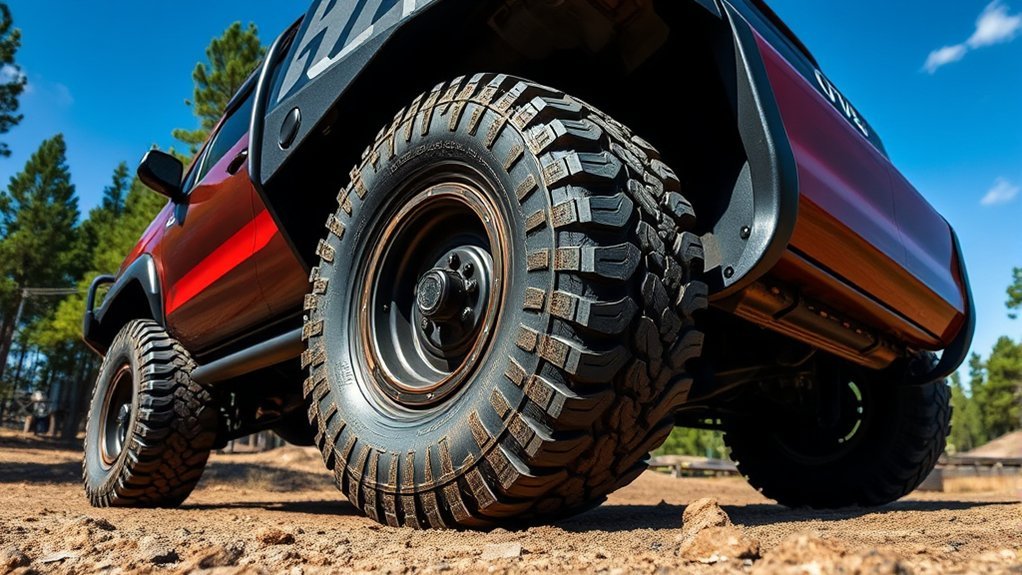
Choosing Toyota Hilux tyres for camping starts with the tyre placard and owner’s manual—not a universal size or pressure chart. Sizes such as 265/65R17 and 265/60R18 are factory examples on some Hilux grades, but the correct choice also depends on your exact model, wheel, load rating, terrain, camping payload, and local modification rules.
Quick Answer
For most mixed road and camping use, a properly rated all-terrain tyre in the size shown on your Hilux tyre placard is the safest starting point. Use the placard’s cold pressures for sealed-road travel, account for your camping load, and only air down cautiously on loose terrain before reinflating for normal road speeds.
Key Takeaways
- Confirm the approved tyre size and cold pressure on the driver’s-door placard or in the owner’s manual.
- Match the full service description, including load index, speed rating, and construction—not just 265/65R17 or 265/60R18.
- All-terrain tyres usually suit mixed highway, gravel, and campsite access; rugged- and mud-terrain tyres involve greater compromises.
- There is no universal Hilux off-road pressure. Safe airing down depends on the tyre, rim, axle load, speed, and surface.
- Inspect the full-size spare, tread, sidewalls, valves, wheel nuts, repair gear, and compressor before remote travel.
At a Glance
| Time Required | 15–30 minutes for a pre-trip inspection; longer if you are comparing replacement sizes |
| Difficulty | Easy for inspection; professional advice recommended for size, wheel, or construction changes |
| Tools Needed | Accurate pressure gauge, tread-depth gauge, torch, owner’s manual, and tyre placard details |
| Cost | Usually $0 for a visual check; approximately $15–$60 for basic gauges, excluding repairs or replacement tyres |
How to Check Your Current Tyre Size on a Hilux
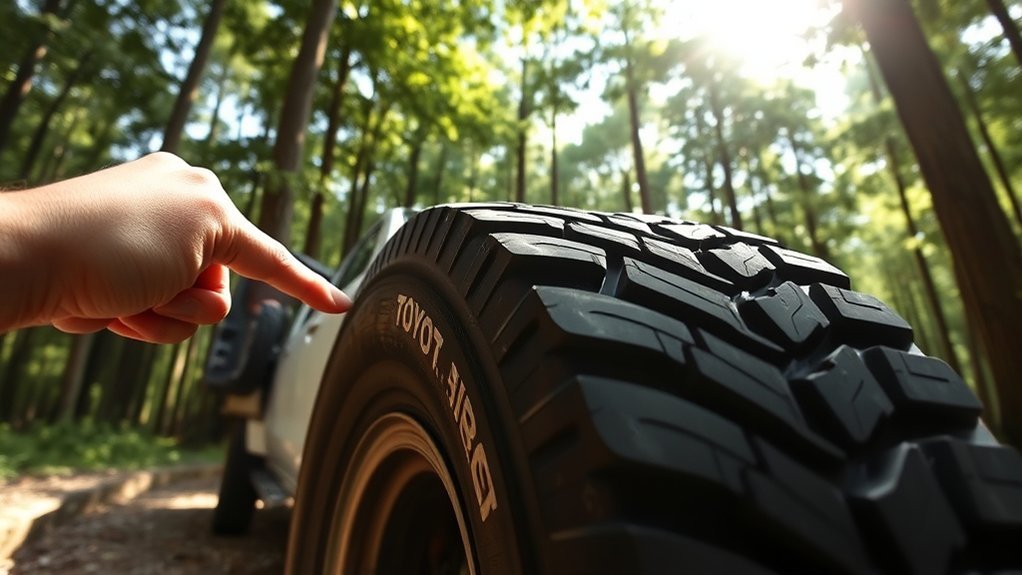
Use the following process before ordering replacement tyres or planning an upgrade:
- Read the driver’s-door tyre placard. It identifies the vehicle manufacturer’s approved tyre information and recommended cold pressures for that configuration.
- Check the owner’s manual. Toyota advises owners to use the placard or manual for tyre pressure and fitment information. The current manual for your market is more reliable than a generic online chart.
- Read the complete sidewall marking. A marking such as 265/65R17 120/117Q includes more than the basic size.
- Compare all four road tyres and the spare. Look for mismatched sizes, constructions, load ratings, excessive age, damage, and uneven wear.
- Confirm modifications. If the wheels, suspension, brakes, or tyres are not standard, have a qualified tyre fitter or vehicle engineer verify compatibility.
In 265/65R17, 265 is the nominal section width in millimetres, 65 is the sidewall height as a percentage of the width, R means radial construction, and 17 is the wheel diameter in inches. Numbers and letters after the size identify the load and speed capability. Michelin’s tyre-marking guide explains why the complete service description matters.
Note: The tyres currently fitted are not proof that the size is approved. A previous owner may have changed the wheels or tyres, so compare the sidewall with the placard, manual, and local modification requirements.
Pro Tip: Photograph the tyre placard, each tyre’s service description, and the spare before visiting a retailer. This reduces the chance of comparing tyres with the right dimensions but the wrong load rating or construction.
Ideal Tyre Sizes for Toyota Hilux Camping
There is no single ideal size for every Hilux. Toyota Australia’s June 2026 Hilux specifications list 265/65R17 on some grades and 265/60R18 on others. Other markets, generations, cab styles, and two-wheel-drive variants may use different sizes.
| Factory-size example | Potential camping benefit | Main consideration |
|---|---|---|
| 265/65R17 | More sidewall than the equivalent 18-inch setup can improve cushioning and provide more tyre deflection on rough surfaces. | It is only suitable where the wheel, brakes, placard, load rating, and local rules allow it. |
| 265/60R18 | Retains a similar nominal overall diameter while using the 18-inch wheel fitted to certain higher grades. | The shorter sidewall generally provides less cushioning and rim protection on sharp or heavily corrugated tracks. |
The two sizes have almost the same calculated nominal overall diameter, but that does not make them automatically interchangeable. Wheel diameter, rim width, offset, brake clearance, steering clearance, tyre construction, and placard approval still matter.
[Products Worth Considering]

These universal tire valve stem caps help protect valve cores from dust, debris, and moisture while helping maintain stable tire pressure. The corrosion-resistant metal construction and sealed design provide reliable protection in road grime, mud, and winter conditions. Twist-on installation makes them quick to fit on cars, SUVs, trucks, and motorcycles.
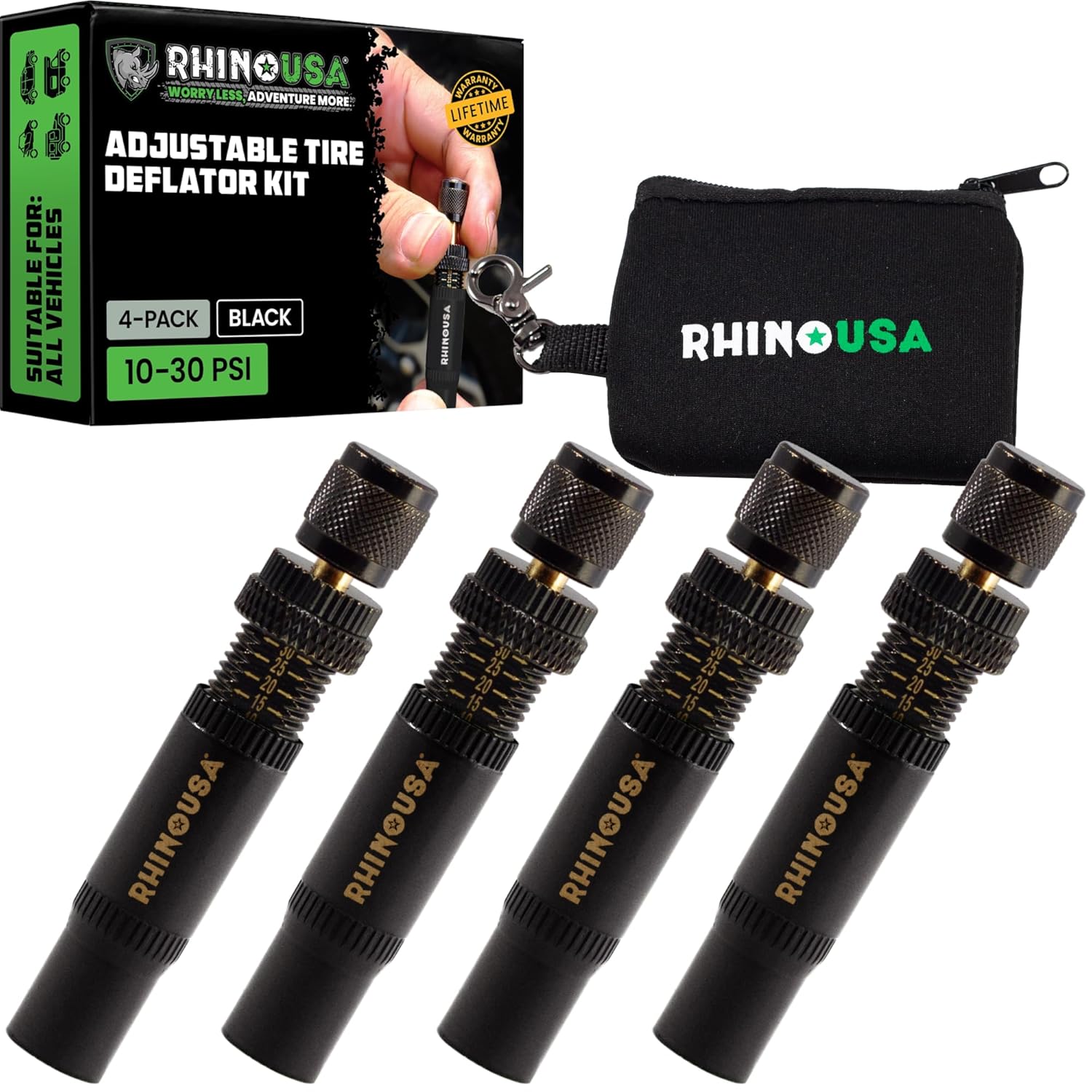
Use the Rhino USA adjustable tire deflators to air down all four tires at once by screwing one deflator onto each valve stem, letting you step away while the tires reach your preset pressure. Each deflator independently adjusts across a 10–30 PSI range with laser-etched indicators for quick setup and verification, making it ideal for beach, sand, and rocky off-road trails.

Upgrade your Toyota’s wheels with durable aluminum alloy valve stem caps that help protect valve cores from corrosion and direct exposure to road grime, clay, water, and snow. Rubber rings improve sealing to help prevent air leakage and maintain stable tire pressure for safer driving. These caps are easy to install or remove without tools and add a unique, stylish look to your car.
Checks Before Changing Tyre Size
- Placard and manual: Start with sizes approved for the exact model, grade, body style, and market.
- Load index: The replacement must meet the vehicle’s requirements and the loads carried by each axle.
- Speed rating: Use a rating permitted by the vehicle manufacturer and local law.
- Rim width and offset: Both must fall within the wheel and tyre manufacturers’ approved ranges.
- Clearance: Check the tyre at full steering lock and through suspension compression, including when the vehicle is loaded.
- Overall diameter: A larger or smaller tyre can affect gearing, braking systems, speedometer accuracy, clearance, and legal compliance.
- Spare compatibility: Carry a spare with a compatible rolling diameter and enough load capacity for the Hilux.
- Vehicle loading: Occupants, drawers, canopy, rooftop tent, water, fuel, recovery equipment, trailer ball load, and accessories all consume payload.
Warning: Do not select a tyre only because its basic dimensions fit inside the wheel arch. An unsuitable wheel or tyre can affect steering, braking, wheel bearings, speedometer calibration, clearance, and insurance or roadworthiness compliance. Have non-standard fitments checked by a qualified professional.
Optimal Tyre Pressure for Off-Roading
The correct sealed-road starting pressure is the cold pressure on your Hilux tyre placard, adjusted only as the manual or an approved load-pressure calculation directs. Toyota recommends checking the pressure when the tyres are cold and also checking the spare. See Toyota Australia’s maintenance guidance.
A blanket range of 2.0 to 2.4 bar (29–35 psi) is not correct for every Hilux. Your exact requirement can change with the model, front and rear axle loads, tyre size, tyre construction, canopy, camping equipment, passengers, towing load, and operating speed.
Use the vehicle placard for normal road travel; treat any off-road pressure reduction as a temporary, low-speed adjustment—not a new highway setting.
How to Air Down More Safely
- Record the cold road pressures. Check all tyres before the trip and note the front and rear settings.
- Assess the surface and load. Loose sand may need more flotation than firm gravel, while sharp rocks demand greater sidewall protection.
- Reduce pressure in small, equal steps. Do not jump to a generic target copied from another vehicle.
- Drive slowly and smoothly. Reduced pressure increases sidewall flex and heat and can make the tyre more vulnerable to pinching, cuts, or bead separation.
- Inspect frequently. Watch for excessive sidewall bulge, rim contact, steering changes, rising tyre temperature, or debris near the bead.
- Reinflate before normal-speed or sealed-road travel. Use an onboard compressor and confirm the pressure with a reliable gauge.
Cooper Tires’ 4WD tyre-pressure guide similarly notes that suitable pressure changes with the tyre, vehicle, load, speed, and surface.
Warning: Very low pressure can unseat a bead, damage a sidewall, overheat the tyre, reduce steering response, and overload the casing. Avoid sharp turns and high speed while aired down, and never return to highway speed before reinflating.
Best Tyre Types for Camping With a Toyota Hilux
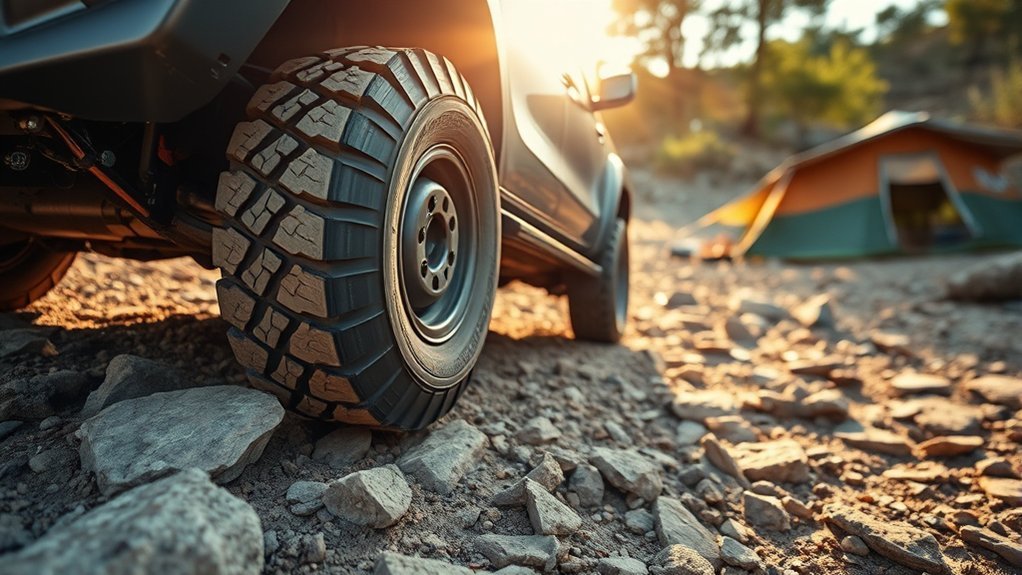
The best category depends on how much of your trip is spent on sealed roads and how difficult the campsite access becomes. More aggressive tread does not automatically make a tyre safer or better for everyday touring.
| Tyre type | Best suited to | Trade-offs |
|---|---|---|
| Highway terrain | Mostly sealed roads, maintained campsites, light gravel, and drivers prioritising quietness and fuel economy. | Less aggressive grip and protection on deep mud, sharp rocks, and heavily rutted trails. |
| All-terrain | Mixed highway, gravel, forestry roads, corrugations, and moderate campsite access. | Usually noisier and heavier than a highway tyre, with performance differences between models. |
| Rugged terrain | Drivers wanting more open tread and off-road protection than a typical all-terrain tyre without moving fully to mud terrain. | Greater road noise, weight, and rolling resistance may be noticeable. |
| Mud terrain | Frequent deep mud, steep loose tracks, and demanding off-road use where self-cleaning tread is a priority. | Often the noisiest and least refined choice for long paved journeys, with potential wet-road and fuel-economy compromises. |
For many camping Hilux owners who drive long sealed-road distances before reaching gravel or moderate tracks, an all-terrain tyre with the correct load rating is the most balanced category. Drivers who regularly encounter deep mud or sharp rocky terrain may justify a rugged- or mud-terrain design, but should accept the extra road compromises.
[Products Worth Considering]

These aluminum alloy tire valve stem caps with an O-ring seal help protect valve stems from corrosion while adding a clean, stylish look to your vehicle. The universal fit works across cars, trucks, motorcycles, bicycles, and more, making them an easy upgrade for everyday driving and off-road use. Installation is quick, and the included four-pack keeps all your tires dressed and protected.

This ALL-TOP auto-stop tire deflator valve kit lets you air down off-road tires quickly without watching pressure, automatically stopping when your preset PSI is reached. Each valve is individually calibrated for reliable performance with an acceptable +/- 2 PSI tolerance. The adjustable deflator range covers 10 to 30 PSI and includes four valves plus valve caps and a zipper pouch for easy setup on trucks, SUVs, RVs, UTVs, and powersports.

Keep your tires properly inflated with this analog VONDIOR tire pressure gauge, designed for fast, easy readings without batteries. The swiveling, two-axis hose and large glow dial help you measure at any tire angle with instant visibility. Built with a protective rubber shield, it supports durable, low-maintenance use for cars and trucks.
Load Rating, Speed Rating, and LT Construction
Two tyres with the same size can have different load and speed ratings. Match at least the manufacturer-required rating unless a qualified professional confirms a legally permitted alternative. A higher tyre load index does not increase the Hilux’s GVM, axle limits, or legal payload.
LT-marked light-truck tyres may provide stronger construction and greater load capability in suitable applications, but they can also be heavier, firmer, and less comfortable. They may need different load-pressure guidance from a passenger or XL tyre. Choose construction according to the actual load and terrain rather than assuming LT is always better.
When Should You Replace Your Hilux Tyres?
Replace a Hilux tyre when it reaches the legal tread limit in your jurisdiction, when a tread-wear indicator is flush with the tread, or when it has unsafe damage or deterioration. Do not assume 1.6 mm is the rule everywhere: several Australian jurisdictions specify 1.5 mm, while the UK specifies 1.6 mm for cars and light vans.
Remote touring may justify replacement before the legal minimum. A tyre near its limit has less available tread for water dispersion, loose surfaces, and unexpected detours, even if it can still pass a basic roadworthiness check.
Inspecting Tread Depth
- Use a tread-depth gauge in several principal grooves around each tyre.
- Measure the inner, centre, and outer areas rather than checking one easy-to-reach point.
- Look for uneven shoulder wear, flat spots, cupping, or rapid wear on one axle.
- Check the tread-wear indicators molded into the main grooves.
- Follow the law where the vehicle is registered and driven.
For an Australian example, Western Australia’s wheel and tyre guidance states that tread depth should be at least 1.5 mm. Other states and countries may define the measurement area differently.
Checking for Damage
Have a tyre inspected promptly if you find:
- Bulges, bubbles, exposed cords, deep cuts, or cracking
- A sidewall puncture or impact mark
- Repeated pressure loss
- A bent or cracked wheel
- Severe vibration, pulling, or a new rhythmic noise
- Uneven wear that suggests alignment, suspension, balance, or pressure problems
- Damage caused by driving while substantially underinflated
Tyre age also matters. Bridgestone Australia advises annual professional checks after five years from manufacture and replacement after ten years regardless of remaining tread. Check the manufacturing code on every road tyre and the spare using the guidance in Bridgestone’s tyre-care information.
Warning: A plug kit is an emergency measure, not proof that a tyre is safe for continued highway use. Sidewall and shoulder damage, exposed cords, large punctures, bead damage, or a tyre driven flat usually require professional assessment and may require replacement.
Tyres to Compare for Hilux Camping
No named tyre is best for every Hilux or every trip. The following current and historical examples show how different categories are positioned. Confirm the exact size, service description, regional availability, wheel compatibility, and intended use before buying.
- Patriot R/T+: The manufacturer classifies the Patriot R/T+ as a rugged-terrain SUV and light-truck tyre. Its open tread and three-ply claims may appeal to drivers wanting a more aggressive design, but it is not a conventional quiet highway tyre and fitment must be checked.
- Cooper AT3 LT: The current Cooper AT3 LT is positioned for mixed sealed and unsealed driving, towing, and load carrying. The Australian range lists both 265/65R17 and 265/60R18, but the size and service description still need to match the Hilux.
- Goodyear Wrangler DuraTrac RT: Goodyear describes the current Wrangler DuraTrac RT as a rugged-terrain tyre focused on traction and durability. Its listed range includes common 17- and 18-inch 4WD sizes, including 265/65R17 and 265/60R18.
- Nokian Rockproof: Nokian introduced the Rockproof in 2016 as a specialist tyre for demanding quarry, forest, mining, and off-road work. Treat it as a specialised historical example and verify present availability in your region rather than assuming it is a current general-purpose camping choice.
Compare independent test results where available, warranty terms, wet-road braking, noise, tread depth, casing construction, load capacity, dealer support, replacement availability, and whether the spare can be matched in remote areas.
[Products Worth Considering]
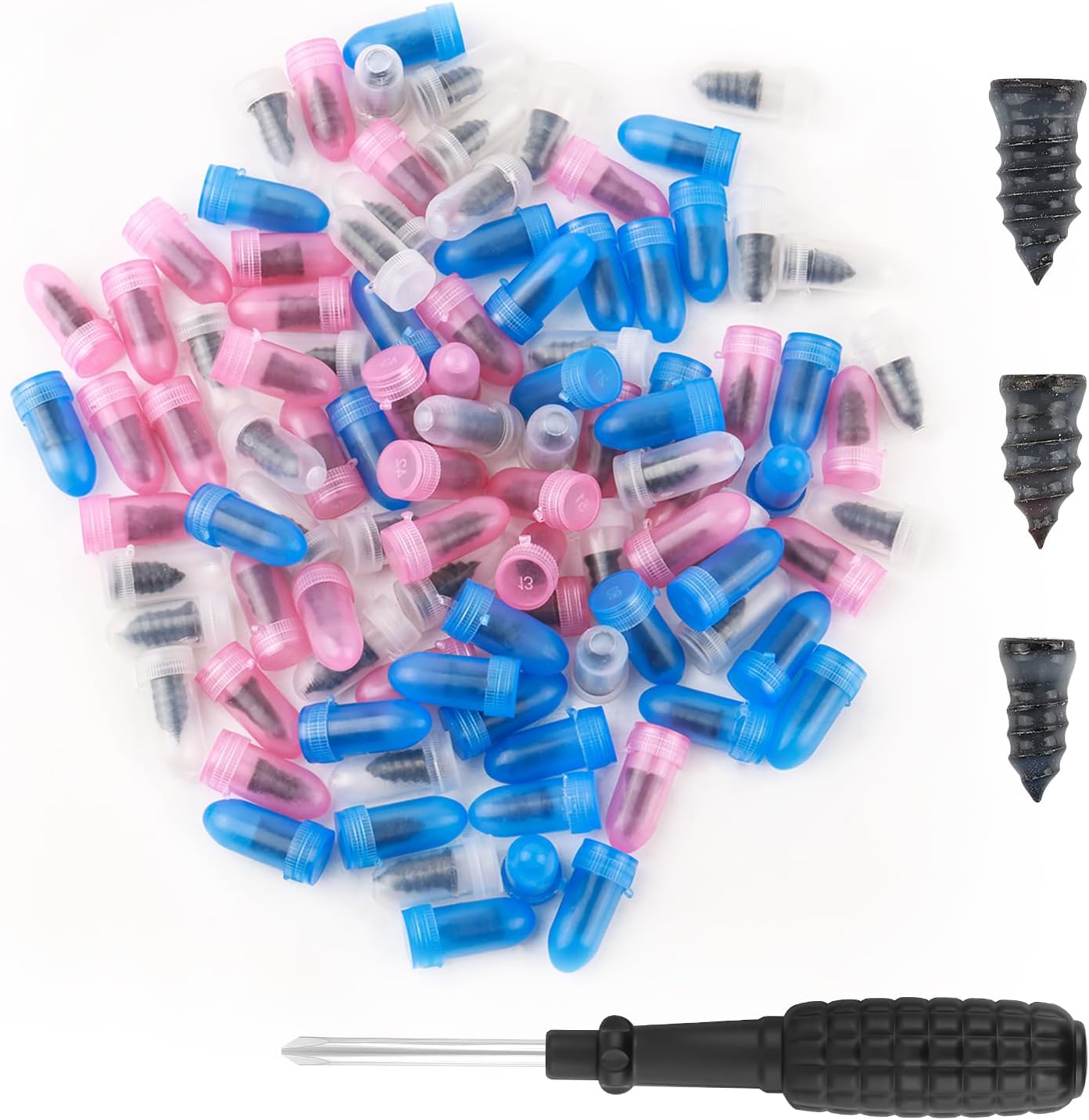
This 100-piece tire repair screw plug kit provides a fast, self-service solution for punctures on the road. Choose the correct plug size, insert it into the break, and screw it in to help seal the puncture and temporarily restore tire pressure. Thickened threads and rubber-wrapped plugs improve bite and sealing while remaining compact and easy to carry.

BAURATTI tire valve stem caps provide corrosion-resistant protection using anodized aluminum alloy with a plastic liner to help prevent rust and cracking. Designed for universal compatibility with standard Schrader valve stems, they install easily by hand and fit cars, SUVs, trucks, RVs, motorcycles, and bikes. Each pack includes 8 caps to support everyday replacement and sharing.

This tire repair kit provides fast emergency puncture repair without removing the tire from the rim, helping you get back on the road quickly. Its screw plug system is designed for punctures in both tread and sidewall and includes a complete patch plug tool set with essential accessories. A portable storage bag makes it easy to carry for cars, trucks, SUVs, motorcycles, and heavy-duty applications.
How Tyres Impact Your Camping Experience
Tyres affect more than off-road traction. Their tread pattern, construction, weight, pressure, and condition influence several parts of a camping trip:
- Wet-road control: Tread design and remaining depth affect water evacuation and grip.
- Highway comfort: Aggressive blocks and heavy construction can increase noise, vibration, and steering effort.
- Fuel use: Added tyre weight, rolling resistance, and incorrect inflation can increase consumption.
- Rough-road durability: Suitable construction can improve resistance to cuts, chipping, and impacts, but no tyre is puncture-proof.
- Flotation: A controlled temporary pressure reduction can lengthen the contact patch on loose sand.
- Payload stability: The correct load capacity and pressure help the tyre support a loaded vehicle without excessive heat or flex.
- Recovery options: A matching spare, compressor, and repair equipment can prevent a minor puncture from ending the trip.
The best touring setup balances the most difficult terrain you realistically expect against the much greater distance many campers travel on sealed roads.
Maintaining Your Tyres During Camping Trips
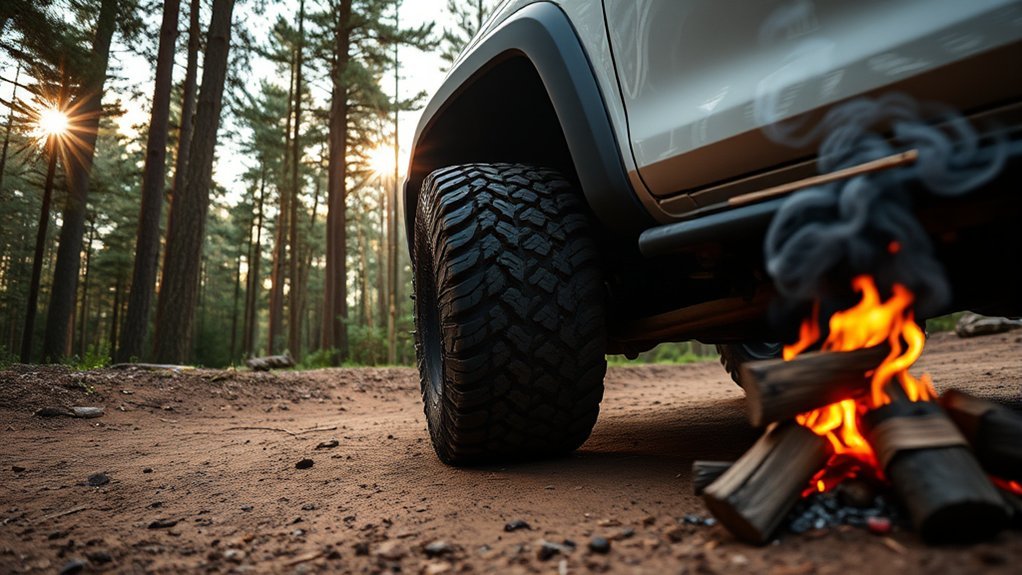
Inspect the tyres before departure, after difficult off-road sections, and before returning to high-speed roads. Include the spare in every check.
Regular Pressure Checks
- Measure pressure when the tyres are cold whenever possible.
- Use the Hilux placard or manual for normal road pressures.
- Account for the camping load using Toyota or tyre-manufacturer guidance rather than guessing.
- Check front and rear values separately because they may differ.
- Recheck after a major temperature change, a puncture repair, or a hard impact.
- Reinflate immediately after low-pressure off-road driving and before normal road speed.
- Do not use the maximum pressure molded on the sidewall as the normal target.
Inspect Tread Depth During the Trip
Check the tread at several points and remove loose stones that are not embedded deeply. Look for fresh cuts, torn blocks, trapped debris, and rapid shoulder wear after rocky or heavily corrugated tracks.
The US penny test is a rough regional shortcut, not a universal measurement method. A small tread-depth gauge provides a direct reading in millimetres and avoids confusion between different coins and legal standards.
Monitor for Damage
- Check both sidewalls, including the inner side that is harder to see.
- Look for bulges, cuts, abrasion, bead damage, and signs that the rim has struck a rock.
- Inspect valves and caps for damage or slow leakage.
- Investigate pressure loss instead of repeatedly adding air without finding the cause.
- If a nail or screw remains in the tread and the tyre is holding pressure, do not pull it out on the trail unless you are prepared to repair or replace the tyre safely.
- Have any temporary repair professionally assessed before sustained highway travel.
Tyre Equipment to Carry on a Hilux Camping Trip
- A full-size, serviceable spare with compatible rolling diameter and load rating
- An accurate pressure gauge
- A compressor rated for the Hilux tyre size
- A controlled tyre deflator
- A quality tread-repair kit for suitable temporary tread-area repairs
- Spare valve cores, valve caps, and a valve-core tool
- The correct jack, wheel-nut tools, and a stable jack base for soft ground
- A torque wrench or a reliable way to confirm wheel-nut torque at the first safe opportunity
- Wheel chocks, gloves, reflective equipment, and a torch
- A tyre-pressure and emergency-contact plan for remote travel
Note: Tyres and accessories contribute to vehicle mass. Weigh the loaded Hilux by axle where possible and keep the vehicle within its GVM, axle limits, tyre capacities, towing limits, and local regulations.
Frequently Asked Questions
Is the Toyota Hilux good for overlanding?
A correctly maintained Hilux can be a practical overlanding platform, but capability depends on the exact variant, payload, tyres, suspension condition, recovery equipment, fuel range, and route. Keep the loaded vehicle within its GVM and axle limits and avoid treating accessories or larger tyres as substitutes for careful driving.
What is the best tyre for a Toyota Hilux?
There is no universal best tyre. A placard-compatible all-terrain tyre usually suits mixed highway, gravel, and moderate campsite access. Highway tyres favour quiet road travel, while rugged- and mud-terrain tyres suit progressively harder off-road use but add noise, weight, and other compromises. Match the size, load index, speed rating, construction, and terrain.
Can you sleep in a Toyota Hilux?
Yes, but most comfortable systems use a secured tray canopy, tub tent, slide-on camper, or rooftop tent rather than the cab seats. Provide ventilation, secure all equipment, and follow the sleeping system’s load limits. Never sleep with the engine running or use an unvented fuel-burning heater or cooker in an enclosed canopy because of fire and carbon-monoxide risk.
Is the Toyota Hilux good for long distances?
It can be suitable for long-distance touring when serviced and loaded correctly. For frequent highway travel, prioritise tyre wet grip, noise, balance, alignment, load capacity, and replacement availability. Check cold pressures and the spare before departure and take regular rest breaks.
What tyre pressure should I use in a Toyota Hilux for camping?
Use the cold pressures on the tyre placard or in the owner’s manual for normal road travel. Account for your loaded camping setup using Toyota or tyre-manufacturer load guidance. Do not assume 29–35 psi is correct for every model, axle, tyre, or load.
Can I fit 265/70R17 tyres to a Hilux that uses 265/65R17?
Not automatically. A 265/70R17 has a larger nominal diameter and may affect clearance, gearing, speedometer accuracy, driver-assistance systems, spare compatibility, and legal compliance. Confirm the wheel width, offset, service description, suspension clearance, and local modification rules with a qualified fitter or engineer.
Are LT tyres better for Hilux camping?
LT tyres can be useful for heavy loads and difficult tracks when their construction and ratings suit the vehicle. They are not automatically better: added casing strength can bring more weight, firmness, noise, and different pressure requirements. Choose them according to measured load and terrain.
Conclusion
The right Toyota Hilux camping tyre is the one that matches the vehicle placard, full service description, wheel, load, terrain, and local rules. For mixed touring, a compatible all-terrain tyre is often the most practical starting point, while more aggressive designs should be chosen only when their off-road advantages justify the road compromises.
Before every remote trip, check cold pressure, tread, tyre age, sidewalls, valves, wheel condition, the full-size spare, and your compressor and repair equipment. Air down only as a temporary low-speed measure for suitable terrain, then reinflate before returning to normal road speeds.
Sources
- Toyota Australia HiLux Specifications — current grade-specific wheel, tyre, weight, and vehicle specification examples
- Toyota Australia Support and Maintenance FAQs — tyre placard, cold-pressure, spare, rotation, and wheel-replacement guidance
- Cooper Tires 4WD Tyre Pressure Guide — factors affecting road and off-road pressure decisions
- Western Australia Department of Transport: Vehicle Accessories and Fittings — tyre placards, modification limits, tread, pressure, and condition requirements
- NHTSA TireWise — pressure, tread, size, rotation, damage, and blowout-safety guidance
- Michelin Tyre Markings Explained — size, load index, speed rating, sidewall maximums, and vehicle pressure guidance