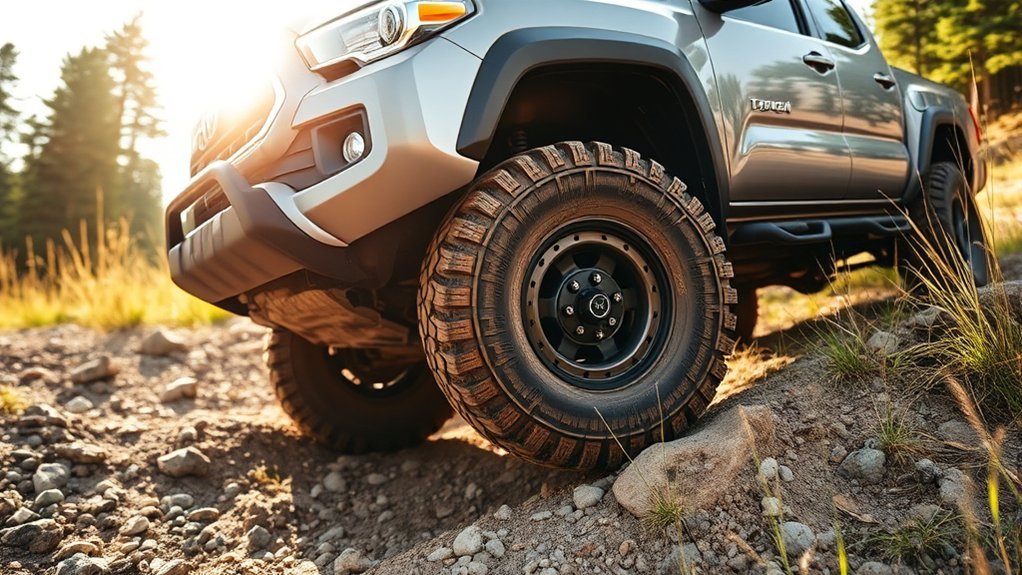
Choosing off-road tires for a Toyota Tacoma is less about buying the largest tire that looks good and more about matching the tire to your exact model year, trim, wheel, load, and terrain. A safe setup keeps adequate clearance, preserves steering and braking behavior, carries the truck’s weight, and can be returned to the correct road pressure after every trail run.
Quick Answer
For most daily-driven Tacomas, start with an all-terrain tire close to the original overall diameter and with at least the original load and speed ratings. Verify the model year, door-jamb placard, wheel width and offset, full-lock clearance, spare-tire fit, and approved inflation pressure before ordering.
Key Takeaways
- Do not shop by “Toyota Tacoma” alone. Third-generation trucks from 2016–2023 and fourth-generation trucks from 2024 onward do not share every wheel, fastener, tire, and pressure specification.
- Common near-stock sizes such as 265/75R16 and 265/70R17 are about 31.6 inches tall, but fitment still depends on trim, wheel offset, alignment, suspension, and actual tire dimensions.
- All-terrain tires are usually the best balance for a Tacoma that spends most of its time on pavement and some time on dirt, gravel, snow, or moderate trails.
- A wider or more aggressive tire can add weight, noise, rolling resistance, steering effort, and rubbing risk. Bigger is not automatically better.
- Use the driver-door placard for normal road pressure. Air down only in small steps off-road, at low speed, with enough pressure to support the load, then reinflate before highway travel.
At a Glance
| Time Required | 30–60 minutes to verify specifications and compare tires; longer if you must measure clearance or consult an installer |
| Difficulty | Moderate |
| Tools Needed | Owner’s manual, driver-door tire placard, tape measure, flashlight, tire-size calculator, accurate pressure gauge, and access to a qualified tire installer |
| Cost | Varies by size and construction; include four tires, mounting, balancing, TPMS service, alignment, and a matching spare in the budget |
How to Figure Out Your Tacoma’s Fitment Specs
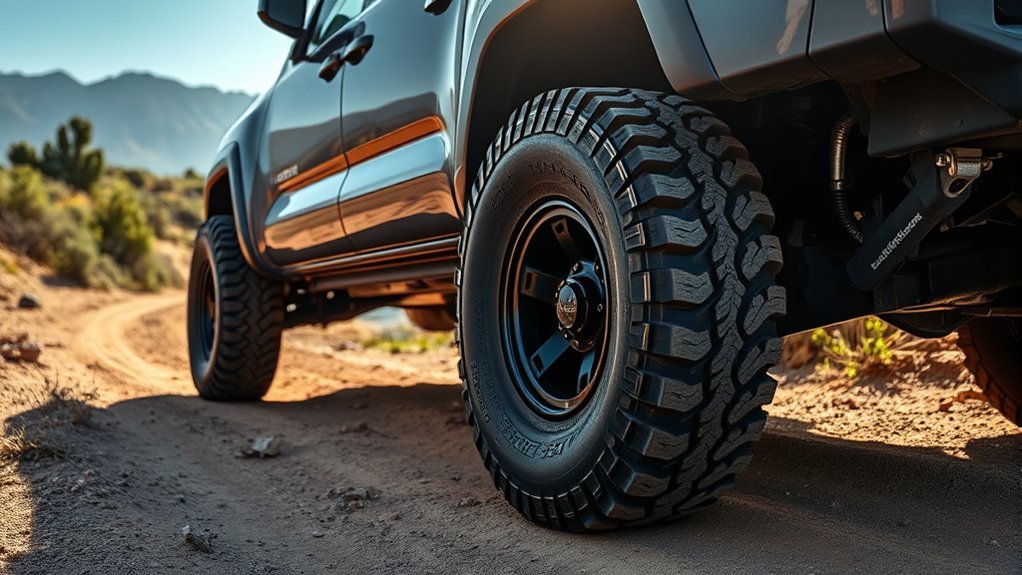
Begin with the truck, not a forum fitment list. Record the model year, trim, drivetrain, cab and bed configuration, current tire size, and wheel size. When there is any doubt, use the VIN with a Toyota dealer or parts catalog. This matters because a specification that is correct for a 2016–2023 Tacoma may be wrong for a 2024-or-newer truck.
The original combination of a 6×139.7 bolt pattern, M14x1.5 threads, and a 106.1 mm center bore should not be treated as a universal Tacoma specification. Wheel-fastener threads, hub dimensions, wheel-seat design, factory tire sizes, recommended pressures, and lug torque must all match the exact generation and wheel. Never force a lug nut onto a stud or reuse factory nuts on an aftermarket wheel unless the wheel maker confirms the seat type and engagement.
Verify These Five Items Before You Buy
- Original tire size and road pressure: Read the Tire and Loading Information label on the driver-side door jamb. The pressure on the tire sidewall is a maximum rating, not the truck’s normal operating pressure.
- Wheel diameter and width: A tire must be approved for the wheel’s width. A tire that is too wide or too narrow for the rim can distort the tread and sidewall.
- Bolt pattern, hub bore, fastener thread, and seat: Confirm all four. Hub-centric rings can center some aftermarket wheels, but they do not correct the wrong bolt pattern, lug thread, or nut seat.
- Offset and backspacing: These determine how far the wheel sits inward or outward. Too much inward position can contact the upper control arm; too much outward position can contact the fender liner or body mount and can change steering geometry.
- Load capacity: The replacement tire’s load index and the wheel’s load rating must support the truck, passengers, cargo, accessories, and tongue weight when towing.
For reference, Toyota’s 2024 Tacoma owner’s manual lists several factory combinations, including 245/70R17, 265/70R17, and 265/65R18, with different cold pressures and wheel specifications. That variation is why the placard and manual for your truck take priority over a generic chart.
Warning: A wheel can bolt on and still be unsafe. Wrong lug-seat geometry, inadequate thread engagement, insufficient load rating, brake-caliper interference, or tire contact at full steering lock can lead to loosening, damage, loss of control, or tire failure.
Choosing the Right Off-Road Tire Size
For many third-generation Tacoma setups, a tire close to 31.6 inches in calculated diameter is a practical starting point because it stays near the size of common factory and near-factory combinations. However, published dimensions vary by tire model, rim width, load range, and inflation pressure, so always check the tire maker’s specification sheet.
| Size | Calculated Diameter | Fitment Guidance |
|---|---|---|
| 265/75R16 | About 31.6 in. | A common near-stock upgrade on some 2016–2023 configurations; still verify trim, wheel width, offset, and actual tire dimensions. |
| 265/70R17 | About 31.6 in. | Factory equipment on some newer Tacomas and a common near-stock choice on other setups; confirm the load index and placard requirements. |
| 275/70R17 | About 32.2 in. | Adds width and diameter; rubbing risk rises at full lock and suspension compression. |
| 285/75R16 | About 32.8 in. | Often called a “33-inch” class tire. It frequently needs careful wheel, alignment, liner, mud-flap, or body-mount clearance work. |
A diameter increase also changes the effective gearing and the distance traveled per wheel revolution. Unless the vehicle is recalibrated, the speedometer and odometer may read low when a larger tire is installed. Added tire weight can also reduce acceleration, increase braking demand, and make the transmission hunt more often on grades.
Load Range, Load Index, and Tire Construction
Do not choose a tire only because it has an aggressive tread or an E-load label. A heavier LT tire can provide stronger construction and puncture resistance, but it also adds unsprung and rotating weight and may ride more firmly. A properly rated passenger or light-truck tire with adequate load capacity can be the better choice for a lightly loaded daily driver.
- Match or exceed the required load index. Include permanent accessories, camping gear, passengers, payload, and trailer tongue weight.
- Check the tire’s approved rim-width range. The same nominal tire size may have different approved wheel widths by product.
- Compare actual weight and diameter. Two tires with the same size on the sidewall can differ noticeably.
- Keep the spare compatible. A much smaller spare can create driveline concerns on four-wheel-drive vehicles and may not clear upgraded brakes or suspension parts.
Pro Tip: Before mounting all four tires, ask the installer to test-fit one front wheel and tire. Turn the steering from lock to lock, check both forward and reverse, and inspect clearance around the upper control arm, sway bar, fender liner, mud flap, body mount, brake hose, and wheel weights.
Benefits of Upgrading to All-Terrain Tires
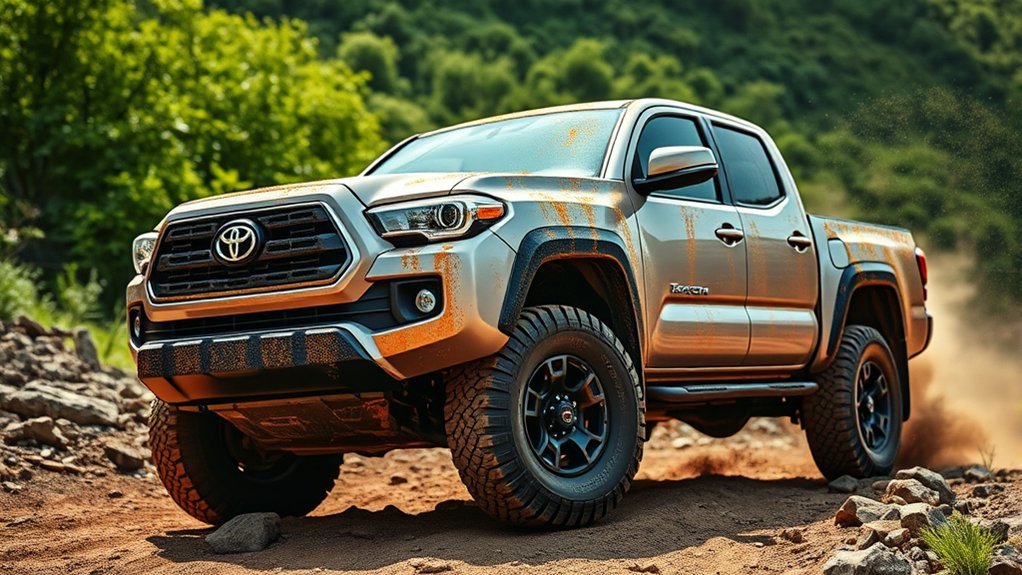
All-terrain tires are usually the most practical upgrade for a Tacoma that must handle commuting, road trips, gravel, forest roads, snow, and moderate trails. They use larger tread blocks and more open voids than a highway tire without going as far as a dedicated mud-terrain design.
- Improved loose-surface traction: More biting edges and open channels can improve grip on dirt, gravel, light mud, and uneven terrain.
- Stronger off-road construction: Many all-terrain tires use reinforced sidewalls, stone-ejecting features, or chip-resistant compounds. Construction varies, so compare the exact model rather than the category name alone.
- Better road manners than mud-terrain tires: A quality all-terrain tire normally produces less noise, vibration, and tread squirm than a mud-terrain tire, although it may still be louder and heavier than the original highway tire.
Drivers who face frequent severe winter conditions should also look for the three-peak mountain snowflake symbol. It indicates that the tire passed a standardized snow-traction test, but it does not make every all-terrain tire equal on ice, wet pavement, or deep snow.
[Products Worth Considering]

These aluminum alloy tire valve stem caps with an O-ring seal help protect valve stems from corrosion while adding a clean, stylish look to your vehicle. The universal fit works across cars, trucks, motorcycles, bicycles, and more, making them an easy upgrade for everyday driving and off-road use. Installation is quick, and the included four-pack keeps all your tires dressed and protected.
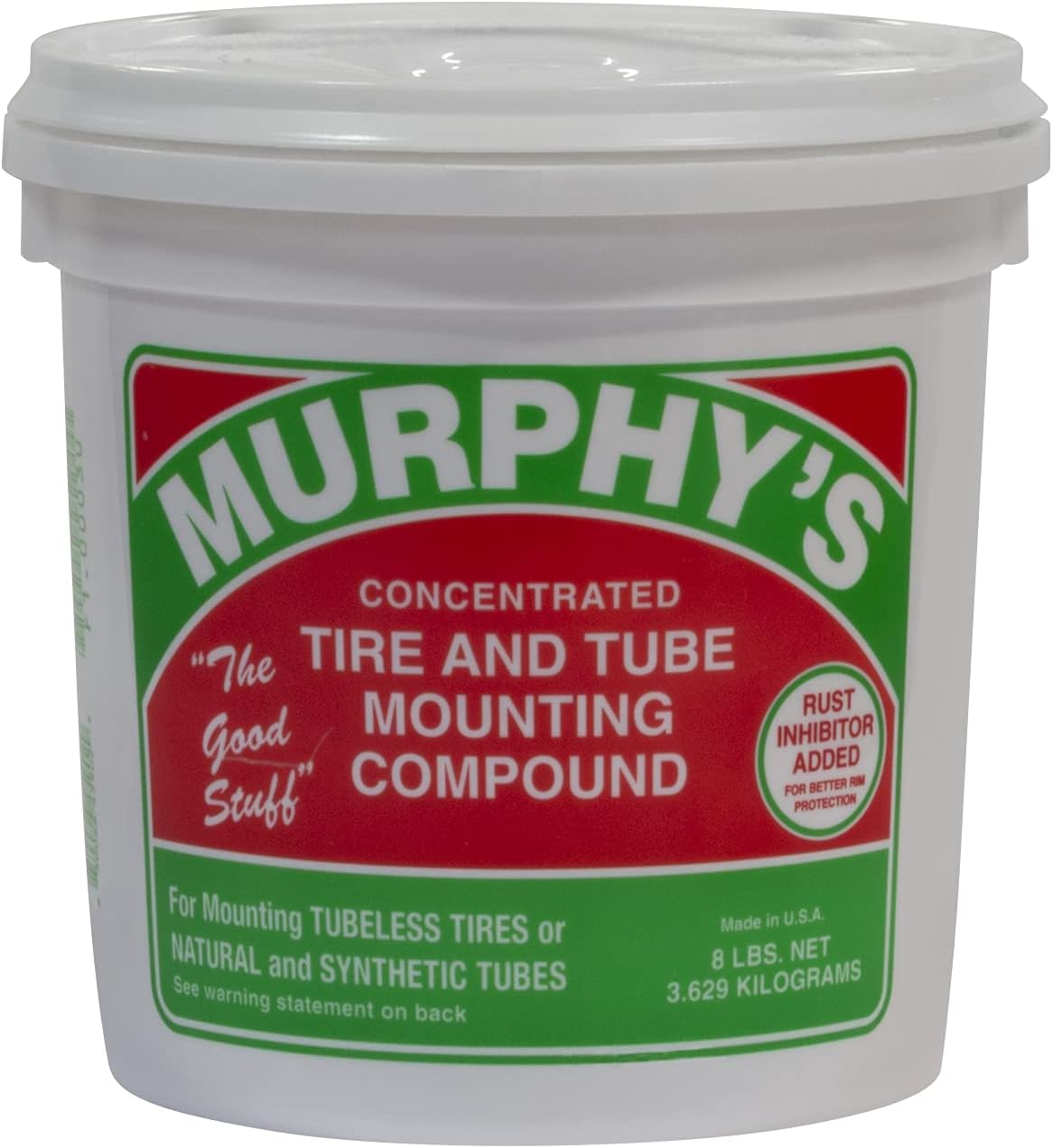
A concentrated tire and tube mounting compound designed to help simplify mounting rubber tires and tubes on passenger, semi truck, construction, and OTR applications. Its ultra-thick formula packs beads effectively and includes rust inhibitors to help protect against corrosion during use.

These M14x1.5 closed-end chrome lug nuts are a one-piece replacement designed for secure fitment on compatible GM, Ford, and select Chrysler/Dodge models. Featuring a 60-degree conical seat and anti-rust chrome plating, they help resist corrosion and maintain a bright look for everyday driving. Built for long-term durability, they include OEM-style part references and are backed by 12 months of support.
Best Tire Brands for Off-Road Performance in Tacoma
Brand matters less than selecting the correct tire family, size, construction, load rating, and intended use. The following current products are useful comparison points, but no tire is automatically the best for every Tacoma.
[Products Worth Considering]

Upgrade your wheels with MIKKUPPA closed-end lug nuts designed for reliable fit and corrosion resistance. The one-piece, cold-forged and heat-treated steel construction helps resist rust and stripping, while the integrated finish delivers a durable black appearance. Built to OEM standards with a conical 60-degree seat, these nuts provide a secure solution for compatible Ford, Honda, Jeep, and Chevrolet models.

LiQuiTube Premium Heavy Duty Tire Sealant provides permanent flat tire protection to help maintain proper air pressure while sealing punctures and leaks. It seals bead, rim, and porosity weathering leaks and helps prevent flats in heavy ply industrial tires. Designed for versatile use on trailers and off-road equipment, it can be installed in tubeless tires and also inside tubes.

Monitor tire tread wear with a smart, color-coded depth gauge that shows clear condition ranges at a glance. The bar is range marked for fast, easy readings, helping you maintain safer traction and performance. Each gauge is portable with a pocket clip, and the set includes 20 units for daily use and sharing.
Top Off-Road Tire Brands
- BFGoodrich All-Terrain T/A KO3: The current successor to the KO2 in a broad size range. It is designed for mixed on-road and off-road use, carries the three-peak mountain snowflake symbol, and emphasizes gravel durability and sidewall protection.
- Goodyear Wrangler all-terrain family: Includes several patterns for different balances of road comfort, work use, wet traction, snow, and trail capability. Check the exact model and size rather than relying on the Wrangler name alone.
- Cooper Discoverer AT3 LT: A light-truck all-terrain option focused on durability, hauling, wet-road grip, and trail use. Its heavier construction may suit loaded trucks better than lightly used commuters.
Older recommendation lists may mention the Goodyear Wrangler UltraTerrain AT. Verify its current retailer availability and exact size fitment, then compare it with Goodyear’s current Wrangler models. Other reputable manufacturers also offer strong all-terrain, rugged-terrain, and mud-terrain options. Compare objective specifications such as load index, tire weight, measured diameter, tread depth, approved rim width, severe-snow rating, mileage warranty, and replacement availability.
All-Terrain vs. Mud-Terrain
| Type | Best For | Main Tradeoffs |
|---|---|---|
| All-terrain | Daily driving, gravel, dirt, snow, camping roads, and moderate trails | Less self-cleaning and bite in deep mud than a mud-terrain tire |
| Rugged-terrain or hybrid | Drivers who want a more aggressive shoulder and better loose-terrain performance without a full mud-terrain | Usually louder and heavier than an all-terrain tire |
| Mud-terrain | Frequent deep mud, loose rock, technical trails, and vehicles with limited pavement use | More noise, vibration, weight, tread movement, wet-road compromise, and often shorter or less even wear |
Products such as the BFGoodrich Mud-Terrain T/A KM3 or Nitto Mud Grappler can make sense for specialized use, but they are usually unnecessary for a Tacoma that spends most of its mileage on pavement. Choose the mildest tread that reliably handles your hardest regular terrain.
Tire Size Recommendations
- Daily driver with occasional trails: Stay close to the placard diameter and choose an all-terrain tire with adequate load capacity. Common examples include 265/75R16 or 265/70R17 where the exact truck and wheel support them.
- Loaded overland or work truck: Prioritize load capacity, heat control, sidewall durability, and replacement availability. A heavier LT construction may be justified.
- Technical off-road build: Treat 275- or 285-width tires as a system change. Verify suspension travel, steering clearance, wheel offset, alignment, gearing, spare fit, and braking before purchase.
Note: Tire labels such as “31,” “32,” or “33 inch” are categories, not precise mounted dimensions. Use the manufacturer’s specification for the exact size and load range, then measure the installed tire if clearance is tight.
Should You Consider Aftermarket Wheels?
Aftermarket wheels can improve tire choice, brake clearance, strength, repairability, or appearance, but they are not automatically a performance upgrade. A 16- or 17-inch wheel often leaves more sidewall than a larger-diameter wheel, which can improve compliance and rim protection off-road. The wheel still must clear the brakes and meet the truck’s load requirement.
Be cautious with offset claims. Moving from a positive factory offset toward zero or a negative offset pushes the tire outward. That may create more clearance at the upper control arm, but it can also increase fender and body-mount contact, alter scrub radius, increase steering kickback, place more leverage on wheel bearings, and throw more debris against the body.
The original KMC 542 Impact 16×8 +0 example may work on some Tacoma configurations, but “fits without rubbing” cannot be guaranteed without the exact model year, trim, tire, suspension, alignment, and wheel design. Confirm brake clearance, hub fit, lug-seat type, thread engagement, and torque instructions with the wheel manufacturer and installer.
[Products Worth Considering]

Keep your tires properly inflated with this analog VONDIOR tire pressure gauge, designed for fast, easy readings without batteries. The swiveling, two-axis hose and large glow dial help you measure at any tire angle with instant visibility. Built with a protective rubber shield, it supports durable, low-maintenance use for cars and trucks.

The Trivd Frol 1/2" air impact wrench delivers high performance torque up to 1500 ft-lbs with a twin hammer impact mechanism for strong, balanced blows. It features an ergonomic grip, compact lightweight design, and quick-stop control with 3 forward speeds up to 8000 RPM plus a reverse speed. Built for demanding automotive repair and tire shop work, the rear exhaust helps keep debris away from the surface.

Upgrade your wheels with MIKKUPPA M12x1.5 mag seat lug nuts built for secure, corrosion-resistant performance. These closed-end chrome lug nuts are a direct replacement for select Toyota models, including Camry, Corolla, RAV4, Sienna, Avalon, Highlander, Matrix, Venza, and Prius. Triple-chromium plating and cold-forged, heat-treated steel help deliver strength for daily driving and replacement needs.
How to Enhance Performance With Wider Tires
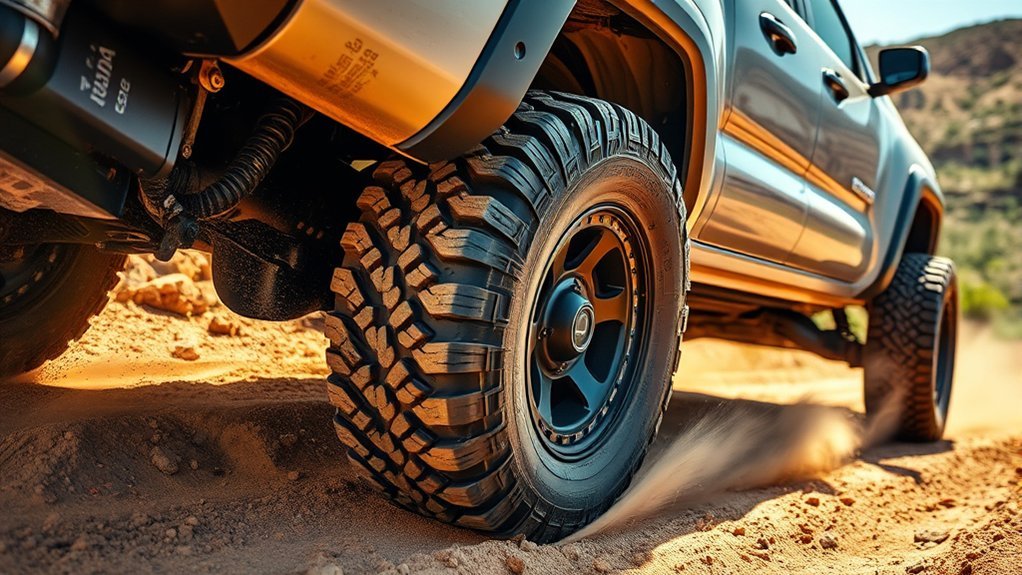
A wider tire can create a larger footprint at the correct load and pressure, which may improve flotation on sand and some loose surfaces. It does not guarantee more traction everywhere. On wet pavement, packed snow, or deep slush, a narrower tire may cut through the surface more effectively, and a heavy wide tire can reduce steering response and fuel economy.
- Choose the size for the terrain: Options such as 275/70R17 or 285/75R16 can add footprint and sidewall, but only after clearance and load checks.
- Use pressure to tune the footprint: Make small changes off-road, monitor sidewall deflection and heat, and keep enough pressure to support the axle load and protect the bead and wheel.
- Select offset conservatively: Do not use a strongly negative offset simply to make the tire sit wider. Choose the position that clears the suspension and body through the full steering and suspension range.
The best-performing setup is usually the smallest and lightest tire that delivers the required ground clearance, flotation, puncture resistance, and traction without creating unnecessary compromises.
Understanding Tire Tread Patterns for Off-Roading
Tread design should match the terrain you encounter most often:
- Highway-terrain: Closely spaced blocks for quiet running, wet-road stability, and fuel efficiency; limited self-cleaning in mud.
- All-terrain: Moderate voids, multiple biting edges, and stronger shoulders for mixed road and trail use.
- Rugged-terrain: More open shoulders and larger blocks than an all-terrain tire, with better road manners than many mud-terrain patterns.
- Mud-terrain: Large voids and aggressive shoulders that eject mud and loose soil; usually louder and less refined on pavement.
- Sand-focused setup: Flotation comes from the full tire-and-pressure combination, not only a wide tread. Smooth throttle control and avoiding wheelspin are just as important.
- Rock-focused setup: Strong sidewalls, durable tread rubber, protected shoulders, and controlled low-speed pressure matter more than an extreme mud pattern.
Also check whether the tire is directional or has an asymmetric inside/outside mounting requirement. Incorrect mounting can reduce water evacuation, noise control, and intended handling.
Clearance and Installation Checks
A parked truck with straight wheels does not prove fitment. After installation, complete these checks before a trail trip:
- Confirm the correct lug nuts, seat type, thread engagement, and torque procedure.
- Turn the steering fully left and right while moving slowly forward and in reverse.
- Inspect the tire-to-upper-control-arm, sway-bar, brake-hose, fender-liner, mud-flap, cab-mount, and body-mount clearances.
- Load the truck as it will be used and recheck clearance through suspension compression.
- Verify that wheel weights do not contact brake components.
- Confirm the spare fits the carrier and can be installed on the front and rear.
- Check TPMS operation and perform any required registration or initialization.
- Have the alignment checked after a tire-size, wheel-offset, lift, or suspension change.
- Recheck lug torque according to the wheel and vehicle manufacturer’s instructions after the initial driving interval.
Why Regular Tire Inspections Matter
Regular inspections protect traction, ride quality, and tire life. Check all four tires and the spare before a long trip and after difficult trail use. Look for cuts, exposed cords, bulges, punctures, cracked rubber, missing tread blocks, bent wheels, loose valve stems, and fresh rub marks inside the wheel wells.
The legal wear limit is not a performance target. Replace a tire when its treadwear indicators are flush, at 2/32 inch, or sooner when damage or the required wet, snow, or off-road traction demands more tread.
- Identify uneven wear: Feathering, cupping, shoulder wear, or one-sided wear can point to pressure, balance, alignment, suspension, or rotation problems.
- Check pressure cold: Use an accurate gauge at least monthly and before long trips. TPMS is a warning system, not a substitute for manual checks.
- Measure tread depth in several places: Off-road tires can wear unevenly across large blocks. Do not rely on one groove.
- Inspect after impacts: A hard rock strike can damage a sidewall or wheel even when the tire still holds air.
The National Highway Traffic Safety Administration advises drivers to use the vehicle manufacturer’s cold pressure, inspect tires monthly, and replace tires when tread reaches 2/32 inch or when damage is present.
Maintaining Proper Tire Pressure Off-Road
Pressure controls load capacity, heat, sidewall flex, footprint, bead retention, steering response, and wheel protection. There is no single correct off-road pressure for every Tacoma. The right setting depends on vehicle weight, axle load, tire size and construction, wheel width, bead design, speed, temperature, and terrain.
Start With the Correct Road Pressure
For normal road use, start with the cold pressure on the driver-door placard or the correct pressure established for the replacement tire’s load capacity. Toyota’s 2024 Tacoma specifications show that factory pressures can vary by tire package, including 30, 32, or 35 psi in different applications. That alone shows why “30–35 psi for every Tacoma” is not a reliable rule.
If you change tire size or construction, ask the tire manufacturer or a qualified tire professional to determine the pressure needed to carry at least the original load capacity. Some Tacomas also require TPMS initialization or pressure-setting procedures after a size or pressure change.
Warning: Never use a trail pressure for highway driving. Low pressure increases heat and sidewall flex, reduces load capacity, can damage the tire or wheel, and can allow the bead to unseat during a turn or impact. Carry a compressor and reinflate before returning to sustained road speed.
Adjusting for Terrain Type
Instead of using a universal pressure table, begin at the validated road pressure and reduce pressure in small, equal steps while driving slowly. Stop when the tire conforms enough to the terrain without excessive sidewall bulge, wheel contact, vague steering, bead movement, or overheating.
| Terrain | Adjustment Approach | Main Risk to Watch |
|---|---|---|
| Graded dirt and washboard | Use placard pressure or a small reduction after checking load and tire construction. | Heat buildup at higher speeds and impacts hidden by dust. |
| Rock | Reduce gradually to improve conformity and low-speed grip. | Pinch damage, rim strikes, sidewall cuts, and bead unseating. |
| Sand | Reduce gradually for a longer footprint; use smooth throttle and avoid sharp steering. | Bead loss during turns and rapid heat buildup if speed rises. |
| Mud | Use only enough reduction to improve conformity while preserving self-cleaning and bead security. | Wheelspin, hidden impacts, sidewall damage, and debeading. |
Michelin’s light-truck tire guidance states that 20 psi is its normal minimum recommendation for passenger and light-truck tires, with lower pressure reserved for off-road use below 15 mph only when the tire still has adequate load capacity. That is manufacturer guidance, not permission to use one number on every tire or truck.
Before leaving the trail, inspect for damage, remove packed mud from the wheels, reinflate all tires to the correct road setting, replace the valve caps, and recheck pressure when the tires are cold. If a tire repeatedly loses pressure or shows a bulge, cut, exposed cord, bead damage, or severe vibration, stop using it and have it inspected.
Beginner Off-Road Tire Checklist
- Know the trail difficulty, weather, distance, and nearest safe exit.
- Carry an accurate gauge, compressor, full-size compatible spare, plug kit for repairable tread punctures, jack, base plate, lug wrench, and torque wrench.
- Do not exceed the tire, wheel, axle, payload, or vehicle capacity ratings.
- Use four-wheel drive and traction aids according to the owner’s manual; tires cannot replace correct driving technique.
- Drive slowly enough to avoid heat, sharp impacts, and sudden steering inputs.
- Inspect the tread and sidewalls at rest stops and after hard obstacles.
- Reinflate and complete a road-speed safety check before the highway.
Frequently Asked Questions
What are some tips for beginner off-roaders?
Start on an easy trail, travel with another vehicle when possible, learn your Tacoma’s four-wheel-drive controls, and keep speed low. Check pressure, tread, sidewalls, lug torque, fluid leaks, recovery points, and the spare before leaving. Carry communication, navigation, water, recovery equipment, a compressor, and basic tire-repair tools.
Will 265/75R16 or 265/70R17 fit a stock Tacoma?
They are common near-stock sizes and both calculate to about 31.6 inches tall, but fitment is not universal. Confirm the model year, trim, factory tire, wheel width and offset, alignment, suspension, mud flaps, and the exact tire’s published dimensions. Test full steering lock and suspension clearance before trail use.
Can a Tacoma run 33-inch tires without a lift?
Some combinations can be made to fit, but a lift alone does not solve every contact point. A tire in the 33-inch class may rub the upper control arm, fender liner, mud flap, pinch seam, or body mount depending on width, offset, caster, and actual diameter. Professional measurement and test fitting are the safest approach.
Is an E-load tire always better for off-roading?
No. E-load tires can offer high load capacity and robust construction, but they are often heavier and firmer. A lighter tire with sufficient load capacity may ride, brake, accelerate, and air down better on a lightly loaded truck. Choose construction from the actual load and terrain, not the label alone.
How low can I air down Tacoma tires?
There is no universal safe number. Tire construction, wheel width, bead design, axle load, terrain, speed, and driving style all matter. Reduce pressure gradually at low speed, keep enough pressure to carry the load and protect the wheel, and use manufacturer or qualified professional guidance. Reinflate before highway travel.
Do larger tires affect the speedometer and gearing?
Yes. A larger tire travels farther per revolution, so the speedometer and odometer can read lower than the true value unless recalibrated. Larger and heavier tires also raise effective gearing, reduce acceleration, increase braking demand, and may cause more transmission shifting on hills.
Sources
- Toyota 2024 Tacoma Owner’s Manual: Maintenance Data — factory tire sizes, wheel sizes, pressures, and wheel-nut torque examples
- NHTSA TireWise — tire-pressure, inspection, TPMS, damage, and minimum tread-depth guidance
- Michelin Tire FAQs — replacement-tire pressure and low-pressure load-capacity guidance
- BFGoodrich All-Terrain T/A KO3 — current product features, severe-snow rating, sizes, and warranty information
- Goodyear Wrangler Tire Family — current all-terrain product range and intended uses
- Cooper Discoverer AT3 LT — load, severe-snow, warranty, and product-construction information
Conclusion
The right off-road tires can make a Toyota Tacoma more capable and predictable, but safe fitment starts with the exact truck rather than a generic size or offset. Verify the model year, placard, wheel and fastener specifications, load capacity, full-range clearance, spare, TPMS, and road pressure. For most mixed-use trucks, a correctly rated all-terrain tire close to the original diameter delivers the best balance of traction, comfort, durability, and manageable modifications.