
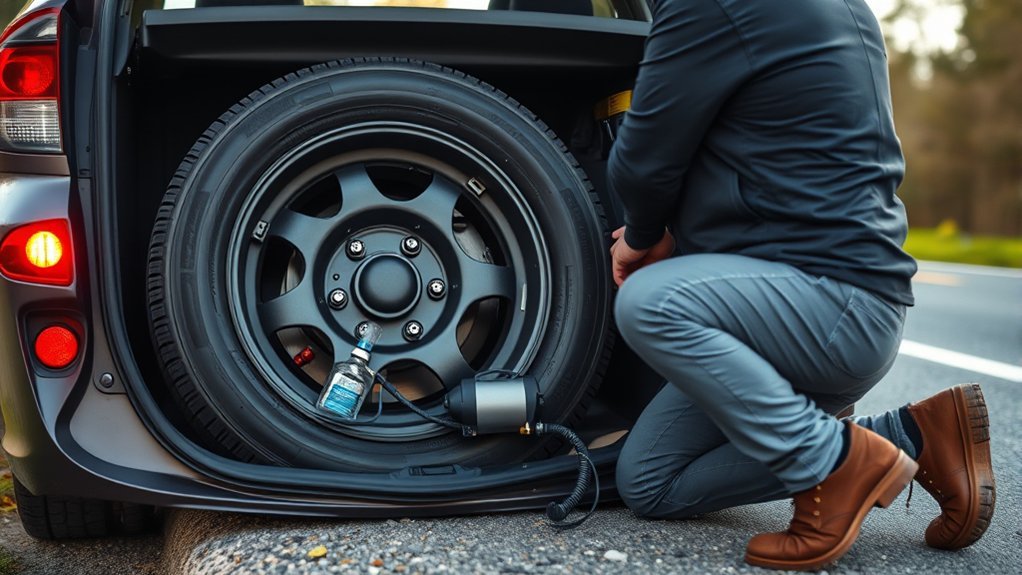
“Service Tire Mobility Kit” on a Mustang or other Ford usually means the tire inflator and sealant kit needs attention. Most often, it is a reminder to inspect the kit, check the sealant canister’s use-by date, replace expired sealant, or reset the reminder after service. It is not a permanent tire repair system, and it should only be used for small tread punctures long enough to reach a tire shop.
Quick Answer
The Service Tire Mobility Kit warning means your temporary tire sealant and inflator kit is due for inspection, replacement, or reminder reset. Check the sealant use-by date, confirm the compressor and hoses are present, replace used or expired sealant, then reset the reminder through the vehicle settings if your model allows it.
Key Takeaways
- A tire mobility kit is an emergency inflator and sealant kit, not a spare tire and not a permanent repair.
- On many Mustangs, the kit is stored under the trunk load floor, but you should confirm the exact location in your owner’s manual.
- Use the kit only for small tread punctures. Do not use it for sidewall damage, large holes, or a tire damaged by driving flat.
- After using sealant, do not exceed 50 mph and drive only as far as needed to reach a tire service location, up to the owner-manual limit.
- Check the sealant use-by date regularly. Ford manuals for many models say to replace the canister after four years of non-use.
At a Glance
| Time Required | About 10–20 minutes to inspect or use the kit, plus the drive to a tire shop. |
| Difficulty | Easy for a small tread puncture; do not use the kit if the tire is badly damaged. |
| Tools Needed | Factory tire inflator/sealant kit, 12-volt power outlet, valve cap access, and the tire pressure listed on the driver-door label. |
| Cost | Inspection/reset may cost nothing. Replacement sealant, TPMS service, or tire repair/replacement can add cost. |
What Does the Service Tire Mobility Kit Warning Mean?

The Service Tire Mobility Kit warning usually means the vehicle wants you to inspect the emergency inflator and sealant kit. In many Ford vehicles, including Mustangs that do not carry a spare tire, the warning is tied to the kit’s maintenance interval or sealant age rather than an active scan of the bottle.
The most important thing to check is the sealant canister. Ford owner information says the sealant has a use-by date, the canister contains enough sealant for one tire repair, and replacement sealant canisters should be obtained through an authorized dealer or proper replacement source. Some Ford manuals also say to replace the canister after four years of non-use.
Do not ignore the warning before a long drive. The kit is emergency equipment. If the sealant is expired, missing, already used, or leaking, it may not help when you get a flat tire.
Note: This warning is different from a low tire pressure warning. If the tire pressure monitor warning is also on, check tire pressure immediately and inspect the tires before driving farther.
Where Is the Tire Mobility Kit in a Mustang?
On many Ford Mustangs, the tire mobility kit is stored beneath the trunk load floor. Lift the trunk floor panel and look for the compressor, sealant canister, hose, power cord, and accessories in the dedicated storage area.
Exact storage can vary by model year, trim, and market. Some Ford vehicles store the kit in the trunk, luggage area, cargo area, or under a seat, so the safest answer is to confirm the location in your owner’s manual before you need it on the roadside.
What’s Inside a Tire Mobility Kit?
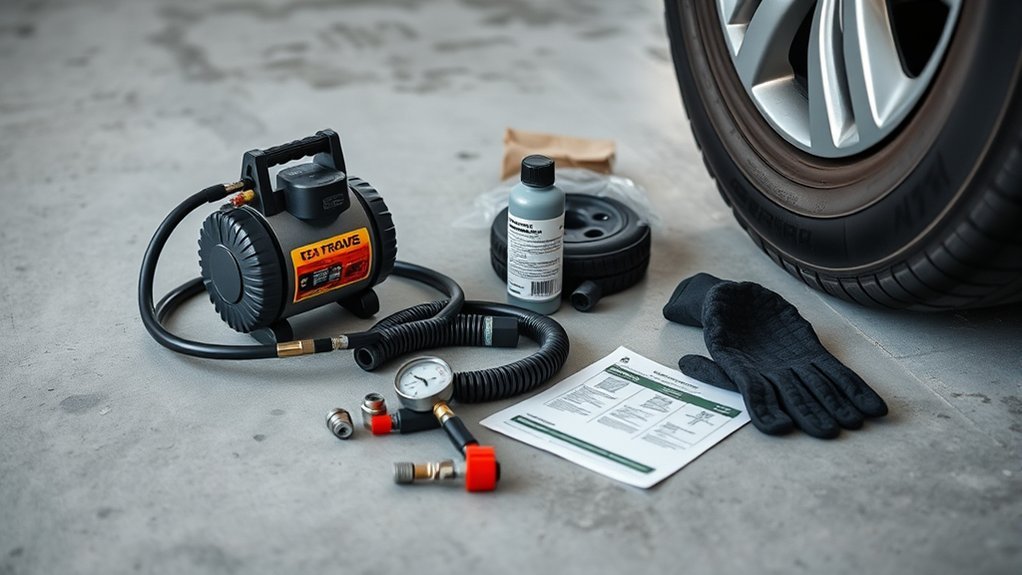
A typical tire mobility kit includes an air compressor, sealant canister, hose, tire valve connector, pressure gauge, and 12-volt power plug. Some versions also include adapters for inflating sports balls, rafts, or bicycle tires.
[Products Worth Considering]

This TPMS sensor training and relearn reset tool is customized for Ford, Lincoln, and Mercury vehicles to help activate tire pressure programming after sensor replacement or tire rotation. It can activate individual tire pressure sensors with one-button operation, helping prevent TPMS warning light illumination. It is not a sensor programming tool and cannot program replacement sensors—use it to trigger/activate sensors only.

TireJect Off-Road Tire Sealant Kit provides 5-in-1 sealing to help fix tread punctures up to 3/8", sidewall punctures up to 3/8", bead leaks, slow leaks, and minor dry rot on low-speed tires. It permanently seals with liquid rubber, recycled tire particles, and Aramid fibers, making it ideal for flats caused by thorns, nails, and screws. The included dispensing cap attaches to the valve stem for a no-mess installation, along with a metal valve core remover tool and valve stem cap. This kit is for off-road use only.

This AUTOWN flat tire repair kit is designed for quick, reliable puncture repairs using a plug kit and spiral probe tool to simplify installation. Built for durability and safe handling, it offers strong adhesion and flexibility to help maintain tire air tightness. With a portable storage case and a multi-vehicle approach, it’s suitable for cars, motorcycles, ATVs, tractors, lawn mowers, RVs, jeeps, and trucks.
Kit Components
| Compressor | Adds air so the tire can reach the pressure shown on the vehicle’s tire label. |
| Sealant canister | Temporarily seals many small tread punctures caused by nails or similar objects. |
| Hose and connector | Connects the kit to the tire valve. Some kits have separate air and sealant hoses. |
| Pressure gauge | Helps you monitor inflation while using the compressor. |
Sealant and Compressor
The compressor can be used to add air, while the sealant is for temporary puncture sealing. The sealant is not a patch, plug, or full tire repair. It is a short-term way to get off the roadside and reach a service location.
Check the canister’s use-by date before road trips. If the bottle is expired, already used, cracked, leaking, or missing, replace it before relying on the kit.
Before You Use the Tire Mobility Kit
Use the kit only when the situation matches what the kit is designed to handle: a small puncture in the tread area. Before connecting anything, park safely away from traffic, turn on the hazard lights, apply the parking brake, and inspect the tire.
Warning: Do not use a tire mobility kit on sidewall damage, a puncture larger than 0.24 in / 6 mm, a tire shredded from driving flat, or a tire that will not hold pressure. In those cases, stop driving and call roadside assistance.
Do not pull out nails, screws, or other objects stuck in the tire before using the kit. Removing the object can make the leak larger and prevent the sealant from working.
[Products Worth Considering]

This tire inflator with pressure gauge delivers long-lasting performance with a durable rubber-protected gauge and sturdy build. The longer hose and 360 swivel air chuck help you seal the valve securely and keep your hands free while measuring, inflating, or deflating. It’s battery-free for reliable use and provides ±2 PSI accuracy in the mid-range for most typical tires, with universal compatibility for 1/4 NPT compressor outputs.

Malco tire mounting and demounting lubricant is a ready-to-use tire lube formulated to reduce friction during tire installation for passenger cars, light trucks, farm tires, and heavy-duty equipment. It provides rust-inhibiting protection to help reduce corrosion on rims and wheels, and helps support proper tire bead seating during inflation to reduce air leakage. The silicone-free, soap-free formula is whitewall safe to help prevent discoloration on whitewall tires and sensitive sidewall markings.

This all-in-one air compressor accessory kit combines a digital tire pressure gauge with an inflator and blow gun in a single easy-to-use unit. The heavy duty, corrosion-resistant construction helps you quickly set and read tire PSI up to 200, and the vent valve releases excess air without removing the chuck. It connects to any 1/4 inch NPT air compressor output and includes multiple nozzles, adaptors, and stem caps for versatile inflating and blowing tasks.
How Do You Use the Tire Mobility Kit?
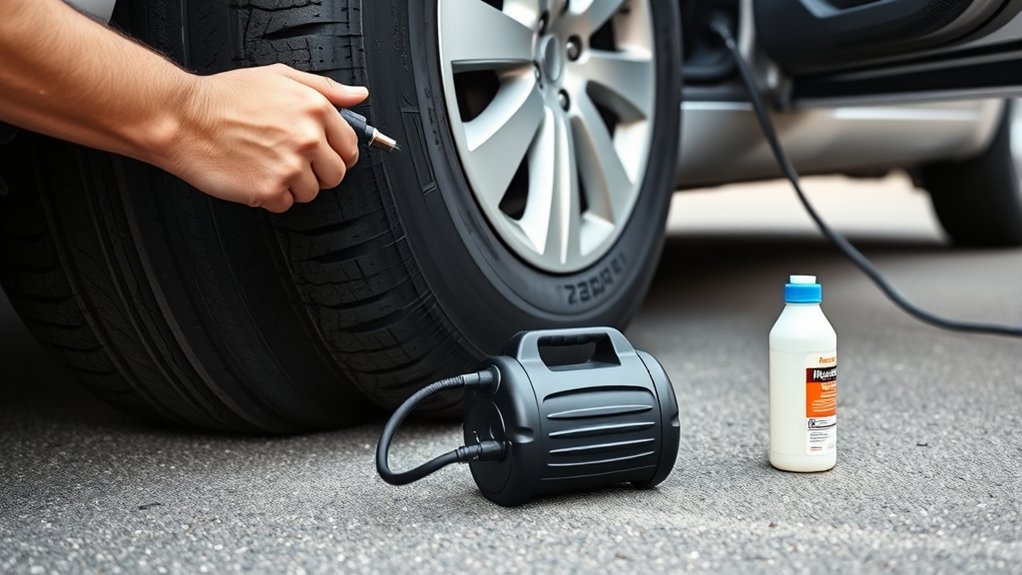
The exact steps depend on whether your kit uses a dial, dual ports, or separate hoses. Always follow the instructions printed on the kit and in your owner’s manual, but the basic process is usually similar.
- Park safely. Move away from traffic, turn on hazard lights, and apply the parking brake.
- Inspect the tire. Use the kit only for a small tread puncture. Do not use it for sidewall damage or major tire damage.
- Leave the puncturing object in place. Do not remove nails or screws from the tire.
- Connect the hose. Remove the valve cap and fasten the correct hose or connector to the tire valve.
- Plug in the power cord. Use the vehicle’s 12-volt outlet as directed by the kit instructions.
- Select sealant mode if required. If your kit has a dial or separate ports, choose the sealant setting or sealant port as instructed.
- Inflate the tire. Turn the compressor on and inflate the tire to the pressure listed on the Safety Certification Label or tire placard inside the driver-side doorjamb.
- Stop the compressor. Turn the kit off when the correct pressure is reached, disconnect the hose, replace the valve cap, and store the kit securely.
- Drive a short distance. Drive about five miles to distribute the sealant, then stop safely and recheck pressure.
- Go to a repair shop. Drive carefully to the closest tire service location for inspection and permanent repair or replacement.
Pro Tip: Take two minutes at home to find the kit, read the label, and check the sealant date. It is much easier to learn the hose layout in your driveway than beside traffic at night.
[Products Worth Considering]
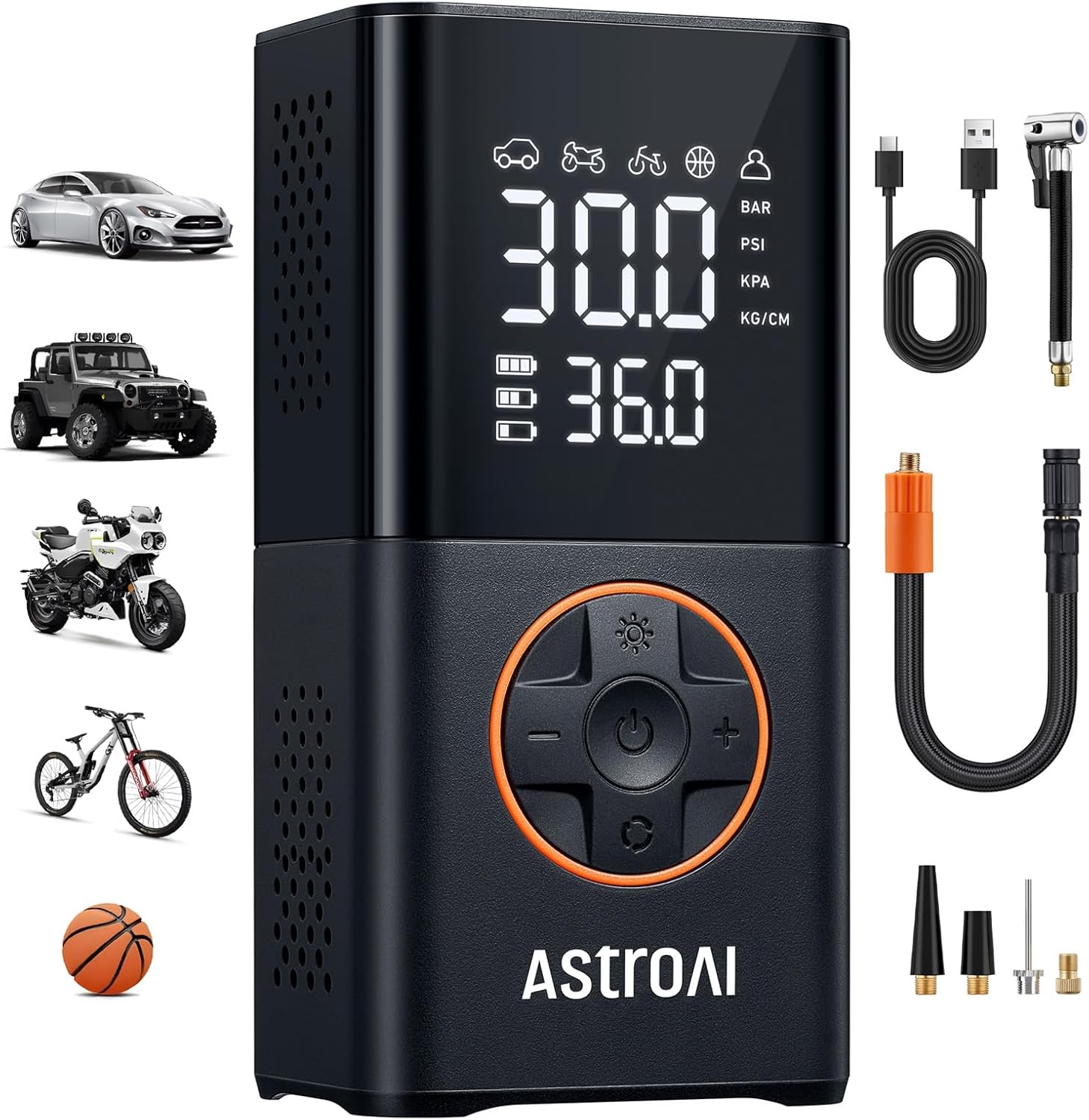
AstroAI L7 provides fast, cordless inflation for cars, motorcycles, bicycles, e-bikes, and sports balls with preset smart modes and a custom pressure option. Its compact design, dual digital display, and built-in auto-off make it easy to use for quick road-trip top-offs and emergency roadside inflation. The unit includes LED lighting and an SOS strobe flashlight for visibility, plus USB-C/USB ports for charging devices.

This tire valve adapter kit lets you connect a 3/4-inch garden hose to tire valves to fill tires with air or liquid. It includes two adapters for standard bore and large bore valves plus a convenient bleeder valve to release trapped air. Designed for tractor tire tubes and compatible air/water valves and extensions, it’s a practical repair tool for getting back on the road or field quickly.

The Airmoto portable tire inflator quickly and accurately fills car, truck, SUV, motorcycle, and bicycle tires up to 120 PSI with auto shut-off when your target pressure is reached. Its large LCD, multi-unit pressure display, and digital gauge make it easy to dial in settings and verify readings, while the built-in LED flashlight helps in low light. The included polyurethane hard carrying case and storage mesh pocket keep the inflator and accessories protected and organized.
How Do You Reset the Tire Mobility Kit Alert?
Reset steps vary by model year and instrument cluster, so check your owner’s manual first. On some Ford vehicles, the reminder can be reset from the vehicle settings menu after you inspect or replace the kit.
| Step | Action | Result |
|---|---|---|
| 1 | Inspect the kit and check the sealant use-by date. | Confirms whether the warning is maintenance-related. |
| 2 | Use the steering-wheel or cluster controls to open Settings or Advanced Settings. | Opens the vehicle reminder controls. |
| 3 | Look for Vehicle > Tire Mobility Kit, then set the reminder interval if your menu supports it. | Starts a new service reminder interval. |
| 4 | Turn the vehicle off, let the cluster shut down, then restart. | Confirms whether the alert cleared. |
For some 2018 Mustang vehicles with the digital instrument panel cluster, Ford SSM 47008 described a specific menu path: Settings > Advanced Settings > Vehicle > Tire Mobility Kit > 4 years. If the alert comes back even after you inspect the kit and reset the reminder, a dealer may need to check the cluster software or the correct service procedure for your VIN.
Can You Drive After Using Tire Sealant?
Yes, but only as a temporary measure. After using the tire mobility kit, drive carefully to the nearest tire service location. For many Ford temporary mobility kit instructions, the limit is up to 120 miles / 200 km and no faster than 50 mph / 80 km/h. Your own manual or kit label is the final authority for your exact vehicle.
Avoid hard braking, sudden steering, fast cornering, and highway-speed driving. Pull over if the tire loses pressure, the vehicle pulls, you feel vibration, or you hear unusual noise.
The kit is designed to get you to service, not to restore the tire to full strength.
Temporary Driving Limits
Treat the sealed tire as limited-service only. Even if it holds air at first, the tire still needs professional inspection because sealant does not repair internal structural damage.
- Do not exceed the speed limit printed in your manual or on the kit label.
- Use the shortest practical route to a tire shop or dealer.
- Recheck tire pressure after the short sealant-distribution drive.
- If the tire loses pressure, stop driving and arrange towing or roadside assistance.
Shop Repair Urgency
Go to a repair shop as soon as possible after using sealant. Some shops may repair a sealant-treated tire if the puncture is repairable, while others may recommend replacement depending on the tire condition, sealant contamination, puncture location, and manufacturer guidance.
For Ford vehicles covered by the cited owner-manual instructions, sealant use may also require replacement of the TPMS sensor and valve stem on the affected wheel. Ask the service shop to inspect the sensor, valve stem, tire, and wheel.
What Are the Limits of Tire Sealant Repair?
Tire sealant has strict limits. It may temporarily seal many small punctures in the tread, but it cannot fix every flat tire.
- Do not use it on sidewall damage. Sidewall cuts and punctures are unsafe to seal.
- Do not use it on large holes. Ford instructions commonly list 0.24 in / 6 mm as the maximum puncture size for kit use.
- Do not use it on a tire destroyed by driving flat. Heat and sidewall damage may make the tire unsafe even if it inflates.
- Do not treat it as a permanent repair. It is only a bridge to inspection and service.
- Do not rely on expired sealant. Old sealant can separate, thicken, or fail to seal properly.
What Should You Do After Using the Kit?
After using the tire mobility kit, your job is not finished. The correct next step is to drive carefully to a professional tire service location for inspection.
- Recheck tire pressure after the short drive that distributes sealant.
- Do not exceed the kit’s speed and distance limits.
- Tell the shop that sealant was used.
- Ask whether the tire can be permanently repaired or must be replaced.
- Replace the used sealant canister before putting the kit back into service.
- Have the TPMS sensor and valve stem checked, especially if your Ford manual requires replacement after sealant use.
Why Does the Tire Mobility Kit Warning Keep Coming Back?
The warning can return for several reasons. The most common is that the reminder interval was not reset after inspection or replacement. It may also return if the battery was disconnected, the instrument cluster reset, the wrong menu interval was saved, or the sealant canister is still due for replacement.
Default Reminder Interval
Many vehicles use a time-based reminder because sealant expires even when it has never been used. If the canister is past its use-by date, replacing the sealant is more important than simply clearing the warning.
Reset After Battery Disconnect
After a battery disconnect or system reset, some reminder settings may return or need to be confirmed again. Recheck the Tire Mobility Kit setting in the vehicle menu if your model has one.
When to Visit a Dealer
Visit a dealer or qualified service center if the alert returns immediately, your menu does not show a reset option, the kit is missing or damaged, the compressor does not run, or your owner’s manual requires a specific service procedure for your model year.
Frequently Asked Questions
What does the Service Tire Mobility Kit warning mean?
It means the tire inflator and sealant kit needs attention. Check whether the sealant is expired, missing, used, or leaking, then inspect the compressor, hoses, and power cord. After servicing the kit, reset the reminder if your vehicle menu allows it.
How long can you drive with a tire mobility kit repair?
For many Ford temporary mobility kits, the owner manual limit is up to 120 miles / 200 km at a maximum of 50 mph / 80 km/h. Drive only to the closest tire service location and follow the exact limit printed in your manual or on your kit.
Is it okay to drive with the service tire monitor system on?
Do not ignore a tire pressure or tire monitor warning. Stop somewhere safe, check tire pressure, inspect the tire, and add air only if the tire is safe to inflate. If the tire is losing pressure, damaged, or unstable, stop driving and call for help.
Is the Service Tire Mobility Kit warning urgent?
It is not usually as urgent as an overheating engine or oil pressure warning, but you should handle it soon. If the sealant is expired or missing, the kit may not help during a flat tire. Inspect it before long trips.
Can I use the compressor without using sealant?
Many kits can add air without sealant when used in air-only mode or with the correct hose. Follow the kit label and owner’s manual. Do not use the sealant hose for ordinary inflation unless the instructions say to do so.
Will tire sealant damage the TPMS sensor?
Sealant can contaminate tire-pressure components. Some Ford owner-manual instructions say the TPMS sensor and valve stem on the affected wheel must be replaced after sealant use. Ask the tire shop to inspect the sensor and valve stem.
Conclusion
The Service Tire Mobility Kit warning is a maintenance prompt for your emergency tire inflator and sealant kit. Inspect the kit, check the sealant use-by date, replace expired or used sealant, and reset the reminder only after the kit is ready to use.
If you ever need the kit, use it only for a small tread puncture, follow the instructions on your kit and in your owner’s manual, do not exceed the speed and distance limits, and drive straight to a tire service location. A sealed tire is temporary transportation, not a finished repair.
Sources
- Ford Owner Manual — Temporary Mobility Kit — kit location, components, use limits, puncture limits, sealant replacement interval, and TPMS after-use guidance.
- Ford Support — How do I use the tire inflator and sealant kit? — step-by-step use, safe parking, do-not-remove-object warning, and 15-minute troubleshooting guidance.
- Ford Owner Manual — Tire Sealant and Inflator Kit — temporary repair definition, 120 mi / 200 km limit, 50 mph / 80 km/h maximum, and one-use sealant note.
- NHTSA Technical Service Bulletin File — Ford SSM 47008 — 2018 Mustang digital IPC Service Tire Mobility Kit message reset path.
- 49 CFR § 571.138 — Tire Pressure Monitoring Systems — federal TPMS performance standard and under-inflation warning context.

![[2026NEW] 5000A Jump Starter with Air Compressor (150PSI)](https://m.media-amazon.com/images/I/71oG4PFNsmL._AC_SL1500_.jpg)