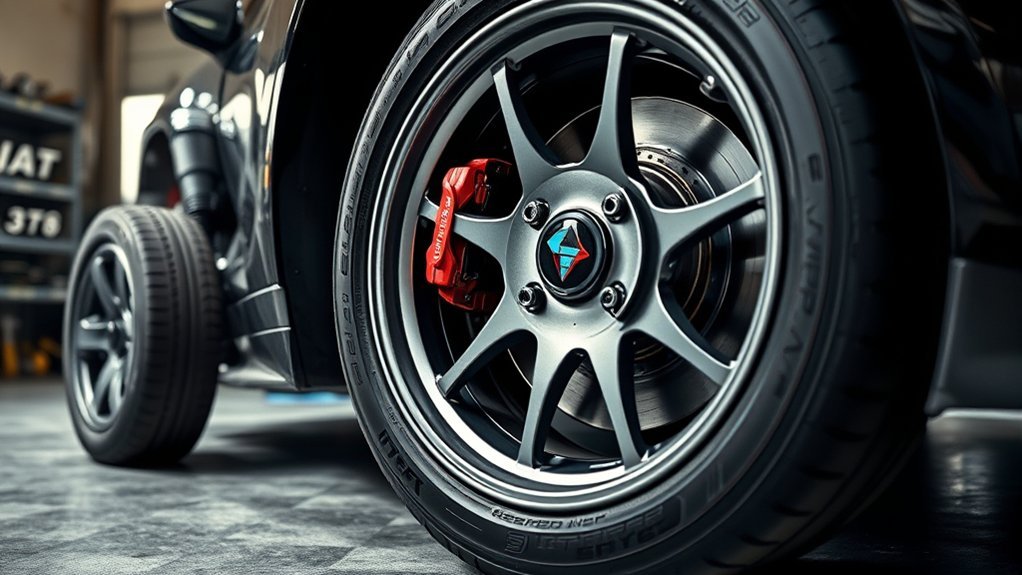
Weight on wheels matters because some of that mass moves with the road and some of it also rotates. The first effect is called unsprung mass; the second is rotational inertia. Lighter wheel-and-tire assemblies can improve suspension control and reduce the energy needed to accelerate or slow the wheels, but there is no universal rule saying one pound at the wheel equals three, ten, or twelve pounds in the body.
Quick Answer
Wheel weight can affect ride, grip, acceleration, and braking because wheels are partly unsprung and also rotate. Reducing weight can help, especially when mass is removed far from the hub, but the benefit depends on suspension design, tire construction, road surface, and the complete wheel-and-tire package. There is no reliable fixed multiplier for the effect.
Key Takeaways
- Unsprung mass includes the wheel-and-tire assembly, hub, much of the brake hardware, and portions of the suspension that move with the wheel.
- Lower unsprung mass can make it easier for the suspension to control wheel motion over uneven pavement.
- Rotational inertia is separate. A wheel, tire, or brake rotor must be spun as the car accelerates, while a brake caliper is unsprung but does not rotate with the wheel.
- Mass positioned farther from the hub contributes more rotational inertia than the same mass positioned near the center.
- Bigger or wider wheels are not automatically better or worse. Compare weight, tire construction, overall diameter, load rating, fitment, and intended use as a complete system.
What Weight on Wheels Means for Performance
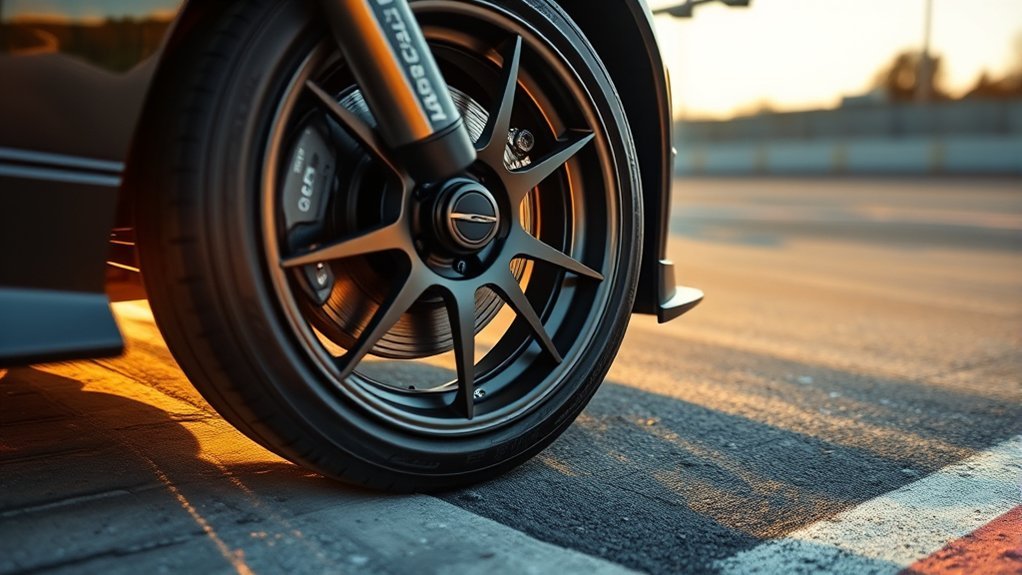
When people talk about weight on wheels, they are usually discussing two related effects: unsprung mass and rotational inertia. They overlap, but they are not the same.
Unsprung mass is the portion of the vehicle that moves vertically with the wheel rather than being fully supported by the suspension springs. Wheels, tires, hubs, brake rotors or drums, and much of the brake hardware belong in this group. Some suspension and driveline parts are only partly unsprung because one end moves with the chassis and the other moves with the wheel.
This distinction is important in vehicle dynamics. SAE’s Vehicle Dynamics Terminology standard separately recognizes vehicle-mass and rotational-inertia properties rather than treating every pound near a wheel as having one identical effect.
When unsprung mass increases, the spring and damper have more mass to control as the wheel moves over bumps. Depending on the road input and suspension design, that can increase wheel motion and variations in tire load. Research into quarter-car suspension models has long shown that unsprung mass influences ride and road holding, while newer work confirms that the effect varies with excitation frequency, damping, tire stiffness, and suspension control.
Rotational inertia creates a different penalty. The engine must supply energy to spin rotating parts faster during acceleration, and the brakes must remove rotational energy while slowing them. Wheels, tires, brake rotors, hubs, and some driveline parts contribute to that inertia.
Note: A brake caliper can add unsprung mass without adding meaningful wheel-spin inertia because the caliper does not rotate with the wheel. A tire adds both unsprung mass and rotational inertia. That is why the two terms should not be used interchangeably.
Sprung vs Unsprung Weight Explained
You can think of sprung weight as the portion of vehicle mass supported by the suspension springs. The body, cabin, passengers, cargo, engine, and most of the transmission are normally part of the sprung mass.
Unsprung weight, more accurately called unsprung mass, moves much more directly with the road. The wheel-and-tire assembly is the clearest example, but the exact division depends on suspension and driveline design.
The ratio and interaction between sprung and unsprung mass help determine how a vehicle reacts to bumps, wheel hop, and rapid changes in tire load. That does not mean reducing unsprung mass automatically improves every aspect of a vehicle. Spring rate, damping, tire stiffness, suspension geometry, and road frequency still matter.
Sprung Weight Basics
Sprung weight includes most of the vehicle mass carried by the suspension. It affects acceleration, braking, body roll, pitch, weight transfer, ride motion, and how much work the suspension must do to control the chassis.
- Sprung mass includes the body, cabin, occupants, cargo, and most powertrain components.
- Reducing total sprung mass can improve acceleration and reduce the energy needed to slow the vehicle.
- Its location also affects center of gravity and weight distribution.
- Suspension tuning must match the sprung mass rather than simply making every component as light as possible.
Understanding sprung mass gives you a baseline for evaluating modifications. A 20-pound reduction from the body and a 20-pound reduction from a wheel do not affect the vehicle in exactly the same way, but there is no single conversion ratio that works for every car.
Unsprung Weight Effects
Unsprung mass commonly includes wheels, tires, hubs, brake rotors or drums, calipers, and portions of suspension or driveline hardware that move with the wheel.
When that mass changes direction over a bump, the spring and damper must control its inertia. More unsprung mass can therefore change wheel-hop behavior, dynamic tire loading, ride response, and how quickly the wheel settles after a road disturbance.
A classic Journal of Sound and Vibration study on unsprung mass found that reducing unsprung mass can improve the balance between ride and wheel-hop behavior in its modeled conditions. More recent 2026 suspension research also shows that added unsprung mass changes suspension behavior differently across frequency ranges.
That is more useful than saying unsprung mass is always worth a certain multiple of sprung mass. The real result depends on the vehicle and the disturbance the suspension is trying to control.
Unsprung Mass vs Rotational Mass
The easiest way to avoid confusion is to ask two separate questions about a component:
- Does it move vertically with the wheel? If so, some or all of its mass is unsprung.
- Does it spin as vehicle speed changes? If so, it contributes rotational inertia.
A tire answers yes to both questions. A brake rotor also contributes to both. A caliper is largely unsprung but does not spin with the wheel. Parts of the driveshaft rotate but may be largely supported by the chassis.
For acceleration and braking, rotational kinetic energy depends on the component’s moment of inertia. University physics treatments of rolling motion express total kinetic energy as translational energy plus rotational energy. The rotational contribution can be represented by an equivalent mass term of I/r², where I is moment of inertia and r is rolling radius.
That equation explains why a universal “three times” rule cannot be correct for every wheel. Moment of inertia changes with the wheel’s shape and with where its mass is located.
Why Unsprung Weight Hurts Handling
Unsprung mass matters most when the wheel must move quickly relative to the body. On perfectly smooth pavement, this vertical-motion effect may be small. On rough pavement, washboard surfaces, bumps, or curbing, it becomes more important.
The suspension tries to keep tire load as consistent as possible while isolating the chassis from road disturbances. Increasing unsprung mass changes that dynamic system and can make wheel-hop control more difficult in important frequency ranges.
Grip Loss On Bumps
As unsprung weight rises, the wheel has more inertia while moving over road irregularities. Depending on speed and suspension tuning, the resulting tire-load variation can reduce available grip just when the tire is being asked to accelerate, brake, or corner.
- A heavier wheel assembly requires more force to accelerate vertically over a bump.
- Its motion must then be controlled by the tire, spring, and damper.
- At sufficiently severe road inputs, dynamic tire load can vary substantially and the tire may momentarily lose contact.
- Good damping and appropriate tire stiffness can reduce the problem, which is why unsprung mass should never be judged in isolation.
For you as the driver, the result may appear as reduced composure, extra wheel movement, or less consistent grip on rough surfaces rather than a simple fixed percentage loss of traction.
Slower Suspension Response
Heavier unsprung parts increase the inertia that the suspension must control when the wheel moves vertically. This changes the natural frequencies and dynamic response of the wheel-and-suspension system.
That does not mean the wheel literally reacts slowly in every situation. Suspension response depends on spring rate, damper force, tire stiffness, road frequency, and the ratio between sprung and unsprung masses.
Recent frequency-domain research into added unsprung mass from in-wheel motors shows why the simple explanation is incomplete: changing unsprung mass can shift wheel-hop-sensitive frequencies and change how disturbances travel through the suspension.
Lower unsprung mass can give suspension engineers more freedom to control wheel movement, but it still has to be matched with the correct spring, damper, tire, and geometry.
Heavier Steering Feel
Wheel and tire changes can alter steering feel, but wheel weight alone does not determine steering effort.
A different wheel-and-tire package can change tire construction, tread width, sidewall stiffness, offset, scrub radius, alignment behavior, and rotational inertia. Those variables may make the steering feel heavier, lighter, sharper, or more reluctant to change direction.
- More rotational inertia resists changes in wheel spin speed.
- Tire construction and sidewall stiffness affect steering response.
- Wheel offset can change scrub radius and steering effort.
- Power-steering calibration may mask or amplify what the driver feels.
For that reason, it is inaccurate to say every 10 pounds of wheel weight produces one predictable amount of steering penalty.
Why Wheel Weight Feels Heavier Than It Looks
A wheel can influence performance in two ways at once: its mass must move forward with the car, and much of that mass must also rotate.
The important rotational quantity is not weight alone but moment of inertia. Physics defines rotational kinetic energy using both angular speed and moment of inertia. The University of Tennessee’s rolling-motion explanation shows that a rolling wheel has both translational and rotational kinetic energy.
Where the mass sits matters. Adding weight near the outside barrel or tread generally changes rotational inertia more than placing the same amount of weight close to the hub because moment of inertia increases strongly with distance from the axis of rotation.
This is also why comparing wheel weights alone can be misleading. Two 20-pound wheels can have different rotational inertias if one concentrates more material near the hub and the other carries more mass around the outer rim.
There is no universal “3×,” “4×,” or “12×” rule for wheel weight. The real effect depends on how much mass changes, where that mass is located, the wheel’s radius, and the vehicle itself.
On a performance car, reducing both total assembly mass and rotational inertia can improve responsiveness. The size of the improvement, however, has to be measured on that particular vehicle rather than inferred from a universal multiplier.
How Bigger Wheels Change Performance
Larger-diameter wheels often change much more than appearance. A typical plus-size setup uses a larger wheel with a lower-profile tire so the overall tire diameter remains reasonably close to the vehicle’s intended specification.
A larger wheel is not automatically heavier. Forging, material choice, spoke design, barrel construction, and tire weight all matter. Still, many larger street-wheel packages do become heavier because there is more wheel material and the matching tire may also be wider.
- Unsprung mass may rise. A heavier complete assembly gives the suspension more mass to control.
- Rotational inertia may rise. Extra mass located farther from the hub can be especially important.
- Sidewall height usually falls during plus-sizing. That can sharpen steering response but may increase impact harshness and wheel-damage risk.
- Overall tire diameter matters. A large change can affect effective gearing, speedometer accuracy, clearance, and electronic vehicle systems.
- Tire construction can outweigh wheel-weight differences. Sidewall stiffness, compound, tread design, and inflation pressure strongly affect how the car feels.
If you want sharper vehicle dynamics, compare the complete mounted wheel-and-tire assemblies rather than choosing by wheel diameter alone.
Pro Tip: When comparing two setups, weigh the complete wheel and tire—not just the bare rim. Also compare overall tire diameter and, when reliable data are available, rotational inertia or where the weight is concentrated.
[Products Worth Considering]

This universal wheel alignment tool helps you accurately restore tire tilt angles after tire or suspension repairs using an adjustable camber gauge. It features a powerful magnetic base that firmly attaches to brake rotors for stationary, slip-free readings, improving consistency during measurement. Built from durable PC plastic, it resists wear and corrosion and is compact enough for car, truck, RV, and motorcycle alignment tasks.

Secure your parked vehicle quickly with AFA Tooling 4T rubber wheel chocks in a 4-pack for two dual-wheel sets. The ribbed design and textured base grip fast without pounding, so you can chock tires on trailers, RVs, ATVs, and work vehicles with confidence. EZ rustproof handles with rope ties keep the pair together for easy placement and removal, while nylon-reinforced rubber stands up to dirt, ice, salt, and harsh weather.

This metal-free wheel and tire cleaning brush uses dense, fluffy synthetic wool to safely clean rims, spokes, fenders, and engine areas without worrying about damaging surfaces. Its flexible, comfortable design helps you reach detailed areas while maintaining durability, and the extra absorbent fibers work well with wheel spray cleaners for faster cleanup. Reusable and washable performance helps prevent grime and build-up for cleaner vehicles and easier maintenance at home.
Can Lighter Wheels Improve Braking?
Yes, lighter rotating parts can reduce the amount of rotational kinetic energy the brakes must remove. A lighter wheel-and-tire assembly can therefore improve brake-system responsiveness and reduce the energy associated with repeatedly accelerating and decelerating the rotating assembly.
However, this does not mean a lighter wheel makes the brake caliper actuate faster. Caliper response is controlled by the braking system. Wheel inertia determines part of the energy and torque involved in slowing the rotating assembly.
Lower unsprung mass may provide another benefit on uneven pavement because the suspension has less wheel assembly mass to control. That can help maintain more consistent tire loading during a rough-road braking event.
On smooth, dry pavement, however, emergency stopping distance is strongly influenced by tire-road friction, ABS behavior, tire temperature, brake capability, load, and road conditions. Therefore, changing to lighter wheels does not guarantee a shorter measured stopping distance.
The safest conclusion is that lighter rotating wheels reduce inertia and brake-energy demand, while any actual stopping-distance improvement depends on the complete vehicle and test conditions.
[Products Worth Considering]

These aluminum alloy tire valve stem caps with an O-ring seal help protect valve stems from corrosion while adding a clean, stylish look to your vehicle. The universal fit works across cars, trucks, motorcycles, bicycles, and more, making them an easy upgrade for everyday driving and off-road use. Installation is quick, and the included four-pack keeps all your tires dressed and protected.

This professional wheel and rim brush kit makes it easy to lift brake dust, grime, and dirt from wheels and tires without scratching finishes. The brushes feature soft, metal-free wool heads and a flexible 360-degree rim brush design for reaching hard-to-clean areas. Includes multiple brush types plus accessories for thorough car, motorcycle, and general vehicle detailing.
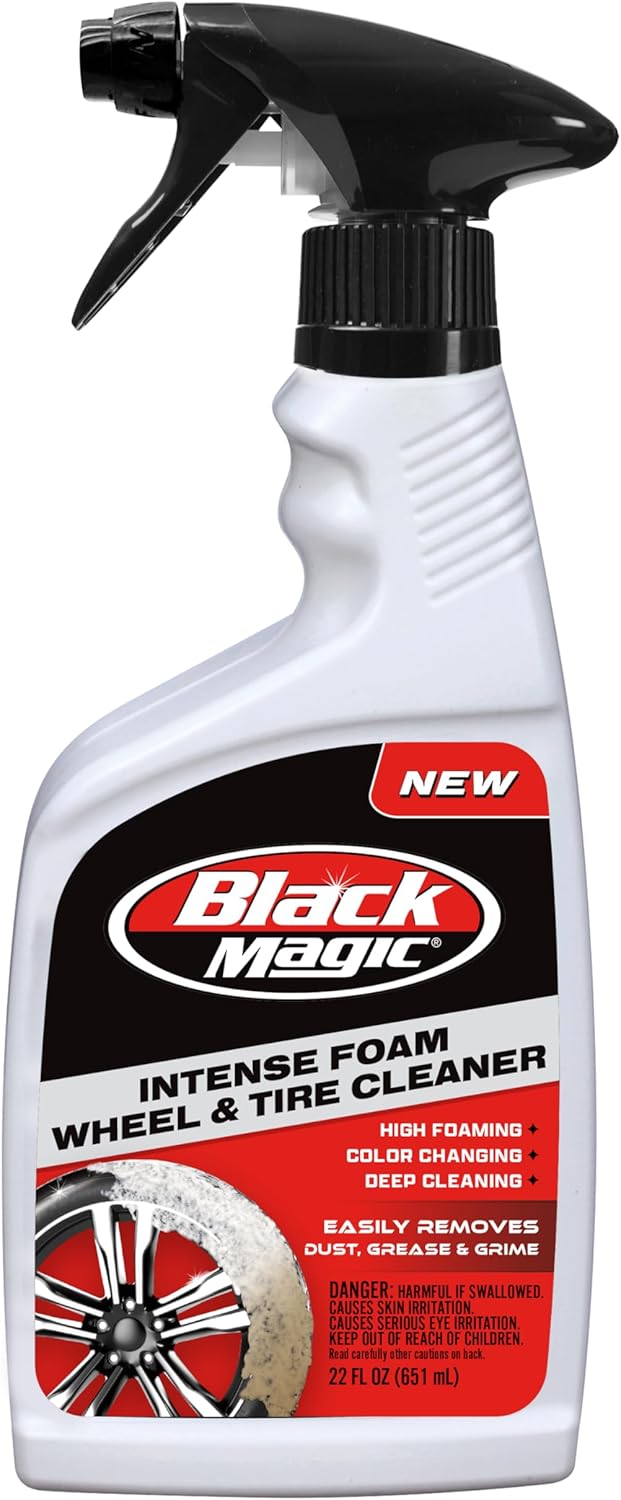
Black Magic Intense Foam Wheel & Tire Cleaner uses a high-foaming action to lift away dirt, grime, and brake dust without scrubbing. The color-changing formula helps show contaminants being dissolved as foam turns from white to brown. Safe for all wheel types and even wheel wells, it leaves a like-new, slick finish with a fresh cherry scent.
When Wider Tires Offset Extra Wheel Weight
Wider tires can improve performance in some applications, but saying they work simply because they create a larger contact patch is too simplistic.
Tire footprint behavior depends on vertical load, inflation pressure, construction, camber, tread design, and operating conditions. Virginia Tech research on a passenger-car tire contact patch demonstrates how footprint shape, size, and pressure distribution change with load, inflation pressure, and driving conditions.
At a similar load and pressure, a wider tire will generally produce a differently shaped footprint—typically wider and shorter—but width alone does not guarantee a proportionally larger total footprint area.
- Wider tires can change the shape and pressure distribution of the contact patch.
- They can provide greater cornering capability when their compound, construction, temperature range, and load sensitivity suit the vehicle.
- The wider tire and wheel may add unsprung mass and rotational inertia.
- Stiffer or shorter sidewalls may improve steering response but can reduce impact compliance.
- Wet-road and standing-water behavior may differ from dry-road performance.
Whether the trade is worthwhile depends on the entire package. A well-engineered wider setup can produce a net performance gain even when it weighs more, while an oversized heavy package can make a car slower and less composed.
How to Compare Wheel-and-Tire Packages
If you are choosing between two wheel setups, compare more than the diameter printed on the wheel.
- Complete assembly weight: Compare the wheel and mounted tire together.
- Weight distribution: Less mass near the outer barrel and tread generally helps rotational inertia more than the same reduction near the hub.
- Overall tire diameter: Stay within the vehicle or tire manufacturer’s acceptable fitment range.
- Wheel load rating: The wheel must safely support the vehicle’s required load.
- Tire load index and speed rating: Do not reduce required ratings simply to save mass.
- Offset and width: These affect suspension clearance, fender clearance, steering geometry, and bearing loads.
- Brake clearance: Verify that the wheel clears calipers and other brake hardware.
- Tire pressure: Use the pressure specified for the vehicle or a properly engineered alternative setup rather than changing pressure simply to alter grip.
- Wheel strength: The lightest wheel is not automatically the best wheel if strength, durability, or impact resistance is inadequate.
- Your use case: A track car, commuter, off-road vehicle, and luxury cruiser may need very different compromises.
Warning: Never choose a wheel only because it is lighter. Confirm the correct diameter, width, bolt pattern, offset, load rating, fastener-seat design, tire load capacity, and brake/suspension clearance for your vehicle. An incorrectly rated or fitted wheel can create a serious safety problem.
[Products Worth Considering]

This professional wheel and rim cleaning brush set lifts brake dust, grime, and dirt with soft, scratch-free microfiber and synthetic wool fibers. The rim brush bends up to 360 degrees for easy access to hard-to-reach areas around spokes, lips, and faces. Ideal for thorough cleaning of car, truck, motorcycle, bicycle, RV, and more wheel and tire surfaces.
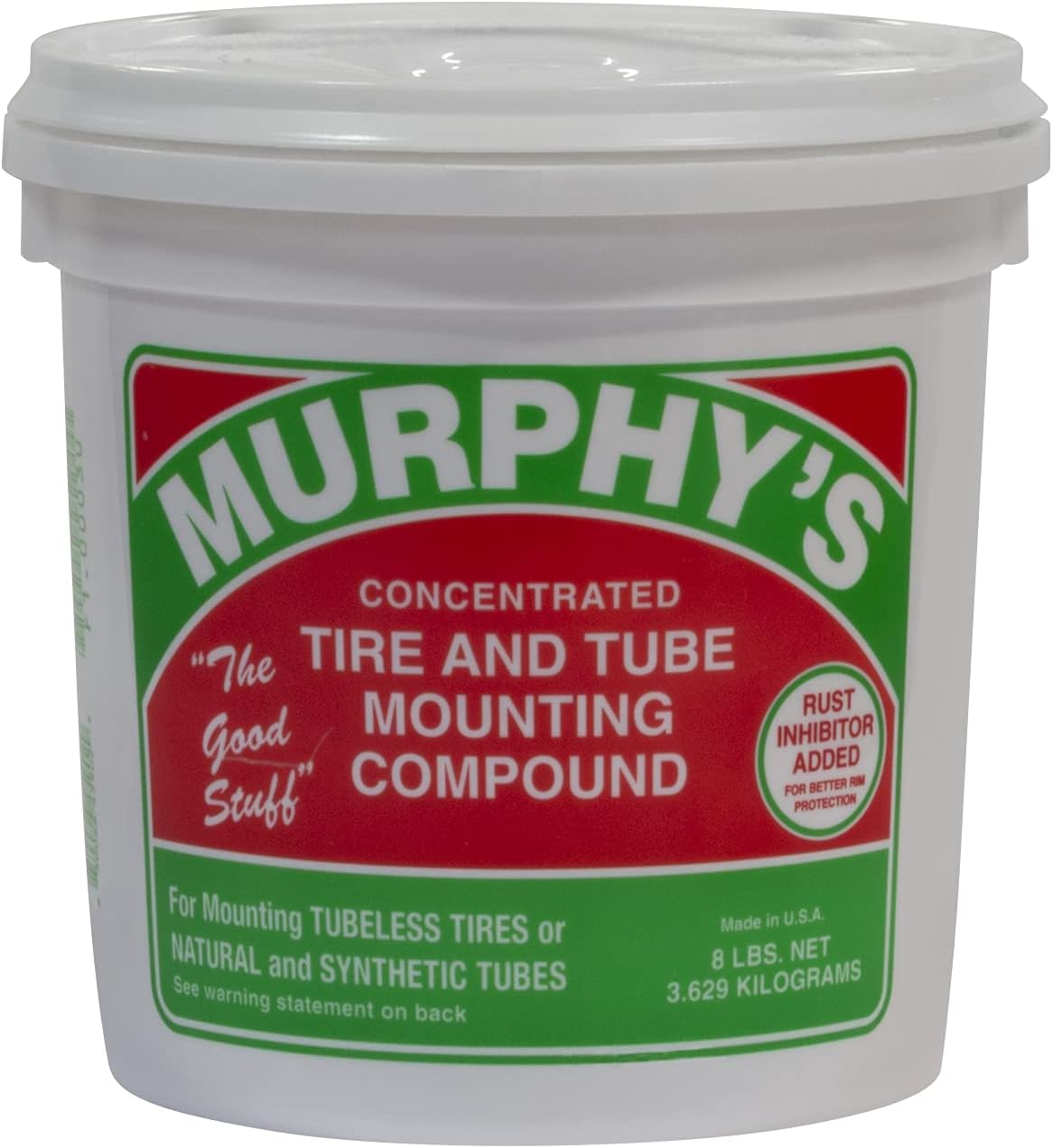
A concentrated tire and tube mounting compound designed to help simplify mounting rubber tires and tubes on passenger, semi truck, construction, and OTR applications. Its ultra-thick formula packs beads effectively and includes rust inhibitors to help protect against corrosion during use.

Tymate TM7 is a wireless tire pressure monitoring system that delivers real-time pressure and temperature readings for safer driving. It includes four external sensors, a bright color LCD display with adjustable backlight, and six alarm modes for high/low pressure, fast leakage, high temperature, and sensor signal or battery issues. The system covers a wide 0–144 PSI range and plugs into your vehicle’s cigarette lighter socket for quick DIY setup.
Frequently Asked Questions
Does Unsprung Weight Matter?
Yes. Unsprung mass affects how the wheel, tire, spring, and damper respond to road inputs. Reducing it can improve wheel control and road holding in some conditions, especially on uneven surfaces, but the size of the benefit depends on the suspension, tire, vehicle mass, and road frequency.
How Does Wheel Size Affect Unsprung Weight?
Larger wheels often weigh more, but not always. Material, construction, spoke design, tire size, and tire weight determine the complete assembly mass. A lightweight forged larger wheel may weigh less than a smaller heavy cast wheel, so compare actual wheel-and-tire weights rather than diameter alone.
Is Unsprung Weight More Important Than Horsepower?
Neither is universally more important. Horsepower strongly affects how quickly a vehicle can gain speed when power is the limiting factor. Unsprung mass affects suspension behavior and road holding, while rotational inertia also affects acceleration and deceleration. Which matters more depends on what performance problem you are trying to solve.
What Is the Difference Between Unsprung Weight and Sprung Weight?
Sprung mass is supported by the suspension springs and includes most of the body, cabin, passengers, cargo, and powertrain. Unsprung mass moves more directly with the wheel and includes the wheel, tire, hub, brakes, and portions of suspension or driveline components.
Does Saving 5 Pounds Per Wheel Make a Noticeable Difference?
It can, but there is no universal result. Saving 5 pounds at each corner removes 20 pounds from the vehicle and may also reduce rotational inertia. The effect is more meaningful when the removed mass was concentrated toward the outer part of the wheel or tire, but tire construction and suspension tuning may be more noticeable in everyday driving.
Are Lighter Wheels Always Better?
No. Weight is only one design requirement. A wheel also needs adequate strength, fatigue resistance, impact durability, load capacity, correct dimensions, and proper fitment. A slightly heavier wheel that safely handles your vehicle and driving conditions can be a better choice than the lightest available option.
Do Brakes Count as Unsprung Weight?
Much of the brake hardware at the wheel does. Rotors or drums, calipers, and related hardware normally contribute to unsprung mass. Rotors and drums also rotate and therefore add rotational inertia, while a conventional caliper does not spin with the wheel.
Conclusion
When you look at weight on wheels, separate two effects. Unsprung mass influences how the suspension and tire respond to road disturbances, while rotational inertia changes the energy needed to accelerate and slow rotating components. Lighter wheels can help both, but there is no credible universal formula saying a pound at the wheel equals three, ten, or twelve pounds in the body.
Bigger wheels and wider tires can still improve performance when the complete package is engineered correctly. The best choice balances assembly weight, mass distribution, tire construction, overall diameter, grip, ride, wheel strength, load rating, fitment, and suspension setup instead of chasing the lowest wheel weight or largest tire size by itself.
Sources
- SAE International — Vehicle Dynamics Terminology, J670_202206 — vehicle-dynamics terminology and treatment of mass and inertia properties.
- Hrovat — Influence of Unsprung Weight on Vehicle Ride Quality, Journal of Sound and Vibration — effects of unsprung mass on suspension ride and wheel-hop behavior.
- Feng et al. — Frequency-Domain Mechanism Analysis for the Adverse Effects of Unsprung Mass, Actuators, 2026 — frequency-dependent effects of added unsprung mass on ride, suspension movement, and road holding.
- University of Tennessee Department of Physics — Energy and Angular Momentum — translational and rotational kinetic energy of rolling objects.
- Virginia Tech — Tire Contact Patch Characterization Through Finite Element Modeling and Experimental Testing — tire-footprint behavior under different loads, pressures, and operating conditions.