
For a Toyota RAV4, the correct tire rotation pattern is the pattern specified for your exact model year, tire type, and wheel setup. Toyota says tire-rotation frequency and pattern are vehicle-specific, so do not choose a cross pattern only because your RAV4 is front-wheel drive or all-wheel drive. Directional tires normally stay on the same side and move front to rear; non-directional tires may allow more patterns, but the owner’s manual remains the final check. This guide helps you choose the pattern and diagnose uneven wear before rotating.
Last updated: August 18, 2026
Quick Answer
Start with the owner’s manual for your exact RAV4 model year. If all four tires are the same size and have a directional arrow, rotate them front to rear on the same side. If the tires are non-directional, use the exact pattern Toyota shows for your vehicle rather than assuming every FWD or AWD RAV4 uses a cross pattern. If the front and rear tire sizes differ, or a spare is temporary or nonmatching, a standard four-tire or five-tire rotation may not apply.
Key Takeaways
- Use the rotation diagram and service interval for your exact RAV4 model year.
- Keep directional tires on the same side unless they are professionally remounted to preserve their rolling direction.
- Do not treat “non-directional” as automatic permission to cross-rotate; Toyota’s vehicle-specific guidance still comes first.
- Check whether the tires are directional, asymmetric, the same size front and rear, and compatible with any spare before choosing a pattern.
- Inspect tread wear and RAV4 tire pressure during every rotation, and fix alignment, balance, or suspension faults if uneven wear returns.
At a Glance
| Tire Setup | Rotation Rule | Check First |
|---|---|---|
| Directional, same size | Front to rear on the same side | Sidewall rotation arrow + owner’s manual |
| Non-directional, same size | Use the pattern in the model-year manual | Do not assume FWD/AWD alone decides it |
| Different front/rear sizes | Standard front-to-rear rotation may not be possible | Front and rear sidewall sizes |
| Temporary or nonmatching spare | Do not include it in a normal rotation | Spare label + owner’s manual |
Recommended Tire Rotation Patterns for Your Toyota RAV4
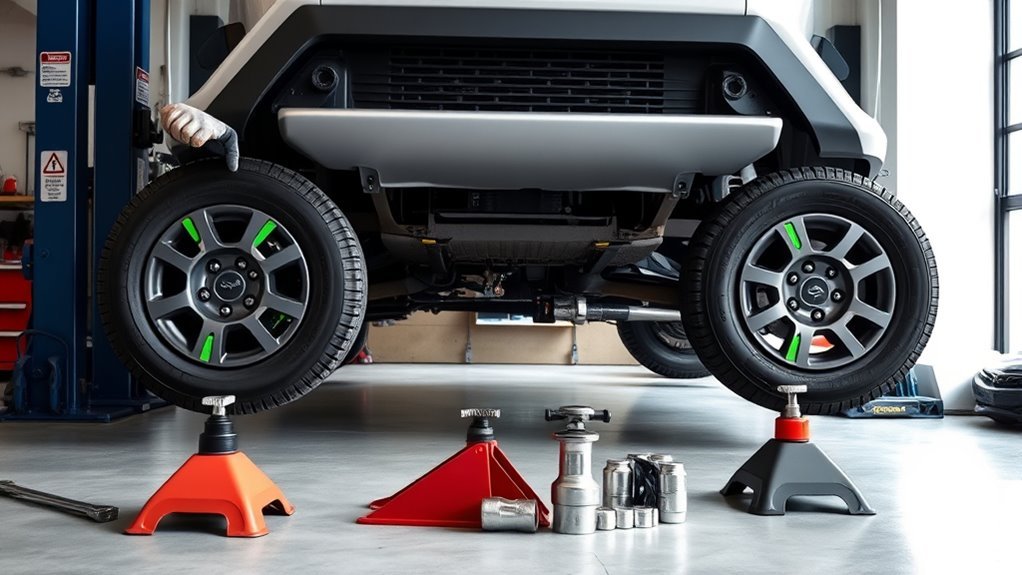
The safest rule is simple: use the pattern Toyota specifies for your exact vehicle. Toyota’s tire rotation guide says both the schedule and the pattern are vehicle-specific and that the vehicle manufacturer’s recommendation takes priority over general rotation advice.
That matters because generic charts often assign one pattern to FWD vehicles and another to AWD vehicles. Those charts are useful background, but they are not a substitute for the RAV4 owner’s manual. Your model year, tire construction, tire sizes, and replacement-tire instructions can restrict which positions are safe.
For directional tires of the same size, move the front tires straight to the rear and the rear tires straight to the front, keeping each tire on the same side. Michelin’s tire-rotation guidance gives the same front-to-rear rule for directional tires because the tread is designed to roll in one direction.
For non-directional tires of the same size, more patterns may be physically possible, including cross patterns. Use them only when the Toyota manual and the tire maker allow them. If your front and rear tires are different sizes, do not use a normal front-to-rear pattern unless your vehicle and tire guidance specifically permits it.
For timing, follow the maintenance guide for your exact RAV4. As a general reference rather than a RAV4-specific rule, NHTSA TireWise says that, when a vehicle manufacturer recommends tire rotation, a 5,000-to-8,000-mile interval is common and tires should be rotated sooner if uneven wear appears.
[Products Worth Considering]

Measure tire tread depth quickly and accurately with this LUMITECO dial gauge that reads in 1/32" increments up to 14/32". The color-coded green/yellow/red zones make it easy to judge tire wear and know when replacement is needed. A rugged, compact design with a protective pouch helps keep the gauge ready for use on cars, trucks, motorcycles, and more.

Monitor tire tread wear with a smart, color-coded depth gauge that shows clear condition ranges at a glance. The bar is range marked for fast, easy readings, helping you maintain safer traction and performance. Each gauge is portable with a pocket clip, and the set includes 20 units for daily use and sharing.

The VEHLIVE SU-50448 II TPMS relearn tool provides a fast activation reset to restore accurate tire pressure monitoring after sensor replacement or tire rotation. It supports 315 MHz and 433 MHz GM series sensors and helps clear dashboard pressure warnings. With simple two-button operation and horn-confirmed relearning order, you can reprogram sensors conveniently at home.
Understanding Tire Types: Directional vs. Non-Directional
Your tire type controls which rotation patterns are possible. Before you move any wheel, read the sidewall and compare the tire sizes at the front and rear.
Directional Tire Characteristics
Directional tires have tread designed to work in one rolling direction. Look for an arrow or rotation marking on the sidewall. When all four tires are the same size, they are normally rotated front to rear on the same side so the direction of travel does not reverse.
Do not cross directional tires from left to right unless a qualified tire professional remounts them on the wheels so the marked rolling direction remains correct. Installing a directional tire backward can reduce the tread’s intended water-management performance.
Warning: Check the sidewall rotation arrow before moving a directional tire. If the arrow would point backward after the move, that position is not correct without remounting.
Asymmetric Tires Are Not the Same as Directional Tires
An asymmetric tire usually has markings such as OUTSIDE and INSIDE because the inner and outer tread zones do different jobs. That does not automatically mean the tire is directional. Michelin explains that directional tires use rotation arrows, while asymmetric tires identify which side must face outward.
If an asymmetric tire is not directional and the front and rear sizes match, a side-to-side or cross move may be possible when Toyota and the tire maker allow it. The OUTSIDE sidewall must still face outward after the wheel is installed.
Non-Directional Tire Benefits
Non-directional tires give you more rotation flexibility because their tread is not restricted to one rolling direction. That flexibility can help distribute normal wear, but the vehicle-specific pattern still comes first.
Use the table below as a capability guide, not as a replacement for the RAV4 manual.
| Benefit | Description |
|---|---|
| More Pattern Options | May allow front-to-rear or cross rotation when approved |
| Wear Balancing | Lets tires experience different vehicle positions over time |
| Easier Position Changes | No directional arrow restricts the tire to one rolling direction |
How to Check Which Tire Rotation Pattern You Need
Use this decision order before you remove a wheel:
- Open the owner’s manual for your exact model year. Toyota says the correct pattern is vehicle-specific. If you do not have the printed manual, use Toyota’s online manuals and warranties section.
- Read every tire sidewall. Look for a rotation arrow, OUTSIDE/INSIDE markings, tire size, load index, and any special mounting instructions.
- Compare front and rear sizes. If they differ, a standard front-to-rear rotation may not be allowed. NHTSA also notes that some vehicles with different front and rear tire sizes cannot use a normal rotation.
- Check the spare. Do not include a temporary or nonmatching spare in a normal rotation. A matching full-size spare should be included only when the vehicle and tire guidance supports a five-tire pattern.
- Record tread depth and pressure. If your RAV4 is AWD, large tread-depth differences deserve extra attention; see the guide to matching tires on an AWD RAV4.
If all four tires are the same size and type but you are still unsure whether Toyota wants a straight or cross pattern, stop there and follow the diagram in the manual rather than a generic drivetrain chart.
Pro tip: Mark each starting position as LF, RF, LR, and RR before removal, then record inner, center, and outer tread depth. The next inspection will show whether the same wear pattern is returning.
[Products Worth Considering]

This TPMS relearn tool helps you quickly activate, match, and reset GM tire pressure sensors to keep the vehicle monitoring system working properly. It clears tire pressure alarms and dashboard warning lights after sensor replacement or tire rotation, and supports learning for common 315/433 MHz TPMS sensors. Designed for simple one-button operation, it can help you avoid unnecessary trips to repair shops.

These aluminum alloy tire valve stem caps with an O-ring seal help protect valve stems from corrosion while adding a clean, stylish look to your vehicle. The universal fit works across cars, trucks, motorcycles, bicycles, and more, making them an easy upgrade for everyday driving and off-road use. Installation is quick, and the included four-pack keeps all your tires dressed and protected.

Steelman white tire marking crayons provide high-contrast, semi-permanent marks for repairing and inspecting tires and equipment. They write on wet or dry, smooth or coarse surfaces including rubber, metal, glass, and wood, making them ideal for puncture location and damage outlining. The lead- and zinc-free crayons resist weather and fading yet wipe away when you no longer need the marks.
Why You Should Follow Manufacturer Guidelines
Tire rotation advice becomes unreliable when a generic pattern overrides the vehicle manual. Toyota specifically tells owners to use the vehicle manufacturer’s schedule and pattern even when general tire-rotation guidance differs.
Your tire maker can add another restriction. Directional construction, asymmetric mounting, different tire sizes, or replacement-tire instructions can change which positions are allowed.
Manufacturer Expertise Matters
The front and rear tires do different work during steering, braking, acceleration, and cornering. The correct rotation pattern is intended to redistribute that normal wear without violating the tire’s mounting requirements.
Use the RAV4 manual for the vehicle rule and the tire sidewall or tire maker for the tire rule. When they differ from a generic chart, follow the more specific guidance.
Consistency Reduces Tire Wear
A consistent schedule makes tread-depth changes easier to spot. Measure the same grooves at each rotation and keep a simple mileage record. If one position repeatedly loses tread faster, the pattern itself may not be the problem.
Repeated uneven wear can point to pressure, alignment, balance, wheel, or suspension issues. Rotation can redistribute normal wear, but it cannot repair a mechanical fault.
Safety Enhancements Through Guidelines
Rotation is also a useful inspection point. Check tread depth, sidewalls, valve stems, visible damage, and cold inflation pressure before the wheels go back on.
NHTSA recommends checking tire pressure regularly and using the vehicle’s specified pressure. For the RAV4-specific pressure source and cold-check method, see the Toyota RAV4 tire pressure guide.
Debunking Common Tire Rotation Myths
- Myth: Every AWD RAV4 should use a rearward-cross or X pattern. Not necessarily. Toyota says the pattern is vehicle-specific, so the model-year manual overrides a generic AWD chart.
- Myth: Every non-directional tire should be cross-rotated. Non-directional construction may make cross-rotation possible, but it does not prove that Toyota specifies it for your RAV4.
- Myth: Rotation fixes uneven tire wear. Rotation can redistribute normal wear. It cannot correct bad alignment, damaged suspension parts, wheel imbalance, or incorrect inflation.
- Myth: You can skip rotation when the tread looks even. A scheduled rotation is also a chance to measure tread, inspect inner edges, check pressure, and catch developing wear before it becomes obvious.
Effective Tips for Tire Maintenance

Use a repeatable tire-maintenance routine instead of relying on appearance alone:
- Follow the rotation interval in your RAV4 maintenance guide.
- Use the exact pattern allowed by the vehicle and tire instructions.
- Check tire pressure when the tires are cold and use the driver-door placard as the pressure reference.
- Measure tread at the inner, center, and outer grooves on all four tires.
- Inspect sidewalls, valve stems, and the tread for cuts, bulges, embedded objects, cracking, or exposed material.
- Schedule alignment, balance, wheel, or suspension checks when you notice pulling, vibration, steering-wheel offset, cupping, or repeat uneven wear.
What to Do About Uneven Tire Wear?
Uneven tire wear is a symptom, not a diagnosis. Start with cold tire pressure and tread-depth measurements, then use the wear pattern to decide what needs inspection. The table below is a triage guide; a shop should confirm the cause before parts are replaced.
| Wear Pattern | Common Clues | Best Next Check |
|---|---|---|
| One inner or outer edge | Alignment or worn steering/suspension parts may be involved | Alignment and suspension inspection |
| Both shoulders | Low pressure or excess load can contribute | Cold pressure, load, and leak check |
| Center tread | Excess inflation can contribute | Cold pressure against door placard |
| Scalloped or cupped dips | Balance, suspension, runout, or alignment may be involved | Wheel/tire balance and suspension inspection |
| Patchy wear with vibration | Imbalance, wheel damage, or tire irregularity may be involved | Balance, wheel, and tire inspection |
If the tread shows scalloped dips or cupping, Goodyear’s tire-cupping guide notes that suspension-related issues can be one cause. Do not keep rotating a badly worn tire in the hope that the pattern will disappear.
If uneven wear returns after a rotation, have the underlying cause inspected. Rotation helps manage normal wear; it does not correct worn parts, poor alignment, or a damaged wheel or tire.
[Products Worth Considering]

The SAFELIFE dial tire tread depth gauge measures tread depth in 1/32 inch increments with clear, easy-to-read 2-inch dial face. Color zones using a traffic light system help you quickly judge whether tread is low, marginal, or ample for safer driving. Built with a durable zinc cast body and a metal detect probe for precise, comfortable use across cars, motorcycles, trucks, and buses.

This TPMS sensor training and relearn reset tool is customized for Ford, Lincoln, and Mercury vehicles to help activate tire pressure programming after sensor replacement or tire rotation. It can activate individual tire pressure sensors with one-button operation, helping prevent TPMS warning light illumination. It is not a sensor programming tool and cannot program replacement sensors—use it to trigger/activate sensors only.

These universal tire valve stem caps help protect valve cores from dust, debris, and moisture while helping maintain stable tire pressure. The corrosion-resistant metal construction and sealed design provide reliable protection in road grime, mud, and winter conditions. Twist-on installation makes them quick to fit on cars, SUVs, trucks, and motorcycles.
Frequently Asked Questions
What Is the Tire Rotation Pattern for a Toyota RAV4?
Use the rotation diagram in the owner’s manual for your exact RAV4 model year. Directional, same-size tires normally move front to rear on the same side. Non-directional tires may allow more patterns, but do not assume a cross pattern is correct based only on FWD or AWD.
Does an AWD RAV4 Always Use a Cross Rotation Pattern?
No. Generic tire guides often show cross patterns for AWD vehicles, but Toyota says the correct pattern is vehicle-specific. Follow the model-year RAV4 manual and the tire maker’s restrictions instead of choosing a pattern from drivetrain alone.
How Often Should You Rotate Toyota RAV4 Tires?
Follow the maintenance guide for your exact RAV4 model year. Toyota’s public tire-rotation guidance does not give one universal interval for every vehicle. As a general reference, NHTSA says 5,000 to 8,000 miles is common when the manufacturer recommends rotation, with earlier attention if uneven wear appears.
Can Directional RAV4 Tires Be Cross-Rotated?
Not while they remain mounted in a way that would reverse their required rolling direction. Same-size directional tires normally move front to rear on the same side. A qualified tire professional can advise whether remounting is appropriate if side-to-side movement is needed.
Do Asymmetric RAV4 Tires Have to Stay on the Same Side?
Not necessarily. Asymmetric and directional are different features. If an asymmetric tire is not directional and the tire sizes match, a cross move may be possible when Toyota and the tire maker allow it, while the side marked OUTSIDE must still face outward.
Can You Rotate RAV4 Tires Yourself?
Yes, if you can safely lift and support the vehicle, follow Toyota’s approved lift points, use the correct rotation pattern, and tighten the wheel fasteners to the specification in your owner’s manual. For the hands-on procedure and tools, see the Toyota RAV4 DIY tire rotation guide.
Should You Include the Spare Tire in a RAV4 Rotation?
Do not include a temporary or nonmatching spare in a normal rotation. Only consider a five-tire rotation when the spare is a matching full-size tire and both the vehicle and tire guidance support that pattern.
Do You Need to Reset TPMS After a RAV4 Tire Rotation?
The required TPMS step can vary by model year and system. After rotation, check the owner’s manual for any initialization, pressure-setting, or tire-position learning procedure. If the warning light or displayed tire positions do not behave normally after service, see the RAV4 TPMS guide or have the system checked.
Conclusion
The best Toyota RAV4 tire rotation pattern is not a one-size-fits-all FWD or AWD diagram. Start with your model-year owner’s manual, then confirm the tire’s direction markings, front and rear sizes, spare type, and wear condition. Keep directional tires moving in their approved rolling direction, use cross patterns only when the specific vehicle and tire guidance allows them, and treat recurring uneven wear as a diagnostic clue rather than something rotation alone can fix.