Toyota Camry Wheel Alignment Explained: What It Is and Why It Matters

A Toyota Camry wheel alignment sets the wheel angles so the tires roll straight, the steering wheel stays centered, and the tread wears evenly. The main angles are toe, camber, and caster. When those angles drift out of specification, you may notice pulling, a crooked steering wheel, wandering, or uneven tire wear. Alignment is not a cosmetic service; it protects handling, tires, and fuel efficiency.
Quick Answer
A Toyota Camry needs a wheel alignment check when it pulls to one side, the steering wheel is off-center, tires wear unevenly, or the car recently hit a pothole, curb, or had steering/suspension work. Toyota recommends alignment as needed, not automatically at a fixed mileage interval.
Key Takeaways
- The biggest alignment warning signs are pulling, an off-center steering wheel, wandering, and uneven tire wear.
- Toyota says wheels only need alignment when needed; use tire rotations and inspections as a good time to check for symptoms.
- Misalignment can create tire scrub, rapid tread wear, unstable handling, and higher rolling resistance.
- A pull is not always caused by alignment, so check tire pressure, tire damage, road crown, brakes, and suspension parts first.
- Ask the shop for a before-and-after alignment printout showing toe, camber, caster, and factory specifications.
At a Glance
| Time Required | Usually about 45–90 minutes if no steering, suspension, or tire repairs are needed. |
| Difficulty | Professional service. A true alignment requires an alignment rack, measuring heads/sensors, and Toyota factory specifications. |
| Tools Needed | Alignment rack, wheel sensors or heads, steering wheel holder, technician tools, and a before-and-after alignment printout. |
| Cost | Varies by location, shop, model year, and repairs needed. Get a written estimate; RepairPal lists a Toyota Camry wheel alignment estimate between $236 and $347 before taxes and fees. |
What Camry Alignment Actually Changes
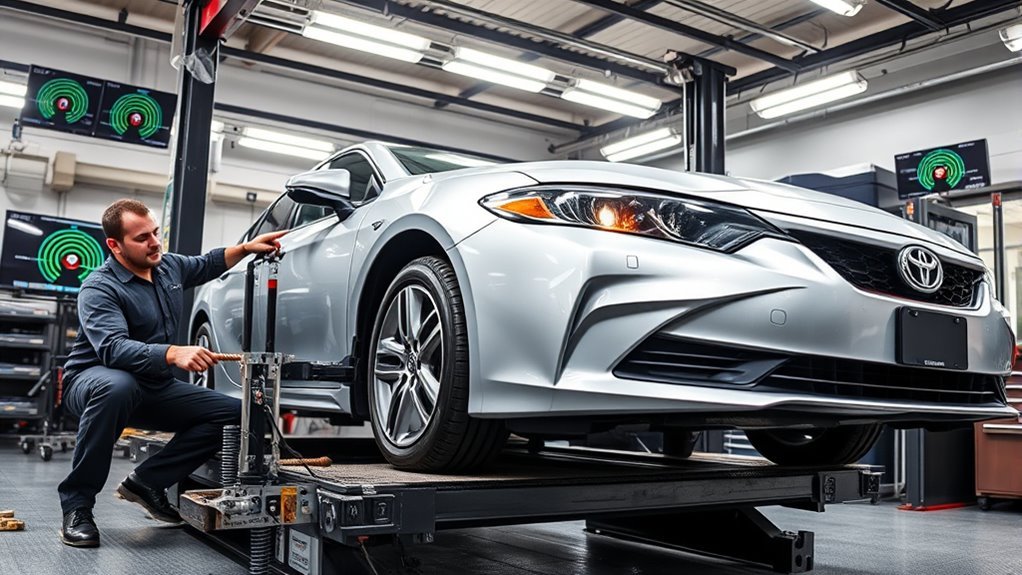
A proper Toyota Camry wheel alignment measures and corrects three main angles: toe, camber, and caster. These angles decide how the tires point, how they contact the road, and how the steering feels.
- Toe is the direction the tires point when viewed from above. Too much toe-in or toe-out can make the tires scrub across the road instead of rolling cleanly.
- Camber is the inward or outward tilt of the tire when viewed from the front. Incorrect camber can wear the inner or outer edge of the tread.
- Caster is the steering-axis angle that helps the steering wheel return to center and helps the car feel stable at speed.
These settings work together to improve steering response, straight-line tracking, and tire life. The technician should compare your Camry’s readings with Toyota factory specifications, then adjust the parts that are adjustable for your model year and suspension design. If a part is bent, loose, or worn, it may need repair before a proper alignment can hold.
[Products Worth Considering]

The SAFELIFE dial tire tread depth gauge measures tread depth in 1/32 inch increments with clear, easy-to-read 2-inch dial face. Color zones using a traffic light system help you quickly judge whether tread is low, marginal, or ample for safer driving. Built with a durable zinc cast body and a metal detect probe for precise, comfortable use across cars, motorcycles, trucks, and buses.

The Ziopetru adjustable magnetic wheel alignment tool helps you check and restore camber and caster positioning after removing and reinstalling undercarriage components. With a clear leveling/bubble measurement system and an easy zeroing adjustment knob, it supports precise horizontal angle checking. The strong magnetic base mounts to metal surfaces for convenient use at home on cars, motorcycles, trucks, vans, and SUVs.

This universal wheel alignment tool helps you accurately restore tire tilt angles after tire or suspension repairs using an adjustable camber gauge. It features a powerful magnetic base that firmly attaches to brake rotors for stationary, slip-free readings, improving consistency during measurement. Built from durable PC plastic, it resists wear and corrosion and is compact enough for car, truck, RV, and motorcycle alignment tasks.
Signs Your Toyota Camry Needs Alignment
Toyota lists pulling to the left or right and abnormal tire wear as signs of a possible wheel alignment concern, and a dealership or qualified shop can confirm whether an alignment is needed. The most common symptoms are easy to notice during normal driving, but they should be checked on a flat, safe road with correctly inflated tires.
Steering Wheel Off-Center
If your Toyota Camry drives straight but the steering wheel sits crooked, the toe setting may be off or the steering wheel may not have been centered during a previous repair. You may notice:
- A crooked steering wheel while cruising straight.
- A slight wandering feel on flat pavement.
- Uneven inner-edge or outer-edge tire wear.
Do not ignore an off-center wheel. It can make the car feel less predictable and may indicate that the front wheels are not tracking correctly. A proper alignment should include centering the steering wheel and verifying the final readings on a printout.
Pulling To One Side
A Camry that consistently pulls to one side on a flat, level road may need an alignment check. Before assuming alignment is the only cause, verify tire pressure, inspect for tire damage, and consider road crown. Some roads slope for drainage, which can make a car drift slightly even when the alignment is correct.
Note: A pull can also come from tire conicity, uneven tire pressure, brake drag, worn steering parts, or damaged suspension. A good shop should diagnose the cause before changing alignment settings.
Uneven Tire Wear
Uneven tire wear is one of the clearest signs that something is wrong with alignment, inflation, rotation, or suspension. Toyota’s tire guidance tells owners to check for uneven wear, including excessive wear on one side of the tread.
- One-sided edge wear: Inner or outer shoulder wear often points to camber or toe issues.
- Feathering: If the tread feels sawtoothed when you run your hand across it, toe may be out of specification.
- Cupping or scalloping: Wavy dips can come from worn shocks, struts, suspension looseness, imbalance, or alignment problems.
- Both shoulders worn: This often suggests underinflation, not alignment alone.
- Center wear: This often suggests overinflation.
Check tire pressure with a gauge before judging wear patterns. The correct pressure is listed on the Tire and Loading Information label on the driver’s doorjamb or in the owner’s manual, not on the tire sidewall.
How Bad Alignment Wears Tires Faster
Bad alignment makes your Camry’s tires drag slightly across the road instead of rolling straight. That creates tire scrub, extra heat, and uneven tread wear. The problem can start small, but it can shorten tire life quickly if the car keeps being driven with the wheels pointed in the wrong direction.
Uneven Tire Scrubbing
When the wheels are out of alignment, the tread does not meet the road evenly. A narrow strip of rubber may carry more load than the rest of the tire. Over time, that can create feathering, shoulder wear, and a rougher ride.
Use these tire maintenance habits to catch the problem early:
- Check tire pressure at least monthly when the tires are cold.
- Look across each tread for one-sided wear, bald spots, cuts, bulges, or exposed cords.
- Rotate tires on the schedule listed in your owner’s manual or maintenance guide.
- Ask for an alignment check after hard pothole hits, curb strikes, suspension work, or new tire installation.
Edge Wear Patterns
Edge wear patterns are a strong clue that your Camry’s geometry or tire pressure needs attention. Inner-edge wear and outer-edge wear can happen when camber or toe is out of specification. Feathering often points to toe problems because the tire is being dragged slightly sideways as it rolls.
Tire rotation can help you spot changes and even out normal wear, but it will not fix bad wheel angles. If one edge keeps wearing faster after pressure and rotation are corrected, schedule an alignment inspection.
Suspension Strain Effects
Misalignment can also add stress to steering and suspension parts because the car is constantly fighting its own wheel angles. Potholes, curb hits, worn bushings, bent control arms, and loose tie rods can all affect alignment. If a shop aligns the car without fixing a worn or bent part, the new settings may not hold.
Warning: Do not keep driving normally if the Camry pulls hard, the steering feels loose, the tire cords are showing, or the car changed direction after an impact. Have it inspected before highway driving.
Why Camry Alignment Helps Safety and MPG

Proper Camry wheel alignment supports safety because the tires contact the road more evenly and the car responds more predictably when you steer, brake, or make an emergency maneuver. It also helps reduce driver fatigue because you are not constantly correcting a pull or drift.
Alignment can also help fuel economy indirectly. Misaligned tires create extra scrub and rolling resistance, which means the engine works harder than it should. The exact fuel loss depends on the vehicle, tires, road conditions, and severity of the misalignment, so avoid any shop or article that promises a fixed mpg gain for every Camry.
Proper tire maintenance, including rotation, balance, and alignment, helps tires last longer and can reduce avoidable ownership costs.
When to Get a Toyota Camry Alignment
You do not need to align a Toyota Camry on a fixed mileage schedule just because the odometer reaches a certain number. Toyota says wheels only need to be aligned as needed. The best approach is to inspect tires regularly, check alignment when symptoms appear, and verify the alignment after events that can change suspension geometry.
Schedule an alignment check when:
- The steering wheel is off-center while driving straight.
- The Camry pulls or drifts on a flat, level road.
- You see abnormal inner-edge, outer-edge, feathered, or cupped tire wear.
- You hit a pothole, curb, road debris, or have a minor collision.
- You install new tires and want to protect the tread from early uneven wear.
- You replace tie rods, control arms, struts, ball joints, bushings, or other steering/suspension parts.
- A tire rotation creates a new pull, vibration, or steering change.
Pro Tip: Ask for a printed or digital before-and-after report. It should show toe, camber, and caster readings compared with the factory specification range.
How Alignment Is Checked and Adjusted
During a Toyota Camry alignment, the technician places the car on a level alignment rack and attaches sensors or measuring heads to the wheels. The machine measures each wheel angle and compares the readings with factory specifications for that Camry’s model year, trim, and suspension setup.
The usual process looks like this:
- Initial inspection: The technician checks tire condition, tire pressure, ride height, and visible steering or suspension problems.
- Measurement: The alignment system reads toe, camber, caster, thrust angle, and steering wheel position.
- Adjustment: The technician adjusts the available points, commonly tie rods for front toe and other factory adjustment points where equipped.
- Recheck: The machine confirms the final readings are within specification.
- Road test: The shop verifies that the steering wheel is centered and the car tracks properly.
Some Camry alignment readings may be non-adjustable without replacing parts or installing approved correction parts. If the numbers are far outside specification after an impact, the issue may be bent or worn hardware rather than a simple adjustment.
[Products Worth Considering]

Upgrade your wheels with MIKKUPPA M12x1.5 mag seat lug nuts built for secure, corrosion-resistant performance. These closed-end chrome lug nuts are a direct replacement for select Toyota models, including Camry, Corolla, RAV4, Sienna, Avalon, Highlander, Matrix, Venza, and Prius. Triple-chromium plating and cold-forged, heat-treated steel help deliver strength for daily driving and replacement needs.

Measure tire tread depth quickly and accurately with this LUMITECO dial gauge that reads in 1/32" increments up to 14/32". The color-coded green/yellow/red zones make it easy to judge tire wear and know when replacement is needed. A rugged, compact design with a protective pouch helps keep the gauge ready for use on cars, trucks, motorcycles, and more.

Keep your tires properly inflated with this analog VONDIOR tire pressure gauge, designed for fast, easy readings without batteries. The swiveling, two-axis hose and large glow dial help you measure at any tire angle with instant visibility. Built with a protective rubber shield, it supports durable, low-maintenance use for cars and trucks.
Alignment Vs. Balancing
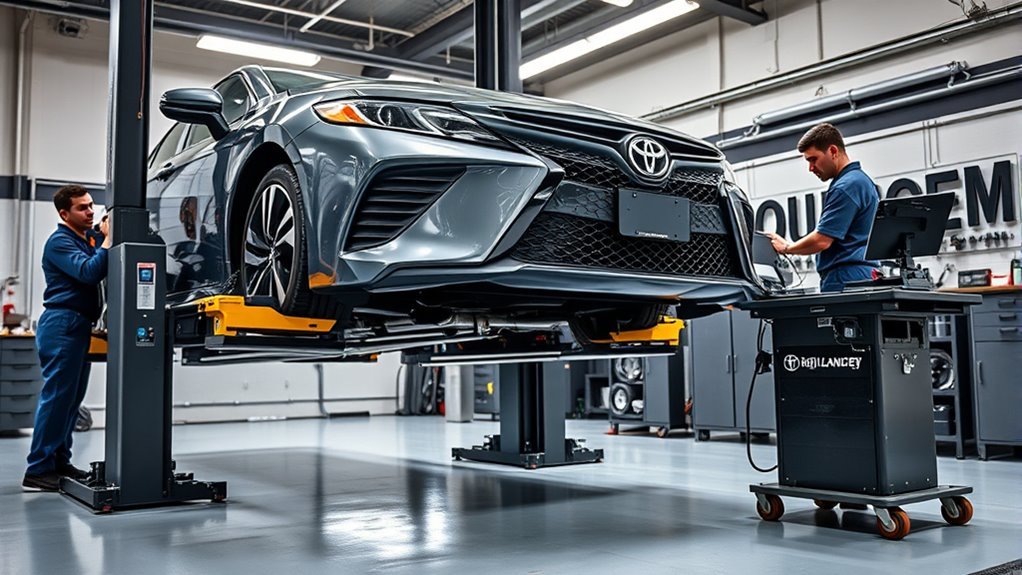
Alignment and balancing solve different problems on your Toyota Camry. Alignment sets the wheel angles so the tires point correctly and wear evenly. Balancing equalizes weight around the wheel and tire assembly so it spins smoothly.
Alignment keeps your Camry tracking straight; balancing keeps the wheels spinning smoothly and helps prevent speed-related vibration.
- Suspect alignment if the car pulls, wanders, the steering wheel is crooked, or tires wear unevenly.
- Suspect balancing if the steering wheel or seat vibrates at certain speeds, especially after new tires are installed.
- Check both when installing new tires, after impact damage, or when tire wear and vibration happen together.
A Camry can need both services at the same time. For example, new tires should be balanced when installed, and alignment should be checked if the old tires showed uneven wear.
How to Protect Your Camry Alignment
Keeping your Camry aligned starts with careful driving and regular tire checks. You cannot avoid every pothole, but you can reduce alignment problems by slowing down for rough roads, avoiding curb strikes, and inspecting the tires after any hard hit.
Use this simple prevention checklist:
- Check tire pressure monthly when the tires are cold.
- Inspect tread for one-sided wear, feathering, cupping, cracks, bulges, and punctures.
- Rotate tires according to your Toyota maintenance schedule or tire manufacturer guidance.
- Have the alignment checked when symptoms appear, after impacts, and after steering or suspension repairs.
- Replace worn suspension and steering parts before alignment, not after.
- Keep a copy of your alignment printout so you can compare future wear or steering problems.
These habits help your Camry track straight, preserve tire life, and maintain a smoother, safer ride.
Toyota Camry Alignment Cost
Toyota Camry alignment cost depends on your location, model year, shop type, and whether extra repairs are needed. A simple alignment costs less than an alignment that also requires tire replacement, suspension repair, seized adjustment bolts, or diagnostic time.
As a current reference point, RepairPal lists a Toyota Camry wheel alignment estimate between $236 and $347, excluding taxes, fees, and location-specific differences. General pricing guides may show lower front-end alignment ranges, but those are not always Toyota- or Camry-specific.
Before approving the service, ask the shop:
- Is this a two-wheel or four-wheel alignment check?
- Will I receive a before-and-after printout?
- Are any steering or suspension parts worn?
- Are the tires still safe, or is the wear too severe?
- Does the quote include taxes, shop fees, and any diagnostic charge?
Frequently Asked Questions
Does a Toyota Camry need a 4-wheel alignment?
Most Camry owners should ask for a four-wheel alignment check because all four wheel positions affect tracking and tire wear. The technician will measure all four wheels and adjust the angles that are adjustable for your model year. If a rear or front angle is out of range but not adjustable, worn or bent parts may need repair.
How much does it cost to get an alignment on a Toyota Camry?
Cost varies by location, shop, model year, and needed repairs. RepairPal lists a Toyota Camry wheel alignment estimate between $236 and $347 before taxes and fees, while general alignment pricing guides may show lower ranges for basic front-end alignments. Always get a local written estimate and ask for a before-and-after printout.
How often should I align my Toyota Camry?
Toyota says wheels only need to be aligned as needed. Have the alignment checked if the car pulls, the steering wheel is off-center, tires wear abnormally, you hit a pothole or curb, or steering/suspension parts were replaced. Tire rotations are also a smart time to inspect for uneven wear.
Can I drive with bad alignment?
A mild alignment issue may not stop the car immediately, but it can wear tires quickly and make handling less predictable. Do not keep driving if the Camry pulls hard, steering feels loose, tires are damaged, cords are showing, or the problem started after an impact. Have it inspected before highway driving.
Is alignment the same as balancing?
No. Alignment corrects wheel angles so the Camry tracks straight and wears tires evenly. Balancing corrects weight distribution around the tire and wheel assembly to reduce vibration. Pulling and edge wear suggest alignment; speed-related vibration suggests balancing.
Conclusion
Keep your Toyota Camry’s alignment in check, and you can protect tire life, steering feel, safety, and fuel efficiency. The key is knowing when to act: pulling, uneven tire wear, an off-center steering wheel, pothole impacts, new tires, and suspension repairs are all strong reasons to schedule an alignment check. Ask for a before-and-after printout, repair worn parts first, and use regular tire inspections to catch small problems before they become expensive ones.
Sources
- Toyota Support — When Toyota recommends wheel alignment — backs up as-needed alignment guidance and symptoms such as pulling and abnormal tire wear.
- Toyota Owners Manual — 2025 Camry Hybrid tires — backs up checking tires for uneven wear and tread condition.
- NHTSA TireWise — Tire safety ratings and awareness — backs up tire pressure checks, tire maintenance, safety, and savings guidance.
- U.S. Tire Manufacturers Association — Tire Care Essentials — backs up pothole/road-hazard alignment concerns and uneven rapid tread wear.
- U.S. Tire Manufacturers Association — Rolling efficiency — backs up misalignment, tire scrub, rolling resistance, fuel consumption, and tire-life discussion.
- RepairPal — Toyota Camry wheel alignment cost estimate — backs up current Camry-specific alignment cost range and service caveats.
[Products Worth Considering]

Monitor tire tread wear with a smart, color-coded depth gauge that shows clear condition ranges at a glance. The bar is range marked for fast, easy readings, helping you maintain safer traction and performance. Each gauge is portable with a pocket clip, and the set includes 20 units for daily use and sharing.

AstroAI’s heavy-duty digital tire pressure gauge delivers quick, accurate readings with 0.1 increments and a secure valve-stem seal. It features a green backlit LCD and built-in flashlight for easy use in low light, plus an ergonomic non-slip stainless-steel design. The wide 0–230 PSI range works across common vehicle tires, with unit selection and an auto shut-off to save battery.

Accurately measure tire tread depth with a calibrated gauge marked from 0 to 1 inch in 1/32 inch increments. The color-coded bar helps you quickly identify tread condition ranges, supporting safe driving for trucks, motorcycles, automobiles, and passenger vehicles.

Related Articles

Toyota Camry All-Season Tires Explained: What They Can and Can’t Do
In exploring Toyota Camry all-season tires, discover their benefits and limitations—are they really the right choice for your driving needs?
Read More
Toyota Camry Tire Traction in Ice and Snow: A Practical Winter Driving Guide
Learn essential tips for maximizing tire traction on ice and snow in your Toyota Camry, ensuring your winter driving is safe and confident. Discover more now!
Read More
Do Toyota Camry Tires Need Snow Chains? When They Help and When They Don’t
How do snow chains enhance your Toyota Camry's winter driving safety, and when should you avoid using them? Discover the essential details inside!
Read More