Disclosure: As an Amazon Associate, we earn from qualifying purchases. If you click a link on this page and make a purchase, we may receive a small commission at no extra cost to you.
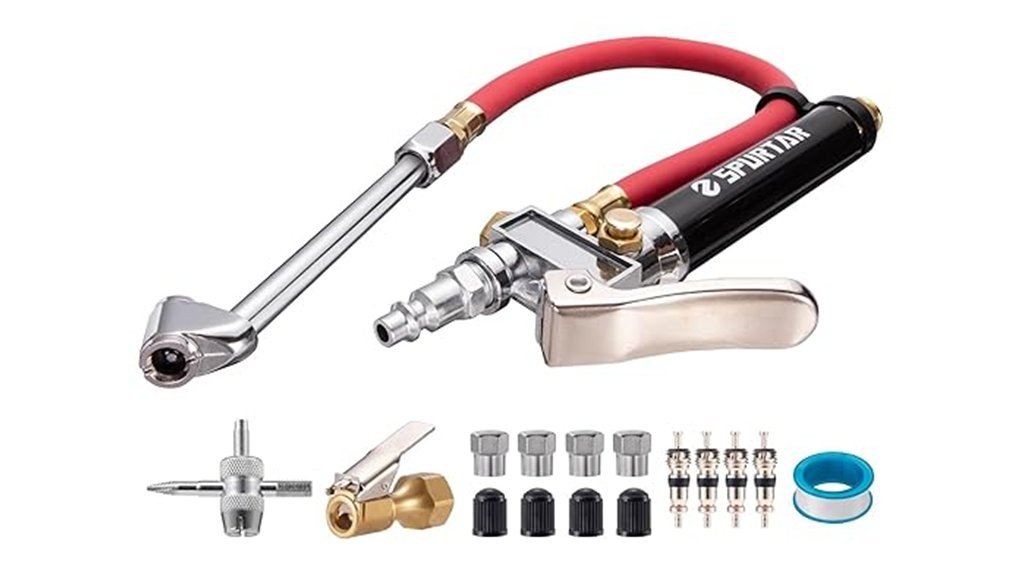
Checking tire pressure should be simple, but short valve stems, dual wheels, and awkward angles can make a basic gauge frustrating to use. The Spurtar Tire Pressure Gauge with Inflator combines an analog 10–120 PSI gauge, a dual-head chuck, an inflation trigger, and a deflation control in one garage tool. Its sturdy metal construction and accessory bundle make it useful for routine maintenance, but the 2 PSI scale is less precise than a fine-resolution digital gauge and inflation requires a separate compressor. This review explains where the Spurtar performs well, what you need before setup, and who should choose another option.
Quick Verdict
Rating: 8.3/10, Recommended with caveats
Best For: Home garages, truck and RV owners, and drivers who want one analog tool for checking, inflating, and bleeding tire pressure.
Bottom Line: The dual-head chuck, metal build, and 10–120 PSI range make this a practical compressor accessory for common vehicle tires. The main tradeoffs are its 2 PSI graduations, lack of an illuminated display, and need for a compatible air source when inflating.
Key Takeaways
- The Spurtar gauge covers 10–120 PSI and uses a mechanical scale marked in 2 PSI increments.
- The listing states that it is calibrated to ANSI B40.1 Grade B with 2% accuracy.
- A 5 11/16-inch push-pull dual-head chuck helps reach standard and hard-to-access valve stems, including many dual-wheel setups.
- The tool uses a 12-inch rubber hose, a 1/4-inch NPT air inlet, a steel inflation trigger, and a separate deflation button.
- The package includes four valve cores, four metal valve caps, four ABS valve caps, and a four-way valve core tool.
- It can measure tire pressure by itself, but you need an air compressor or pump to add air.
Spurtar Tire Pressure Gauge at a Glance
| Specification | Detail |
|---|---|
| Brand | Spurtar |
| Part number | ATG0198ND |
| Product type | Analog tire inflator gauge with dual-head air chuck |
| Pressure range | 10–120 PSI |
| Scale resolution | 2 PSI increments |
| Calibration claim | ANSI B40.1 Grade B, stated 2% accuracy |
| Chuck design | 5 11/16-inch push-pull dual head with 30-degree forward head and reverse chuck |
| Hose | 12-inch rubber hose |
| Air inlet | 1/4-inch NPT |
| Materials | Alloy steel, brass, and rubber, with chrome-plated metal components |
| Listed weight | 302 grams, about 10.7 ounces |
| Included accessories | Four valve cores, four metal caps, four ABS caps, and one four-way valve core tool |
| Compatibility | Cars, trucks, SUVs, RVs, motorcycles, and Schrader-equipped bicycles |
| Warranty | One-year manufacturer warranty listed by Amazon |
| Required for inflation | Compatible air compressor or pump and, when needed, a matching quick-connect fitting |
What Is the Spurtar Tire Pressure Gauge?
The Spurtar ATG0198ND is a mechanical tire pressure gauge and inflator attachment designed to connect to a compressed-air source through its 1/4-inch NPT inlet. It lets you place the chuck on a tire valve, read pressure on the analog bayonet-style scale, add air with the steel trigger, and release excess pressure with a separate bleed control.
Its main selling point is reach. The 5 11/16-inch dual-head stem has a 30-degree forward chuck for inner or recessed valves and a reverse chuck for outward-facing valves. This layout is especially useful on trucks, RVs, and wheels where a short straight chuck is difficult to align.
Who Should Buy It?
Best For
- Drivers who already own an air compressor and want one tool for measuring, inflating, and bleeding pressure.
- Truck, RV, and fleet users who regularly deal with recessed or dual-wheel valve stems.
- Home mechanics who prefer a durable analog tool without batteries or electronic controls.
Skip If
- You need 0.1 PSI resolution for performance tires, racing, or suspension tuning.
- You want a cordless inflator with its own motor and battery.
- You mainly work in dim conditions and need a backlit digital display.
Before You Buy: This is an inflator gauge attachment, not a self-powered air compressor. Confirm that your compressor setup can accept a 1/4-inch NPT connection, and plan on a separate Presta adapter if your bicycle does not use Schrader valves.
[Products Worth Considering]

This 2-pack closed-flow locking air chuck set delivers controlled airflow only when the valve stem is held in place, helping prevent leaks during inflation. Made for heavy-duty use with a 300 PSI maximum rating, it features a brass body for corrosion resistance and long service life. The 1/4" FNPT connection and quick-plug compatibility make it convenient for use with Schrader valve systems and common truck, RV, and auto air compressors.

Inflate Presta and Schrader bike and car tires with one compressor attachment, including tubeless setups. The digital gauge lets you monitor 2–200 PSI readings in 0.1 PSI increments with ±2 PSI accuracy, while the adjustable lever and built-in bleed button help you dial in precise pressure. Quick-connect coupler, hose, and a complete Presta service kit with spare cores and caps make it ready for fast maintenance.

This all-in-one air compressor accessory kit combines a digital tire pressure gauge with an inflator and blow gun in a single easy-to-use unit. The heavy duty, corrosion-resistant construction helps you quickly set and read tire PSI up to 200, and the vent valve releases excess air without removing the chuck. It connects to any 1/4 inch NPT air compressor output and includes multiple nozzles, adaptors, and stem caps for versatile inflating and blowing tasks.
Accuracy and Readability
Spurtar states that the gauge is performance-tested and calibrated to ANSI B40.1 Grade B with 2% accuracy. That is suitable for routine passenger-vehicle, truck, RV, and motorcycle pressure checks when you need a clear mechanical reading rather than laboratory-level precision.
The 10–120 PSI span covers most everyday road-vehicle needs, but the scale moves in 2 PSI steps. You can estimate between markings, though a digital gauge with 0.1 PSI resolution is easier to use when one-pound adjustments matter. Because the Spurtar uses a mechanical scale, it requires no battery, but it also has no backlight for nighttime work.
A good seal matters as much as the gauge specification. Press the chuck squarely against the valve and listen for a steady seal. A continuous hiss or a jumping reading usually means the chuck needs to be repositioned.
Dual-Head Chuck and Valve Access
The push-pull dual-head chuck is the feature that separates this tool from a basic pencil gauge. Its 30-degree forward head reaches inward-facing or recessed stems, while the reverse head is positioned for outer valves. This reduces the need to twist the hose or force your hand between wheel openings.
For passenger cars and motorcycles, the extra reach can make low-profile wheels easier to service. For trucks and RVs, it is more valuable because dual rear wheels often place one stem deeper inside the wheel assembly. The rigid metal stem provides control, while the 12-inch rubber hose gives the gauge enough flexibility to sit where you can read it.
Build Quality and Controls
The listing identifies alloy steel, brass, and rubber as the main materials and describes the stem and inflator body as heavy-duty chrome-plated metal. At about 302 grams, the tool has more substance than a lightweight plastic gauge without becoming difficult to store in a garage drawer or service cart.
The solid steel inflation trigger controls airflow into the tire. A separate deflation button lets you bleed off excess air in small steps rather than removing the chuck and pressing the valve core with another tool. The design is simple, but the hose, threaded inlet, chuck seals, and valve mechanism should still be inspected for cracks, looseness, or air leaks before use.
Included Accessories
The package adds a four-way valve core tool, four replacement valve cores, four metal valve stem caps, and four ABS caps. These parts are useful for replacing a leaking core or missing cap during routine maintenance, and they reduce the need to buy a separate basic valve-service kit.
The four-way tool can help remove and install valve cores, clean internal threads, and service valve stems, but opening a valve core releases tire pressure quickly. Use it only when you intend to deflate or service the tire, and reinstall the core carefully to avoid damage or leaks.
How It Performs in Real Use
For Routine Car and SUV Checks
The analog scale is quick to read during monthly pressure checks, and the combined trigger and bleed button make it easy to correct a tire that is slightly low or high. The 2 PSI markings are adequate for ordinary road use, though you may need to estimate between lines when the door placard calls for an odd-number pressure.
For Trucks, RVs, and Dual Wheels
The long dual-head chuck is most useful here. It can reach inner valves that are difficult to access with a short clip-on chuck, while the reverse head handles outward-facing stems. Valve orientation still matters, so badly positioned or flexible extensions may require adjustment or a different chuck.
For Motorcycles and Bicycles
The pressure range works for many motorcycle tires and Schrader-equipped bicycles. Check that the rigid chuck can approach the valve without contacting a brake disc, spoke, or rim. Presta valves need a separate adapter, and high-pressure bicycle users may prefer a gauge with finer graduations.
For Repeated Garage Use
The metal body, simple controls, and replaceable valve accessories suit regular home-garage work. For fleet or shop use, compare its readings with a trusted reference gauge at intervals and replace damaged hoses or seals rather than continuing with an unstable reading.
How to Use It Correctly
- Confirm the connection. Install the correct quick-connect plug or hose fitting in the 1/4-inch NPT inlet. Use suitable thread sealant when the fitting instructions call for it.
- Check tires cold. Use the pressure shown on the vehicle placard or in the owner’s manual, not the maximum pressure molded into the tire sidewall. The NHTSA tire safety guide recommends checking pressure when tires are cold.
- Seat the chuck squarely. Choose the head that gives the straightest path to the valve and press it firmly until air leakage stops.
- Read before adding air. Note the current pressure, then squeeze the inflation trigger in short bursts if the tire is low.
- Fine-tune the result. Pause after each burst to read the scale. Use the deflation button in short presses if you overshoot.
- Recheck and inspect. Remove and reseat the chuck for a final reading, then replace the valve cap and check for visible tire damage.
Pro Tip: Take one reading with the chuck removed and reseated after adjustment. This catches a poor first seal and gives you more confidence that the final pressure is repeatable.
Compatibility and Safety
The tool is designed around common automotive-style Schrader valves and compressed-air equipment. Do not exceed the gauge’s 120 PSI range, and do not use damaged hoses, cracked fittings, or a chuck that will not seal. Wear eye protection when servicing valve cores because a loosened core can release air and debris quickly.
Set each tire to the vehicle manufacturer’s recommended cold pressure. Front and rear values can differ, and RV or truck pressures may depend on the vehicle, axle load, and tire specification. A gauge helps you measure pressure, but it does not diagnose punctures, sidewall damage, overloaded tires, or a faulty TPMS sensor.
Pros and Cons
Pros
- Combines pressure measurement, inflation, and controlled deflation.
- Dual-head chuck improves access to recessed and dual-wheel valves.
- 10–120 PSI range covers common car, truck, RV, and motorcycle use.
- Metal construction and mechanical operation avoid battery dependence.
- Includes useful valve cores, caps, and a four-way service tool.
Cons
- Two-PSI scale is less precise than fine-resolution digital gauges.
- Inflation requires a separate compressor and compatible fitting.
- No illuminated display, and Presta bicycle valves require an adapter.
Is It Worth the Price?
The Spurtar sits in the practical, budget-to-mid-range category of compressor accessories. It offers strong value for the price when you will use the dual-head chuck, inflation trigger, bleed button, and valve accessories rather than buying those functions separately.
It makes the most sense for a home garage, work truck, RV setup, or small fleet that already has compressed air. It is not the best fit if you only need an occasional pocket gauge, want a self-powered portable inflator, or require finer digital resolution.
[Products Worth Considering]

The ETENWOLF T500 digital tire pressure gauge with inflator delivers accurate readings across a wide 0–250 PSI range, calibrated to ANSI B40.7 Grade 2A. An all-in-one tool combines gauge, air chuck, hose, inflating and controlled bleed for checking, inflating, and deflating tires on many vehicle types. It’s built for reliable use in extreme temperatures and features an illuminated backlit display with replaceable AAA batteries for convenient operation.

This digital tire pressure gauge with built-in inflator helps you accurately check and adjust tire pressure for safer driving and better fuel efficiency. It supports multiple units (PSI, KPA, BAR, KG/CM²) and reads within 1% for reliable results. The 3-in-1 design inflates, deflates, and measures, with a quick-connect air chuck and compatible hose setup for cars, trucks, SUVs, RVs, and motorcycles.

The AstroAI 2 pack air chucks provide a heavy-duty, closed-flow locking design that helps keep air flowing during inflation while securely attaching to the valve stem. Built with 250 PSI rated brass components and compatible with Schrader valves, they feature 1/4" female NPT threads for a wide fit with common inflators. The straight tip and locking clip make filling tires and monitoring pressure more convenient.
How It Compares to Alternatives
The AstroAI T3 and QWORK 10–120 PSI inflator gauges use a similar analog, dual-head format, so they are worth comparing for hose length, fitting package, warranty, and current seller support. The Spurtar stands out through its included valve-service accessories and straightforward metal controls.
A digital inflator gauge is the better direction when you want a backlit screen, easier low-light reading, or tenths-of-a-PSI resolution. The Spurtar is the stronger match when battery-free simplicity and dual-wheel access matter more than display precision.
[Products Worth Considering]

The Milton S-693 straight foot dual head air chuck is designed for accurate tire pressure checks and quick, secure valve-core engagement with lock-on threads on both ends. With a 1/4" FNPT connection and a maximum 150 PSI rating, it’s built for use on inner duals and common vehicle tires, including trucks and RVs.

ETENWOLF T300 is a calibrated digital tire pressure gauge for accurate readings from 3 to 200 PSI across light and heavy-duty vehicles. It includes thermal compensation for reliable performance in extreme cold or heat, with an auto shut-off to extend battery life and an LED for easier reading. The sturdy design supports rugged everyday use, making it ideal for pickups, RVs, and industrial applications.

Check tire pressure with the Milton S-925 pencil gauge built for trucks, RVs, and bicycles. It features a single-head chuck with a built-in deflator valve, and it displays readings in both PSI and kPa for convenient use. The gauge is designed for accurate, repeatable pressure checks within its working range.
Frequently Asked Questions
Does the Spurtar gauge work without an air compressor?
You can use it to check tire pressure without adding air. Inflation requires a separate compressor or pump connected through the 1/4-inch NPT inlet.
How accurate is the Spurtar tire pressure gauge?
The product listing states ANSI B40.1 Grade B calibration and 2% accuracy. Its 2 PSI scale is suitable for routine vehicle maintenance, but a fine-resolution digital gauge is easier for very small adjustments.
What pressure range does it measure?
The gauge reads from 10 to 120 PSI in 2 PSI increments. That range suits many cars, trucks, SUVs, RVs, motorcycles, and bicycles, provided the required pressure stays within the gauge limit.
Can it release excess tire pressure?
Yes. A separate steel deflation button lets you bleed air in short presses, then check the analog scale again before removing the chuck.
Does it work with motorcycle and bicycle valves?
It works with common Schrader valves used on motorcycles and many bicycles. A bicycle with a Presta valve needs a separate adapter, and the rigid chuck must have enough clearance around the wheel.
Is the gauge easy to read at night?
It is a mechanical analog gauge without a backlit screen. Use a work light or flashlight in dim conditions, or choose a digital model with an illuminated display.
Is the dual-head chuck useful for dually wheels?
Yes, the forward and reverse heads are designed to reach inward-facing and outward-facing valve stems. Access still depends on the wheel opening and how the valve stem is positioned.
What accessories come with the gauge?
The listed package includes four replacement valve cores, four metal valve caps, four ABS valve caps, and a four-way valve core tool. Check the current listing at purchase because marketplace packaging can change.
The Bottom Line
The Spurtar Tire Pressure Gauge with Inflator is a sensible choice for drivers and home mechanics who already own a compressor and need better access to recessed or dual-wheel valves. Its main strengths are the dual-head chuck, durable mechanical design, and combined inflate-and-bleed controls, while the 2 PSI scale and unlit display are the main limitations. Skip it for ultra-fine pressure tuning or cordless roadside inflation, but consider it for dependable routine garage work.
Ready to Buy?
Check the latest price, seller, package contents, and product details before you decide.