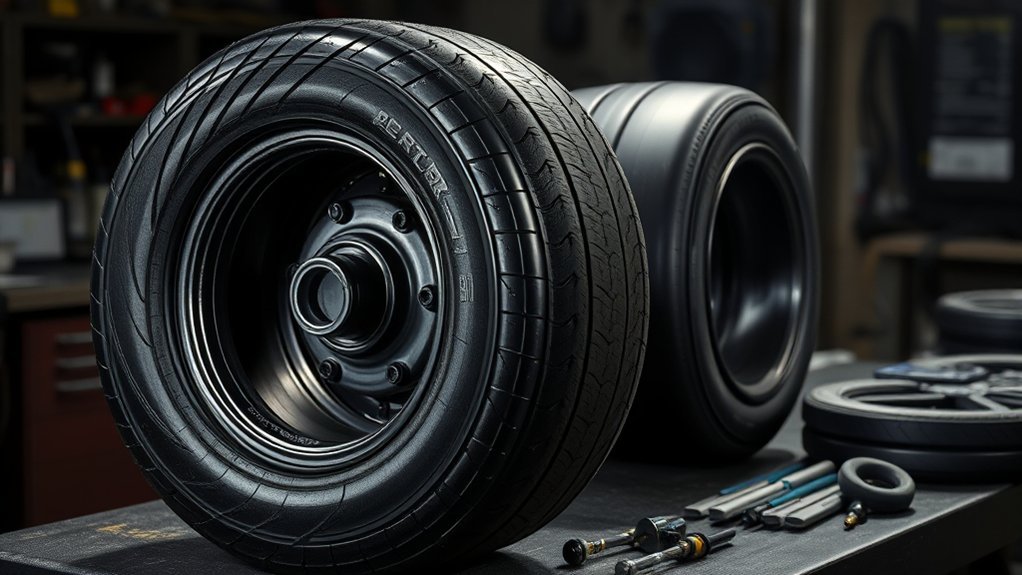
Racing tires make a car faster by turning engine power, braking force, steering input, and aerodynamic load into usable grip at the track surface. Soft compounds, specialized construction, carefully chosen tread designs, and tightly controlled temperature and pressure all matter. The fastest tire is not simply the softest or widest one; it is the tire working in the right conditions for the car, circuit, and race distance.
Quick Answer
Racing tires are fast because their rubber, construction, pressure, and temperature are optimized to produce high grip under heavy braking, acceleration, and cornering loads. Slicks maximize usable rubber on dry pavement, rain tires move water away, and the correct operating window keeps the contact patch working consistently lap after lap.
Key Takeaways
- Racing tires use specialized compounds that favor grip and response over the long tread life expected from normal road tires.
- Slick tires remove tread voids for strong dry-track performance, while rain tires use grooves to clear water and reduce aquaplaning risk.
- Radial and bias-ply constructions behave differently; neither design is automatically best for every form of motorsport.
- Temperature and pressure must stay inside the tire supplier’s intended operating range to maintain predictable grip and wear.
- Slip angle, braking slip, camber, aerodynamic load, and chassis setup all change how effectively the contact patch produces force.
- More usable tire grip can shorten braking zones, raise cornering speed, improve acceleration, and ultimately reduce lap time.
What Makes Racing Tires So Fast?
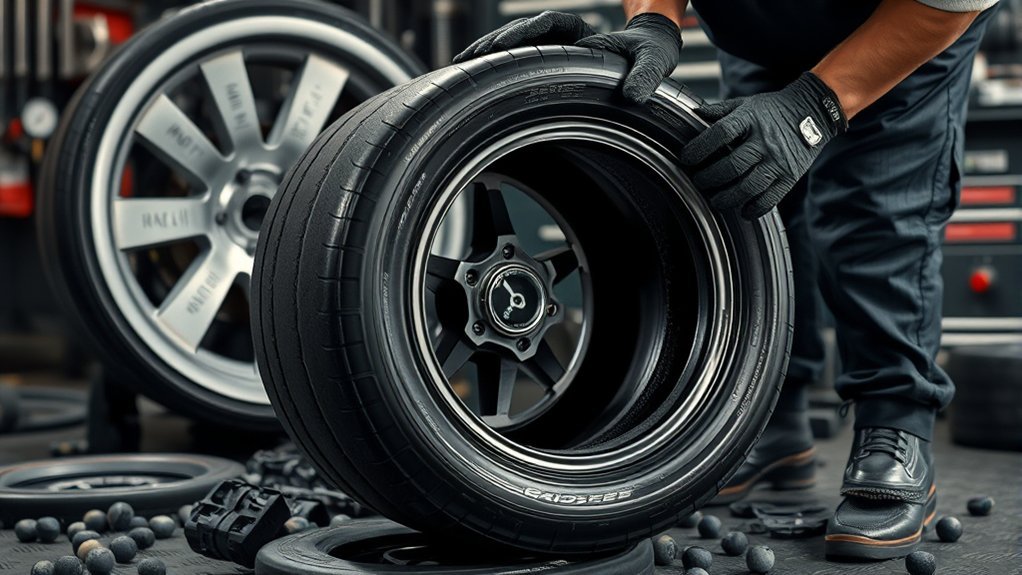
Racing tires are fast because they are designed around a very different set of priorities from normal street tires. Road tires must cope with long mileage, standing water, cold starts, noise, potholes, and months or years of use. A racing tire can focus much more heavily on grip, response, heat control, and consistency over a much shorter service life.
Softer performance compounds can deform around tiny irregularities in the track surface more effectively, helping the tire generate grip. The tradeoff is faster wear and greater sensitivity to temperature.
The tire’s construction is just as important. Its carcass, belt package, sidewall, and tread must deform enough to create force without becoming so flexible that steering response becomes vague.
On a dry circuit, a slick tread leaves almost no grooves interrupting the working surface. In rain, however, that same design cannot clear standing water effectively, so a grooved rain tire becomes the faster and safer choice.
Warning: Purpose-built racing tires are not automatically legal or safe for public-road use. For example, Hoosier states that its racing tires are designed for closed-course competition and are not intended for highway use except for specifically identified street-legal products. Always check the exact tire manufacturer’s road-use approval before driving away from the track.
How Racing Tire Grip Works at the Contact Patch
The contact patch is the portion of the tire touching the track at any moment. That small area must transmit every force used to accelerate, brake, and turn the car.
Race-tire grip is more complicated than the simple idea that more area always produces more friction. Rubber is viscoelastic, which means it bends, stretches, and returns toward its original shape as it passes over the microscopic texture of the track.
Grip comes from several effects working together. The rubber mechanically follows the roughness of the asphalt, deforms under load, and develops adhesion at the rubber-to-track interface. Formula 1’s technical explanation describes both mechanical and chemical contributions to tire grip, with temperature strongly affecting both.
Slip Angle and Longitudinal Slip
A tire usually develops its strongest forces while the rubber in the contact patch is deforming slightly. During cornering, the direction the wheel points and the direction the tire actually travels are not perfectly identical. That difference is called slip angle.
Something similar happens during braking and acceleration. A small amount of longitudinal slip allows the tire to generate braking or drive force. Too much slip turns controlled deformation into excessive sliding, which normally reduces useful grip and creates additional heat.
The fastest tire is not a tire that never slips. It is a tire working near the amount of controlled deformation and slip that produces its strongest usable force.
Downforce and Tire Load
Aerodynamic race cars add another factor: downforce. Wings, floors, and other aerodynamic surfaces push the car harder against the track as speed rises. That extra vertical load lets the tires generate more cornering and braking force, which is one reason high-downforce cars can corner so quickly.
Extra load also means more stress and heat in the tire. Engineers therefore match compound, pressure, camber, suspension, and aerodynamic settings rather than treating the tire as an isolated component.
Racing Tire Compounds and Construction
Racing compounds balance several competing goals. A softer compound may provide stronger peak grip and warm quickly, while a harder compound may tolerate greater loads, higher track temperatures, abrasive pavement, or a longer stint.
Construction controls how the tire carries those forces. The casing and reinforcing layers must keep the tread stable while still allowing the tire to absorb bumps and conform to the track.
[Products Worth Considering]
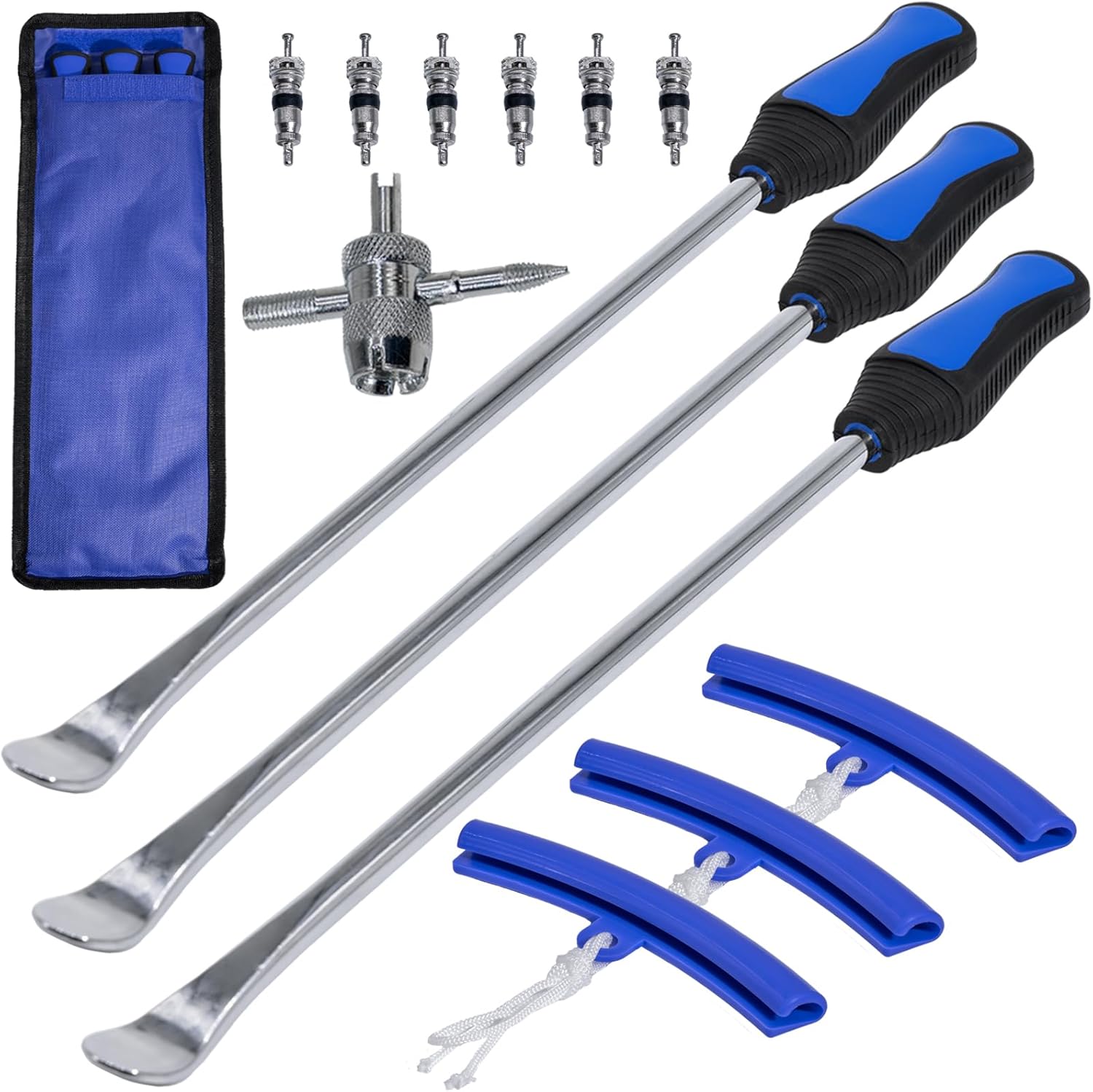
This tire spoon set helps you remove and install motorcycle, dirt bike, lawn tractor, and bicycle tires with extra leverage from a 14.5-inch spoon length. The kit includes tire removal tools, rim protectors, and a valve tool to simplify repairs and help protect rims during changing. Designed for quick, on-the-go service, it’s convenient for garage work, trails, and track-side fixes.

TP-M13W combination repair unit kit includes wrapped stems with matching patches for fast, reliable tire repairs. It’s suitable for both radial and bias ply tires and is designed for chemical or heat vulcanization. Gray vulcanizing gum with blue backing helps create a strong bond, with the stem portion wrapped for added effectiveness.

The Classic Racing Tire toy chest makes fast, fun cleanup for cars, toys, and everyday items with a classic racing design. Its reversible lid doubles as a hilly raceway for die-cast cars, encouraging imaginative play. The chest is easy to clean and can also be used as a laundry basket for added convenience.
Compound Grip Tradeoffs
A softer compound is not automatically the fastest choice for every race. If it overheats, wears too quickly, or cannot tolerate the circuit’s loads, its early grip advantage may disappear.
A harder compound generally gives up some immediate mechanical grip in exchange for greater durability and temperature resistance. Race strategy therefore involves matching the available compound to track temperature, asphalt roughness, fuel load, stint length, and expected weather.
Formula 1 provides an easy current example. Pirelli’s 2026 Formula 1 range runs from C1, the hardest dry compound, through C5, the softest. Three dry-weather specifications are made available at a competition under the FIA tire rules rather than every car simply using the softest possible tire.
Bias Ply To Radial
Bias-ply construction uses reinforcing plies laid diagonally across one another. That links tread and sidewall behavior closely and can make the tire more compliant in ways that remain useful in some specialized racing applications.
A radial tire uses body cords that run more directly from bead to bead, with a separate reinforcing belt package beneath the tread. This allows engineers to control sidewall flex and tread stability differently from a bias-ply design.
There was no single moment in the 1960s when all racing switched from bias-ply to radial tires. Different racing disciplines adopted radial technology at different times, and specialized bias-ply racing tires continue to exist where their particular deformation characteristics are useful.
That is why it is misleading to describe bias-ply tires as simply producing less grip. Construction changes the way a tire responds to steering, vertical load, bumps, heat, and slip, and the best design depends on the racing application.
Belt Layers And Rigidity
Reinforcing layers beneath the tread help a racing tire control deformation at high speed. Depending on the design, manufacturers may use steel, textile, aramid, or other reinforcement materials.
The goal is not maximum stiffness everywhere. Too much compliance can make steering vague, while too much rigidity can stop the tire from following the track surface effectively.
A successful race-tire structure keeps the tread stable under lateral and longitudinal loads while allowing enough controlled deformation for the compound to work. That balance improves steering response, heat distribution, and consistency across the contact patch.
How Slicks and Grooves Change Grip
Tread design changes dramatically with track conditions. Dry racing favors as much stable rubber as practical in the footprint, while wet racing requires channels that can move water away.
[Products Worth Considering]

The Continental Grand Prix 5000 is an allround road bike tire engineered for faster rolling, improved ride comfort, and enhanced puncture protection. It features a Vectran Breaker cut-protection layer, Lazer Grip micro-profile tread for confident cornering control, and Active Comfort Technology to damp vibration for smoother rides. BlackChili compound optimizes grip and speed for everyday performance and long-lasting confidence.

This 1/2-inch drive breaker bar delivers powerful leverage for loosening and tightening stubborn lug nuts and automotive fasteners. The 180-degree flex head helps you reach tight spaces at the angle you need, making tire and brake jobs easier. A spring-loaded ball detent design holds 1/2-inch sockets securely while the chrome-moly head provides durable strength for everyday use.

Black Magic Tire Wet delivers a deep wet-look shine that makes tires appear dark, rich, and freshly detailed. Its long-lasting formula helps resist rain, dust, and road grime for weeks of glossy protection, not days. Apply by spraying onto clean, dry tires—no buffing or wiping required—with a low-sling design to reduce splatter on paint and wheels.
Slick Tires Maximize Contact
Slick racing tires have a continuous tread surface with no normal water-evacuation grooves. Removing tread voids leaves more rubber available within the tire’s footprint and eliminates much of the tread-block movement found in heavily patterned tires.
That makes slicks highly effective on warm, dry pavement when the compound is working in its intended temperature range.
The advantage should not be reduced to “a bigger patch automatically creates more friction.” Compound behavior, pressure distribution, tire load, track texture, temperature, and slip all contribute to the force the tire can generate.
In dry conditions, however, removing unnecessary water channels allows the tire designer to devote more of the tread surface to stable rubber-to-asphalt interaction.
Grooves Channel Water Away
Once water builds on the track, a slick loses its greatest advantage. It has no substantial tread channels to move water out from beneath the tire.
Grooved wet tires create paths through which water can escape, helping the rubber maintain contact with the road and reducing aquaplaning risk.
In current Formula 1, Pirelli provides an intermediate tire for wet or drying conditions without heavy standing water and a full wet tire for heavier rain. The FIA’s 2026 Formula 1 regulations specify dry, intermediate, and wet-weather tire availability.
The fastest choice therefore changes with the surface. A dry slick is normally best when the track is dry enough, while a rain tire becomes essential when water evacuation matters more than maximizing slick rubber.
Racing Tire Temperature and Pressure
Race tires are highly sensitive to temperature and pressure. Cold rubber may be too stiff to produce its intended grip, while excessive temperature can make performance inconsistent and accelerate degradation.
Pressure changes at the same time because the gas inside the tire heats as the tire works. That is why racers distinguish between a starting or “cold” pressure and the pressure reached after the tire has been running.
There is no universal racing PSI that works for every car or tire. There is also no universal rule saying race pressure should remain within 3% of a specification. Series and manufacturers can prescribe minimum starting pressures, camber limits, or other operating requirements for a particular tire and event.
- Start with the tire supplier’s or race team’s approved pressure range.
- Warm the tire through normal running instead of making abrupt assumptions from a cold reading.
- Measure pressure and temperature consistently so one session can be compared with another.
- Change pressure only within the manufacturer’s or series’ permitted operating limits.
The FIA specifically requires Formula 1 tires to be operated according to the prescriptions issued by the FIA and the tire supplier. That is a useful principle even outside F1: the tire’s own technical guidance comes before generic internet PSI advice.
Pro Tip: Record whether a pressure reading was taken cold, immediately after a run, or after the tire had time to cool. A pressure number without its temperature and timing can be misleading when you compare setups.
What Happens When Racing Tires Degrade?
A race tire can lose performance even while it still looks usable. Heat, sliding, repeated load cycles, and surface wear gradually change how the rubber interacts with the track.
Graining can occur when the tire slides and small pieces of tread rubber tear and roll across the surface, creating an uneven working layer. Grip may fall until the surface cleans up or the tire is replaced.
Blistering is associated with excessive heat inside or near the tread. Localized overheating can damage the working surface and reduce consistency.
A heavy brake lock can create a flat spot, producing vibration and potentially forcing an early tire change. Normal wear can also cause progressive performance fall-off even without a visible defect.
Drivers therefore manage tire slip as well as outright speed. A lap that overheats or damages the tire can cost more time later in the stint than it gains immediately.
Cornering Forces Racing Tires Must Handle
During a fast corner, the tires must create large lateral forces while carrying the car’s weight and, on aerodynamic race cars, additional downforce.
Managing tire temperature, pressure, load, and slip helps racing tires stay predictable under heavy cornering forces.
The contact patch also rarely deals with only one direction of force. If you brake while turning, the tire must divide its available capability between longitudinal braking force and lateral cornering force. Accelerating out of a corner creates the same type of combined demand.
That is why a driver cannot normally ask for maximum braking and maximum cornering at exactly the same moment. Smoothly releasing the brake as steering demand rises, then adding throttle as steering angle falls, helps keep the tire within its usable force range.
Tire construction supports this process by controlling how the carcass and tread deform. When the setup is right, the response builds predictably and the driver can operate closer to the limit with fewer corrections.
How Race-Car Setup Changes Tire Grip
The tire does not work alone. Alignment, suspension, aerodynamics, and vehicle balance determine how the contact patch is loaded.
Camber
Race cars often use negative camber so the outside tire maintains a useful footprint as the car rolls and the tire deforms in a corner. Too much camber can overload one edge of the tread and create uneven temperature or wear.
Pressure
Pressure changes tire shape, stiffness, response, heat generation, and the way load is distributed across the footprint. The correct target comes from tire data and supplier guidance, not from simply choosing the lowest pressure that appears to create a larger patch.
Weight Transfer and Aero Balance
Braking moves load toward the front tires, acceleration shifts load rearward, and cornering transfers load toward the outside tires. Aerodynamic balance adds another layer at high speed. Engineers tune the chassis so all four tires contribute as effectively as possible instead of overworking one corner of the car.
How Racing Tires Lower Lap Times
Racing tires lower lap times by increasing the amount of force the car can transfer through the track surface while keeping that force predictable.
More usable grip can improve three major parts of a lap: braking, cornering, and acceleration.
- Shorter braking zones: More tire grip lets the car decelerate harder before a corner.
- Higher corner speed: Strong lateral grip allows greater speed for a given corner radius.
- Earlier acceleration: Rear or driven tires can transmit more power before excessive wheelspin develops.
- Greater consistency: Keeping temperature, pressure, and degradation controlled helps the driver repeat competitive lap times throughout a stint.
Compound choice also affects race strategy. A softer specification may deliver faster peak laps but require earlier replacement, while a harder option may trade some immediate pace for a longer, more consistent stint.
The fastest race strategy therefore depends on more than one qualifying-style lap. Teams consider tire degradation, pit-lane time, traffic, weather, fuel load, track evolution, and the available compounds before deciding how aggressively to use each set.
Why Racing Tires Differ by Motorsport
There is no single design that can be called “the racing tire.” Different forms of motorsport ask the tire to solve different problems.
- Dry circuit racing: Often uses slick or near-slick tires designed for high cornering loads and predictable response on pavement.
- Wet circuit racing: Uses grooved tires that can clear water and work at cooler surface temperatures.
- Oval racing: Can use different constructions, compounds, and even left- and right-side specifications to suit sustained cornering loads.
- Drag racing: Some applications continue to use highly compliant bias-ply designs because the tire’s deformation is part of how the car launches and transfers power.
- Rally and dirt racing: Tread blocks and grooves become essential because the tire must bite into loose or changing surfaces rather than smooth dry asphalt.
This is also why statements such as “radial is always faster” or “slicks are always best” do not hold across every racing discipline.
[Products Worth Considering]

Tymate TM7 is a wireless tire pressure monitoring system that delivers real-time pressure and temperature readings for safer driving. It includes four external sensors, a bright color LCD display with adjustable backlight, and six alarm modes for high/low pressure, fast leakage, high temperature, and sensor signal or battery issues. The system covers a wide 0–144 PSI range and plugs into your vehicle’s cigarette lighter socket for quick DIY setup.

Keep your tires properly inflated with this analog VONDIOR tire pressure gauge, designed for fast, easy readings without batteries. The swiveling, two-axis hose and large glow dial help you measure at any tire angle with instant visibility. Built with a protective rubber shield, it supports durable, low-maintenance use for cars and trucks.

This ecocstm ratchet wrench is designed to make emergency and routine tire changes faster with a 360° rotating head and quick forward/reverse switching. The extended handle provides extra leverage to reduce effort and hand fatigue, while the adapter helps fit many scissor jacks on cars, SUVs, trucks, and vans. Built for reliable performance with durable construction, it’s a practical travel essential for on-the-road preparedness.
Frequently Asked Questions
How Does NASCAR Change Tires So Fast?
Modern NASCAR Cup crews use a highly rehearsed five-person over-the-wall team that includes front and rear tire changers, a tire carrier, jackman, and fueler. The Next Gen car uses a single center-locking lug per wheel. NASCAR’s 2026 pit-crew data showed elite teams recording best four-tire stops of about 8.9 seconds.
How Much Does One NASCAR Tire Cost?
There is no dependable current 2026 per-tire price published in the official NASCAR and Goodyear material reviewed for this article. Older figures such as $400 should not be presented as a current price because tire programs, service arrangements, and costs change. Current NASCAR race notes focus on tire codes, specifications, and each team’s event allotment rather than a consumer-style retail price.
What Is the 3% Rule for Racing Tire Pressure?
There is no universal rule requiring racing tire pressure to remain within 3% of a manufacturer’s value. Race pressures depend on the exact tire, car, axle, track, load, temperature, and series rules. Use the tire supplier’s prescribed cold or starting pressure and any required minimum running pressure instead of applying a generic percentage rule.
How Do They Change F1 Tires So Fast?
Formula 1 uses a large group of specialists working simultaneously at all four corners. Wheel-gun operators, wheel-on and wheel-off crew, jack operators, stabilizers, and other crew members rehearse the same movements repeatedly. Formula 1’s official pit-stop explanation notes that strong modern stops are around two seconds and cites a 1.80-second record.
Are Racing Slicks Street Legal?
Do not assume they are. Purpose-built competition slicks may be prohibited or unsuitable for public-road use, especially because they are designed around track temperatures and dry-surface performance rather than standing water and normal road conditions. Hoosier’s racing tire safety guidance, for example, specifically warns against highway use of its race-only products except identified street-legal exceptions.
Do Softer Racing Tires Always Make a Car Faster?
No. A softer compound can offer greater peak grip, but it can also overheat or degrade too quickly for a particular car, circuit, or stint. A harder compound may be faster over the full race if it stays consistent longer or handles high loads and temperatures better.
Sources
- Pirelli — Formula 1 Tires — 2026 dry compounds, intermediate tires, full wet tires, and intended operating conditions.
- FIA — Formula 1 Regulations — current Formula 1 tire regulations and supplier operating requirements.
- Formula 1 — Tire Grip and Temperature — mechanical and chemical grip and the role of the tire’s operating window.
- NASCAR — 2026 Pit Crew Performance — current Cup pit-crew roles and four-tire stop performance.
- Formula 1 — Anatomy of a Pit Stop — modern F1 tire-change procedure and timing.
- Hoosier Racing Tire — Technical and Safety Guidance — race-tire application and public-road-use warnings.
Conclusion
A racing tire is fast because its compound, construction, tread, pressure, temperature, and setup work together. Slicks give dry-track racers a stable rubber surface, wet tires clear water, and different constructions suit different forms of competition. The driver and engineers then manage slip, heat, pressure, wear, and vehicle balance so the tire stays close to its best operating window.
When that balance is right, the car can brake later, carry more speed through corners, accelerate sooner, and repeat those gains throughout a stint. That is how racing tires turn a small contact patch into one of the biggest contributors to a faster lap.