
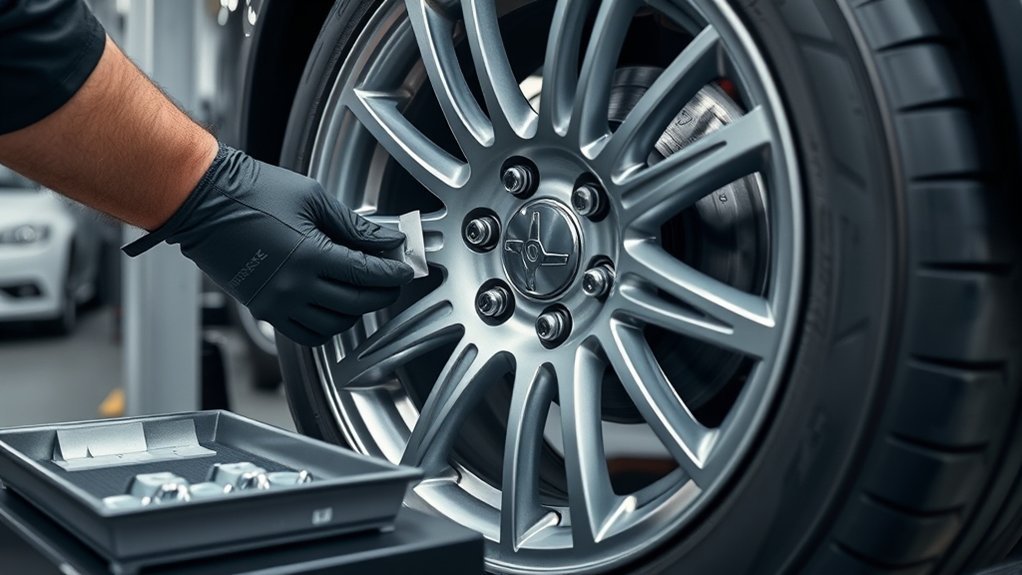
Tire balancing weights correct small differences in mass around a tire-and-wheel assembly so it can rotate smoothly. Proper balancing can reduce highway-speed vibration, help prevent irregular tread wear, and limit unnecessary stress on steering and suspension parts. Adhesive and clip-on weights are both useful, but the correct choice depends on the wheel design, rim profile, and balancing-machine recommendation rather than wheel material alone.
Quick Answer
Tire balancing weights offset heavy spots in a tire-and-wheel assembly. A technician uses a balancer to calculate the amount and location of correction needed, then installs compatible adhesive or clip-on weights. Balance the wheels when tires are installed or remounted, after a weight is lost, or when speed-related vibration develops.
Key Takeaways
- Wheel weights correct uneven mass so the tire-and-wheel assembly rotates with less vibration.
- Adhesive weights are common on wheels where a hidden or flange-free installation is preferred, while correctly matched clip-on weights work on many steel and alloy rims.
- Steel, zinc, and composite weights are widely available lead-free alternatives.
- Highway-speed vibration, lost weights, tire replacement, or remounting are good reasons to have balance checked.
- Balancing and alignment are different services: balancing corrects mass distribution, while alignment adjusts wheel angles.
- Service prices vary. Some retailers charge per tire, while others include lifetime rebalancing with a tire purchase.
What Are Tire Balancing Weights?
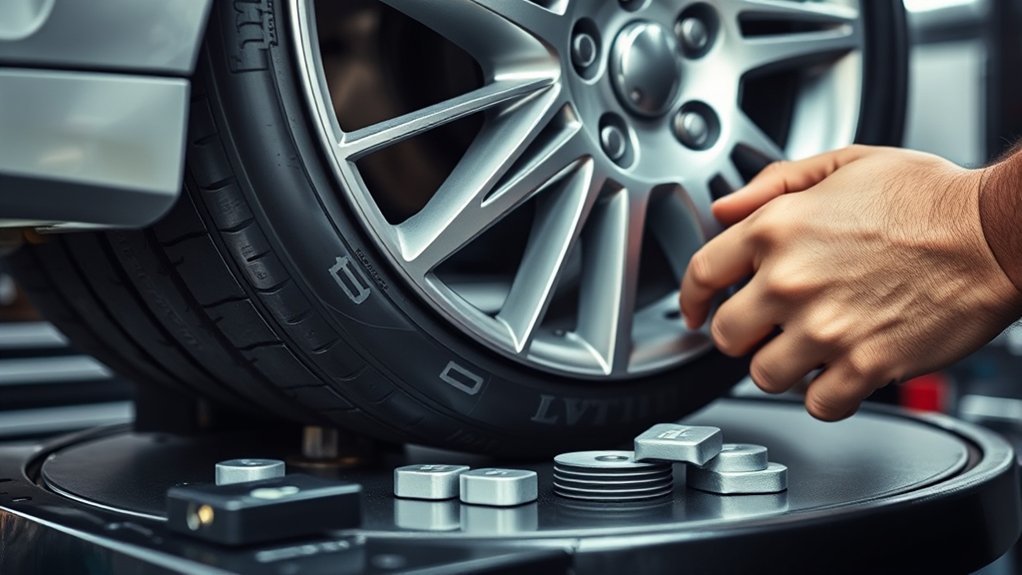
Tire balancing weights are small metal or composite pieces installed on a wheel to correct uneven mass distribution in the tire-and-wheel assembly.
No tire and wheel combination is perfectly uniform. A slightly heavier area creates centrifugal force as the wheel turns. At certain speeds, you may feel the result as a vibration through the steering wheel, seat, or floor.
A balancing machine measures that imbalance and tells the technician how much correction is required and where it should be installed. The technician then adds clip-on or adhesive weights and spins the assembly again to confirm the correction.
Michelin recommends balancing when tires are replaced and when a balance weight has moved or fallen off. New tires should also be balanced when they are mounted.
Types of Tire Balancing Weights
The two main fixed wheel-weight designs are adhesive weights and clip-on weights. Both can balance a wheel accurately when the correct style and placement are used.
The important point is fit. Do not assume that every alloy wheel needs adhesive weights or that every steel wheel needs the same clip. Wheel manufacturers and weight suppliers use different rim-flange profiles, and the technician should match the weight to the actual wheel.
Adhesive vs. Clip-On
Adhesive, stick-on, or tape weights attach to a cleaned flat surface inside the wheel barrel. They are useful when the wheel has no suitable exposed flange, when a low-profile installation is needed, or when you want the weights hidden behind spokes for appearance.
Good surface preparation matters. Dirt, brake dust, oil, moisture, and old adhesive can reduce bond strength. The installation area should be cleaned and dried before the backing is removed.
Clip-on weights attach to a wheel flange. Steel-wheel applications commonly use clip-ons, but many alloy wheels also have dedicated clip profiles. The clip must match the flange shape closely enough to remain secure without damaging the rim.
Wheel-weight manufacturer Plombco recommends using a rim gauge or application chart to select the correct clip-on style for alloy rims rather than forcing an incorrect clip to fit.
Lead-Free Weight Options
Lead-free wheel weights are now widely available in materials such as steel, zinc alloy, and plastic-metal composites.
The U.S. Environmental Protection Agency reported in December 2024 that alternatives such as steel, zinc alloy, and plastic-metal composite weights were widely available. EPA also reported that nine U.S. states and Canada had banned lead wheel weights and that automakers no longer used lead wheel weights on new vehicles sold in the United States.
There is not currently one nationwide federal ban that applies to every replacement wheel weight, so shops should follow applicable state and local requirements.
Which Wheel Weight Type Fits Your Rim?
Choosing between adhesive and clip-on weights starts with the wheel design and approved weight profile, not just whether the rim is steel or aluminum.
| Weight type | Common uses | Main consideration |
|---|---|---|
| Adhesive | Alloy, custom, flangeless, or appearance-sensitive wheels | Surface must be clean, dry, and suitable for adhesion |
| Clip-on | Many steel wheels and compatible alloy-wheel flanges | Clip profile must match the rim flange |
| Lead-free steel or zinc | Passenger vehicles and light trucks where compatible | Use the correct material, profile, coating, and increment |
Names such as MC, IAW, FN, P, and AW refer to different clip profiles rather than universal nationality labels. For example, Plombco describes MC styles as common on many North American applications, IAW on some European and Asian applications, and FN on many Asian applications. The actual flange shape remains the deciding factor.
Warning: Never bend or reshape an incorrect clip-on weight just to make it fit. Wheel-weight manufacturers warn that altering the clip can reduce retention and allow the weight to fall off.
[Products Worth Considering]

Keep your tires properly inflated with this analog VONDIOR tire pressure gauge, designed for fast, easy readings without batteries. The swiveling, two-axis hose and large glow dial help you measure at any tire angle with instant visibility. Built with a protective rubber shield, it supports durable, low-maintenance use for cars and trucks.

The Ziopetru adjustable magnetic wheel alignment tool helps you check and restore camber and caster positioning after removing and reinstalling undercarriage components. With a clear leveling/bubble measurement system and an easy zeroing adjustment knob, it supports precise horizontal angle checking. The strong magnetic base mounts to metal surfaces for convenient use at home on cars, motorcycles, trucks, vans, and SUVs.

Replace or upgrade your zero-turn lawn mower tires with a universal fit flat-free tire and wheel assembly in a convenient 2-pack. Smooth tread front-caster style helps turning with reduced turf damage, while flat-free design eliminates the maintenance and downtime of air-filled flats. The included adapter kit supports 5/8-inch axles and hub lengths from 3.4 to 5 inches for compatibility across most ZTR mowers.
How Wheel Weights Affect Performance
Correct wheel balance mainly affects vibration, ride quality, tread wear, and the load transmitted to steering and suspension components.
It should not be treated as a substitute for alignment, tire-pressure maintenance, suspension repair, or diagnosis of damaged wheels.
Ride Comfort and Stability
An out-of-balance wheel creates a repeating force every time it rotates. As road speed rises, that force can become noticeable as a shake or vibration.
The U.S. Tire Manufacturers Association notes that out-of-balance tire-and-wheel assemblies can cause vehicle vibration and bounce and may significantly reduce tire mileage.
Correcting the imbalance can make the ride smoother and reduce repeated forces reaching bearings, steering components, and suspension parts.
Fuel Economy and Wear
Proper balancing helps the tire rotate more consistently and can reduce one source of irregular tread wear. Tire manufacturers also associate imbalance with increased fuel consumption, but there is no reliable universal percentage that applies to every passenger vehicle.
That means you should be cautious with claims that balancing automatically improves fuel economy by a fixed 1–2% or extends tire life by a fixed 30%. Actual results depend on the severity of the imbalance, tire condition, alignment, pressure, suspension condition, driving style, and many other factors.
The strongest practical benefit is preventing an imbalance from continuing to create vibration and abnormal wear.
Signs Your Tires Need Balancing
The most common warning sign is speed-related vibration. You may feel it through the steering wheel, seat, or floor, often more clearly at highway speeds.
| Symptom | Possible clue | What to do |
|---|---|---|
| Steering-wheel shake | Often associated with a front wheel, but not definitive | Inspect tires and wheels and check balance |
| Seat or floor vibration | May point toward a rear-wheel or whole-vehicle vibration | Inspect all four assemblies |
| Cupped or patchy tread wear | Balance, suspension, or other mechanical issue may exist | Have balance and suspension inspected |
| Vibration after a pothole or curb impact | Lost weight, bent wheel, tire damage, or alignment change | Schedule an inspection promptly |
A missing wheel weight is another reason to have the assembly checked. You may see a clean or differently colored patch where an adhesive weight used to sit, or notice that a clip-on weight is missing from a wheel flange.
Do not assume every vibration is a balance problem. Bent rims, tire runout, flat spotting, suspension wear, brake problems, and drivetrain faults can produce similar symptoms.
Tire Balancing vs. Wheel Alignment
Balancing and alignment solve different problems.
Balancing corrects uneven weight distribution within a rotating tire-and-wheel assembly. Alignment adjusts wheel angles such as toe, camber, and caster so the wheels point and contact the road as intended.
A vehicle that pulls consistently to one side or has one edge of a tire wearing faster may need an alignment check. A vibration that changes with speed is more typical of a balance or tire/wheel uniformity problem.
Michelin’s alignment and balancing guidance also notes that the two services affect tire wear and ride quality in different ways.
How Tire Balancing Works
A professional balance normally starts with the complete tire-and-wheel assembly mounted on a calibrated balancing machine.
The machine spins the assembly, measures the imbalance, identifies the correction planes, and calculates the weight needed. The technician then installs the recommended weights and performs another spin to verify the result.
Balance Detection Basics
Static imbalance creates a force that tends to produce an up-and-down shake or hop. Dynamic imbalance includes side-to-side or couple forces that can create wobble or shimmy.
Modern dynamic balancers measure these forces and calculate where correction is needed. Hunter Engineering describes static imbalance as shake and couple imbalance as side-to-side wobble.
Because vibration can have several causes, a technician should also inspect the tire and wheel if the machine indicates an unusual condition or if the vehicle still vibrates after balancing.
Weight Placement Methods
The balancing machine determines the angular location, correction plane, and weight amount. Technicians should follow that result instead of simply adding weights to the top or bottom of the rim.
Static correction may use one correction plane in an appropriate balancing mode. Dynamic balancing generally considers two planes so both vertical imbalance and couple imbalance can be controlled.
Depending on wheel design, the machine may call for clip-on weights, adhesive weights, or a combination of the two.
For adhesive weights, the mounting surface should be clean and dry. For clip-on weights, the clip profile must match the rim flange and remain firmly seated.
Recheck and Fine-Tune
After the correction weights are installed, the technician spins the assembly again. If the balancer still detects an unacceptable residual imbalance, the weights may be adjusted and the wheel retested.
If a wheel repeatedly needs large corrections or will not balance smoothly, simply adding more weights may not address the real problem. The technician may need to inspect for a bent rim, poor tire seating, tire runout, or tire/wheel uniformity problems.
Pro Tip: If standard balancing does not eliminate a persistent highway-speed vibration, ask whether the shop can check radial-force variation with a road-force balancer instead of repeatedly adding or moving weights.
When Road-Force Balancing Helps
A standard spin balancer measures mass imbalance. A road-force balancer adds a load roller that presses against the tire and helps detect variations that may not appear during a normal free-spin balance.
This can be useful when:
- A vibration remains after a normal balance.
- New tires have vibrated since installation.
- The vehicle started vibrating after a pothole or curb strike.
- The tire or wheel has excessive radial or lateral variation.
- Repeated balancing attempts have not solved the problem.
Hunter’s Road Force equipment can also identify opportunities for match-mounting, where the tire is repositioned on the wheel to reduce combined tire-and-rim variation before final balancing.
Match-mounting can sometimes reduce the amount of correction weight needed, but it requires tire-changing equipment and should be handled by a trained technician.
How Often Should You Balance Tires?
There is no single maintenance interval that every manufacturer applies to every passenger vehicle.
Good times to check or rebalance include:
- When new tires are mounted.
- When a tire is removed and remounted after repair or service.
- When a wheel weight falls off or moves.
- When speed-related vibration begins.
- After a significant pothole or curb impact if vibration follows.
- When irregular tread wear suggests a possible balance problem.
Some service providers recommend combining balance checks with tire rotations. Discount Tire, for example, recommends balancing about every 6,000 miles, while Continental publishes broader guidance of approximately 5,000–10,000 km, or about 3,100–6,200 miles, or every one to two years.
Your tire manufacturer, vehicle manufacturer, driving conditions, and symptoms should take priority over a generic mileage rule.
How Much Tire Balancing Costs
Tire balancing cost varies by retailer, location, wheel size, tire type, and whether balancing is bundled with installation.
As one current example, Walmart lists its Lifetime Balance & Rotation service at $15 per tire. Other shops use different pricing structures.
Discount Tire includes lifetime rebalancing with tires purchased and installed through its stores. For tires purchased elsewhere, it says balancing is available for a per-tire charge that varies by region.
Road-force balancing or specialty-wheel handling may follow different pricing policies, so ask for the complete service price before work begins.
Do not assume a quote for “mount and balance” is the same as balancing alone. Tire mounting, valve or TPMS service, disposal, road-hazard coverage, and balancing may be listed or bundled differently.
How to Choose the Right Wheel Weights
The safest approach is to let the balancing machine and the wheel manufacturer’s or weight supplier’s application information determine the setup.
Check these factors:
- Rim material and design: steel, alloy, painted, chrome, plastic-clad, flanged, or flangeless.
- Rim-flange profile: clip-on weights must match the actual flange.
- Correction plane: the balancer determines where correction is required.
- Appearance: adhesive weights may be hidden behind spokes on custom or premium wheels.
- Weight material: steel, zinc, composite, or another locally permitted material.
- Increment: weights may be supplied in ounces or grams depending on the system and application.
- Coating: coated clip-on weights can help protect alloy-wheel surfaces and the weight itself from corrosion.
The Plombco application chart and similar manufacturer guides exist because one clip profile cannot safely fit every wheel.
[Products Worth Considering]

This professional wheel and rim cleaning brush set lifts brake dust, grime, and dirt with soft, scratch-free microfiber and synthetic wool fibers. The rim brush bends up to 360 degrees for easy access to hard-to-reach areas around spokes, lips, and faces. Ideal for thorough cleaning of car, truck, motorcycle, bicycle, RV, and more wheel and tire surfaces.

This 3-piece wheel brush set makes it easy to clean wheels and tires with soft, scratch-free brushes designed for lifting brake dust and grime. The flexible rim brush bends up to 360 degrees to reach hard-to-access areas for a thorough clean, while the comfortable grip helps control during detailing. A dedicated detailing brush supports gentle cleaning for sensitive surfaces, including interior use.

This oesee 8-piece wheel care kit helps you clean, scrub, and dry wheels safely with purpose-built brushes and towels. The scratch-free microfiber wheel brush lifts brake dust and grime, while the stiff pro-grip tire brush removes tire browning and embedded dirt. A twist loop microfiber drying towel and an applicator help achieve a streak-free finish and cleaner, more even product application.
Wheel Weight Safety Rules
Correct fit and secure installation matter because a poorly installed weight can loosen, fall off, damage a wheel finish, or leave the assembly out of balance.
- Use the correct clip profile instead of bending an incompatible clip.
- Clean adhesive-weight mounting surfaces before installation.
- Avoid touching exposed adhesive after removing its liner.
- Apply adhesive weights firmly and evenly.
- Do not hammer adhesive weights.
- Inspect clip-on weights for secure seating.
- Replace damaged, distorted, or poorly retained components rather than forcing them back into service.
- Use wheel and tire equipment according to the equipment manufacturer’s instructions.
Wheel balancing itself is precise service work, and tire mounting introduces additional hazards. If a tire must be removed from the rim, use a qualified tire-service professional rather than attempting the procedure without proper training and equipment.
Where to Buy Wheel Balancing Weights
Once you know the correct weight type and fit for your wheel assembly, you can source wheel weights from local tire-service suppliers, automotive-tool retailers, wheel-weight manufacturers, and online automotive-parts sellers.
Local tire shops have an important advantage: they can inspect the wheel and determine the correct profile instead of making a selection from appearance alone.
Correct wheel-weight fit matters more than simply choosing “alloy” or “steel” on a product listing.
If you buy weights online, verify the material, clip profile, increment, coating, and intended wheel application. For adhesive weights, also confirm that the adhesive is intact and has been stored properly.
Used wheel weights may look inexpensive, but damaged clips, corrosion, contaminated adhesive, or an incorrect rim profile can make them a poor choice. For dependable service, use parts whose condition and compatibility can be verified.
[Products Worth Considering]
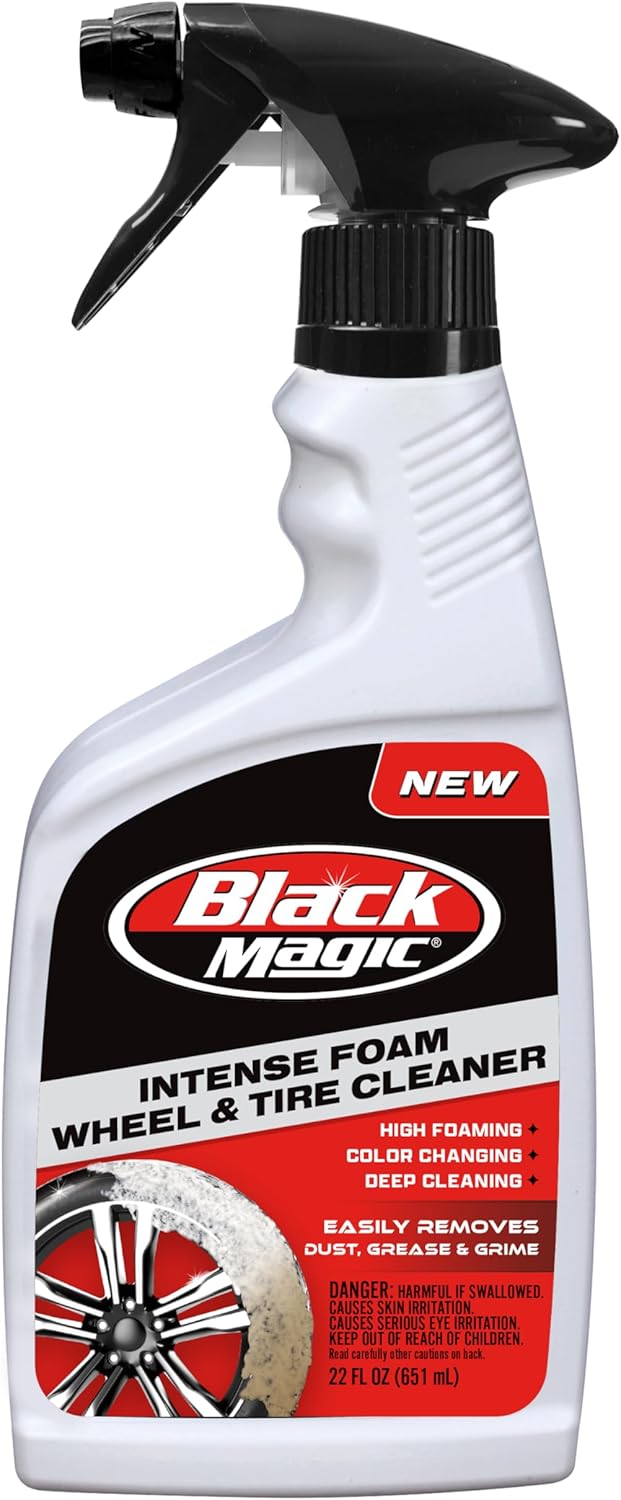
Black Magic Intense Foam Wheel & Tire Cleaner uses a high-foaming action to lift away dirt, grime, and brake dust without scrubbing. The color-changing formula helps show contaminants being dissolved as foam turns from white to brown. Safe for all wheel types and even wheel wells, it leaves a like-new, slick finish with a fresh cherry scent.

Measure tire tread depth quickly and accurately with this LUMITECO dial gauge that reads in 1/32" increments up to 14/32". The color-coded green/yellow/red zones make it easy to judge tire wear and know when replacement is needed. A rugged, compact design with a protective pouch helps keep the gauge ready for use on cars, trucks, motorcycles, and more.

Steelman white tire marking crayons provide high-contrast, semi-permanent marks for repairing and inspecting tires and equipment. They write on wet or dry, smooth or coarse surfaces including rubber, metal, glass, and wood, making them ideal for puncture location and damage outlining. The lead- and zinc-free crayons resist weather and fading yet wipe away when you no longer need the marks.
Frequently Asked Questions
Are tire weights necessary?
They are necessary when the tire-and-wheel assembly needs correction to meet the balancer’s tolerance. Most mounted assemblies require some correction, but the exact amount depends on the individual tire and wheel. The goal is proper balance, not installing a predetermined number of weights.
Which is better, balancing beads or weights?
For ordinary passenger-car service, machine balancing with fixed clip-on or adhesive weights is the conventional approach and lets a technician measure and verify the correction. Internal balancing products are used in some commercial, off-road, or specialty applications, but suitability depends on the tire, wheel, TPMS system, and manufacturer guidance.
How many weights should it take to balance a tire?
There is no standard number. The balancer determines the total correction and placement. One wheel may need very little correction while another needs several segments. If unusually large corrections are repeatedly required, the technician should inspect tire seating, wheel runout, tire uniformity, and possible match-mounting options.
Can a tire be balanced without weights?
Occasionally, an assembly may already fall within the balancer’s acceptable tolerance and require little or no correction. Repositioning the tire on the wheel through match-mounting can also reduce the correction needed. Most passenger-vehicle assemblies, however, use fixed wheel weights when the machine calls for them.
What happens if a wheel weight falls off?
The wheel may become unbalanced again, although you may not notice the change immediately. If you see evidence of a missing weight or develop a new speed-related vibration, have that wheel checked and rebalanced rather than guessing at the replacement weight and position.
Why does my car still vibrate after tire balancing?
Balance is only one possible cause of vibration. A bent wheel, tire runout, radial-force variation, flat spotting, suspension wear, brake problems, or drivetrain issues can create similar symptoms. If a standard rebalance does not solve the problem, a road-force check and broader mechanical inspection may be appropriate.
Conclusion
The right tire balancing weights help a tire-and-wheel assembly rotate smoothly and reduce vibration, irregular tread wear, and unnecessary stress on vehicle components. The key is accurate measurement and correct fit rather than simply adding more weight.
Use adhesive or clip-on weights according to the wheel design and balancing-machine recommendation, follow the correct rim-profile application, and have the balance checked when tires are mounted, a weight is lost, or speed-related vibration develops. If standard balancing does not solve the problem, inspect the tire, wheel, suspension, and consider road-force diagnosis instead of repeatedly changing weights.
Sources
- Michelin — Routine Tire Care Tips — balancing purpose, service timing, and weight correction.
- U.S. Tire Manufacturers Association — Care and Service of Passenger and Light Truck Tires — tire/wheel balance, vibration, tread wear, and tire-service safety.
- Hunter Engineering — SmartWeight Wheel Balancers — static and dynamic imbalance and modern weight placement.
- U.S. EPA — Lead Wheel Weight Rulemaking Decision — current U.S. lead-wheel-weight context and alternatives.
- Plombco — Wheel Weight Installation Instructions — clip fitment, adhesive preparation, and installation safety.
- Plombco — Wheel Weight Application Chart — wheel-weight profiles and vehicle/rim applications.
