Disclosure: As an Amazon Associate, we earn from qualifying purchases. If you click a link on this page and make a purchase, we may receive a small commission at no extra cost to you.
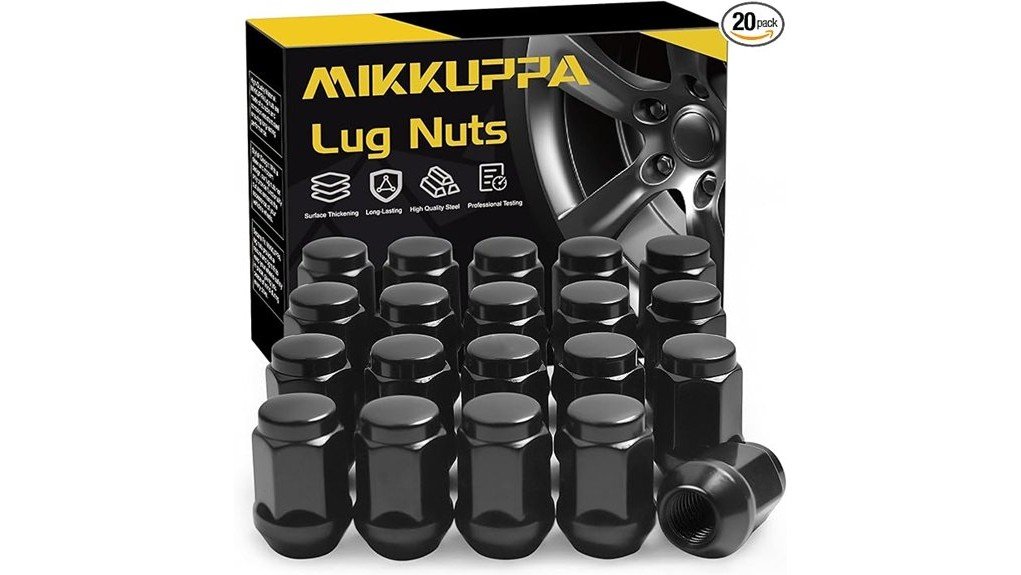
Replacing worn, swollen, or rusted lug nuts sounds simple, but an incorrect thread or seat can prevent the wheel from clamping safely. The MIKKUPPA M12x1.5 Black Lug Nuts provide a 20-piece, one-piece alloy-steel set with a closed end, 19 mm hex, and 60-degree conical seat. They are a practical choice for compatible aftermarket wheels and listed vehicle applications, but you must verify the stud thread, wheel-seat shape, nut dimensions, and vehicle torque specification before ordering. This review explains the fit limits, installation process, durability claims, and situations where an OEM-style alternative is the safer choice.
Quick Verdict
Rating: 8/10, recommended with fitment caveats
Best For: Drivers who need 20 black M12x1.5 lug nuts for wheels that use a 60-degree conical seat and accept a 22 mm-wide, 35.05 mm-long closed-end nut.
Bottom Line: The one-piece cold-forged alloy-steel design avoids the outer-shell swelling associated with some two-piece nuts and gives you a standard 19 mm hex. The main tradeoff is narrow compatibility, because matching a vehicle name or M12x1.5 thread alone does not confirm the correct wheel seat or clearance.
Key Specifications
| Specification | Detail |
|---|---|
| Brand | MIKKUPPA |
| Model / part number | QLN104 |
| Product type | Closed-end bulge-style wheel lug nuts |
| Quantity | 20 pieces |
| Thread | M12x1.5, right-hand, fully threaded |
| Seat | 60-degree conical seat |
| Hex size | 3/4 inch / 19 mm external hex |
| Length | 1.38 inches / 35.05 mm |
| Width / diameter | 0.87 inch / 22 mm |
| Material | Cold-forged, heat-treated alloy steel |
| Finish | Black polished zinc exterior finish |
| Corrosion claim | Manufacturer states the coating passed a 72-hour salt-spray test |
| Listed support | 12 months of brand support |
| Best use | Compatible aftermarket wheels requiring this exact thread, seat, hex, and clearance |
Key Takeaways
- The set includes 20 one-piece M12x1.5 lug nuts with a closed-end bulge design.
- Each nut uses a 60-degree conical seat, a 19 mm hex, a 35.05 mm length, and a 22 mm width.
- Cold-forged, heat-treated alloy steel gives the nuts a solid construction without a separate decorative outer cap.
- The black finish adds a clean appearance, but careful socket use is still needed to reduce cosmetic damage.
- Vehicle lists are only a starting point. Your wheel-seat shape, stud length, torque specification, and lug-hole clearance must also match.
What Are MIKKUPPA M12x1.5 Lug Nuts?
MIKKUPPA QLN104 is a set of 20 closed-end lug nuts for wheel studs with an M12x1.5 right-hand thread. The nuts use a one-piece alloy-steel body instead of a steel core covered by a separate cosmetic cap. That construction gives you a consistent 19 mm external hex and removes one common source of swelling or separation found on some capped two-piece designs.
The bulge-style base ends in a 60-degree cone. That tapered seat is designed to center and clamp against a matching conical recess in the wheel. It should not be used on a radius or ball seat, a flat mag seat, or a wheel that requires a washer or shank-style nut.
Before You Buy: Do not order by vehicle name alone. Confirm M12x1.5 studs, a 60-degree conical wheel seat, enough closed-end depth for the exposed stud, and at least 22 mm of lug-hole clearance. Check the wheel maker’s instructions when you use aftermarket wheels.
Who Should Buy It?
Best For
- Drivers replacing a complete 20-nut set on compatible five-lug wheels.
- Owners of aftermarket wheels that specify M12x1.5 threads and a 60-degree cone seat.
- Buyers who prefer a one-piece 19 mm hex instead of a capped two-piece nut.
Skip If
- Your wheel uses a ball, radius, flat, mag, shank, or washer-style seat.
- Your studs use another thread, including M12x1.25 or M14 sizes.
- You need locking or spline-drive nuts for added theft resistance or narrow lug wells.
[Products Worth Considering]

This professional wheel and rim cleaning brush set lifts brake dust, grime, and dirt with soft, scratch-free microfiber and synthetic wool fibers. The rim brush bends up to 360 degrees for easy access to hard-to-reach areas around spokes, lips, and faces. Ideal for thorough cleaning of car, truck, motorcycle, bicycle, RV, and more wheel and tire surfaces.

Upgrade your wheels with MIKKUPPA closed-end lug nuts designed for reliable fit and corrosion resistance. The one-piece, cold-forged and heat-treated steel construction helps resist rust and stripping, while the integrated finish delivers a durable black appearance. Built to OEM standards with a conical 60-degree seat, these nuts provide a secure solution for compatible Ford, Honda, Jeep, and Chevrolet models.

These M14x1.5 closed-end chrome lug nuts are a one-piece replacement designed for secure fitment on compatible GM, Ford, and select Chrysler/Dodge models. Featuring a 60-degree conical seat and anti-rust chrome plating, they help resist corrosion and maintain a bright look for everyday driving. Built for long-term durability, they include OEM-style part references and are backed by 12 months of support.
Fit and Compatibility
The product listing names selected Ford Escape, Focus, and Fusion years; Honda Accord, Civic, CR-V, and HR-V years; Mazda 3 years; Jeep Compass and Patriot years; Dodge Journey, Avenger, Caravan, and Grand Caravan years; and Chevrolet Cruze, Equinox, Malibu, and Trax years. These applications do not prove that every trim, factory wheel, or aftermarket wheel uses the same seat and dimensions.
Start with the stud thread. An M12x1.5 marking means a 12 mm nominal stud diameter with 1.5 mm between thread peaks. Next, inspect the wheel seat. These nuts require a straight 60-degree taper, not a rounded radius seat. Finally, measure lug-hole diameter, exposed stud length, and surrounding clearance so the 22 mm-wide, 35.05 mm-long body can seat fully without bottoming out.
For factory wheels, compare the original nut’s seat shape and dimensions with the replacement. For aftermarket wheels, use the wheel manufacturer’s lug-nut specification. A vehicle compatibility chart cannot override the wheel’s required hardware.
Pro Tip: Remove one existing lug nut and compare its thread, seat profile, overall length, and hex size before ordering. A paper or digital caliper measurement can also help you confirm lug-hole clearance.
Materials and Build Quality
MIKKUPPA describes the QLN104 nuts as cold-forged and heat-treated alloy steel. Cold forging shapes the metal under pressure, while heat treatment is intended to improve strength and wear resistance. The one-piece body is the most useful design feature because the wrench contacts solid steel rather than a thin decorative cap.
The closed end keeps the stud tip out of view and can reduce direct exposure to dirt and moisture. It also creates a fit limit. If the stud projects farther than the internal depth allows, the nut can bottom against the stud before its cone clamps the wheel. That condition can leave the wheel loose even when the wrench feels tight.
The black polished zinc finish gives the set a uniform appearance. The manufacturer states that the coating passed a 72-hour salt-spray test and uses an infrared drying process. That is a useful corrosion-resistance claim, but it does not make the finish immune to road salt, impact tools, abrasive sockets, or repeated wheel service.
Installation and Safety
Park on a firm, level surface and follow the vehicle’s lifting and wheel-removal instructions. Confirm that the hub, wheel, studs, and nuts are clean and undamaged. Follow the vehicle or wheel maker’s instructions on whether the threads must remain dry or receive a specified treatment. Do not add lubricant unless the manufacturer explicitly directs you to do so.
- Place the wheel squarely against the hub and support it so it does not hang on one stud.
- Start every lug nut by hand for several turns. Stop if a nut binds, rocks, or feels rough.
- Snug the nuts in the vehicle maker’s recommended cross or star sequence.
- Lower the vehicle as directed, then use a calibrated torque wrench set to the exact specification for your vehicle and wheel.
- Check that every conical seat is centered and flush against the wheel.
- Recheck torque after the wheel or vehicle manufacturer’s stated break-in distance. If no interval is supplied, ask a qualified tire professional for guidance.
A 19 mm socket fits the external hex, so a spline key is not required. Use a clean six-point socket that fits closely. An impact wrench can speed removal, but final tightening should be completed with a torque wrench rather than by impact alone.
Stop using any nut with damaged threads, a distorted seat, severe corrosion, cracks, or a rounded hex. Wheel-fastener errors can cause loss of clamp load and wheel separation, so have a tire shop inspect the setup if you are unsure about fit or torque.
How It Performs in Real Use
For Daily Driving
Once fitted and torqued correctly, the one-piece design should provide a simple, conventional fastening setup. The 19 mm hex is common, so you can use a standard socket instead of carrying a special key. The black finish also hides the bright-metal look of standard nuts on dark wheels.
For Seasonal Wheel Changes
Drivers who switch between summer and winter wheel sets may benefit from the solid external hex because it avoids a separate cap that can deform. You still need to confirm that both wheel sets use the same 60-degree cone seat and have enough clearance. Matching stud thread does not make one nut suitable for every wheel you own.
For Wet or Salted Roads
The closed end and coated surface provide more protection than an open-ended bare-steel nut, but road salt can still collect around the seat and hex. Rinse road grime from the wheels, avoid harsh metal brushes, and inspect the finish when the wheels come off for service.
For Repeated Removal
Frequent tire rotations and brake service put wear on the coating and hex corners. A correctly sized six-point socket and hand-starting each nut help reduce chipping and cross-threading. Replace the nut rather than forcing it if the threads no longer run smoothly.
Pros and Cons
Pros
- One-piece alloy-steel construction avoids a separate outer cap.
- Standard 19 mm hex works without a proprietary spline key.
- Twenty-piece count suits many five-lug passenger vehicles.
- Closed-end design covers the exposed stud tip.
- Black finish pairs neatly with dark or black wheels.
Cons
- Only fits M12x1.5 studs and 60-degree conical seats.
- Closed-end depth may not suit long or extended wheel studs.
- Black coating can show socket wear or chips after repeated service.
Is It Worth the Price?
The MIKKUPPA set sits in the value-oriented replacement category. You receive 20 matching nuts, a one-piece steel body, a common 19 mm hex, and a coated closed-end design. That combination can be strong value when it matches your wheels exactly and you want to replace a full set rather than mix old and new hardware.
The set is less valuable when you are trying to adapt it to an uncertain factory-wheel seat, extended studs, or narrow tuner-style lug holes. In those cases, paying more for an OEM-style, wheel-specific, or locking set is preferable to accepting a questionable fit.
[Products Worth Considering]

Upgrade your wheels with MIKKUPPA M12x1.5 mag seat lug nuts built for secure, corrosion-resistant performance. These closed-end chrome lug nuts are a direct replacement for select Toyota models, including Camry, Corolla, RAV4, Sienna, Avalon, Highlander, Matrix, Venza, and Prius. Triple-chromium plating and cold-forged, heat-treated steel help deliver strength for daily driving and replacement needs.

The Trivd Frol 1/2" air impact wrench delivers high performance torque up to 1500 ft-lbs with a twin hammer impact mechanism for strong, balanced blows. It features an ergonomic grip, compact lightweight design, and quick-stop control with 3 forward speeds up to 8000 RPM plus a reverse speed. Built for demanding automotive repair and tire shop work, the rear exhaust helps keep debris away from the surface.

This car D-wheel lock nut key provides an anti-theft solution for D-shaped wheel lock bolts, helping keep your wheels secure. It features a flower-shaped internal pattern that resists micro-adjustment theft while allowing removal and mounting of compatible locking nuts. Made for reliable performance under high torque, it’s easy to use with standard socket wrench turning for quick tire maintenance and emergency repairs.
How It Compares to Alternatives
Compared with factory-style radius-seat nuts, the MIKKUPPA QLN104 uses a 60-degree cone and should only be chosen when the wheel calls for that seat. Compared with spline-drive M12x1.5 nuts, it is easier to service with a standard 19 mm socket, but it may not fit very narrow lug wells and offers no locking function.
Solid one-piece alternatives from brands such as Gorilla Automotive, McGard, Dorman, or White Knight may offer different seat profiles, hex sizes, locks, and vehicle-specific applications. The MIKKUPPA set makes the most sense when its exact dimensions and cone seat already match your wheel, not simply because another M12x1.5 nut looks similar.
[Products Worth Considering]

This 1/2-inch drive breaker bar delivers powerful leverage for loosening and tightening stubborn lug nuts and automotive fasteners. The 180-degree flex head helps you reach tight spaces at the angle you need, making tire and brake jobs easier. A spring-loaded ball detent design holds 1/2-inch sockets securely while the chrome-moly head provides durable strength for everyday use.

The 22800 wheel stud installer makes replacing wheel studs quick and secure, saving time and effort during tire service. It uses a ratchet or impact wrench to pull new studs firmly into place, helping when existing studs are too long. Compatible with most automotive wheels and light-duty truck wheel studs, it’s designed for easy, tool-assisted installation.

The SEESII cordless impact wrench delivers high tightening and loosening power for fast wheel bolt and industrial bolt work. Its brushless motor and variable-speed 3 forward/2 reverse modes help you control precision installs and stubborn nut removal. A dual-battery system with rapid charging and an included storage case make it ready for home, car, and jobsite use.
Frequently Asked Questions
Do these lug nuts have a universal torque specification?
No. Use the torque value and tightening sequence specified for your vehicle and wheel. The M12x1.5 thread size does not determine one universal torque setting.
Do I need a spline key for installation?
No. These nuts use a conventional 3/4-inch or 19 mm external hex. A close-fitting six-point socket is the best choice for protecting the hex corners and finish.
Will they fit factory wheels?
Only when the factory wheel uses an M12x1.5 stud and a matching 60-degree conical seat with enough clearance. Some factory wheels use radius, mag, flat, or other seat types, so compare the original hardware or consult the wheel specification.
Can the closed end bottom out on long studs?
Yes. Measure the exposed stud and compare it with the nut’s usable internal depth before installation. A nut that bottoms on the stud may feel tight without clamping the wheel correctly.
Will the black finish chip over time?
It can show wear from impact sockets, dirt, road salt, and repeated removal. A clean six-point socket, controlled tool use, and regular cleaning can reduce cosmetic damage, but no coated lug nut stays perfect under all conditions.
Can these lug nuts be reused after removal?
Yes, provided the threads, cone seats, and hexes remain clean and undamaged. Replace any nut that binds during hand-threading or shows cracks, severe corrosion, rounded corners, or seat deformation.
Are these locking lug nuts?
No. They use a standard external hex and do not provide a unique lock pattern. Consider a compatible locking set if theft deterrence is a priority.
What is the most common fitment mistake?
The most common mistake is checking only the thread pitch or vehicle list. You must also match the 60-degree seat, nut width, lug-hole clearance, stud length, and wheel maker’s hardware requirements.
The Bottom Line
The MIKKUPPA QLN104 lug nuts are a sensible 20-piece replacement set for drivers whose wheels require an M12x1.5 thread, 60-degree conical seat, 19 mm hex, and compatible closed-end dimensions. Buy them for the solid one-piece construction and straightforward socket fit, but skip them when your wheel uses another seat type, extended studs, narrow tuner holes, or a locking system.
Ready to Buy?
Check the latest price, seller availability, and product details after confirming your wheel and stud specifications.