
Choosing between Load Range C, D, and E tires for a Toyota Tacoma is not as simple as picking the strongest letter. The correct tire must match your truck’s model year, trim, wheel size, load index, speed rating, and real axle load. A higher load range may add useful capacity or durability, but it can also add weight and stiffness without increasing the Tacoma’s factory payload or towing limits.
Quick Answer
For most daily-driven Tacomas, the best tire is the one that matches or exceeds the factory load index at the correct pressure—not automatically Load Range E. Choose C for lighter mixed use, D for a middle ground, and E only when the tire size, load table, cargo, towing, or severe trail use truly requires it.
Key Takeaways
- Start with the tire and loading label inside the driver’s door, not the load-range letter.
- Load index and tire-specific load tables show actual carrying capacity; C, D, and E do not have one fixed pound rating.
- A higher load range does not increase the Tacoma’s GVWR, GAWR, payload rating, or towing capacity.
- Changing from an original passenger-type tire to an LT tire may require a new pressure calculation.
- Tire model, weight, tread, compound, and construction often affect comfort and traction more than the letter alone.
Understanding Load Ratings: C, D, and E Explained
Load Range C, D, and E are strength and inflation categories most often found on LT-metric and flotation light-truck tires. Within the same tire size and product line, moving from C to D or E generally allows the tire to carry more load at a higher inflation pressure.
The letter alone does not tell you the tire’s exact capacity. Actual capacity depends on the tire size, load index, inflation pressure, and manufacturer load table. The tire’s maximum load is also molded into its sidewall.
Note: “Ply rating” is a historical strength term. Load Range C, D, and E traditionally correspond to 6-, 8-, and 10-ply ratings, but a modern radial tire does not necessarily contain six, eight, or ten physical casing plies.
Load Range vs. Load Index
Load range describes a tire’s load and inflation category. Load index is the number in the service description that points to a specific maximum load in a standardized chart. For example, the “115” in 265/70R17 115T is the load index, while “T” is the speed rating.
When selecting replacement tires, the load index must meet or exceed the requirement for the truck. Michelin explains that the required load rating can be found on the tire sidewall, vehicle placard, or owner’s manual and should meet the vehicle manufacturer’s specification. See Michelin’s tire load-rating guide.
Why Load Range Does Not Equal One Maximum Load
Two Load Range E tires in different sizes can have different load indexes and maximum capacities. A wider or taller tire may carry a different load than a smaller tire with the same E marking. The same principle applies to C and D tires.
Choose a Tacoma tire by its complete size, load index, speed rating, and pressure table—not by the C, D, or E letter alone.
Comparing Load Range C, D, and E for a Toyota Tacoma
The best load range depends on the exact tire size available for your Tacoma and how the truck is used. The table below compares the ranges without assigning misleading universal pound limits.
| Load Range | Historical Ply Rating | General Character | Typical Tacoma Use | Main Tradeoff |
|---|---|---|---|---|
| C | 6-ply rating | Lower load and inflation range than D or E in a comparable size | Daily driving, light cargo, camping, and moderate trails when the load index is adequate | May offer less reserve capacity than a higher-rated option |
| D | 8-ply rating | Middle load and inflation range | Mixed highway and trail use, regular cargo, or moderate towing when supported by the tire’s specifications | Can be heavier or firmer than C |
| E | 10-ply rating | Higher load and inflation range within these three categories | Frequent heavy cargo, demanding commercial-style use, or severe terrain when the exact tire and load table justify it | Often adds weight, stiffness, and cost |
These descriptions are general. One Load Range C tire may weigh more or have a tougher tread package than another brand’s Load Range E tire. Compare the exact product specifications rather than assuming every tire with the same letter behaves alike.
Warning: Installing a tire with a higher load range does not increase your Tacoma’s GVWR, GAWR, payload, hitch rating, or towing capacity. Always stay within Toyota’s vehicle and axle limits.
[Products Worth Considering]

These aluminum alloy tire valve stem caps with an O-ring seal help protect valve stems from corrosion while adding a clean, stylish look to your vehicle. The universal fit works across cars, trucks, motorcycles, bicycles, and more, making them an easy upgrade for everyday driving and off-road use. Installation is quick, and the included four-pack keeps all your tires dressed and protected.

Monitor tire tread wear with a smart, color-coded depth gauge that shows clear condition ranges at a glance. The bar is range marked for fast, easy readings, helping you maintain safer traction and performance. Each gauge is portable with a pocket clip, and the set includes 20 units for daily use and sharing.

Vigorder rubber cement glue delivers superior adhesion and cures quickly within about 30 seconds for seamless rubber bonding. Once cured, it helps provide a strong, durable, waterproof seal that holds up to vehicle weight, pressure, and heat. Suitable for cars, motorcycles, trucks, bicycles, and off-road tires, it’s designed for emergency patch and maintenance repairs.
Check Your Tacoma’s Placard Before Choosing a Load Range
Before comparing C, D, or E tires, open the driver’s door and read the Tire and Loading Information label. Confirm the original tire size and recommended cold pressure. Then compare those details with the owner’s manual for your exact model year and trim.
Tacoma specifications are not universal. For example, Toyota’s 2024 Tacoma data lists configurations including 245/70R17 110T at 35 psi, 265/70R17 115T at 30 psi, and 265/65R18 114T at 32 psi. These are model-year-specific examples, not pressure recommendations for every Tacoma. Review the Toyota Tacoma maintenance data and your own truck’s label.
Some Tacoma factory tires are identified by a load index without an LT load-range letter. That means changing to an LT-metric C, D, or E tire is a tire-type conversion, not a simple letter upgrade.
Tacoma Tire Selection Checklist
- Confirm the original specification: Record the tire size, load index, speed rating, and cold pressure from the placard and manual.
- Check the replacement tire’s full service description: Do not compare the load-range letter alone.
- Verify wheel compatibility: The tire must fit the wheel diameter and approved rim-width range, and the wheel must have enough load capacity.
- Consider real use: Include passengers, bed cargo, accessories, camper weight, trailer tongue weight, and towing gear.
- Check published tire weight: A large increase can affect steering, braking feel, acceleration, and ride quality.
- Confirm pressure: If tire size or type changes, use the tire manufacturer’s load-inflation information or a qualified tire professional.
Pro Tip: Weigh the loaded truck by axle at a certified scale before choosing tires for a camper, heavy overland build, or frequent towing. Compare the measured axle loads with Toyota’s GAWR limits and the tire manufacturer’s load table.
Load Range C Tires: Pros and Cons for Daily Driving
Load Range C can be a sensible choice when an LT tire is desired but the truck does not need the higher capacity of D or E. It is often considered for daily-driven Tacomas that carry moderate cargo and see occasional trail use.
Comfort and Ride Quality
A C-rated tire may weigh less and feel more compliant than a comparable E-rated version, but the result depends on the exact model. Sidewall design, tread depth, compound, wheel size, and pressure all influence ride quality.
Do not lower road pressure simply to soften the ride. When the tire size and type match the factory specification, use the cold pressure on the vehicle label. When converting to an LT tire or another size, have the required pressure calculated from the new tire’s load table.
Load Capacity Considerations
A C-rated option is suitable only when its actual load index and pressure-based capacity meet the Tacoma’s needs. It may be a poor match for a heavily equipped truck, slide-in camper, high tongue weight, or repeated operation near the rear axle limit.
| Feature | Load Range C | Load Range D |
|---|---|---|
| Relative capacity | Lower within a comparable size | Higher within a comparable size |
| Physical casing plies | Varies by tire model | Varies by tire model |
| Ride potential | Often lighter or more compliant | May feel firmer |
| Best fit | Daily use and moderate loads | Mixed use and greater load reserve |
| What to verify | Load index, pressure table, weight, and wheel fit | Load index, pressure table, weight, and wheel fit |
How Load Range D Tires Can Balance Performance and Durability
Load Range D sits between C and E and can provide a useful middle ground when it is available in the correct size. It may offer more load capacity than C without the full weight or stiffness of an E-rated version.
Improved Load Capacity
The extra capacity of a D-rated tire is useful only when the tire’s load index and approved pressure match the truck’s requirements. It can provide more reserve for cargo, towing equipment, and accessories, but it cannot authorize the truck to exceed Toyota’s axle or vehicle limits.
Do not inflate a D tire to its sidewall maximum unless the tire manufacturer’s load table and operating conditions require that pressure. More pressure than needed can reduce ride comfort and change the size of the tire’s contact patch.
Enhanced Off-Road Capability
A D-rated tire may use a stronger casing than a C-rated version of the same tire, but load range alone does not guarantee better trail traction or puncture protection. Tread pattern, sidewall design, rubber compound, tread depth, and driving technique are also important.
For a mixed-use Tacoma, compare the exact C, D, and E versions of the tire. Look at weight, tread depth, sidewall features, load index, approved rims, warranty, and manufacturer use recommendations.
Why Choose Load Range E Tires for Heavy-Duty Use?
Load Range E provides a higher load and inflation range than C or D within many comparable LT tire sizes. It may be appropriate for a Tacoma that carries substantial permanent equipment, operates near an axle limit, tows frequently, or travels through conditions where the specific E-rated tire’s construction provides a real advantage.
E should not be the automatic choice for every Tacoma. An unloaded daily driver may gain little from unused capacity while experiencing more tire weight, firmer impacts, slower steering response, and higher replacement cost.
The correct question is not, “Is E stronger?” It is, “Does this exact E tire provide a needed benefit without creating unnecessary tradeoffs for my truck?”
Note: The maximum pressure printed on an E-rated tire is an operating limit tied to its load table. It is not a recommendation to use that pressure on an unloaded Tacoma.
[Products Worth Considering]

These universal tire valve stem caps help protect valve cores from dust, debris, and moisture while helping maintain stable tire pressure. The corrosion-resistant metal construction and sealed design provide reliable protection in road grime, mud, and winter conditions. Twist-on installation makes them quick to fit on cars, SUVs, trucks, and motorcycles.

Keep your tires properly inflated with this analog VONDIOR tire pressure gauge, designed for fast, easy readings without batteries. The swiveling, two-axis hose and large glow dial help you measure at any tire angle with instant visibility. Built with a protective rubber shield, it supports durable, low-maintenance use for cars and trucks.

Upgrade your Toyota’s wheels with durable aluminum alloy valve stem caps that help protect valve cores from corrosion and direct exposure to road grime, clay, water, and snow. Rubber rings improve sealing to help prevent air leakage and maintain stable tire pressure for safer driving. These caps are easy to install or remove without tools and add a unique, stylish look to your car.
How Tire Weight Impacts Comfort and Fuel Efficiency
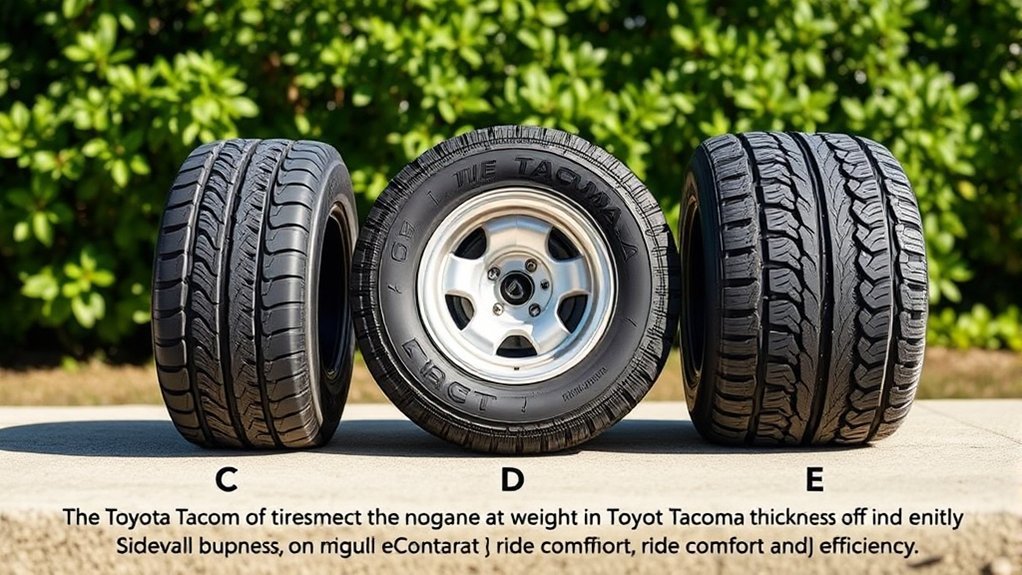
A heavier tire increases rotating and unsprung mass. Depending on the size of the change, this can affect acceleration, braking feel, suspension response, and steering effort. A heavier all-terrain or mud-terrain tread may also create more road noise than a highway-oriented tire.
Fuel-economy changes cannot be predicted from the load-range letter alone. Tire diameter, tread compound, rolling resistance, pressure, alignment, driving speed, and vehicle load all contribute. Compare the published weight of each candidate tire instead of assuming every E tire creates the same penalty.
Proper inflation remains important for both safety and efficiency. The U.S. Department of Energy notes that properly inflated tires can improve fuel efficiency and that replacement-tire rolling resistance varies. See the Department of Energy fleet-efficiency guidance.
On-Road Inflation Pressure After Changing Tires
For an original-equipment-size tire with the correct service description, use the recommended cold pressure on the Tacoma’s driver-door label unless Toyota provides another instruction for the specific configuration.
If you change from a passenger-type tire to an LT tire, change tire size, or choose a substantially different load specification, the original placard pressure may not produce the same load capacity. A tire professional should compare the old tire’s capacity at the placard pressure with the new tire’s manufacturer load-inflation table.
NHTSA advises drivers to check pressure when the tires are cold and to use the vehicle manufacturer’s recommendation rather than the maximum number printed on the tire. Review the NHTSA TireWise safety guidance.
- Check all tires, including the spare, at least once a month.
- Measure pressure before driving or after the vehicle has been parked long enough for the tires to cool.
- Do not use the sidewall maximum as the normal road setting.
- Follow the owner’s manual for TPMS initialization or registration after changing wheels, tire size, or target pressure.
Off-Road Performance: Which Load Range Is Best for Your Tacoma?
The best off-road tire is the one that combines adequate load capacity with the tread, casing, weight, and pressure range needed for the terrain.
- Load Range C: Often suitable for a lighter Tacoma that spends most of its time on pavement and tackles moderate trails. Confirm that the exact tire has enough capacity.
- Load Range D: Can offer a middle ground for a truck that carries more equipment or needs additional casing strength without moving to the heaviest option.
- Load Range E: May suit a heavily equipped truck or severe trail use, but extra weight and stiffness can be unnecessary for a lightly loaded daily driver.
Safe Off-Road Airing Down
Lowering pressure off-road can enlarge the tire’s footprint and improve comfort or traction on sand, rocks, and uneven ground. There is no universal safe PSI for every Tacoma.
The correct trail pressure depends on vehicle weight, tire size, wheel width, tire construction, speed, terrain, and whether the wheel has suitable bead-retention features. Pressure that is too low can damage the tire or wheel or allow the bead to unseat.
Warning: Never return to highway speeds on tires that remain aired down for trail use. Carry an accurate gauge and a compressor, inspect for damage, and reinflate before driving on pavement.
BFGoodrich provides additional terrain and reinflation guidance in its off-road tire selection guide.
Factors to Consider When Choosing the Right Tire for Your Tacoma
Model Year, Trim, and Factory Specification
Start with the exact Tacoma, not a general online recommendation. Two trims from the same year may use different tire sizes, load indexes, wheels, and cold pressures.
Actual Loaded Weight
Include passengers, tools, bed cargo, bumpers, winches, racks, drawers, tents, campers, fuel, water, and trailer tongue weight. Permanent accessories reduce the payload available for people and cargo.
Load Index and Speed Rating
The replacement tire should meet or exceed Toyota’s required load index and use an appropriate speed rating. Bridgestone explains how tire size, tire type, load index, and service description work together in its tire-size and load-index guide.
Wheel and Tire Size Compatibility
The tire must be approved for the wheel’s diameter and width. Its overall diameter and section width must also clear the suspension, body, brakes, and steering at full travel and full steering lock.
Terrain and Weather
Load range does not identify wet grip, snow traction, mud performance, or road noise. Compare the tire category, tread pattern, compound, siping, severe-snow rating, and test results.
Comfort, Noise, and Steering
A stiff or heavy tire can change the way an unloaded Tacoma rides. Compare actual tire weight and user-relevant test data instead of assuming that C is always comfortable or E is always harsh.
Cost and Long-Term Value
Consider purchase price, expected tread life, fuel use, rotation needs, repair availability, and replacement availability. A tire with more unused capacity is not automatically a better value.
Which Load Range Should You Choose?
| How You Use the Tacoma | Good Starting Point | What Decides the Final Choice |
|---|---|---|
| Mostly commuting, light cargo | Factory-equivalent tire or an appropriate C-rated LT option | OE load index, tire weight, comfort, wet grip, and pressure requirement |
| Daily driving plus regular trails | C or D | Actual load, terrain, sidewall design, wheel fit, and available sizes |
| Overland build with permanent equipment | D or E after weighing the truck | Measured axle loads, Toyota GAWR, tire load table, and tire weight |
| Frequent towing or heavy bed loads | D or E when required by actual load | Rear axle load, tongue weight, load index, pressure, and all factory ratings |
| Severe rocks or remote trail use | The tire with the right casing and load capacity, often D or E | Tire-specific sidewall design, puncture protection, repairability, and trail pressure plan |
For many Tacoma owners, the lightest tire that safely meets the complete load requirement provides the best balance. Extra capacity is useful when it solves a real load or durability need, not when it is selected only because a higher letter sounds stronger.
[Products Worth Considering]

The SAFELIFE dial tire tread depth gauge measures tread depth in 1/32 inch increments with clear, easy-to-read 2-inch dial face. Color zones using a traffic light system help you quickly judge whether tread is low, marginal, or ample for safer driving. Built with a durable zinc cast body and a metal detect probe for precise, comfortable use across cars, motorcycles, trucks, and buses.

The Topeak SmartGauge D2 delivers precise digital tire pressure readings for bikes, motorcycles, and sports equipment up to 250 psi (17 bar). Its rotating SmartHead works with both Presta and Schrader valves, so you can check pressure quickly without adapters. The LCD display makes it easy to read results in psi, bar, or kg/cm² with an included CR2032 battery for immediate use.

This ALL-TOP auto-stop tire deflator valve kit lets you air down off-road tires quickly without watching pressure, automatically stopping when your preset PSI is reached. Each valve is individually calibrated for reliable performance with an acceptable +/- 2 PSI tolerance. The adjustable deflator range covers 10 to 30 PSI and includes four valves plus valve caps and a zipper pouch for easy setup on trucks, SUVs, RVs, UTVs, and powersports.
Tire Replacement, Mixing, and Condition
For predictable handling, use four tires with the same size, construction, tread model, load index, and speed rating whenever possible. Do not mix radial and bias construction, and avoid combining very different tread patterns or load characteristics.
If only two tires are replaced, follow Toyota’s instructions and the tire manufacturer’s placement guidance. Bridgestone recommends choosing replacement tires with the same category, size, load capacity, and speed rating specified by the vehicle manufacturer. See its tire replacement guidance.
Replace or professionally inspect a tire when you find:
- Tread worn to the wear indicators or the legal minimum
- Cuts, exposed cords, bulges, deep cracks, or impact damage
- Repeated pressure loss or a puncture that cannot be safely repaired
- Severe uneven wear, vibration, or internal damage concerns
- Age that reaches Toyota’s or the tire manufacturer’s inspection or replacement limit
Frequently Asked Questions
Can I mix different load-range tires on my Tacoma?
Avoid it when possible. For consistent handling, use the same tire size, construction, model, load index, speed rating, and load range at all four positions. An emergency spare is an exception, but it should be used only as Toyota directs.
How do tire load ranges affect ride comfort?
A higher-rated version of the same tire may have a firmer casing and greater weight, which can make impacts feel sharper. However, tire size, wheel diameter, tread, pressure, and construction also matter, so compare the exact tires rather than the letters alone.
What are the signs that I need new tires?
Replace or inspect tires with worn tread indicators, exposed cords, bulges, deep cracks, repeated air loss, severe uneven wear, vibration, or damage that cannot be safely repaired. Also follow Toyota’s and the tire maker’s age-inspection and replacement guidance.
Do tire load ranges affect fuel economy?
They can, but the effect is not fixed. A heavier tire, aggressive tread, larger diameter, incorrect pressure, or higher rolling resistance may reduce efficiency. Compare the published weight and design of the exact tires you are considering.
How often should I check my tire pressure?
Check all tires, including the spare, at least once a month and before long trips. Check them cold and use the Tacoma’s placard pressure unless an approved load calculation has been completed for a changed tire size or type.
Does Load Range E increase Tacoma towing capacity?
No. A stronger tire may provide additional tire capacity, but it does not change Toyota’s GVWR, GAWR, payload, hitch, or towing limits. The truck must remain within every factory rating.
Can I install LT tires if my Tacoma came with passenger-type tires?
Possibly, but the new tire must fit the wheel and vehicle, meet the required load and speed ratings, and use a pressure that carries the same or greater load as the original setup. Have a qualified tire professional verify the conversion with the tire manufacturer’s load table.
Conclusion
Load Range C, D, and E tires can all work on a Toyota Tacoma when the exact tire matches the truck. C may suit lighter daily and trail use, D can provide a useful middle ground, and E may be appropriate for demanding loads or severe terrain. None is automatically best.
Start with your Tacoma’s model-year-specific placard and owner’s manual. Match the required size, load index, speed rating, wheel fit, and pressure. Then compare tire weight, tread design, casing features, weather performance, and actual use. This approach protects ride quality and safety without paying for capacity your truck does not need.
Sources
- Toyota 2024 Tacoma Maintenance Data — Tacoma tire sizes, load indexes, wheel specifications, and cold pressures.
- National Highway Traffic Safety Administration: TireWise — placard pressure, cold-pressure checks, tire maintenance, and safety guidance.
- Michelin Tire Load Rating and Speed Rating Guide — service descriptions, load ratings, and replacement requirements.
- Bridgestone Tire Size and Load Index Guide — passenger, LT-metric, load-index, and tire-size explanations.
- BFGoodrich Off-Road Tire Selection Guide — road pressure, changed tire sizes, airing down, and reinflation guidance.
- U.S. Department of Energy Fleet Efficiency Guidance — tire inflation, rolling resistance, and fuel-efficiency considerations.
