
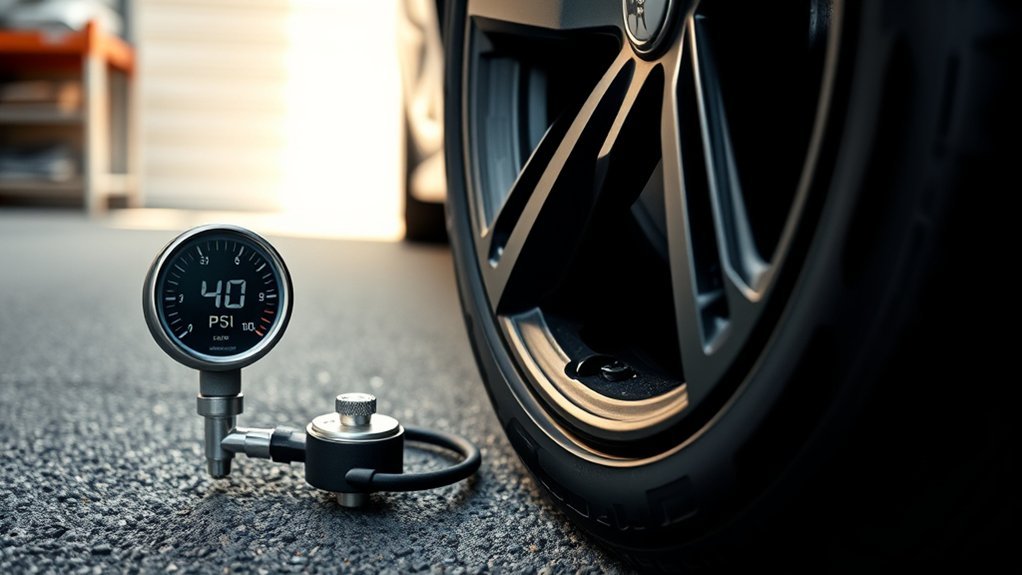
A 40 PSI reading can be perfectly normal on one vehicle and overinflated on another. The deciding number is the vehicle manufacturer’s recommended cold pressure, not the maximum pressure molded into the tire sidewall. If the door-jamb placard lists 40 PSI for that axle and load condition, then 40 PSI is appropriate.
Quick Answer
Use 40 PSI only when it matches the cold pressure on your vehicle’s Tire and Loading Information label or owner’s manual. If the label specifies less, 40 PSI is overinflated relative to the vehicle; if it specifies more, 40 PSI is underinflated. Compare the front and rear recommendations separately.
Key Takeaways
- 40 PSI is not a universal tire-pressure target. Your vehicle placard is the primary reference.
- The pressure molded into a tire sidewall is a maximum cold inflation limit, not the normal pressure you should automatically use.
- Check pressure when the tires are cold because driving and warmer temperatures raise the reading.
- Front and rear tires may have different recommended pressures, and some vehicles specify another setting for heavier loads.
- TPMS is a warning system. It should not replace regular checks with an accurate tire-pressure gauge.
Is 40 PSI Good Tire Pressure?
)
40 PSI is good tire pressure only when your vehicle manufacturer specifies it. Vehicle type alone is not enough to decide. A car, SUV, truck, or EV may require different pressures depending on its weight, tire size, axle loading, and manufacturer setup.
The best reference is the Tire and Loading Information label, normally on or near the driver’s door jamb. The NHTSA tire-pressure guidance says the recommended cold inflation pressure is listed on this label or in the owner’s manual.
Do not confuse that recommendation with the number on the tire itself. The sidewall marking shows the tire’s maximum cold inflation pressure or the pressure associated with its maximum load. The U.S. Tire Manufacturers Association advises drivers to use the vehicle manufacturer’s recommended pressure.
| Where you see the number | What it means | How to use it |
|---|---|---|
| Vehicle placard | Recommended cold tire pressure for the vehicle | Use this as your normal inflation target |
| Tire sidewall | Maximum cold inflation or load-related tire limit | Treat it as a limit, not your automatic daily target |
| TPMS display or warning | Pressure information or a low-pressure warning | Use it as a monitoring aid, then confirm the target on the placard |
If your placard lists a special pressure for a full load, towing, or another operating condition, follow that instruction when it applies. Do not add extra PSI simply because you are carrying cargo unless the vehicle manufacturer tells you to do so.
How Does 40 PSI Affect Your Tires?
The effect of 40 PSI depends on how it compares with your vehicle’s specified pressure. At the correct setting, the tire can support its intended load and work with the vehicle’s suspension and handling design. Above or below that setting, ride quality, heat buildup, tread wear, handling, and fuel use can change.
If 40 PSI Matches the Placard
If 40 PSI is the specified cold pressure, there is no reason to lower it simply because the number seems high. Running the manufacturer’s intended pressure helps the tire carry its load correctly and maintains the handling characteristics designed for the vehicle.
You may see the pressure rise after driving. That is normal because the tire warms during use. Do not bleed a warm tire back down to the cold specification just because its hot reading is higher.
If 40 PSI Is Above the Placard Pressure
If the vehicle calls for less than 40 PSI, a cold reading of 40 means the tire is overinflated relative to that vehicle. You may notice a firmer ride because the tire flexes less over bumps and road joints.
Long-term overinflation can also concentrate wear toward the center of the tread. Michelin’s tire-wear guidance identifies excessive center-tread wear as a sign associated with overinflation.
Do not deliberately overinflate tires to chase a small change in rolling resistance or steering feel. Correct inflation is intended to balance load capacity, handling, ride, tire durability, and fuel efficiency rather than maximize one characteristic at the expense of the others.
If 40 PSI Is Below the Placard Pressure
If the vehicle requires more than 40 PSI, then 40 PSI is underinflated for that application. Underinflation increases tire flex and heat generation, and it can increase rolling resistance and irregular shoulder wear.
A tire can also be meaningfully underinflated without looking flat. Use a gauge rather than judging pressure by appearance.
When Is 40 PSI Too High or Too Low?
You can decide whether 40 PSI is high, low, or correct by comparing it with the vehicle’s cold-pressure specification. This is more reliable than comparing your number with another driver’s car or assuming all vehicles of the same general type use similar pressure.
| What the placard says | What a cold 40 PSI reading means | What to do |
|---|---|---|
| Less than 40 PSI | Pressure is high for that vehicle or axle | Adjust to the placard specification while cold |
| 40 PSI | Pressure matches the listed target | Leave it at the specified cold pressure |
| More than 40 PSI | Pressure is low for that vehicle or axle | Add air until the cold reading reaches the specified pressure |
Warning: Never exceed the maximum cold inflation pressure marked on the tire. Also, do not bleed air from a hot tire merely to bring its warm reading down to the vehicle’s cold-pressure specification.
Also check whether the front and rear values differ. A 40 PSI reading could be correct on one axle and incorrect on the other if the manufacturer specifies different pressures.
[Products Worth Considering]

ETENWOLF’s tire pressure gauge helps you quickly and accurately check tire PSI across cars, trucks, motorcycles, bikes, and more. It’s manually calibrated to ANSI B40.1 Grade A for reliable readings, includes a large glow dial for easy nighttime viewing, and features a 360-degree swivel chuck for use at any valve angle. The gauge also works consistently in extreme hot or cold weather.

Milton S-921 pencil tire pressure gauge helps you maintain optimal tire pressure for passenger cars with accurate readings in PSI and kPa. It features a built-in deflator valve for convenient pressure adjustments, plus a single chuck head and nylon indicator bar for easy use on the go. Built from durable plated brass and designed for reliable performance, it’s a practical road trip and cold-weather maintenance tool.

Keep your tires properly inflated with this analog VONDIOR tire pressure gauge, designed for fast, easy readings without batteries. The swiveling, two-axis hose and large glow dial help you measure at any tire angle with instant visibility. Built with a protective rubber shield, it supports durable, low-maintenance use for cars and trucks.
How Do You Check the Right Tire Pressure?
Find the recommended cold pressure first, then check each tire with an accurate gauge before driving. NHTSA defines a cold tire for routine pressure checking as one that has not been driven for at least three hours, which avoids confusing normal heat-related pressure rise with overinflation.
- Find the placard. Look on or near the driver’s door jamb for the Tire and Loading Information label. Use the owner’s manual if needed.
- Read front and rear pressures separately. Do not assume all four tires require the same PSI.
- Let the tires get cold. For the most consistent reading, check them before driving or after they have been parked long enough to cool.
- Remove the valve cap. Press the gauge firmly and squarely onto the valve stem so air does not continue escaping around the connection.
- Compare the reading with the placard. Add air if the reading is low. If a cold tire is high, release air in small amounts and recheck.
- Check every road tire and the spare. Replace each valve cap when finished.
Do not wait for the dashboard warning before checking inflation. Under the current U.S. Federal Motor Vehicle Safety Standard No. 138, a compliant TPMS must warn when pressure reaches the specified low-pressure threshold, generally based on 25% below the manufacturer’s recommended cold pressure or a defined minimum threshold, whichever is higher.
That means the TPMS light is not a signal that your pressure was perfect until the moment it illuminated. The system is designed to warn of significant underinflation, while regular gauge checks help you correct smaller changes sooner.
Pro Tip: Take a clear photo of your tire placard with your phone. You will have the correct front and rear cold-pressure specifications available even when you are using an air pump away from home.
[Products Worth Considering]

Monitor tire tread wear with a smart, color-coded depth gauge that shows clear condition ranges at a glance. The bar is range marked for fast, easy readings, helping you maintain safer traction and performance. Each gauge is portable with a pocket clip, and the set includes 20 units for daily use and sharing.

The TYAMATE TM8 solar-powered wireless TPMS delivers real-time tire pressure and temperature monitoring with six alarm modes for safer driving. A vibrant color LCD display shows readings clearly while windshield mounting keeps it hands-free and easy to read. With a wide 0–87 PSI range, strong 433.92 MHz signal transmission, and quick sensor pairing, it’s ideal for RV, sedan, SUV, MPV, and truck use.

Steelman white tire marking crayons provide high-contrast, semi-permanent marks for repairing and inspecting tires and equipment. They write on wet or dry, smooth or coarse surfaces including rubber, metal, glass, and wood, making them ideal for puncture location and damage outlining. The lead- and zinc-free crayons resist weather and fading yet wipe away when you no longer need the marks.
How Do You Maintain Tire Pressure Year-Round?
Check tire pressure at least once a month and before long trips, then make adjustments while the tires are cold. Seasonal temperature changes can move the reading even when the tire has no puncture, so autumn and winter cold snaps are common times to find pressure below the placard target.
USTMA says tire pressure can change about 1–2 PSI for every 10°F change in temperature. Do not permanently add an arbitrary winter “bonus” pressure. Instead, measure the tires cold in the conditions you are actually driving in and restore them to the vehicle specification.
- Recheck pressure after a major temperature change.
- Do not bleed air simply because pressure rises during normal driving or hot weather.
- Check the spare along with the road tires.
- Inspect valve stems and valve caps while you are checking pressure.
- Investigate one tire that repeatedly loses more air than the others.
Altitude can also change measured pressure, although Michelin’s mountain-driving guidance notes that altitude itself usually has a relatively small effect and that temperature changes during a climb often matter more. Check the tires cold at your location and use the vehicle manufacturer’s recommended pressure rather than inventing an altitude correction.
Note: If one tire repeatedly loses pressure, have it inspected for a puncture, leaking valve, bead leak, wheel damage, or another fault instead of repeatedly adding air and ignoring the cause.
[Products Worth Considering]

The Big Rig Defense Tire Thumper is a truck tire pressure checker that lets you quickly check multiple tires by giving them a firm whack. Listen for a reassuring thump and feel the stick bounce when a tire is fully inflated, helping you get back on the road safely. It features a comfortable, glove-friendly handle and a secure wrist strap for confident use on busy routes.

Upgrade your Toyota tire setup with these corrosion-resistant, leak-proof valve stem caps designed to help protect the valve core from water, snow, and road grime. The caps feature a snug rubber seal and durable copper alloy construction to resist rust and oxidation while maintaining stable tire pressure. Ideal for replacing worn original caps and keeping your wheels looking clean and stylish.

Upgrade your vehicle’s tire valves with these durable, universal black stem caps that help protect against dust and moisture. Each cap includes a rubber sealing ring to reduce the risk of air leakage during long, rugged drives. Made from corrosion-resistant plastic with a textured grip, they fit most Schrader valve-equipped cars, SUVs, trucks, motorbikes, and bikes.
Frequently Asked Questions
Does Tire Pressure Change With Altitude?
Yes, measured tire pressure can change with altitude, but the effect is usually smaller than the pressure change caused by temperature. Continue using the vehicle manufacturer’s cold-pressure specification and recheck the tires at your destination, especially when a climb also brings a large temperature change.
Can Overinflated Tires Improve Fuel Economy?
You should not overinflate tires to improve fuel economy. Correcting underinflation can reduce unnecessary rolling resistance, but going above the vehicle manufacturer’s specification can trade ride quality, grip, wear, and impact resistance for no recommended maintenance benefit.
How Often Should Tire Pressure Sensors Be Replaced?
There is no universal replacement interval for every TPMS sensor. A Mitsubishi service bulletin hosted by Schrader gives an expected sensor-battery life of five to ten years depending on the sensor. Replace a sensor when diagnostics show battery or sensor failure, or as your vehicle maker directs.
Do Winter Tires Need Different PSI Settings?
Winter tires normally use the vehicle manufacturer’s specified pressure unless the vehicle or tire maker provides different instructions for that setup. Cold weather can lower the measured PSI, so check the tires cold more often as temperatures fall and restore them to the specified value.
Can Tire Pressure Affect Braking Distance?
Yes, incorrect tire pressure can affect braking and handling, although the size of the effect varies with the tire, road surface, water depth, vehicle, and amount of underinflation or overinflation. Keeping the tires at the specified cold pressure gives you the operating condition the vehicle manufacturer intended.
Is 40 PSI Safe if It Is Below the Tire’s Maximum Pressure?
Not necessarily. A pressure can be below the tire’s sidewall maximum and still be too high for the vehicle. The sidewall figure is a tire limit, while the vehicle placard provides the cold inflation pressure intended for that vehicle and axle.
Conclusion
40 PSI can be exactly right, too high, or too low depending on your vehicle. Check the driver’s door-jamb placard, compare the front and rear cold-pressure specifications, and adjust each tire to those values. Use the sidewall pressure as a maximum tire limit, not as your default inflation target.
Sources
- National Highway Traffic Safety Administration — TireWise: Recommended cold inflation pressure, monthly checks, placard location, and TPMS guidance.
- U.S. Tire Manufacturers Association — Tire Care Essentials: Proper inflation, cold checks, temperature effects, underinflation, and overinflation.
- Michelin — Excessive Tire Wear: Center-tread wear associated with overinflation.
- Electronic Code of Federal Regulations — 49 CFR 571.138: Federal TPMS detection requirements and manufacturer cold-pressure reference.
- Michelin — Driving in the Mountains: Tire pressure, altitude, and temperature guidance.
- Mitsubishi TPMS Service Bulletin hosted by Schrader: Typical TPMS sensor battery-life range and sensor-failure information.

